(Mis)Anthropic.
The Math Ain’t Mathing So Good.
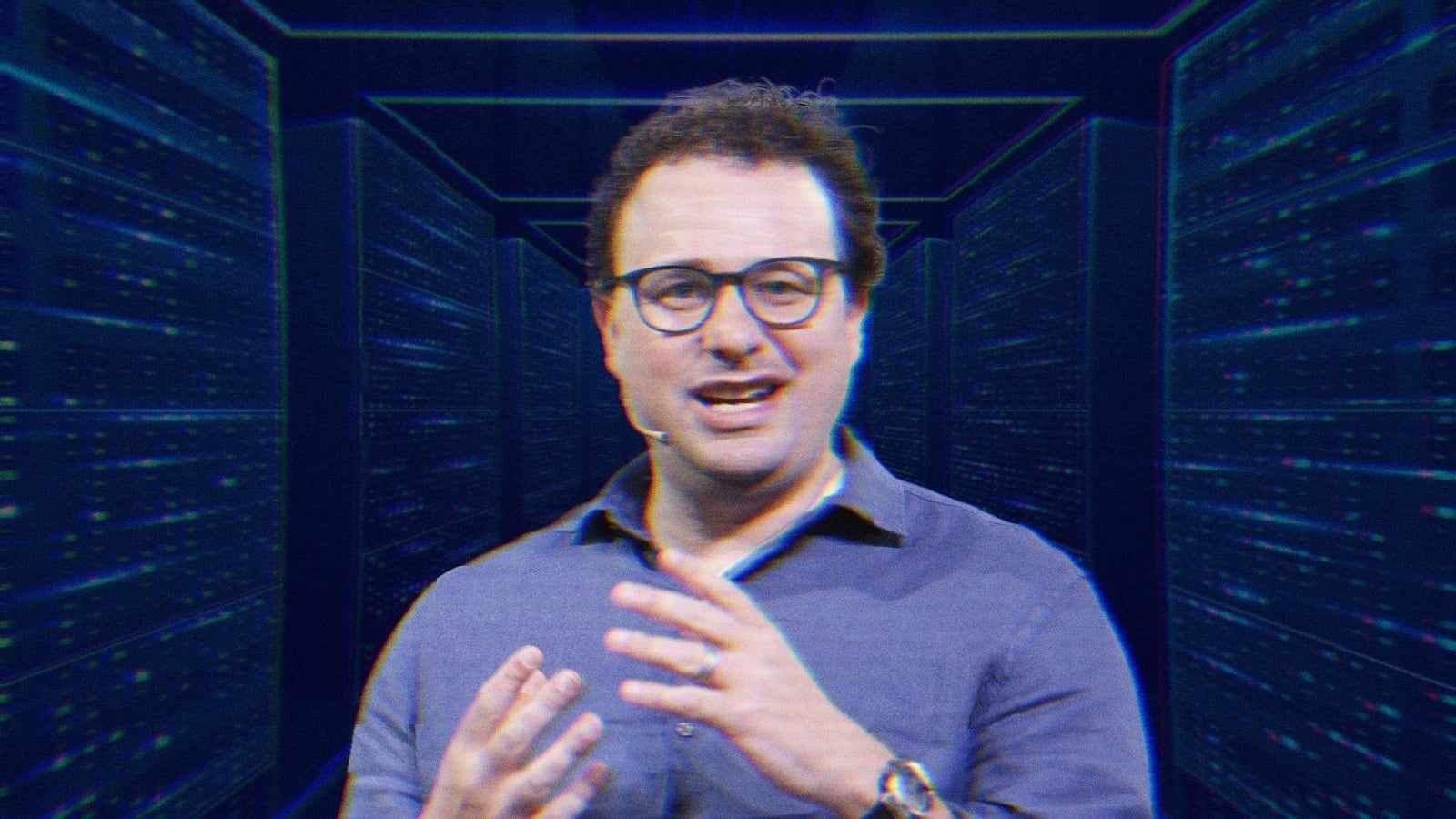 Image Description: Dario Amodei mid-speech, he's wearing a wireless mic and is talking with his hands. His image is overlayed over a rendering of futuristic server room.
Reuters “leaked” information from the forthcoming Anthropic prospectus and the numbers were pretty brutal. But that isn’t stopping all of Wall Street from lining up to invest in yet another AI company (SpaceX) with no discernible path to profitability. In this episode, Max digs through what we learned from the Reuters release and pairs it with other publicly available information on Anthropic to paint a bleak picture of a five-year old company that loses a ton of money but is somehow asking to be valued at around $2 trillion. Max then leads a philosophical discussion about the future of AI and punching babies. (That last part will make more sense in context.)
Would it be a good thing or a bad thing to punch a baby? Before you answer that, what if I gave you a million dollars to punch that baby?
We’ll come back to that a bit later, but the first question at hand is, does Anthropic have the potential to be a viable company? How are those related? Hmm. And to be clear, there are far more pressing questions regarding Anthropic and AI generally. Like, will it kill us all? Either directly or indirectly as a result of the resource war required to keep growing this sector. We all have many thoughts on these more pressing and existential questions, but today we’re going to focus our energy on digging through the available numbers to determine whether Anthropic is the next Amazon or Enron.
Then we’ll talk about punching babies.
I’ve been hypercritical of Dario Amodei for a while now because I don’t buy his conscience-of-AI savior routine. Like, at all. He’s the walking equivalent of Google’s “don’t be evil” motto. The existential threat questions are for policy makers in the United States and across the world to address. Our job is to unpack the financial claims because Anthropic has emerged as the leader in this space.
Well, we got our first peek at Anthropic’s prospectus via Reuters in early October. (This essay was written before the Wall Street Journal obtained a more recent draft of the prospectus on October 20. Nothing in it changes the argument below. The numbers are just bigger—the infrastructure obligations we walk through have since climbed past $600 billion.) Though there’s scant detail, there’s enough to build an early case for this being one of the most absurd IPOs ever. Had SpaceX not recently gone public, I might have removed the “one of the most” caveats. We’ll dig into the full prospectus when it’s released as we did with SpaceX, but it’s worth getting this down on record so we can build on it when we see the full picture.
Let’s start with the proposed valuation of (gulp) $2 trillion. That is the number bankers have attached to the five-year-old company as it prepares for a public listing.
For reference, as of this week, Amazon is worth about $2.68 trillion. ExxonMobil, the largest oil company in the Western world, is worth about $733 billion. Citigroup, one of the four pillars of the American banking system, is worth about $205.5 billion.
So Anthropic at $2 trillion would be worth roughly three ExxonMobils, or nine Citigroups, or nearly three-quarters of Amazon.
Now look at what those companies actually produce. Over the last 12 months, ExxonMobil earned about $33 billion in profit on $361 billion in revenue. Citigroup earned about $18 billion. Amazon took over three-quarters of a trillion dollars in revenue and generated about $94 billion in operating income. Anthropic, according to the prospectus Reuters reviewed, brought in nearly $4.6 billion in revenue in 2025 and lost more than $8 billion.
ExxonMobil earns more in profit in about seven weeks than Anthropic collected in revenue all of last year.
At $2 trillion, Anthropic would be priced at more than 400 times its 2025 revenue. Even if you give Anthropic full credit for its explosive 2026, which we will, the valuation does not rest on what the company is. It rests on what bankers say it will become. Reuters reported in August that the pitch hinges on a company projection of $190 billion to $200 billion in revenue in 2028. From $4.6 billion in all of 2025 to $200 billion two years from now?
Okay. Um, sure.
The headline number most people ran with was the $42 billion net loss. We need to look through this number, though, because about $34 billion of it is an accounting charge tied to the rising value of financing that could eventually convert into Anthropic shares. This is a noncash item that reflects the theoretical increase in value of the early investments.
The operating numbers are where the real story is. In 2025, Anthropic spent $12.6 billion to run the business and brought in about $4.6 billion. Compute and infrastructure alone cost $7.3 billion, three times the prior year and more than half of all operating expenses. Put that in household terms: For every dollar a customer paid Anthropic last year, the company spent about $1.59 just on the computers needed to deliver the product, and about $2.75 in total.
For my money, the biggest issue is how concentrated that revenue is. Two unnamed customers each accounted for about 12% of 2025 revenue, nearly a quarter combined, and the company’s own risk factors warn that many of its largest clients are not locked into long-term contracts and could cut or stop spending at any time. A separate dependence runs through the sales channel. Again, according to Reuters, about 47% of Anthropic’s 2025 sales, roughly $2.16 billion, were routed through the Amazon and Google cloud marketplaces, and Anthropic paid the two platforms about $351 million in fees. These are the same two companies that invested billions in Anthropic and sell it the cloud capacity it runs on.
What no one is talking about is how one of these companies (Google) is a top competitor to Anthropic and the other has the most robust cloud computing and data infrastructure in the world. In the snap of Bezos’ fingers, they could enter this market and become a giant. So the two largest sales channels (and possibly clients??) could theoretically be wiped off the board in the near future.
Now, the fair part. Anthropic’s 2026 looks nothing like its 2025. Bloomberg reported second-quarter revenue of $11.5 billion, up roughly 14-fold from a year earlier, and the Financial Times reported that Anthropic told a small group of shareholders it would post positive adjusted operating income for a second straight quarter. Revenue growth like that is real, and pretending otherwise would be dishonest.
Before we come back to the key term in their assertion, which is “adjusted,” I just want to benchmark Anthropic’s revenue against its closest competitor and first-mover in AI: OpenAI. According to the New York Times DealBook memo, “OpenAI’s annualized revenue, a measure favored by start-ups to demonstrate revenue momentum, was about $50 billion at the end of last month, up from roughly $28 billion at the end of June.” This was according to an OpenAI spokesperson.
Importantly, this is less than the $70 billion annualized run rate that the Street was expecting from OpenAI at this point. Meanwhile, Anthropic appears to be pulling ahead with a projected run rate of $100 billion for 2026, though we can’t yet tell if we’re comparing apples-to-apples because of the lack of transparency in the numbers.
But if we go back to Anthropic’s claim that it will have adjusted operating income for Q2 based on these revenue numbers, we have to understand what’s behind the word “adjusted.”
“Adjusted” operating income strips out costs including stock-based compensation, which is not a small expense for a company hiring at this pace. The amount of incentivized compensation in this industry is like nothing we’ve ever seen. Moreover, this is for employees and distribution partners. The FT’s reported gross margin above 80% is measured before the revenue Anthropic shares with distribution partners like Amazon and before the cost of training its models, which is the most expensive thing an AI lab does.
So if my primary critique—purely economic mind you—is that these companies cannot achieve the economies of scale required to run profitable businesses over time, then so far the picture is murky. We just don’t know. Anthropic appears to have slightly bent the cost curve on a purely operational level. But if they’re not factoring in talent and distribution compensation or training expenses, it’s impossible to know until we see the full picture. But even when the prospectus comes due and we get a look under the hood, there are other issues that will plague these companies moving forward. That’s where the circular financing deals, off-book commitments, and debt picture come into play.
The CapEx Lie
Let’s start with some simple math. The leaked prospectus shows $518 billion in cloud, computing, and infrastructure obligations in the coming years. Anthropic had about $20.28 billion in cash and short-term investments at the end of 2025. The obligations are roughly 26 times its cash on hand.
It is tempting to call that half-trillion “CapEx,” but that word implies the company is buying things it will own. This is one of the biggest misnomers in the AI discussion, in my opinion.
Anthropic doesn’t own data centers. What it has is nearly half a trillion dollars in noncancelable equipment leases to Broadcom, Amazon, Google, Nvidia, and Microsoft. And it’s on the hook for these commitments whether it ever uses the capacity. It might hold the compute contracts but it doesn’t own the buildings or the energy substations. It doesn’t even own the chips in most cases.
If Anthropic stops paying on these leases, the whole thing comes crashing down.
This is circular infrastructure financing. This is what folks like Ed Zitron have been screaming about. Anthropic and OpenAI are, in most cases, tenants. The landlords are cloud giants, chipmakers, private credit funds, and former bitcoin miners who have converted their sites into data center shells.
Unlike facilities in the SaaS cloud data center universe, these facilities run toward obsolescence in a big hurry. On their books, the big tech firms depreciate GPUs over five or six years, though there are those in the industry who put the economic life of AI hardware closer to three.
That’s why it is utterly disingenuous, if not outright malfeasance, to call this CapEx from Anthropic’s perspective. These are leases on giant facilities that house technology that loses financial viability in less time than it takes to get a high school diploma. So the $518 billion figure is really just an opening bid, not a sunk cost that builds equity over time. I mean, this is complete horseshit.
And by the way, the companies that lease to Anthropic are also its competitors, and they have something Anthropic does not.
Take Google. Alphabet raised its 2026 capital spending forecast to $195 billion to $205 billion. It designs its own TPU chips with Broadcom. It owns its data centers. It sells Anthropic more than $100 billion in compute, holds an equity stake in the company, guarantees some of Anthropic’s lease obligations in exchange for project equity, and then competes directly against Claude with Gemini, whose Flash model is roughly 13 times cheaper on input tokens. Google is Anthropic’s landlord, guarantor, shareholder, chip supplier, and rival all at once. If AI model-making becomes a low-margin commodity, Google still owns the land.
But the comparison worth examining most closely is Amazon, because the bull case for Anthropic leans on it. The argument goes like this: Amazon lost money for years, the skeptics laughed, and now it’s one of the most profitable companies on earth. Be patient.
Amazon was founded in 1994, went public in 1997, and posted its first full-year profit in 2003, a net income of $35.3 million. That is nine years without an annual profit. But look at what Amazon was building during those nine years: warehouses, distribution networks, logistics systems, and eventually the server capacity that became Amazon Web Services. Amazon owned what it built.
Today, AWS is the most profitable piece of that machine. In 2025, AWS generated $128.7 billion in revenue and $45.6 billion in operating income, about 18% of Amazon’s sales but 57% of its segment operating profit. AWS rents computing to a huge slice of the economy, including to Anthropic. On top of that, Amazon runs the largest retail operation in the Western world, a physical network of stores, warehouses, and delivery fleets, an advertising business, and an entertainment division. Anthropic sells one product that runs on data centers. Amazon owns the data centers. This is apples and trucks.
Amazon’s economies of scale also didn’t come from patience alone. They came from brutally crowding out competitors. In other words, predatory pricing. Whatever you think of the legality, the strategy depended on Amazon being able to absorb losses longer than anyone else. Anthropic is not in that position. Not only do the current tech giants have the ability to undercut Anthropic, but we have a fully subsidized and centrally controlled industry on the other side of the planet that might do this thing better and for less.
Where the Amazon analogy really fails, while also revealing the incestuous nature of all of this, is the interplay between the two companies. Amazon has a stake in Anthropic. When Anthropic’s numbers grow, Amazon books this as nonoperating income. That’s part of why Amazon’s profit picture looks so rosy—the rising paper value of Anthropic’s $100 billion spend on Amazon’s cloud. Anthropic signs the lease, AWS books the revenue, Anthropic’s valuation rises, and Amazon books the gain on its stake.
So back to the pure economies of scale discussion.
Amazon’s scale lowered its costs because it owned the infrastructure. Anthropic’s scale lowers its cost per query, but every gain in demand requires more leased capacity, signed years in advance, on hardware that loses most of its value before the lease is over. Its fixed obligations are locked in. Much of its revenue is not.
Over Here in the Real World
When we covered the SpaceX IPO, the argument was that the listing was built on a speculative total addressable market (TAM) story. Forget about how big the market actually is and trust us on how big it should be. Anthropic is following a similar valuation strategy so SpaceX actually offers a bit of insight into what happens now.
After the initial IPO where Elon Musk pilfered the equity market, the company immediately began issuing new debt.
Less than two weeks after its IPO, SpaceX sold $25 billion in senior unsecured bonds on nearly $90 billion in orders, at rates from 5.35% to 6.65%, with maturities stretching to 2056. You’re welcome to review our essay on what we think of SpaceX as a company. (Spoiler: Not much). These companies are giant money sucking black holes and Anthropic is no exception. It is finalizing a $15 billion revolving credit facility, three times the size of SpaceX’s pre-IPO credit line, syndicated across the same banks competing for IPO underwriting roles. And Wall Street has begun syndicating a record $60 billion debt package to finance Anthropic’s lease of Google-designed chips scheduled for 2027 delivery.
No audit history. No real assets, as we explored. An unproven business model that loses gobs of money and has tremendous competition already. Debt to purchase chips that depreciate before most loans fully amortize. And all layered onto apocalyptic warnings about its own product. I personally think the bond holders here need their heads examined more closely than anyone who invests in this IPO.
And, by the way, we haven’t even talked about what exactly all these companies are selling. Like, what’s the actual product here?
We are making enormous bets on companies that still haven’t explained how their technology delivers the future they’re selling. Amodei has written that AI could cure most major diseases in the next five to 10 years and create a world of abundance. The broader industry pitch is a world where machines do the work and people collect some form of universal basic income.
So walk through the real economy. Will a language model change your oil? Make you a sandwich? Mow your lawn? Frame a house? Care for a grandparent with Alzheimer’s? Dig a tunnel, build a bridge, or load containers onto a ship? These jobs make up the physical economy, and no executive has laid out how AI takes them over and turns the result into broadly shared prosperity.
AI is a real productivity tool. It is oversold as a creator of value and possibly undersold as a source of disruption and harm. And the physical world doesn’t move at software speed. There are people who still don’t have broadband in America. About 10 million of us. AI is not going to lay fiber in rural counties, and it is not going to help your parents set up their router or get on a Zoom call.
For this to work, the AI companies have to do several hard things at once, and none of them have explained how.
They have to disrupt entire physical industries, not only software and office work, to generate revenue on the scale their valuations imply. They have to bend the cost curve on compute and on the energy required to run it, while transformers take three to five years to procure and large gas turbines more than five. They have to get a longer useful life out of chips that are economically obsolete in about three years. And to reach these TAMs, our total economic output has to grow, not shrink. If you add up the theoretical value of these AI-first companies—SpaceX, Alphabet, Meta, Oracle, OpenAI, and Anthropic—it comes to almost $12 trillion. Put another way, the third-largest economy on the planet behind the U.S. and China.
But to reach these fantastical revenue numbers that justify these valuations, these products have to shrink output by design. And as we’ve said before, if AI magically replaces all jobs then who’s going to pay for AI? Well, we’ll need a universal basic income, they say. Last I checked we’re still waiting on a tariff dividend. And a health care refund. And five grand to vote. We’re not allowed to even talk about universal healthcare let alone universal income.
And the last note on revenue and valuations just to show you how completely full of shit these guys are—there are downward pressures on the theoretical revenue picture. The first is just pure pricing. Enterprise organizations are already balking at the price of tokens and compute and forcing their employees to scale back on usage. So the AI leaders are already releasing price sensitive versions of their packages. The second, which is, again, horseshit, is the whole notion that Dario is promoting to slow everything down. Fuck off.
And that’s a good place for us to pivot. The economics of this make no sense. They’re just impossible. But I want to back away and just have a philosophical discussion before we close out. Let’s talk about punching babies.
Punching Babies
There’s a house, a “proper” American nuclear family with a mom and a dad, two teenage kids and a baby. One day the teenagers burst through the door and say, “There’s a guy outside who says he’ll give us a million dollars if we punch the baby.” Obviously, the parents are a little suspicious and think it’s a joke.
“It’s true,” they exclaim. “He’s right out there with a briefcase full of cash. He says all we have to do is punch the baby and we get the whole thing.” So, the parents look outside and lo and behold, there’s a man with a briefcase smiling and waving back at them.
The mom says flatly, “Tell him to fuck off. No one is punching my baby.” But the dad thinks for a moment and says, “Hang on. I think we should hear the man out.” So he opens the door and invites in the man who indeed confirms that the first kid to punch the baby gets all the money.
Again, the mom blurts out, “No one is punching my baby!” Only this time one of the teenagers objects and says, “Wait a minute. If my brother does it first, HE gets all the money?” Stunned, the mom responds, “Um, that’s hardly the point,” to which the dad says sternly, “Honey, let the men talk.”
So the stranger thinks about it and says, “Tell you what. If you both punch the baby, you each get a million dollars.” And with that he gestures to the door and another guy walks in with a briefcase, flashes a toothy grin and opens it to reveal another million bucks.
“Holy shit, now we’re talking!” exclaims the dad. To which the mom is like, “Donald!” (We’ll call him Donald.) “Donald,” she says, “they could seriously hurt the baby, even kill it.” The second stranger pipes up and says, “It’s true. Based on our calculations there’s a 10% chance that one of your kids will indeed kill the baby. But there’s also a chance, based on zero evidence, that when you take your baby to the hospital its blood test will reveal the secret genetic code to curing cancer.”
At this point, the family huddles up. To be fair, the baby is new, so they’re not that attached to it, and two million bucks is two million bucks, know what I mean? So the dad says, “Honey, I’m smart, I mean a lot of people say I’m like the smartest, so let me do the talking.” With that, he turns to the men and says, “Let me get this straight. If my kids punch my baby, no matter what we get two million bucks, right?” The stranger corrects him. “THEY get two million bucks.”
Taken aback a bit, our stable genius dad thinks about it then winks at his family and says, “That’s fine. I mean, they belong to us so what’s theirs is ours anyway.”
“I’m afraid it doesn’t work that way, Mr. Donald,” the first stranger interjects. “Upon receipt of the cash for punching the baby, the boys are emancipated and you are only entitled to a fraction of the money they make from the $2 million several years down the road. That is, of course, if they make any at all.”
Now, the mom, ever the astute one in the family asks, “Where did this money come from anyway?”
“Great question,” says the second stranger. “It’s actually yours. The two million is your pension, your husband’s 401(k), the equity in your home and an estimate of your future earnings. Basically, your life savings.”
“Wait a minute,” yells papa Don. “You mean to tell me that we’d be spending our own money to have our kids punch our own baby only to wind up with a hurt baby, or worse, no money? And if they squander the $2 million, what happens then?”
“They move back in with you, and you answer for what they’ve done to the baby, and you’re still out $2 million,” the first stranger says with a shrug.
“What’s in this for you?” says the mom incredulously.
“A cut,” they answer in unison.
After a quick confab, the family decides to pass but not before asking one more question. The mother asks, “There seems to be very little upside to punching our baby. To be clear, we can just say no and nothing happens, right?”
“Of course,” the strangers offer with enthusiasm. “But you should know that a Chinese family just moved in down the block and we’re pretty sure they also have a baby.”
“You, you…you would make THEM the same offer?” stammers the dad.
“Not exactly. There are men with briefcases outside their house right now, so we can only assume that there’s a baby somewhere that’s about to get punched in the fucking face.”
Stunned, the dad replies, “You mean to tell me that there’s some Chinese family that isn’t even from here that is willing to take that money to punch their baby?”
“Well, we can’t really be sure. You know how they are. They’re very private. But, yeah, presumably.”
The dad thinks for a second and then in a moment of inspiration says, “Tell you what. We’ll let our kids punch our baby, but we want to sweeten the pot. How about you loan us another $2 million on top? Make it $4 million—though we can never possibly cover it—and you’ve got yourself a deal!”
And…Scene.
In the best-case scenario Anthropic, OpenAI, and SpaceX all magically find a customer base, turn a profit and become multi-trillion dollar companies. But in this scenario, there are no more jobs, and we can (maybe) cure cancer. In the worst-case scenario, these companies fold and we would have poured trillions of dollars down the drain. And less water. More climate catastrophes. And fewer jobs resulting from underinvestment into every other fucking part of this economy that actually matters. And if we want to actually cure cancer, we should fund research grants and universities that already work on this stuff instead of ripping their funding sources to shreds. We should approach it with the same centralized effort and planning zeal that we did when we wanted to land on the moon.
Punching our baby because some other family might do it first is a bad idea. And, for what it’s worth, it’s pretty bad economics.
Image Source
- TechCrunch, CC BY 2.0, via Wikimedia Commons. Changes were made.
 Max
Max is a political commentator and essayist who focuses on the intersection of American socioeconomic theory and politics in the modern era. He is the publisher of UNFTR Media and host of the popular Unf*cking the Republic® podcast and YouTube channel. Prior to founding UNFTR, Max spent fifteen years as a publisher and columnist in the alternative newsweekly industry and a decade in terrestrial radio. Max is also a regular contributor to the MeidasTouch Network where he covers the U.S. economy.