
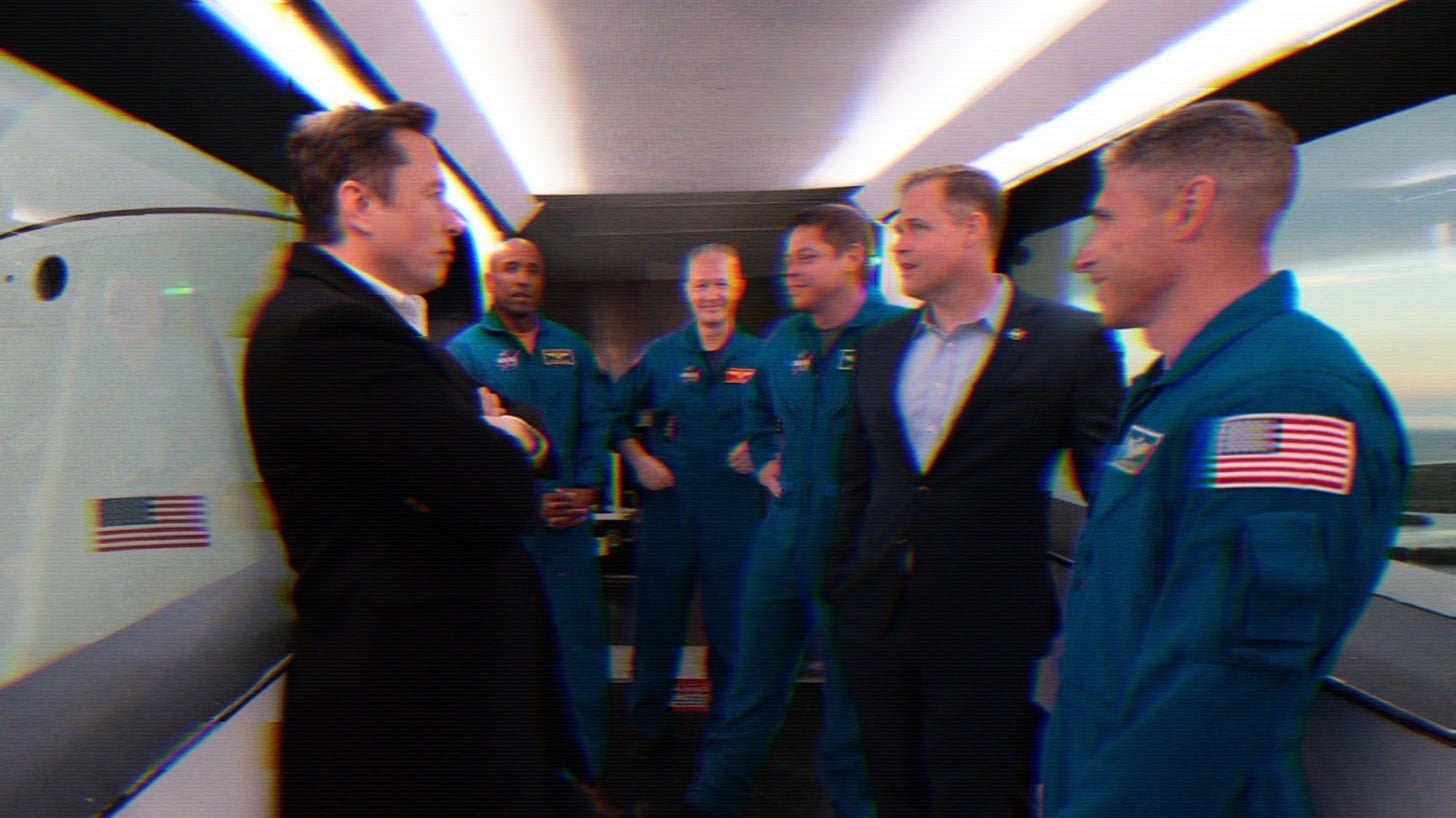
 Image Description: Elon Musk, NASA astronauts Victor Glover, Doug Hurley, Bob Behnken, Mike Hopkins, and NASA Administrator Jim Bridenstine inside the crew access arm with the SpaceX Crew Dragon spacecraft visible behind them during a tour of Launch Complex 39A before a 2019 launch of the Demo-1 mission at the Kennedy Space Center in Florida.
In 2021, Donald Trump merged his cash-hemorrhaging Truth Social into a blank-check SPAC and took it public. The product was functionally Twitter for people banned from Twitter. The financial press laughed, retail investors got vaporized and it dropped from the headlines as quickly as it appeared.
That was embarrassing. This SpaceX IPO is something altogether different. Donald Trump is a pickpocket on the grift scale compared to Elon Musk who’s about to make the pyramids disappear.
On June 12, 2026, SpaceX lists on the Nasdaq at $135 a share, valuing the company at $1.77 trillion—the largest IPO in American history, raising roughly $74.4 billion, more than all U.S. IPOs combined over the past two years. Pretty impressive for a company that loses money across every operating segment. But don’t worry, the upside is huge. All you need is a little faith.
Every IPO prospectus has a Total Addressable Market (TAM) slide. SpaceX’s S-1 has claimed, in a federal securities filing, that their TAM is $28.5 trillion—described as “the largest actionable total addressable market in human history.” For the sake of comparison, the current U.S. nominal GDP is approximately $29 to $30 trillion.
Ergo, SpaceX is claiming its addressable market is the entire American economy.
Here’s how they get there:
- $370 billion in Space
- $1.6 trillion in Connectivity
- $26.5 trillion in AI
The actual business: rockets, Starlink, and X (formerly Twitter.) These divisions made up the $18.67 billion in 2025 revenue and threw off a net operating loss of nearly $5 billion. One of the stars of the portfolio is Starlink, which boasts 10.3 million subscribers. It’s a modest base for a company priced at the GDP of a continent, but okay. The company does send up a ton of rockets into space and is paid by various contracts, most notably the United States government.
Morningstar put the fair value of the IPO at $780 billion—56% below the IPO price. More than half the valuation is a narrative premium on a money-losing business. Investment advisor George Pearkes told More Perfect Union: “The combination of sheer size and this extreme multiple is completely unprecedented.” Robin Wigglesworth, editor at the Financial Times added, “Based on the numbers that we know, that is absolutely batshit.”
They just don’t understand. It’s almost like they didn’t read the prospectus. I mean, it’s all right there in black and white. The mission statement clearly says, “To build the systems and technologies necessary to make life multiplanetary, to understand the true nature of the universe, and to extend the light of consciousness to the stars.”
And here I thought they were raising money to power Grok queries like, “Grok, put tits on my second grade teacher’s Facebook profile picture.”
I suppose the biggest valuation in history on an unprofitable company seems reasonable if you’re Elon Musk with designs on colonizing space. Here on Earth, however, we have things like gravity, reality and actual numbers to contend with. So let’s go through the actual revenue picture for each business segment.
There’s a case to be made for “space” as this is where SpaceX currently makes its money. They launch satellites and other “payloads” into orbit for their own network of connected satellites and on behalf of other organizations ranging from governments and militaries to multinational firms. And while it doesn’t directly state how much revenue it derives from the U.S. government, it mentions it in the “risk factors” (which we’ll go through in a bit) saying, “In 2025, approximately one-fifth of our revenue was attributable to agencies within the U.S. federal government.” So the guy who tried to gut the federal government for wasteful spending made 20% of his bag from the very same government. Cool.
Anyway, here’s how “Space” revenue breaks down as of the IPO.
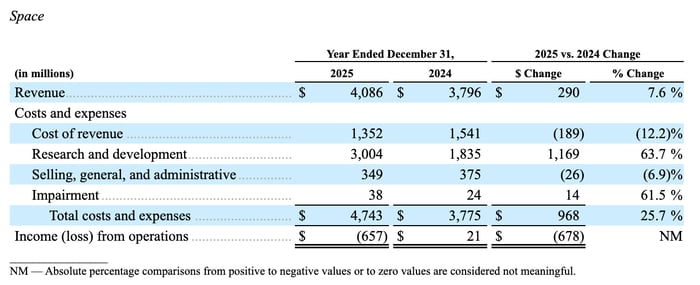
So far “space” has been a losing proposition for the company named SpaceX. In 2025 it lost $657 million on $4 billion in revenue and overall revenue was only up 7.6% from 2024, also a losing year. Not exactly the type of returns that warrant a 50x valuation. I guess the “Connectivity” picture is a heckuva lot better.
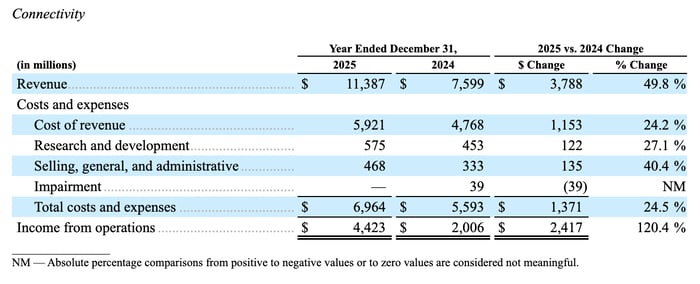
There it is. Show me the money baby. $11 billion in revenue with $4.4 billion to the bottom line. Of course the average revenue for a Nasdaq 100 listed company is somewhere between $30–$35 billion, so they have a bit of catching up to do, but at least this offsets the losses in “space.” Still, nothing here seems to warrant the extravagant valuation and potential raise of $75 billion at listing. That must mean that AI is the hidden treasure in all of this. Let’s have a look under Grok’s hood.
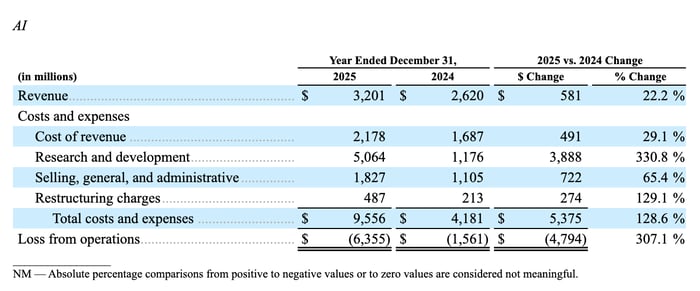
Holy shit. They spent $9.5 billion to make $3.2 billion. Good lord. Oh, Grok you money grubbing little bitch. I guess we’ll have to dig a bit deeper on this since the AI piece is 93% of their projected TAM.
Of the total, the prospectus lists $22.7 trillion as “enterprise applications.” Awesome. What’s that you might ask? No one knows. That figure is not revenue; it’s a projection from a company with no enterprise AI revenue, for a market that does not yet exist. And whatever revenue that exists from its core model is light years behind its competitors, as Grok ranks fourth globally in AI chatbot web traffic—behind ChatGPT, Gemini, and Claude.
Where most of the other AI leaders fake sincerity when it comes to saving humanity, Elon has no such hangups. This is the man who built up his side of PayPal without money laundering guardrails to boost revenue before Peter Thiel engineered his ouster. The same dude who built a tunnel under Las Vegas without permits or safety precautions. Who’s building autonomous cars so dangerous that entire countries have banned them. The same guy who gave 20-something coders from X access to our Social Security data when DOGE tried to rip apart the government.
Common Sense Media rated Grok “among the worst” AI chatbots for safety, documenting nearly 6,700 sexually suggestive image requests per hour. The FTC has an active child safety inquiry. The Irish Data Protection Commission opened a GDPR investigation into how xAI handles children’s data. The S-1 describes Grok as “a truth-seeking AI model built on our founder Elon Musk’s mission to enable humanity to understand the universe.” A chatbot under investigation in two jurisdictions for what it did to kids is, per the prospectus, a tool for understanding the cosmos.
The xAI merger—folding Grok and X into SpaceX—was also done without a fairness opinion. Morningstar called it “a material threat of value destruction.” The Colossus data center, xAI’s flagship compute cluster, is selling spare capacity to Anthropic—whose Claude is beating Grok in global rankings. SpaceX’s best AI hardware is underutilized by its own product.
That makes the S-1’s enterprise AI strategy of “deepen[ing] enterprise and government adoption” less of a strategy and more of a to-do list entry.
The most entertaining part of the prospectus is the pages upon pages of “risk factors.” To be fair, these are always fun to read in any IPO, because the lawyers have to think of everything to make sure investors are fully informed of the business risks. But these take the cake. Here’s a smattering of “risk factors” investors have to look past to believe that Elon Musk is about to build a company with a market cap the size of the U.S. economy:
“We have experienced, and will likely continue to experience, launch delays and failures that could have a material adverse effect on our business, financial condition, results of operations, and future prospects.”
“Current FAA regulations do not permit return-to-launch-site reentries for Starship”
“Certain of our AI products, including Grok, offer features or modes designed to generate more candid, direct, or less reserved or irreverent outputs, such as ‘Spicy’ Imagine Mode and ‘Unhinged’ Voice Mode…they present heightened risks, including reputational harm, the generation of potentially explicit content and misinformation or deceptive outputs, potential nonconsensual or exploitative imagery.”
“AI technologies…may be flawed, insufficient, of poor quality, rely upon incorrect, inaccurate, harmful or illegal data, reflect unwanted forms of bias, hallucinate, misrepresent, mislead or contain other errors or inadequacies…certain of our AI products, such as Grok, have been alleged to be susceptible to ‘data poisoning’ in the past.”
“Others, including in-orbit manufacturing, passenger transport to the Moon, an established human presence or gateway hub on the Moon, passenger and cargo transport to Mars, energy production on the Moon or Mars, manufacturing capabilities on the Moon or Mars, and asteroid mining do not exist today.”
“We do not maintain key-person life insurance on Mr. Musk…he does not devote his full time and attention to our businesses.”
“Upon completion of this offering, Mr. Musk will beneficially own a majority of the outstanding shares of our Class B common stock and a majority of the voting power…and therefore will be able to elect all the members of our board. Mr. Musk…can only be removed from our board or these positions by the vote of Class B holders.”
“Our substantial level of indebtedness could materially adversely affect our financial condition.”
“The continued proliferation of satellite constellations in Low-Earth Orbit, as well as the risk of collisions with space debris or other spacecraft, could limit or impair our launch flexibility and satellite deployment, which could adversely affect our business, financial condition, results of operations, and future prospects.”
“Many of our initiatives, including those to develop orbital AI compute at scale, manufacture AI chips at scale, establish a lunar economy, develop human augmentation systems, and transport humans and cargo to the Moon and Mars, involve significant technical complexity, unproven technologies, or technologies that do not exist or may require significant advancement, and such initiatives may not achieve commercial viability.”
“Many of our initiatives, including those to develop orbital AI compute at scale, manufacture AI chips at scale, establish a lunar economy, develop human augmentation systems, and transport humans and cargo to the Moon and Mars, involve significant technical complexity, unproven technologies, or technologies that do not exist or may require significant advancement, and such initiatives may not achieve commercial viability.”
“Several of our anticipated market opportunities, including certain AI, orbital, lunar, and interplanetary transportation and industrial activities, are still emerging and evolving or do not currently exist, and such markets may not develop as we expect, or at all.”
And, finally. The most honest statement of all.
“We have a history of net losses and may not achieve profitability in the future.”
Elon’s Tulip Moment
The real kick in the teeth is how many retail investors are likely to get burned in the coming months. A company being rushed to market on hype and bold promises is nothing new. Nearly everything else about this particular IPO is either very new, or so old that it’s new again. And all of it is shady.
Here’s the breakdown of the go-to-market con.
SpaceX is issuing, or “floating” less than 5% of company shares to create artificial scarcity that forces a day-one spike. It’s also allocating 30% of the offering to retail—three times normal. It could be a sign that institutional investors won’t pony up for the list price, though it’s not for lack of trying as we’ll see in a moment. Either way, that’s a lot of average Joe’s skin in the game.
The most audacious aspect of the IPO is that Musk managed to push a rule change through Nasdaq. It’s called a “fast entry rule” that lets SpaceX enter the Nasdaq 100 in just 15 trading days instead of up to a year. No SEC approval required. Musk reportedly conditioned his listing on the fast track; Nasdaq had direct financial incentive. The reason this is so significant is that index funds that own the Nasdaq 100 represent passive investments from all over the world. Nearly a third of all American stock is tied to passive indexes such as these. For example, your 401(k) may wind up owning SPCX whether you ever heard of Grok.
That covers the entry point, but the off ramp is even more insidious. There’s something called a “lockup” period that restricts the earliest investors with premium share holdings from dumping their stocks after the initial surge. Not so in this instance. The SpaceX lockup is engineered for fast exits. Insiders—Andreessen Horowitz, a Saudi prince, a Palantir co-founder, Jack Dorsey—all got SpaceX stock through the Twitter→xAI→SpaceX merger chain, and they can begin selling 20% of their stakes at the first quarterly earnings call, weeks after listing. With estimates of nearly $50 billion in retail and passive flows heading into this deal it means a significant portion of that can be liquified in a matter of weeks by the early investors.
We have measures to prevent this kind of behavior, mind you. But the largely self-policed Wall Street under Donald Trump is reverting back to the good old days. Joseph Kennedy would be proud. And there are a lot of dirty hands in this deal.
Nearly two dozen banks are splitting $500 million-plus in fees—the largest IPO fee haul ever. Goldman Sachs and Morgan Stanley are both primary underwriters and had analyst teams circulate projections of a $3.4 trillion market cap by 2040—not published, leaked informally to investors during the live deal.
On CNBC, Andrew Ross Sorkin raised the obvious:
“This is something that banks frankly did not do—were not allowed to, to some degree—post that global settlement that Elliot Spitzer made back, I want to say, what was it? 2001, 2002? If you can publish internally and then leak them—and you happen to be the underwriter—what does that say?”
What it says is nobody learned anything from the dot-com crash.
Even Jamie Dimon—the man who holds himself out there as the voice of reason, the steady banking hand who plays it all above board—held a private event for 350 wealthy investors—Robert Kraft taking time away from the strip club in the front row, Kenneth Langone beside him—and called it the “democratization of finance.” Those clients face no trading restrictions post-IPO. Fidelity retail customers who sell once within 15 days get locked out of future IPOs. Dimon said ”democratization” to describe a deal where billionaires get a free exit and regular people get a holding penalty.
Sometimes Rockets Explode
Listen. SpaceX the company is remarkable. Most of their shit doesn’t blow up. They go to space and leave things there that communicate back to Earth. I can be flip about it and say whoopdeedo we landed on the moon almost six decades ago, but the fact of the matter is these guys are doing stuff that most of us can’t wrap our heads around. So if it was just that, just a company doing cool shit in space and a normal valuation that didn’t upend every rule and protection of the market and put tens of billions of dollars at risk to line the pockets of a guy who freely gives a Nazi salute, then maybe it wouldn’t be such a hit.
But “remarkable” and “worth $1.77 trillion” are not the same sentence. It’s a literal fuck you that insults the intelligence of anyone who can read a prospectus. The $990 billion gap between Morningstar’s fair value and the IPO price is a bet on orbital data centers that can’t yet exist legally, on a $22.7 trillion market invented to make the math work, on a chatbot under federal investigation.
It’s not actually a company. It’s just an IPO. A shell. Perhaps a balloon. Truth Social with rockets.
One final number for your consideration to erase any remaining doubt about who this ultimately benefits. The CEO’s salary: $54,080 a year. His performance bonus—one billion Class B shares—vests when a city of a million people exists on Mars. A second tranche of 302 million shares vests when non-Earth data centers reach 100 terawatts of compute—roughly four times current global electricity consumption, in space. That’s designed to make you think that there are real incentives for Elon in the future. But the rigging of the Nasdaq listing, quick exit from the lockup and control of the Class B shares are all the frontloaded incentives he needs to add hundreds of billions of dollars to his net worth.
That’s really what this is about. And, he’s going to use your retirement accounts to get there whether you want it, authorize it, or even know about it.
Image Source
- Joel Kowsky, Public domain, via Wikimedia Commons. Changes were made.
 Max
Max
Max is a political commentator and essayist who focuses on the intersection of American socioeconomic theory and politics in the modern era. He is the publisher of UNFTR Media and host of the popular Unf*cking the Republic® podcast and YouTube channel. Prior to founding UNFTR, Max spent fifteen years as a publisher and columnist in the alternative newsweekly industry and a decade in terrestrial radio. Max is also a regular contributor to the MeidasTouch Network where he covers the U.S. economy.