
Pam Bondi and the Dow.
Bondi Screamed the Loud Part, Loudly.
 Image Description: Pam Bondi Speaking at a podium, there is a Department of Justice Sign behind her.
Attorney General Pam Bondi took to Capitol Hill with her burn book in hand and a message to Congress, the victims of Jeffrey Epstein and the American people: Shut up, the Dow hit 50,000. She was right about the Dow Jones Industrial performance until the next day, when stocks dumped out on news that AI might be real and that the economy added 400,000 fewer jobs last year than we originally thought. That’s the thing about building an entire narrative around the stock market. The stock market is not the economy. And the victims of Epstein’s crimes deserve better.
When Pam Bondi sat before Congress on Capitol Hill, she came prepared with a “burn binder” full of insults for Democratic lawmakers. It was quite the spectacle. But what really got her juices flowing with incredulity was that Congress had the audacity to question her during a bull run. She continually struck back at legislators by announcing, “The Dow is at 50,000,” even though the topic at hand was the Epstein Files.
Not once did she even acknowledge the victims of Jeffrey Epstein who sat directly behind her in silent protest. Not once.
This is the single metric presidency. Deportations are important. Tariff revenue is fun for them. Subpoenas and prosecutions are nice side bets. But the ‘Real Deal Holyfield’ for this crew is the Dow Jones Industrial Average. The share prices of 30 companies versus net worth of 350 million people? No comparison.
Welcome to Trump’s lottery economy.
Since 2009, the story of the American economy has been money in search of a home. The miracle workers on Wall Street cannot stop patting themselves on the back. It’s the “never go down, number go up” market for the investor class and it’s making a whole bunch of stupid people look pretty smart. We have gone into so much debt to produce so much capital that we barely know what to do with it anymore.
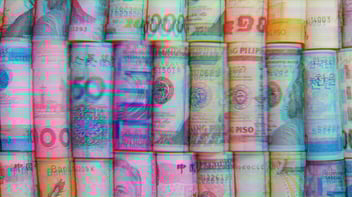
Another nation with the privilege of being the world’s reserve currency might have gone into hock to build bridges, public housing or high speed rail transportation. But not us. We cranked up the money printer and shot Benjamins to corporate America like singles to strippers on payday if every day was payday. So allow me to introduce you to my favorite term to explain how it just keeps rolling: Rotation.
That’s what they call it when a particular sector takes a shit because Wall Street moves away from it. Money moves from one part of the market to another, sometimes gradually and sometimes in a big hurry. For example, the smart money for the past few years was in tech with names like Nvidia storming the markets like a hurricane. The big names in tech dominated the headlines and the flows pushing equity indexes well beyond any realistic expectations or valuations. (We’re so far past historical norms for market overvaluation it’s not even worth talking about.)
And it’s amazing how quickly it can sour on what was always a bad idea. Case in point, as I just mentioned, the past couple of years has been all about hyperscalers, Big Tech, the Mag 7. The early boosters of AI promised to change the very nature of work, so they went chasing big money and found it around every corner.
But won’t it put people out of jobs and isn’t that bad?
Gotta do it because China.
Shouldn’t we regulate it and put some guardrails around it?
We tried that. It’s too late for that because, China.
And so the money kept rolling in.
Then, two things happened while the Dow was on its way to 50,000 just in time for Pam Bondi’s appearance on the Hill.
The first was simultaneous new releases from OpenAI and Anthropic, the two AI giants in the U.S. The Anthropic drop was so stunning that people seemed to forget all about OpenAI, which is becoming a theme that we’ll talk about another time. Anthropic’s Claude 4.6 caused a staggering selloff in a couple of major sectors such as Software as a Service (SaaS) and legal tech. Then it bled to fintech and commercial real estate as forecasters started doing the math on the sheer disruption that might occur if Claude is capable of everything the company claims. Almost a trillion dollars in value was wiped off the table across multiple sectors.
The second was a blog post from an AI tech exec named Matt Shumer who re-posted it to X (it now has 85 million views and counting, and it made its way around my day job as well). Not only did AI help him write the post, but it included a bold line that stated, “AI is now building the next AI.”
Shumer’s post had the effect of validating Claude’s claims and negative sentiment about AI’s potential to destroy jobs, and it whipped through the market like COVID-19 in a preschool.
Yet somehow that trillion dollar wipe out in value found its way somewhere else in the stock market because, you know, rotation.
- When the large cap stocks take a shit, that’s okay. That’s just a rotation to small and mid caps.
- When the growth stocks are getting pounded, don’t worry. There’s just a rotation to value.
- When the tech sector nosedives, we got this. Just a defensive move to staples.
Geniuses everywhere. But no genius more powerful and triumphant than the one sitting in the Oval Office. Just ask Pam Bondi.
I consume a ton of financial media. For every position there’s a pundit. For every buyer, a seller. Every bull has a bear. Bondi thought it was a smart play to shift America’s attention away from the victims seated behind her to focus on the stock market. Seemed like a safe bet for the single metric presidency. Of course a day after her non-testimony Mean Girls burn book reading, equities tanked because of these AI fears. That brings us to my next favorite term: Hedge.
The big money players and institutions have playbooks for this, and they trade on algorithms that allow them to move money in a nanosecond. This isn’t the 1920s and ‘30s where people traveled from all over the country to lower Manhattan to find out what’s going on. The institutional money will have hedged against a downturn, moved their money around so fast it will make your head spin, and they’ll pivot to cash positions, bonds, emerging markets and cash in on their downside options. And after prices have been driven down, they’ll come storming right back in and make money on the upside all over again. Just like they did after the financial crisis. Just like they did after COVID.
This is a new day. You cannot move as fast as they do. Hell, they might even pump and dump Bitcoin again just for shits and giggles.
We’ve often repeated our mantra that the market is not the economy, and this only rings more true with each passing day and every data release.
The jobs figures that came in early February were widely celebrated because we added 130,000 jobs, which was way above consensus forecasts of around 50,000. Of course, the real story was the 2025 revisions that took jobs down by 400,000 over what was previously reported, bringing the 2025 job creation total down to the lowest point since 2003.
The market suddenly panicked on the realizations we just covered that AI might perform certain basic functions across multiple sectors better than entry level employees. Housing starts and sales are plummeting while bankruptcies skyrocket. Every pundit interviewed speaks with such confidence about the resilience of the markets while acknowledging the uneven distribution of gains in the real economy, the K-shaped economy, asymmetric recovery.
These are the verbal gymnastics and hoops they go through instead of just saying, “the economy is pretty well fucked.”
But again, the reason this sole metric presidency relies so heavily on the equity market narrative is because of the capital tsunami released by Democratic administrations. And the crazy thing about government spending today is that it’s still on fire. The January Treasury release shows how much government spending the Trump administration kept in place from Biden. Despite the massive cuts to government programs, foreign aid, federal employees and the like, we’re still profligate spenders here in the good ol’ US of A. We still ran a $95 billion deficit in the month of January alone, almost $700 billion through the first four months of this fiscal year (which starts in October).
When the market crashes, dips or corrects, just remember that the big guys will have already hedged and they’ll have rotated their money out of whatever is cratering way faster than you will. And then they’ll run it back up again.
The real damage is being done each and every day on the streets, in small businesses across the country, in stressed out households, and in the souls of Epstein’s victims who will have to wait a little longer for some semblance of justice, because it ain’t coming from this administration.
But hey, did you see the Dow?
Image Source
- United States Department of Justice, Public domain, via Wikimedia Commons. Changes were made.
 Max
Max
Max is a political commentator and essayist who focuses on the intersection of American socioeconomic theory and politics in the modern era. He is the publisher of UNFTR Media and host of the popular Unf*cking the Republic® podcast and YouTube channel. Prior to founding UNFTR, Max spent fifteen years as a publisher and columnist in the alternative newsweekly industry and a decade in terrestrial radio. Max is also a regular contributor to the MeidasTouch Network where he covers the U.S. economy.