

Seven Months After the Minab School Strike, New Reporting Raises More Questions
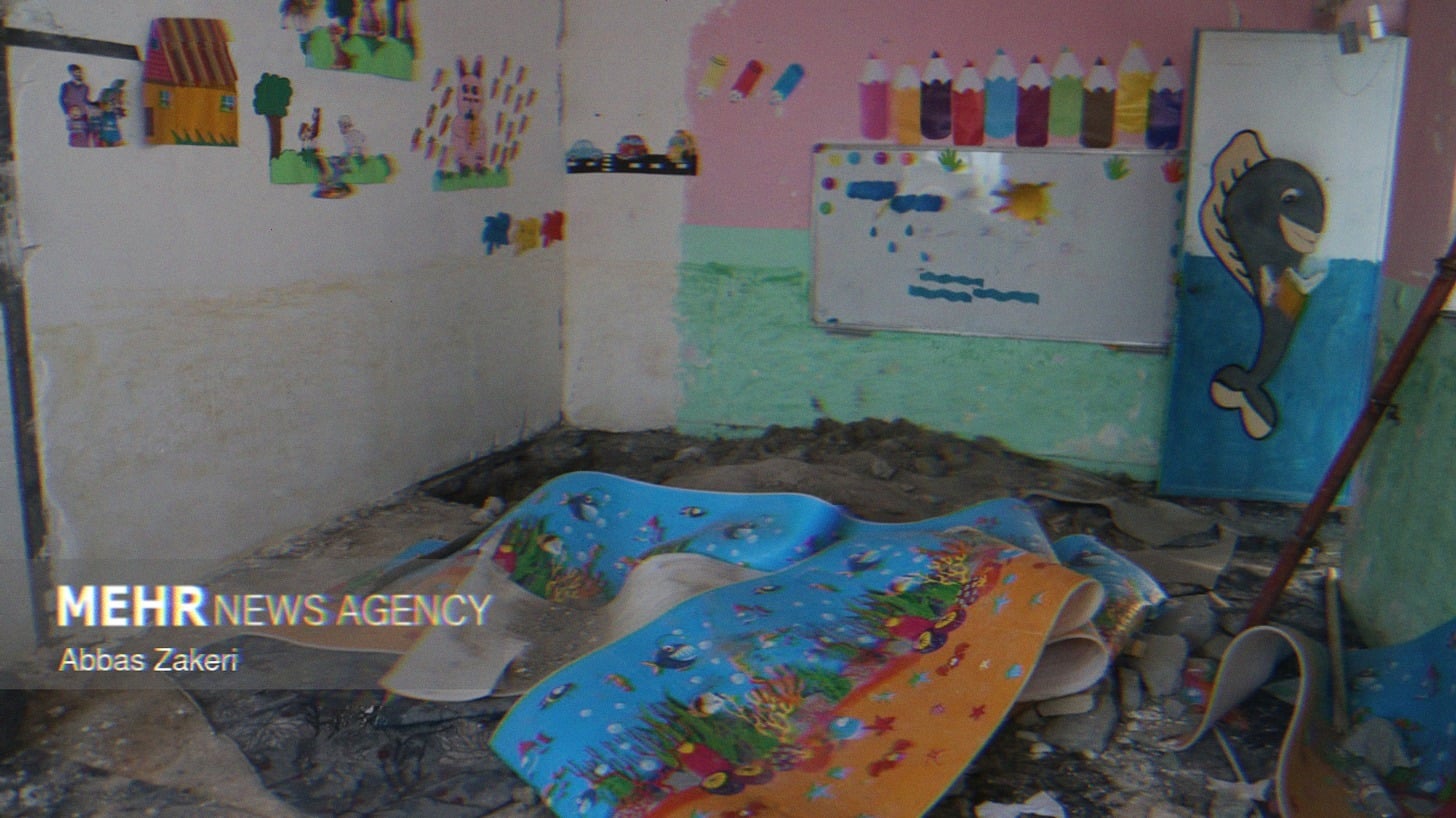 Image Description: A room in the Shajareh Tayyebeh school. Rubble lines the floor, along with damaged banners depecting marine life. Decorations like farm animals, colored pencils, and a whiteboard line the walls. A once vibrant classroom now condemned
This essay appeared in the Oct. 1, 2026 edition of UNFTR’s premium newsletter. Become a UNFTR member to receive our bonus newsletter each week and for other perks.
“Is it true that America had attacked a school?”
In the aftermath of the United States attack on Shajareh Tayyebeh school in Minab in southern Iran at the outset of Trump’s war of choice, that’s the question families, rescue workers and teachers—anyone with a pulse, really—obsessed over.
To their dismay, they quickly determined that, yes, the United States did in fact rain hell down on a school amid its surprise attack on Feb. 28. After picking up the pieces of their loved ones—literally—a tidal wave of other questions whipsawed in their heads.
Why did the United States target a school?
Why did the United States kill teachers, students, and petrified parents rushing to save their children?
Why did the United States strike the complex where the school was located three times over the course of several hours?
And simply: How did they not know this was a school—or did they and they just didn’t care?
Seven months later, those answers remain elusive to the world and the tormented family members of the 156 people killed by the Trump administration, including 120 children and 26 teachers, all women.
In the absence of those details, Drop Site’s Jeremy Scahill published a devastating report on the human suffering incurred by the United States’ attack on the school, along with critical details about the area in which the school is located, exclusive images of the Raytheon-made Tomahawk missiles that obliterated the school and the terrifying play-by-play of the strikes—three in all—that forever changed Minab and the Iranians who call it home.
The incalculable human suffering is far and away the most poignant and necessary element of Scahill’s reporting on the deadly attacks. The investigative journalist spent weeks speaking to surviving family members, school staff, local and national Iranian officials, hospital employees and many others in Minab for this story. It is a painful but necessary read. Seriously, we all hear that a lot—but stop what you’re doing, sit down and read it. Re-read it. Let it penetrate your soul and conscience.
You’ll cry. You’ll lament not spending more time thinking about those 120 young souls and the brave teachers that tried to save them. And once those emotions have completely washed over, you’ll explode with outrage contemplating how such a barbaric and depraved attack could happen in the first place. In your name. For Israel. Under false pretenses.
If that’s not all, you’ll realize, oh, there’s also a damn cover-up. The Trump administration maintains that the mass murder (they don’t call it that) is under investigation—but what are the chances we’ll get the whole truth? You’ll turn to yourself and ask if there will be a reckoning. A reckoning? When was the last time the United States held itself accountable for a war crime of this scale? As we’re often reminded, the United States is not a party to the Rome Statute of the International Criminal Court (ICC). The Empire so vehemently opposes its authority that a bipartisan Congress in 2003 passed what’s become known as The Hague Invasion Act, meaning the U.S. reserves the right to use the military to descend on The Hague and extract any U.S. citizen charged with a crime. As we speak, Trump is actively attempting to dismantle the ICC for good, allowing past and future presidents to breathe a big sigh of relief. Then your thoughts will return to the incinerated kids, 120 of them, who had their own hopes and dreams, like your kids. One boy who was slain was only identified by the SpongeBob SquarePants imagery on his socks—something your kids or one of their friends could identify with. Or your heart will take you to the dad who, when he realized he would never get to speak to his daughter again, sat with her backpack and talked to it, desperately trying to manifest the unbreakable bond he shared with her. Or you’ll gravitate toward Yaghoub Yazdanpanah, who painstakingly tried to find the best school that would support his daughter’s passion for poetry and proudly picked Shajareh Tayyebeh, the Minab school, for his 6-year-old, Fatemeh, who was killed alongside her cousin.
That it took this long for an article such as this to come out is a tragedy in its own right. As Scahill himself argues, this is likely the deadliest war crime the United States has committed since Vietnam. In the context of the scale of the atrocity, it has barely registered, which is a sad commentary on the state of our politics and society. Making it even more distressing is the fact that the government continues to obfuscate and stall while victim’s families and human rights groups call for accountability. Recall Trump’s response a week after the attacks, in which he accused Iran of killing its own people.
“In my opinion,” Trump said, “based on what I’ve seen, that was done by Iran…We think it was done by Iran, because they’re very inaccurate with their munitions, they have no accuracy whatsoever, it was done by Iran.”
Secretary of Defense Pete Hegseth, aboard Air Force One with Trump at the time, claimed an investigation was underway, adding, “the only side that targets civilians is Iran.”
At a press conference three days later, Trump leaned into the Iran hoax. “Well, I haven’t seen it, and I will say that the Tomahawk, which is one of the most powerful weapons around is…sold and used by other countries. You know that. And whether it’s Iran, (which) also has some Tomahawks. They wish they had more. But whether it’s Iran or somebody else, the fact that a Tomahawk—a Tomahawk is very generic. It’s sold to other countries. But that’s being investigated right now.”
To be sure, Iran does not possess Tomahawk missiles—munitions that only five countries in the world have in their respective arsenals.
A day later, on March 11, unnamed U.S. officials acknowledged to The New York Times that a preliminary probe determined the United States was responsible for the strikes.
In light of Scahill’s reporting, it’s worth returning to that Times article. Interestingly, there wasn’t much pushback at the time the paper reported on the preliminary findings, suggesting it was a so-called “approved leak.” While no one but the sources themselves can reveal their true intentions, one possible theory is the administration was laying the groundwork for an eventual sanitized narrative.
Here’s a key portion of the Times piece:
“The Feb. 28 strike on the Shajarah Tayyebeh elementary school building was the result of a targeting mistake by the U.S. military, which was conducting strikes on an adjacent Iranian base of which the school building was formerly a part, the preliminary investigation found. Officers at U.S. Central Command created the target coordinates for the strike using outdated data provided by the Defense Intelligence Agency, people briefed on the investigation said.”
So, the paper is reporting definitively, based on its sources, that the massacre was the product of a “targeting mistake” and that the intended mark was supposedly “an adjacent Iranian base.”
A lot has been said publicly about the area where the school was located, enabling the Trump administration and its allies to wave away the massacre as a tragic consequence of war.
“Mistakes are made. War is nasty,” Trump said on June 17.
Here’s what we now know. The current school sits on the same property that was once home to an Islamic Revolutionary Guard Corps (IRGC) barracks. But that area was redeveloped as far back as 2014, according to Scahill, who got his hands on the school’s permits. The IRGC reportedly left one section as an administrative office, but abandoned it in 2025 amid the so-called 12-Day War with Israel and the United States. Not only was there apparently nothing of importance for the U.S. military to destroy on Feb. 28, but along with pulverizing the school with a direct strike, it reportedly hit multiple other civilian buildings in subsequent strikes.
There are no excuses for such an attack, and using the media to claim it was purely a mistake defies basic intelligence. They want you to believe that the world’s most sophisticated military, which boasts an unparalleled and ever-rising budget, made a regrettable error based on alleged bad data. Worse yet, Scahill reported that satellite imagery from late 2025 “showed children standing in the school yard and on a soccer field.”
As critical as this reporting is, we still lack the full picture. Among them: How incompetent is the Pentagon? To what extent did AI play a role in determining the location—and did anyone care to determine its validity? Regardless of AI’s potential involvement, wouldn’t the U.S. know that the school had existed for more than a decade?
For survivors and loved ones, the void in their hearts has produced unimaginable grief. And the lingering pursuit of answers—and accountability—has manifested into its own form of torture.
“What did you see at the school?” a pre-school teacher who survived the attack said to Scahill. “What were you afraid of? You were afraid of the children?”
Her answer from the man ultimately responsible: “Mistakes happen.”
Image Source
- Mehr News Agency, CC BY 4.0, via Wikimedia Commons. Changes were made.
 Rashed Mian
Rashed Mian is the managing editor of the award-winning News Beat podcast and co-founder of the newly launched Free The Press (FTP) Substack newsletter. Throughout his career, he has reported on a wide range of issues, with a particular focus on civil liberties, systemic injustice and U.S. hegemony. You can find Rashed on X @rashedmian and on Bluesky @rashedmian.bsky.social.