
Is This The Most Dangerous Period of the U.S.-Iran War?
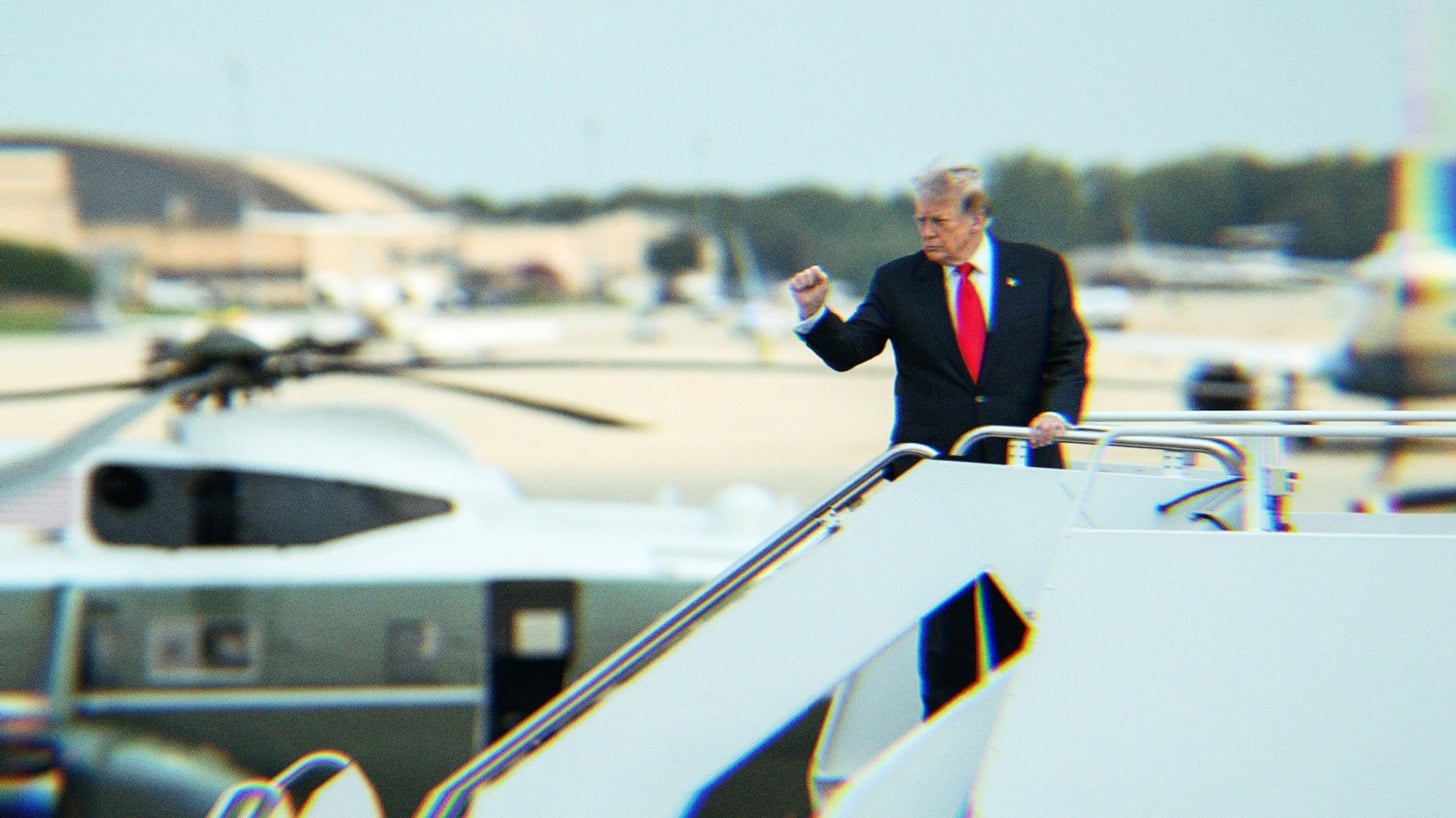 Image Description: Trump standing on airplane stairs facing forward raising his fist in the air.
This essay appeared in the July 30, 2026 edition of UNFTR’s premium newsletter. Become a UNFTR member to receive our bonus newsletter each week and for other perks.
Trump’s war of choice with Iran appears to be teetering toward precarious and dangerous new levels, potentially increasing the chances for this to spiral into the type of metastasizing regional conflagration that many have feared—and warned about.
Having crossed five months of war with America’s perpetual bogeyman, it’s becoming harder and harder to find a way out. It’s both shocking and not surprising at the same time. When Trump declared on March 3, five days into the war, that it is “going to be finished pretty quickly,” everyone not exposed to neocon derangement syndrome understood the opposite to be true.
Alas, here we are.
- In the last several weeks, the U.S. bombed Iranian targets for 13 nights in a row, setting off an intense tit-for-tat that led to the slayings of three U.S. service members, including two stationed at an American base in Jordan—yet another reminder of how the pursuit of complete and total U.S. hegemony has endangered the lives of countless Americans.
- That period also included the collapse of a four-year-old truce between the Houthis in Yemen and Saudi Arabia, reigniting a devastating war that had spawned one of the worst humanitarian crises in the world.
- And just last week, Iran’s Islamic Revolutionary Guard Corps (IRGC) launched ballistic missiles “in an attempted surprise attack” on U.S. forces in Jordan, according to U.S. Central Command, claiming that all missiles were “successfully intercepted.”
- In retaliation (Trump promised to “beat the fucking shit” out of Iran), the region saw the first joint U.S.-Saudi strikes against groups in Iraq purportedly aligned with Iran, prompting an angry response from Ali al-Zaidi, Iraq’s prime minister, who dubbed it “an unacceptable aggression.”
Remarkably, the escalating—and expanding—conflict comes just mere days after what was characterized as “relative calm” between the two primary warring factions following the initial 13-day bombardment by the United States.
And as we consider all of this, it’s important not to forget Israel’s instrumental role in helping spawn this madness. Despite convincing Trump to attack Iran, Israel has recently conveniently taken a backseat to this conflict specifically. In fact, Israeli officials are actively gloating about it—even as the situation worsens by the day.
“When it comes to the state of Israel, there is no interest in joining the campaign,” Israeli Finance Minister Bezalel Smotrich said, while attending a settlement conference, no less. “The current situation, where there is a confined campaign between Iran and the United States, is the correct [situation] and best for us.”
The danger in all of this is no one knows where we’re headed—especially not Trump, who continues to oscillate from claiming Iran’s weapon systems have been obliterated to feigning optimism over a potential peace deal to vowing to completely devastate Iran. The only real strategy, such as there is one, is for the U.S. to periodically “pause” fighting just long enough for oil markets—and the stock market—to settle down, before unleashing new waves of destruction.
But periodic timeouts aren’t a way to wage war, and Iran appears ready to exploit what it views as a sign of weakness on Trump’s part.
Consider the perspective of Trita Parsi, the executive vice president of the Quincy Institute. In a new piece for Zeteo, Parsi took note of the Iranian attack on Jordan, since it marked the first time during a “pause” that the IRGC took offensive action before the United States.
Is Iran launching missiles just for the sake of extending the war? Or is it a strategic move to actually push the U.S. to work toward a more durable deal?
“In Tehran’s view, an informal pause in fighting allows Washington to reap the energy market benefits of de-escalation without making any political or diplomatic commitments in return,” Parsi wrote, adding: “Iran wanted Washington to understand that it no longer assumes the first strike must come from the United States.”
“But most importantly,” he continued, “the strike appears intended as a warning against a broader American escalation that Tehran believes Netanyahu – and perhaps Zelensky as well – were advocating during their meetings in Washington. There is an obvious paradox here. Attempting to prevent American escalation by attacking American forces risks producing precisely the escalation Iran says it seeks to avoid. Yet from Tehran’s perspective, allowing Washington to believe it could escalate without facing immediate costs may be even more dangerous.”
Where does this leave us? While the war is expanding out of control, it’s also coming down to which side can push the other to concede at the negotiating table. Trump, of course, has dug himself a Mar-a-Lago-sized hole over the last five months, making it difficult to envision him simply washing his hands of the war. As for Iran, its new leadership seems intent on making the United States bleed—with lives, financially and militarily—for as long as possible.
“As long as there is no formal ceasefire, Iranian policymakers believe the United States retains maximum flexibility to resume military operations whenever it considers the political moment favorable,” Parsi wrote.
In so many ways, the last two weeks have been as clarifying a period as there has been in this nonsensical, calamitous and tragic war. All this destruction, apparently, to see who is going to blink first. And what if no one does?
Image Source
- The White House, Public domain, via Wikimedia Commons. Changes were made.
 Rashed Mian
Rashed Mian is the managing editor of the award-winning News Beat podcast and co-founder of the newly launched Free The Press (FTP) Substack newsletter. Throughout his career, he has reported on a wide range of issues, with a particular focus on civil liberties, systemic injustice and U.S. hegemony. You can find Rashed on X @rashedmian and on Bluesky @rashedmian.bsky.social.


