 Image Description: On The Record 11-10-26. The “Jewish Question.” Hegseth Impeachment. Jensen Huangs Himself. Racist Ole Miss. Cybertruck Stalls. UNFTR.
The two most famous, intriguing and polar opposite political figures were put to the test by the mainstream media following the midterm bloodbath in which Democrats posted victories across the nation and flipped more than 40 House seats. A dejected but defiant Trump sat with New York Times columnist Ross Douthat on 60 Minutes and Zohran Mamdani went on CNN with Jake Tapper. Both were pressed for reactions to the election, and tucked inside both conversations was the “Jewish question.”
Before we dive into the questions and their responses, let’s talk about the framing of this discussion. The “Jewish question” is a loaded statement and I’m using it provocatively for a reason. The way the mainstream media fumbles the coverage of Jewish issues in the United States is something that never ceases to amaze me. It has become a disclaimer. A litmus test. A dividing line. And it’s one in which Jewish people have lost a great deal of agency. There are a lot of people talking about and on behalf of Jews in much the same way that white people talk about issues facing the Black community or any community of color.
But there’s also a pernicious backstory to the phrase. Catholics in Spain answered the question by expelling Jewish people known today as Sephardic Jews. The Russians had a similar answer over several decades leading to multiple diasporic waves. And, of course, the Germans under Hitler believed they had the ultimate answer to the question.
We’ve often said that the Jewish experience in the world is singular. It holds true for two important reasons. The first is that it remains the only identity that represents a culture, an ethnicity, and a religion. The second is that it is the only identity that has been denied agency across nation states and empires throughout history. In fact, many Orthodox Jews believe the diaspora is a divinely ordained state until such time as the Messiah reappears. That’s why the Orthodox community is not unified on the question of a Jewish state in Israel, a position that confuses casual observers.
In recent years the Jewish question has changed form. It’s now a two-part question, and you can only ask the second half if you pass the test on the first one, which is “Do you believe Israel has a right to exist?” Once this has been disclaimed, the conversation is permitted to move to whether you support Jews generally. It’s a curious time to be alive. That brings us to the fumbling and uncomfortable inquiries after the midterm elections.
Take the loathsome case of Jake Tapper. Tapper had Zohran Mamdani on his program ostensibly to speak to the success of progressive candidates who took great inspiration from his campaign in New York. You can see Mamdani’s soul leaving his body as Tapper caps the interview by asking what the mayor has to say to the Jewish people in the state of Michigan who might be concerned about the election of Abdul El-Sayed.
First off, watching people like Jake Tapper stumble over the word “Jew” would be funny if the stakes weren’t so high. Mamdani, ever the professional and certainly used to this line of questioning, handles it with grace. Now, I don’t want to speak for my Jewish brothers and sisters, but this continual and unrelenting line of questioning of Muslim public officials, and only Muslim public officials, is beyond insulting. In this way, the mainstream has effectively been part of the problem. By constantly probing Muslim leaders with the Jewish question, the mainstream has relegated an entire people to the status of “other.”
This leads us to the far more disturbing conversation between Douthat and Trump. It’s not a lengthy exchange, but it’s revealing because it marks the moment that the dangerous alliance between the conservative movement in the United States and the Zionist project might have ended. When Trump was asked to list the reasons Republicans lost so handily, one of his answers was “there’s a great dislike, incredibly for Israel.” The two would go on to discuss Middle Eastern affairs in greater detail, but if you know anything about this president, that’s the signal. Trump has cultivated power by tapping into popular sentiment, so if he sees Israel as a losing proposition, the cult of MAGA isn’t far behind.
Side note about all of the pundits declaring this the death knell of MAGA: be very careful. It was never about the movement. It was always about its principles. This fealty to Israel among Christian nationalists was manufactured over many decades as a matter of doctrinal convenience. Far-right Christians view the settlement of Jews in Israel as a requirement for their Messiah’s return. The catch, of course, is that even those who returned must accept Christ or be vanquished to Hell. Israel is part of their plan. The Jewish people are not. Means to an end.
Whatever replaces MAGA when Trump is finally sent packing won’t be a kinder, gentler version of the movement. It won’t be kind in responding to the Jewish question moving forward because it’ll blame Israel for its losses. And because the conservative representatives of Israel’s interests, such as AIPAC and the ADL, have decided to partner with the Christian nationalists, they have left the Jewish people exposed once again to the worst instincts of the alt-right.
Jonathan Weisman, author of “(((Semitism))): Being Jewish in America in the Age of Trump,” warned of the inherent dangers of such a fraught alliance:
“For years now, it has been the only question in the Jewish political world: Where do you stand on Israel? The American Jewish obsession with Israel has taken our eyes off not only the politics of our own country, the growing gulf between rich and poor, and the rising tide of nationalism but also our own grounding in faith.”
For the past several years, as Muslim figures have moved into the political mainstream, this alliance has hardened even further. But the unrelenting images of the genocide in Gaza, the violent settler behavior in the West Bank, and the destruction of southern Lebanon—along with the belief that Israel is dragging the United States into immoral conflicts—have finally brought matters to a boiling point across constituencies.
To be clear, anti-Zionist sentiment is part of the radical Black tradition in this country dating back to the early 1960s. It took decades for this sentiment to bleed out into other demographics because the conservative Christian alliance with the mainstream media was airtight. It’s only within the past few months that broadcast and cable outlets even entertained the notion that Israel might be committing atrocities. Even so, every inquiry begins with the disclaimer and the litmus test before a discussion can even take place.
But throughout social media and on independent outlets—despite the attempts of the tech sector to suppress images out of Palestine and Lebanon—the narrative broke down. And now, by tying the fate of every Jew to the state of Israel, the very institutions established to protect and defend Jews throughout the Western world might be responsible for the next wave of dangerous antisemitism.
Zionism was always a settler-colonial project and to deny these roots is to be intellectually dishonest. Take the words of Ze’ev Jabotinsky, one of the earliest and most prominent founders of the Zionist movement.
“Every native population in the world resists colonists as long as it has the slightest hope of being able to rid itself of the danger of being colonised. That is what the Arabs in Palestine are doing, and what they will persist in doing as long as there remains a solitary spark of hope that they will be able to prevent the transformation of ‘Palestine’ into the ‘Land of Israel.’”
The honest intellectual discussion on the left for many years has been the attempt to reconcile the colonial project in Palestine with the need to protect Jewish people throughout the world. This was a colonial project from the start. “They [Palestinians] feel at least the same instinctive jealous love of Palestine,” wrote Jabotinsky, “as the old Aztecs felt for ancient Mexico, and the Sioux for their rolling Prairies.” Jabotinsky wrote these words during the pogroms in Eastern Europe and just a decade before the Nazis came to power in Germany.
Importantly, the early Zionist leaders were more secular than the Israelis today. They weighed several options to settle the diaspora, including Uganda, California, Argentina and Palestine. The religious rationale for “returning” according to Jewish faith was largely mapped onto the project after the fact. As a practical matter, Palestinians had already welcomed Jews fleeing persecution in earlier pogroms, known today as “Aliyah.” And the Ottoman land codes at the time allowed Jews to purchase tracts of land throughout the region. Thus the initial wave of secular Jews who established socialist farming communities known as Kibbutzim.
We should also grapple with the fact that the United States and most of our Western allies refused to admit large numbers of Jews fleeing Nazi persecution during and after World War II. So to argue that the state of Israel was unnecessary is just as fraudulent and ahistorical as claiming that it wasn’t also a colonial project. That’s why this is and has been one of the most complicated and gut-wrenching sagas in modern history.
Understanding these nuances helps contextualize the impossible situation hard-line groups like AIPAC and the ADL have created for Jews in the United States. By tying the “Jewish question” to Israel while forming an alliance with Christian nationalists, they have exacerbated dangerous historical conditions. They have effectively tied the Jewish people, culture, and faith to the actions of a genocidal regime and are relying on the whims of a far-right group that never valued them in the first place; Jews were merely a means to a doctrinal end for the most xenophobic and racist element of our society.
Now that Donald Trump has it in his head that the very thing his movement supported is a political loser, the movement is free to drop everything and everyone associated with it. And the fractured movement that springs from the ashes of MAGA won’t make this mistake again. It will be free to fully express the bitterness and hatred it always harbored. The mainstream media parrots the AIPAC and ADL narratives that online figures like Hasan Piker present a danger to the Jewish people. They repeatedly question the motives of public officials like Zohran Mamdani. They pummel candidates like Abdul El-Sayed over his statements regarding Israel rather than his signature policy of Medicare for All. They barely covered the raid of a sitting Muslim congresswoman’s home at the behest of the Trump DOJ.
All the while the far right grows even more emboldened to spew hatred toward Jews. If they covered the words of Nick Fuentes as much as Hasan Piker, people would take to the streets. If they promoted the hate speech of figures like Proud Boy Gavin McInnes, people would be horrified. But names like “Nick” and “Gavin” just aren’t as scary as “Zohran” and “Abdul.”
That leaves us on the left. It’s incumbent on us to have more elevated conversations whenever the “Jewish question” arises. “Fuck Israel” isn’t a stance. Lampooning Jews who express fear means you haven’t done the work.
So let’s turn this into a productive exercise. If this is something that piques your interest and you want to learn more about how the left can fight antisemitism without compromising its views on the state of Israel and Zionism, I have a book for you. “Safety Through Solidarity: A Radical Guide to Fighting Antisemitism” by Shane Burley and Ben Lorber. I had the opportunity to interview these guys a couple years ago and I cannot say enough about this book.
Crisis or Cycle?
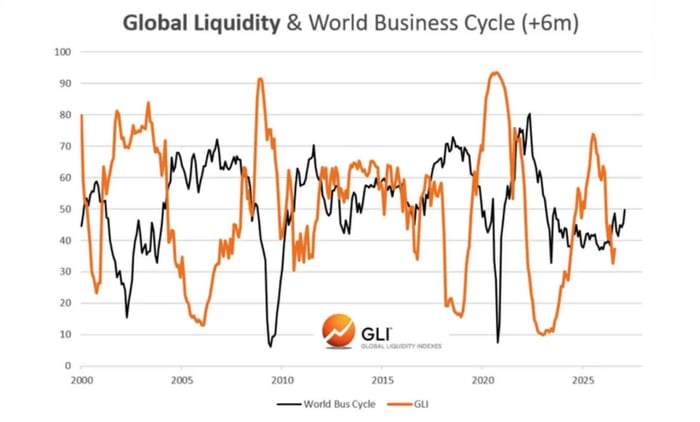
I learned of Michael Howell’s work on a George Noble subscriber call. (You can sign up for Capital Wars on Substack, which is where this is pulled from.)
Sources: Capital Wars
This paints an interesting picture by pitting global liquidity against business cycles. Essentially, there is an inverse relationship between the two. When there is excess cash in the financial system it means it’s not working in the real economy. When there’s less money in the system, it means it’s at work in the real economy. Money doesn’t disappear, it’s always somewhere. Because central banks aren’t currently tightening (meaning they’re not yet pulling money out of the system by raising reserve requirements) it means the money is at work in the real economy. “All money that’s anywhere must be somewhere,” says Howell.
His view is that we’re entering a late stage business cycle. Investment capital is being put to work in narrow spaces (the AI buildout), which accounts for the uptick in investing and that we’re going to enter into a volatile period before markets bottom out and the cycle begins building again.
 Max
Max is a political commentator and essayist who focuses on the intersection of American socioeconomic theory and politics in the modern era. He is the publisher of UNFTR Media and host of the popular Unf*cking the Republic® podcast and YouTube channel. Prior to founding UNFTR, Max spent fifteen years as a publisher and columnist in the alternative newsweekly industry and a decade in terrestrial radio. Max is also a regular contributor to the MeidasTouch Network where he covers the U.S. economy.