
Trump’s Iran MOU Is Proof He Lost the War.
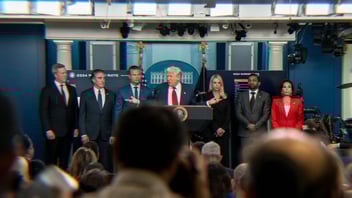
 Image Description: Trump at an event, red and blue lights dot the background. He is clapping and standing behind a glass barrier.
This essay appeared in the June 18, 2026 edition of UNFTR’s premium newsletter. Become a UNFTR member to receive our bonus newsletter each week and for other perks.
The grand experiment has failed—and we should all be worried about what comes next.
Over the weekend, the United States and Iran announced the framework of a memorandum of understanding to end the war of choice, which began Feb. 28 with joint U.S.-Israel strikes on Tehran, an opening salvo that led to the murder of more than 160 Iranian school girls.
The memo, which various experts have characterized as complete “capitulation” on the U.S. part, has yet to be formally signed, despite President Trump teasing that the memorializing of the document was imminent.
Since then, the key points of the MOU, which are quite remarkable, were published by Bloomberg. It includes an “immediate and permanent end to the war on all fronts, including Lebanon,” the latter of which we’ll come back to. For Iran’s part, the MOU, which precedes a much broader deal to be worked out 60 days after it’s signed, also includes a “comprehensive plan...for the rehabilitation and economic development of the Islamic Republic of Iran,” along with the eventual end of any sanctions against Tehran by the United States.
As we process what this unofficial agreement means, it’s important to remember where we started, with two nuclear-armed countries launching joint attacks against Iran at the end of February, almost instantaneously leading to the assassination of Ayatollah Ali Khamenei, a decapitation we were told would spark successful regime change, allowing the United States to install a puppet regime in his place.
Instead, and as even The New York Times acknowledged this weekend, the killing of Khamenei, who was adamant against pursuing nuclear weapons, evidenced by his religious decree banning them, opened Iran up to a takeover by more emboldened figures willing to resist the United States and its allies on all fronts.
“These new leaders believe they can survive even a major renewal of fighting without significantly altering their negotiating positions or their larger regional aims,” the paper wrote. “Those aims include to restore their power of deterrence so that they cannot be attacked again as they were in late February.”
With Khamenei gone, Iran launched an asymmetric war against U.S. allies in the Gulf and cut off the Strait of Hormuz, a strategically obvious countermeasure that some U.S. officials reportedly didn’t think possible. The fallout over the closure of the passageway, which Trump once referred to as “The Straight of Iran,” came to dominate the war, giving Iran more leverage than they could dream of as energy prices began to soar.
More than anything, the historically idiotic war has the potential of changing the game in the Middle East in a way unthinkable before Feb. 28, as has been predicted by University of Chicago’s Robert Pape, a professor of political science and author of the “Escalation Trap” Substack, for weeks now.
“Complete capitulation by US, including US agrees to support $300 billion for Iran,” he wrote on X in response to the basic details of the MOU that were released by Bloomberg. “This is a roadmap to Iran’s regional primacy and becoming the 4th center of world power.”
Such a statement is stunning, not just in the context of Iran fending off attacks from the United States and Israel, but when you consider that for two decades, Americans were conditioned to believe that military force against Iran was not only necessary, but would strike a devastating, if not, unrecoverable blow to Tehran. As Sen. Tom Cotton famously said in May 2019, all it would take is “two strikes—the first strike and the last strike.”
Whether it was U.S. government officials or influential neocons in media or whatever hegemonic think tanks that grew out of the so-called war on terror, calls for war against Iran were endless.
In 2006, Joshua Muravchik wrote a piece in the Los Angeles Times called “Confronting Iran,” in which the lede read: “We must bomb Iran.” Ironically, Muravchik argued that failure to act could lead to Tehran achieving its “goal of regional supremacy”—something it may now get because we bombed Iran.
A year later Norman Podhoretz argued in an article for Commentary titled “The Case for Bombing Iran” that “there is no alternative to the actual use of military force—any more than there was an alternative to force if Hitler was to be stopped in 1938.”
Former Trump National Security Advisor and noted neocon John Bolton didn’t recall the rise of Nazi Germany when making his case for war with Iran, but nevertheless said: “The inescapable conclusion is that Iran will not negotiate away its nuclear program. Nor will sanctions block its building a broad and deep weapons infrastructure. The inconvenient truth is that only military action like Israel’s 1981 attack on Saddam Hussein’s Osirak reactor in Iraq or its 2007 destruction of a Syrian reactor, designed and built by North Korea, can accomplish what is required.”
And when former President Obama was negotiating the Joint Comprehensive Plan of Action (JCPOA), less formally known as the “Iran Nuclear Deal,” Bill Kristol infamously urged Congress to “kill” it.
“We believe sanctions, sabotage, and the threat of military force can better constrain the Iranian regime’s nuclear weapons program than this bad deal,” Kristol wrote in a memo. “But we will also say openly that, if it comes to it, airstrikes to set back the Iranian nuclear weapons program are preferable to this deal that lets it go forward.”
Indeed, cable news and corporate media has been awash with jingoistic calls to arms against Iran for years—so will we have multiple segments holding those accountable for egregiously and recklessly pushing the U.S. to war? I think we all know the answer to that.
Already, hawks are circling each day the United States gets closer to signing the MOU with Iran. They’re downright outraged that the MOU includes halting violence in Lebanon, a country devastated by Israel. What’s more, Trump in the last few days has publicly expressed some of his annoyance with Israeli Prime Minister Benjamin Netanyahu, criticizing him for leveling apartments in Beirut, killing too many people in Lebanon and for generally being unhappy “with the way Israel has handled themselves with Lebanon, and with Hezbollah.” Trump, remarkably, also suggested that Syria, whose president was a former al Qaeda leader, would do a better job fighting Hezbollah than Israel. (“If Israel can’t do the job without killing everyone else, he’ll do the job, Syria will do the job.”)
The MOU (and likely his comments) have enraged neocons and members of Israel’s ultra-right-wing government, which is why we should all be worried about what comes next.
Mark Levin, among the biggest pro-war cheerleaders on the American right, could hardly contain himself this week, writing on X:
“[T]here is no way most Americans, let alone Israelis and the Lebanese, can abide a deal in which Hezbollah, which has brutally murdered hundreds of our fellow citizens, is essentially protected by our government in alliance with the Iranian regime, and free to continue to kill Americans, Israelis, and others as the most potent terror weapon of the Iranian regime not only survives but is immunized. And since Israel is the only country that actually fights this enemy with its soldiers and airmen, and whose citizens are in the direct line of fire from missile and drone attacks, nobody in their right mind will tolerate this.”
Israel’s leaders are similarly not taking the news well, with National Security Minister Itamar Ben-Gvir effectively dismissing the MOU out of hand. “Trump’s agreement does not bind us,” he claimed. “Israel is not subject to the United States, and we are an independent and sovereign nation.”
“We must not compromise on anything less than the dismantling of Hezbollah, we must not withdraw from any territory that our fighters have captured and cleared of terror infrastructure, we must not return to a situation where thousands of terrorists sit on the fences of northern settlements, and certainly we must not remain silent for a moment in the face of fire directed at the State of Israel.”
Netanyahu, who convinced Trump to attack Iran during a pivotal Situation Room meeting, was on the receiving end of multiple attacks, with his political enemies castigating him over the reported U.S.-Iran framework.
“Netanyahu is good for Hamas,” said Yair Golan, an Israeli politician. “Netanyahu is good for Iran. Netanyahu is good for Hezbollah. Netanyahu is not good for Israel.”
Over at Israel’s Channel 14, known for championing Netanyahu, Yinon Magal went scorched earth, referring to Trump as a “loser” and labeling Vice President J.D. Vance a “lowlife,” while his colleague Shimon Riklin dubbed the United States “treacherous.”
While the pro-Israel lobby in the United States likely won’t go that far, the next 60 days (once the deal is signed) will be critical. Those who want continued war with Iran will stop at nothing to convince Trump that the deal is bad and Iran can’t be trusted. And if there’s anything we know about Trump, it’s that he can be easily convinced.
Whatever happens, it’s possible that Trump and Netanyahu forever changed the power dynamic in the region—just not in the way they thought.
Image Source
- The White House, Public domain, via Wikimedia Commons. Changes were made.
 Rashed Mian
Rashed Mian is the managing editor of the award-winning News Beat podcast and co-founder of the newly launched Free The Press (FTP) Substack newsletter. Throughout his career, he has reported on a wide range of issues, with a particular focus on civil liberties, systemic injustice and U.S. hegemony. You can find Rashed on X @rashedmian and on Bluesky @rashedmian.bsky.social.