The Market Just Lost Its Sugar Daddy.
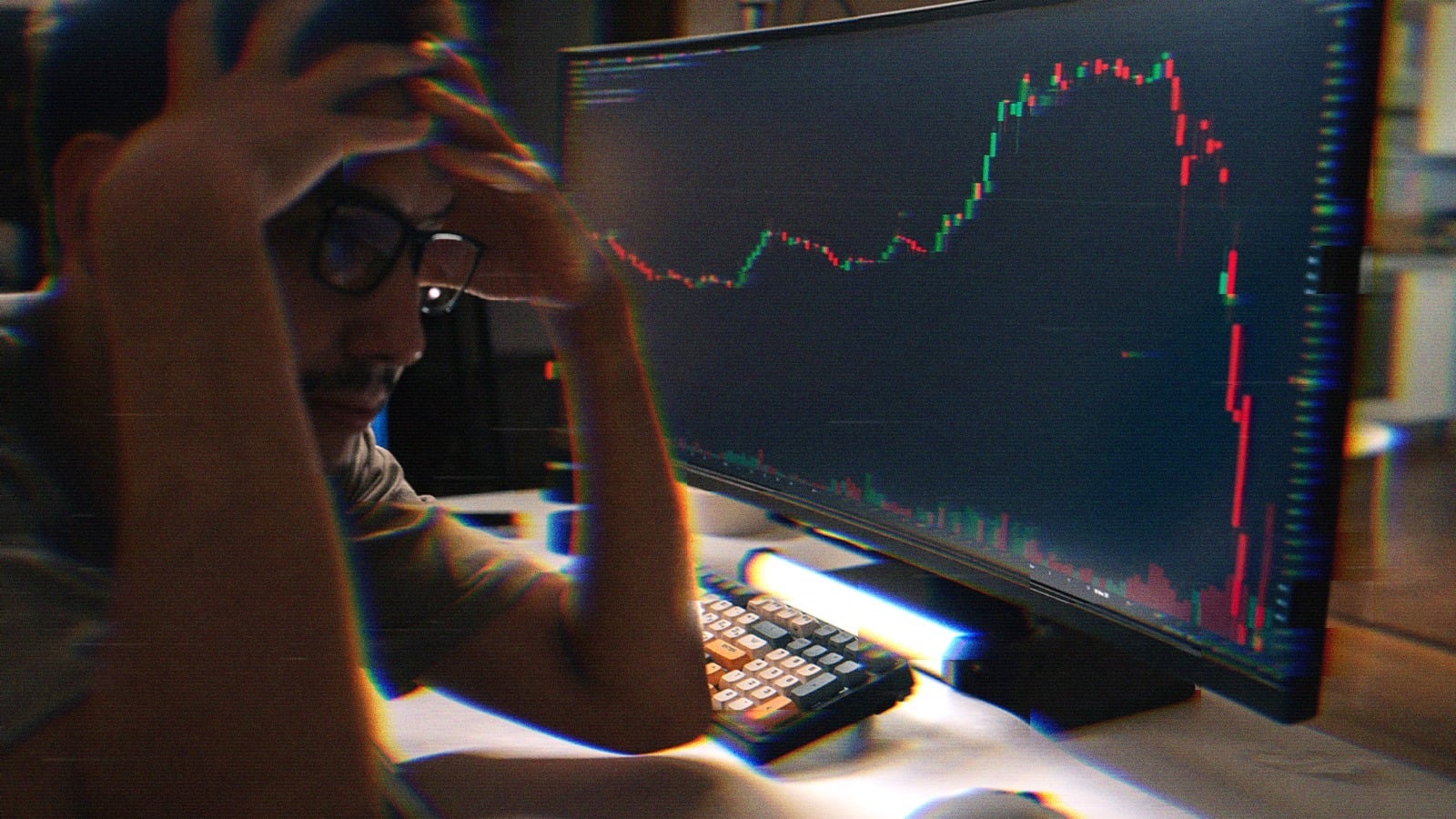 Image Description: A man looking at a (fictional) stock on his computer screen. It has plummeted from a high, and he has his hands on his head, worried.
After the initial post-election market gains, the stock market came crashing back down to earth with losses heavily concentrated in the tech center. The AI trade is coming under intense scrutiny and pressure with several states voting for moratoriums against new data center construction. Other factors like hyperscaler debt and cash flow issues, nebulous financing agreements, and slowing revenue growth from high profile companies like Anthropic are poisoning the AI investment narrative. And Donald Trump, one of its biggest proponents who has been blocking and tackling for the industry and giving it everything it asks for, was just hammered in the midterms.
The markets are heading toward what observers call “correction territory.” After an initial optimistic uptick on the heels of the Democratic election wipeout, the markets are coming back down to earth with stock prices falling and bond yields increasing. For a brief stretch in the coming weeks, we’ll have to go back on our mantra that the stock market is not the economy.
The market is about to go through a period of reckoning and repositioning.
On Wednesday, the Dow gained more than 1,500 points. Traders cheered as Trump acknowledged the results and talked about working with Democrats. By Thursday, the S&P 500 fell 4%, its worst day since the April 2025 tariff meltdown. The Nasdaq slid into correction. The semiconductor index dropped 8%.
The selling went straight to the companies that depend most on Washington clearing the road for AI. And it tells you what this market has been running on. For the past two years, Donny the Sugar Daddy has been blocking and tackling for his side piece, AI. And she’s been thriving. Shopping sprees, new digs, expensive dinners, nights out on the town. A total coke high that’s about to come crashing down like Sharon Stone at the end of Casino.
Some history first. This is nothing new. AI is new, but the cycle isn’t. Washington has been bankrolling corporate America since the recovery from the financial crisis. First, the Fed set near-zero rates with an arbitrage play in the Treasury market to ensure liquidity. Smart. It worked. But went on too long. Then the direct purchase of toxic assets. Smart. It worked. Went on too long and saved some that weren’t worth saving. Then came the forgivable pandemic loans. Necessary. Probably the best of the bunch. And then there were multiple stimulus bills that landed on corporate income statements and parked on balance sheets. Too much, for too long. As a result, over the last 15 years, the S&P 500 is up roughly 490% before dividends. From the bottom in 2009, close to 900%.
It’s been an amazing run for corporate America, the biggest recipient of government welfare, government socialism really. Even China is like, damn. And there are no bigger welfare queens than the big tech companies because Trump cut back on the stuff aimed at building a resilient future for the people and created the conditions for one industry to absorb all of the capital flows.
Trump’s One Big Beautiful Bill made 100% bonus depreciation permanent, so a company can write off servers, chips and cooling gear in year one. Microsoft, Alphabet, Amazon, Meta, Nvidia and JPMorgan collected an estimated $83 billion in federal income tax breaks last year. His data center executive order fast-tracked environmental reviews, opened federal and military land, and promised loans, grants and tax incentives. His administration has struck 43 equity deals worth about $30 billion. And with Republicans running Congress, Nvidia’s close relationship with Trump insulated it from scrutiny. Not for much longer.
Cheap taxes. Fast permits. Federal land. A government shareholder. No oversight. That was the allowance from Daddy, and his stable of queens couldn’t spend it fast enough. And now we’re all about to pay the price for it because they actually spent more than they had.
Imagine free cash flow as you would your household budget. After catching up on all your bills and cashing all your paychecks, it’s what’s left over in the bank. For companies, free cash flow is what’s left after a company pays for what it builds. For the most profitable companies in history, it’s supposed to be a gusher. This year, four of them went negative. I don’t know how else to characterize this other than it’s a fucking stunning disaster. It’s not that they can’t absorb it, they can. It’s just that it portends a very bad outcome.
Alphabet (Google’s parent company) burned $5.9 billion in the second quarter, its first negative quarter in 22 years as a public company. Then it burned $9.07 billion in the third, more than three times what analysts expected. Meta went negative in the third quarter, spending $34.9 billion against $32.8 billion of operating cash. Amazon’s free cash flow over the past 12 months swung to an outflow of $42.4 billion. Oracle has been negative five quarters running. Of the biggest cloud builders, only Microsoft’s operating cash still covered its spending.
And now they’re borrowing money. This is unreal.
And the customers at the center of the boom are getting more expensive to serve. Anthropic’s prospectus shows revenue growth falling from 144% in the second quarter to 47% in the third, while operating expenses kept climbing about 65% a quarter. Compute costs jumped 77%. Anthropic slipped back to an operating loss. And because it buys computing power 12 to 18 months in advance, those costs are, in its words, “generally fixed in the near term.”
Which brings us to the bond market, the ultimate truth serum. Treasury yields actually fell this week as money ran for safety. That’s a good and a bad sign depending on the view. It’s good for mortgage rates and auto loans, and for the government presumably, but this type of increased demand usually indicates a flow of money leaving another market. Having said that, the corner of the bond market that prices AI risk isn’t pulling any punches. The cost of insuring Amazon, Alphabet, Microsoft, Meta and Oracle against default hit its highest level since 2021. Oracle’s hit a record. CoreWeave’s blew past 1,000 basis points.
Actually, let’s hang on CoreWeave for a second because there is so much speculation surrounding this company. CoreWeave is what’s called a neocloud. Neoclouds rent AI chips to the big players. They sign long leases with Microsoft or Meta, then borrow against those contracts and the chips themselves. Lenders often care more about the customer’s credit than the neocloud’s. That’s how CoreWeave piled up $35.1 billion in debt. This week its 2032 bonds traded at 78.5 cents on the dollar, yielding more than 15%.
Now add the Fed. In September, Trump’s own Fed chair, Kevin Warsh, raised rates while Trump demanded rates of “1%, or less.” Inflation hit 3.7% in September, driven by the Iran war oil shock. Markets expect another hike in December, though we’ll see what shakes out over the rest of this month because it might be a rocky ride.
When so much of the buildout runs on borrowed money, every move higher in the cost of capital raises the cost of the next data center, and the next one. The sugar daddy couldn’t get the Fed to cut. That was the first check that bounced.
The second bounced Tuesday night. Voters weighed roughly 40 data center measures in 10 states and sided against development in every one except Harwood, North Dakota.
Seventy-seven percent voted against. Texas elected a governor, Gina Hinojosa, who promised an immediate moratorium on new data centers. Georgia elected a governor who ran against them too. Americans have officially weighed in. Not in my backyard, or anywhere close to it.
So the market is selling what Washington propped up. From their highs of the past year, IREN is down about 75%. Applied Digital, about 72%. CoreWeave, about 68%. Oracle and Vertiv, which makes data center power and cooling gear, are both down more than half. It’s a bloodbath all around.
The most vulnerable links carry the most debt and the thinnest cushion. Neoclouds first. Then the bitcoin miners that converted into AI hosts. Then Oracle. Then the power, cooling, and memory suppliers whose orders depend on the building never stopping. The big money will rotate out as fast as it can, and once prices fall to where it feels comfortable, it’ll pick up somewhere else. That’s called a sector rotation. Basically, musical chairs. So now the question is: Who winds up without a seat when the music stops?
The hyperscalers, insurers, equity, and bond investors aren’t the only ones with skin in the game. You likely have some too whether you know it or not. And this is where things might really turn ugly if credit seizes up all over the country. There’s more than $500 billion in AI data center debt, about $200 billion of it in private credit. Roughly 30% of insurers’ real estate lending last year went to data centers. State and local pensions may have as much as $700 billion in AI-related exposure. Much of that debt doesn’t trade on an exchange, and nobody prices it every day.
But there is a tremendous amount of retail exposure in these corners of the economy. That’s you and me. If you own an index fund or a 401(k), you own this trade, because AI-linked assets now dominate both the stock and corporate bond markets. The damage won’t stay with the people who chose it.
So watch the hedges and the institutions, because they’ll cover their exposure before they mark it to market and let it fall out of their portfolios.
This is the financial crisis replaying in real time. Hard-to-price debt, sold to institutions that need yield, held on behalf of people who never chose it. The difference is that the companies at the top still have enormous businesses underneath. So the only question now is whether this stays contained, with equity investors and early money getting hammered while bondholders get paid, or whether it’s a bloodbath that spills into everything else.
Don’t count on Washington to steer. Democrats take the gavels in January, and the incoming Oversight chair, Robert Garcia, had a two-word message for tech: “Lawyer up.” But hearings and subpoenas don’t stop a slide. The executive branch still runs the SEC and the CFTC. Trump still holds the veto. Changing course takes the White House and Congress working together, and that’s how you know this is going to be a brutal period.
The sugar daddy is still in the house. He just can’t cover the bills anymore. Which way the wind blows from here is anybody’s guess.
 Max
Max is a political commentator and essayist who focuses on the intersection of American socioeconomic theory and politics in the modern era. He is the publisher of UNFTR Media and host of the popular Unf*cking the Republic® podcast and YouTube channel. Prior to founding UNFTR, Max spent fifteen years as a publisher and columnist in the alternative newsweekly industry and a decade in terrestrial radio. Max is also a regular contributor to the MeidasTouch Network where he covers the U.S. economy.