
 Image Description: A roll of cash tied with a rubber band; a $100 bill is visible on the outside.
This won’t initially seem like a private credit conversation, but that’s where it’s headed.
Looking back on the housing market collapse in 2008, the default figures were pretty wild, and pretty wide. Delinquencies ranged from 2% of prime mortgages to 25% of subprime. To this day there is no clean “tipping point” figure that broke the market. A bit troubling considering how well documented this era is.
The best estimates have the total serious delinquency-to-default spectrum as somewhere around 9%. It wasn’t just the breadth of the housing market that was so problematic; it was the amount of leverage baked into it that ultimately brought it all crashing down. A typical mortgage bond could have 50 to 100 individual mortgages in it. A collateralized debt obligation (CDO) could hold 50 to 100 of these bonds.
In order to insure against defaults, investors could purchase what’s called a credit default swap (CDS) on a bond or a synthetic CDS on the bundle, or CDO. That way if the holding goes bust, you’re insulated from the downside.
Remember that little fact.
The private credit market is not the same size as the U.S. housing market, nor does it pose the same systemic risk in the event of a default. Estimates place the size of this nonbank lending market somewhere between $2 trillion and $3.5 trillion. These private institutions fill the gap that commercial banks abandoned after the financial crisis because business lending is messy, expensive, and labor-intensive. Post-crisis regulations made this type of lending much less profitable so most banks simply walked away.
That doesn’t mean banks aren’t in the mix. They’re very much in the mix because they’re often the source of capital. Together with hedge funds and investment banks, commercial banks help provide liquidity to private credit firms that mark up the money and loan it to private industry. It’s the Goldilocks business solution. Small mom-and-pop businesses often get funding from friends, family, community banks, and credit unions. Large companies and public firms have access to traditional banks because they have bigger balance sheets, track records, collateral, and cash on hand. Easy to underwrite, easy to fund.
In the middle lies everyone else. Private credit is the glue holding the middle of the barbell economy together and it’s the section most at risk right now.
At one end of the barbell is one giant plate that houses the absurdly wealthy in this country. On the other end, millions of little hourly wage weights that together have as much wealth as their counterpart. In the middle, small- and medium-sized businesses, entrepreneurs, salaried employees.
The Heavy End
SoftBank, a Japanese investment holding company with around a $230 billion market cap, is a leading tech investor. Its nearly $65 billion bet on OpenAI has drawn financing from banks, bondholders, and Japanese households. It’s also tapping into private credit funds. Its latest borrowing included long-dated dollar bonds yielding 9.75%, the highest rate the company has paid, to support a strategy centered on an AI company that has yet to turn a profit.
This is just one headline, randomly highlighted. There are scores if not hundreds of similar stories to choose from.
But the one component that has disappeared from the headlines is the opaque private credit market. There are only a couple of publicly traded private credit firms known as business development companies, or BDCs. The vast majority are private, closed funds. In 2025 and the beginning ‘26, they were all over the news due to highly publicized defaults and bankruptcies, which led to mass redemption requests. But in recent months, the news has been relatively quiet.
Doesn’t mean everything is fine. It’s not.
The mainstream media processes information no differently than we do; there’s only so much chaos and concern the brain can handle. Thus, we move from hot topic to hot topic until we’re bored. Most of the time, the issue has yet to be resolved. We’ve simply lost interest.
But make no mistake, private credit is very much a part of the machinery behind the wave of debt in the tech sector: One major player is Apollo, which was reportedly negotiating an increase in a loan backed by SoftBank’s Vision Fund 2 assets from $5.4 billion to $9 billion, although the expansion was not finalized. So now we’re borrowing against existing investments to finance new investments and stacking repayment obligations on uncertainty in a market known for circular financing and impossible valuations. I mean, what could go wrong?
When it comes to the AI trade more broadly, there is something almost absurd about committing so much borrowed money to such an uncertain commercial outcome. But the question is not whether AI works. It is whether the businesses financing its expansion can earn enough, soon enough, to justify what they are spending and borrowing.
The bond market is making that question more urgent: the global selloff pushed the 30-year Treasury yield to its highest level since 2004. Higher benchmark yields raise the starting price of new borrowing and refinanced loans. These yields flow directly into private credit portfolios that comprise multiple variable-rate products that constantly renew at higher and higher rates. In a market that was already pushed against the wall, it’s hard to imagine things have gotten much better.
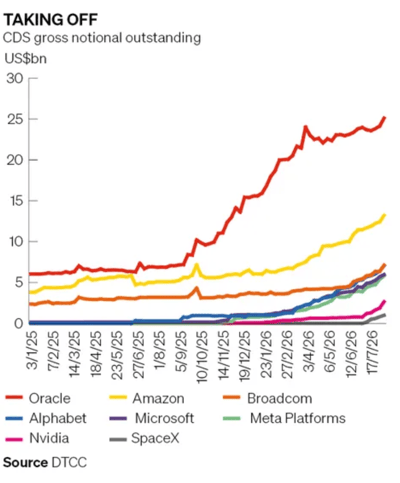
The problem is that we simply don’t know. Outside of the public BDCs, we rarely get a look into the portfolios of these funds. But what we do know about the visible market is that professional investors are now also trading against potential AI-related credit. Remember those credit default swaps we referenced earlier? They’re back and gaining momentum. Only instead of housing, they’re betting against the debt instruments of our biggest and most profitable companies.
Source: IFR
This means that investors are now trying to time the demise of the AI investment. Nvidia’s credit-default-swap volume alone jumped from roughly $640 million to $6.9 billion in just a year.
Again, I don’t believe there is systemic risk in AI credit. That’s not this story. CDS represent only around 6% of the total “hyperscaler” issuance. But understand what they’re betting against. In plain terms, there are real investors with real money betting that companies like Oracle, Microsoft, and Amazon might default on their debt. Take a moment to process this.
It’s not going to happen. These companies and these particular debt instruments aren’t the problem. But there is a problem related to AI debt that’s not as easy to spot.
Beneath the publicly traded corporate bond market is another debt market related to the AI buildout. A $3 trillion debt market that sits off the balance sheets of the tech giants. This is the debt fueling data center buildouts across the country and the major leaseholders like Meta don’t have to recognize the related debt until the facilities are fully leased and operational. In the meantime, guess who is holding most of that risky debt? Yeah. Private credit firms like Blue Owl.
The Ripple Effect
The First Brands and Tricolor collapses in 2025 provoked scrutiny of opaque lending, although industry executives were quick to point out that these were isolated cases of fraud and uncharacteristically poor lending standards.
In September, Reuters reported that Blackstone’s flagship private credit fund had received third-quarter redemption requests equivalent to about 10% of outstanding shares, with a substantial backlog from the previous quarter. Earlier, Ares reportedly shrank a planned continuation vehicle after prospective investors demanded deeper discounts on the loans being transferred into it.
Even with all of the scrutiny and reporting since the First Brands and Tricolor news, hard numbers remain impossible to come by.
Fitch projected a 6.3% industry default rate over the 12 months through August, while Pimco’s broader BDC-focused “shadow” measure stood at 19%; Houlihan Lokey’s size-weighted measure remained below 1%, reflecting stronger performance among the largest borrowers. In other words, no one knows how bad things are under the hood.
What we do know is that there is a tremendous amount of dealmaking going on behind the scenes. Payment-in-kind (PIK) adjustments in which loans are modified into equity or other givebacks are rampant. The same holds for basic restructuring where new loans take out old loans to extend terms or change interest rates. None of these are counted as defaults, which makes the full picture even murkier.
That is the connection back to SoftBank, not a claim that its loans are already impaired. The fact that money is still flowing isn’t proof that risk is falling.
The Global Financial Crisis was triggered by an astounding concentration of risk around a single product. Our homes. A mortgage became a bond to be bought and sold. The bond was bundled with hundreds more to be bought and sold. The people who were trading them did so with other people’s money, betting that it would always pay off. More than a trillion dollars sitting on top of a complex layer of investments all betting that you would pay your mortgage.
Today the numbers are actually much, much bigger. A trillion here, a trillion there. Trillions more everywhere. But the market dismisses the inherent risk because it’s “distributed” and “diversified.” But is it?
Hyperscaler debt is now 14% of top-rated corporate debt. There’s $3 trillion in data center debt that’s not even sitting on anyone’s balance sheet right now. You have $2 to $3.5 trillion in investor money tied up in private credit that’s very much invested in these areas. And you have hedge funds and traditional banks putting their capital at risk behind them. And now you have momentum in the insurance-against-default game of credit default swaps.
Here’s the thing about debt. At some point, it comes due. It’s ahead of equities. It’s the first-in, smart money that demands repayment. There’s a growing awareness right now that these AI companies aren’t going to make enough money to service their debt. Not even close. So follow that money downstream to the chipmakers and data center companies, the battery storage and energy companies. If it breaks bad at the top, it’s a long way down.
A ripple like this through private credit will be problematic for more than just investors and AI-related companies. It means that credit risk will be widespread. As it is, outflows are outpacing inflows into private credit funds so there is less and less capital available for Main Street companies. And the capital that is there is getting more expensive by the day.
The coming earnings season will offer another test. If revenues and cash generation disappoint, investors could reconsider technology exposure in favor of higher-yielding fixed income, commodities, or even bitcoin.
Savvy institutional investors will rotate money into Japanese bonds, U.S. Treasurys, and stable AAA corporate bonds so fast it’ll make your head spin. And, yes, they might even dip back into the bitcoin waters because it’s easier to risk capital on pure speculation if your fixed income portfolio is kicking off 7%.
The cost of capital connects these stories.
This administration is running the economy hot by maintaining deficit spending, starting wars, and levying outlandish tariffs. All of it is pushing the U.S. risk profile higher and higher, which is why rates will only keep rising. If SoftBank is paying 9.75%, what do you think is happening inside those mid-market software loans and lines of credit? When we did get a peek into First Brands’ bankruptcy filing, there were multiple revolving lines and short-term loans with rates that ranged from 9% to 15%, and that was more than a year ago. It doesn’t take a genius to imagine where the floating rates are now that the Fed is hiking rates and bond yields have exploded over the past several months.
As a country we now have too much riding on the AI investment trade to back away from it. And with institutional rotation to non-AI fixed income products, it means that there will be less and less money available to the middle of the barbell. That, my friends, is the real economy. If we had real economic stewards at the helm of this country instead of Tim Scott, Kevin Hassett, Scott Bessent, Howard Lutnick, and his majesty The Donald, we would be opening the books of these private credit firms and preparing a liquidity backstop in the background for when the whole system fails.
Sadly, we do not.
 Max
Max
Max is a political commentator and essayist who focuses on the intersection of American socioeconomic theory and politics in the modern era. He is the publisher of UNFTR Media and host of the popular Unf*cking the Republic® podcast and YouTube channel. Prior to founding UNFTR, Max spent fifteen years as a publisher and columnist in the alternative newsweekly industry and a decade in terrestrial radio. Max is also a regular contributor to the MeidasTouch Network where he covers the U.S. economy.