
Little Marco’s Coup D’Etat.
Kidnapping Maduro.
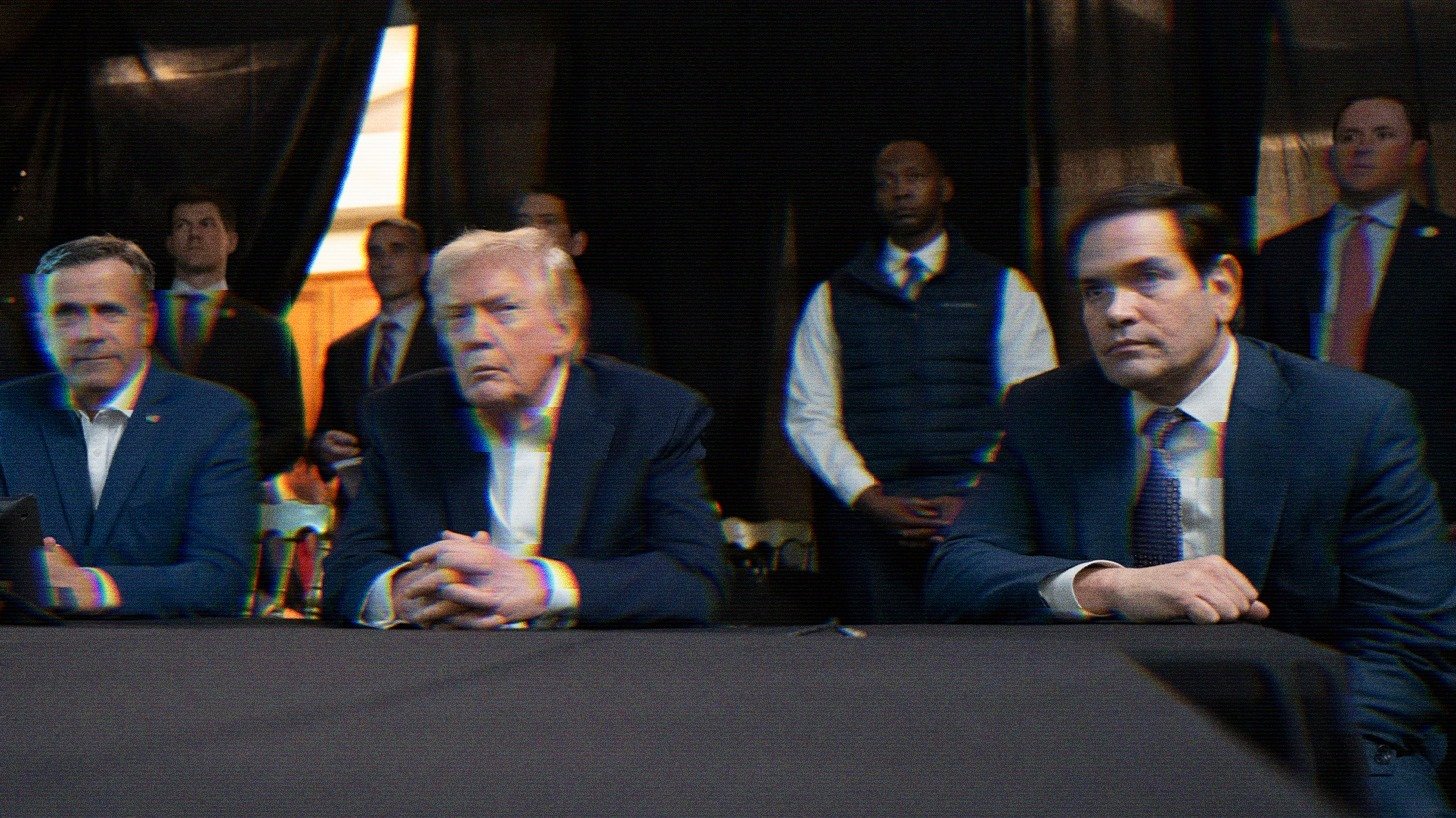 Image Description: John Ratcliffe, Donald Trump and Marco Rubio watching the Venezuela invasion from a room at Mar-a-Lago.
The United States carried out a special-operations strike in Caracas, Venezuela and captured President Nicolás Maduro and his wife Cilia Flores who are reportedly being taken to Manhattan to face criminal charges for drug trafficking. In this video, Max breaks down what’s really behind this stunning intervention, perhaps the most brazen and illegal action undertaken by the U.S. since Kissinger’s secret bombing of Cambodia. He talks about all the angles portrayed in the media from narcoterrorism to oil, reveals what’s more likely behind our actions and how Marco Rubio is intimately involved.
Let us be absolutely clear about the kidnapping of Venezuelan President Nicolás Maduro and his wife Cilia Flores. The United States military, without a declaration of war, without Congressional authorization, without UN Security Council approval, without any legal framework whatsoever, bombed the capital city of a sovereign nation and kidnapped its head of state. Full stop.
Now, before you jump in with “but Venezuelan elections aren’t legitimate”—yeah, I get it. They have serious integrity issues. But let’s not go down that path of comparing election integrity among supposed democratic nations, because we’re currently partnering with Saudi Arabia, an absolute monarchy that doesn’t hold elections at all. We prop up dictators across the world who suspend elections and constitutions whenever it suits us. We’ve recognized coups that overthrew democratically elected leaders when the outcome served our interests. And given our own recent history with election challenges, lawsuits, and January 6th, maybe we shouldn’t be throwing stones from this particular glass house.The professional pundit class wants you to focus on Maduro’s sins to justify this action. Don’t fall for it. Any take you see that offers a whataboutism on Maduro should be ignored completely because it distracts from the central point.
This is unprecedented. And I hate using that word because it’s overused, but it genuinely applies here. You would have to go back to the CIA-backed coup that overthrew Chile’s Salvador Allende in 1973 and installed the dictatorial regime of Augusto Pinochet to come close to this level of intervention. Or Henry Kissinger’s secret bombing campaign in Cambodia—operations conducted completely outside Congressional authority that led to hundreds of thousands of deaths.
I even saw a pundit try to draw parallels to Nicaragua in 1989, but that doesn’t work either. Yes, the U.S. spent a decade destabilizing the Sandinista government through the Contras, economic embargoes, and diplomatic pressure that eventually led to their electoral defeat in 1990. And yes, the Iran-Contra scandal was one of the biggest political disasters in American history. But even that involved covert backchannel dealings over years. It wasn’t a direct military assault on a capital city followed by the abduction of a sitting president. The closest approximation might be the ouster of Manuel Noriega from Panama but this is a fraught comparison considering Noriega was a longstanding CIA asset prior to taking the reigns of the country.
I’m not excusing prior U.S. actions but this is more brazen than anything we’ve done since the early 20th Century when Theodore Roosevelt was invoking the Roosevelt Corollary of the Monroe Doctrine.
Let’s apply the logic the Trump administration is using here to any other situation. The United States has been charged with crimes in the International Court of Justice (ICJ) multiple times. We’ve been accused of war crimes by numerous countries and international bodies. We don’t recognize many of these courts or their jurisdiction. Fine. But using the precedent we just set, any of those countries would now have the same standing to bomb Washington D.C., fly into the Capitol with special forces, and capture Donald and Melania Trump to spirit them away for trial in The Hague or wherever they see fit.
Sound absurd? Good. Because it is absurd. It’s a flagrant violation of international law, the UN Charter, and every norm that’s existed since World War II about how nations interact with each other.
As a weak justification, there has already been coverage of Venezuelans—both in the United States and in Caracas—being interviewed and saying Maduro was ruthless and incompetent and shouldn’t be in power. Okay, flip the script for a second. If another country did to the United States what we just did to Venezuela—if they bombed Washington and kidnapped Trump and Melania—there are at least 150 million Americans who would give you the exact same soundbite about Trump. “He’s incompetent, he shouldn’t be in power, good riddance.”
Would that justify it? Of course not. Because domestic unpopularity is not a license for foreign military intervention and kidnapping.
All of this—every bit of the media coverage focused on Maduro’s failings—is designed to distract from the point. This action is illegal under both U.S. and international law. It’s incredibly dangerous. It sets a precedent that essentially says “might makes right” and any powerful nation can simply grab the leaders of weaker nations whenever they feel like it.
So what is this really about? Because it sure as hell isn’t about justice or democracy or any of the noble rhetoric we’re going to hear at Trump’s press conference.
Let me lay out the theories that are being floated. Is this about oil? Drugs? Maybe even a distraction from the Epstein files because Venezuela was an easy target?
In order, the answers are: ‘a little,’ ‘no,’ and ‘please stop.’
But there’s another element that we’ve covered before on this show that needs to be explained again because it’s already getting lost in the noise. Let’s break down each theory.
We keep hearing this is about oil. But what does that really mean?
Here’s what you need to understand about Venezuelan crude. It’s not like American oil. Venezuela produces mostly very heavy, sour crude—extra-heavy oil from the Orinoco Belt. It’s thick, contaminated with metals, and expensive to process.
Their main export blend is a heavy sour crude. To even make it exportable, they have to blend the ultra-heavy Orinoco crude with very light condensate.
Compare that to U.S. oil. Our benchmark West Texas Intermediate and most shale output from places like the Permian and Bakken are light, sweet crudes that are easier and cheaper to refine into gasoline.
So why does Venezuelan oil matter at all? Because U.S. refineries, especially on the Gulf Coast, were historically built and optimized to process heavy sour crude. They were designed to take imports from Venezuela, Mexico, and the Middle East and blend them with domestic light sweet crude. These complex refineries are specifically configured to handle this nastier oil and turn it into diesel and industrial fuels.
Venezuelan crude is technically valuable to certain refineries even though it’s lower quality on paper. The two types of oil—heavy sour and light sweet—are complements, not substitutes.
But here’s the thing. After years of U.S. sanctions, Venezuela has been shipping its oil to other countries with refineries that can handle it—namely India and China. And this is where it gets interesting.
We just released a piece about the BRICS alliance—Brazil, Russia, India, China, South Africa, and their expanding membership—working to create an international payment system based on a new digital currency called “The Unit.” This represents a direct challenge to U.S. dollar hegemony.
If BRICS countries start paying for oil with Units instead of petrodollars, that’s a massive problem for the United States. Not because we need Venezuelan oil—we’re actually the largest oil producer in the world now. We don’t need their oil. Chevron still does business in Venezuela anyway.
Now, ExxonMobil and ConocoPhillips would presumably like to someday resume operations there after being kicked out during Chávez’s nationalization. But would we really risk overthrowing an entire government just to put two U.S. companies back in business when oil is trading below $60 a barrel?
Even if these companies wanted back in, they’re not going to invest the capital right now. Trump just put us into a global recession with his tariff wars. Oil companies are pulling back on new investments everywhere. They’re not even exploring open leases in the United States, let alone trying to reclaim operations in a country we’ve completely destabilized through sanctions.
So anyone telling you this is about the U.S. “taking the oil” doesn’t understand the dynamics here.
The oil story is actually about maintaining the petrodollar system. It’s about making sure that oil continues to be traded in U.S. dollars, which creates demand for our currency and helps us sell the Treasury bonds we desperately need to fund our massive deficits. It’s not about putting money in ExxonMobil’s pockets—it’s about ensuring continued demand for dollars in global energy markets.
Because if Venezuela—and more importantly, if other oil producers—shift to BRICS payment systems or cryptocurrency that isn’t dollar-backed, it undermines the entire structure that allows the U.S. to run trillion-dollar deficits without immediate consequences.
And we know it’s not about drugs. Our own intelligence agencies have established that drug trafficking from Venezuela is limited to relatively small amounts of cocaine, and most of that goes to Europe, not the United States.
The overwhelming majority of drugs entering the United States come through Mexico—fentanyl and fentanyl precursors from China, processed in Mexican labs, and smuggled across our southern border. If this were actually about narcoterrorism, we’d be invading Mexico or launching strikes on Chinese pharmaceutical companies.
The narco-state accusation is a pretext. It’s the kind of justification we trot out when we want to intervene somewhere but need a reason that sounds tough on crime and plays well domestically. It’s propaganda, pure and simple.
And as far as this being a distraction from the Epstein files, look, I think it’s a small side benefit for Trump, but anyone who suggests this is the primary motivation is missing the big picture. Trump does love his distractions, but you don’t launch a military operation of this scale just to change the news cycle. There are easier ways to do that.
So the biggest reason that I guarantee you’re not going to hear in the mainstream is that, yes, it’s about oil but not directly. It’s about payments for oil and standing up the petrodollar—getting ahead of the fact that the BRICS nations, the biggest of which are now the primary recipients of Venezuelan heavy sour crude, just launched a mechanism to get around the petrodollar. But there’s another angle that you also won’t hear about: Cuba.
To contextualize this idea, we have to explain the relationship between Venezuela and Cuba. These two countries have been joined at the hip since Hugo Chávez came to power in 1998, united by what they call the Bolivarian Revolution—a shared ideological project of resistance to U.S. imperialism and economic self-determination.
Let’s rewind to the 1990s. When the Soviet Union collapsed in 1991, Cuba lost its primary benefactor. The result was catastrophic. Cuba entered what Fidel Castro called the “Special Period”—a decade of severe food and fuel shortages, economic contraction, and genuine suffering for ordinary Cubans.
The United States, sensing an opportunity to finally topple the Castro regime, doubled down with the Helms-Burton Act in 1996, tightening the embargo and prohibiting foreign companies from doing business with Cuba. After decades of failed assassination attempts and efforts to foment internal revolution, American policymakers thought this was finally it—the Cuban Revolution would collapse under its own weight.
But then Hugo Chávez won the Venezuelan presidency in 1998. And everything changed.
Chávez and Castro formed an immediate and deep bond. They shared ideologies, shared enemies, and shared visions. For Castro, Chávez represented one of the last champions of Cuban-inspired revolutionary movements in Latin America. For Chávez, Castro was a mentor, a symbol of resistance, and a model for how to maintain power against overwhelming U.S. pressure.
The relationship wasn’t just symbolic—it was profoundly practical. Venezuela needed expertise in healthcare, education, and security. Cuba needed oil and hard currency. So they made a deal.
Venezuela would provide Cuba with heavily subsidized oil—at its peak, 105,000 barrels per day, essentially for free or at deeply discounted rates. In exchange, Cuba would send doctors, teachers, intelligence officers, and military advisors to Venezuela.
This exchange saved Cuba’s economy. Venezuelan oil pulled Cuba out of the Special Period and gave the Communist Party a lifeline it desperately needed. Between 2000 and 2018, over 219,000 Cuban professionals served in Venezuela.
This is why the Cuba-Venezuela relationship is absolutely central to understanding what just happened.
For over six decades, the United States has wanted to overthrow the Cuban government and undo the Castro revolution. We’ve tried everything—the Bay of Pigs invasion, multiple assassination attempts against Fidel Castro, a crippling embargo, diplomatic isolation. Nothing has worked. The Communist Party has survived every attempt to dislodge it.
But if we can topple Venezuela, we cut off Cuba’s economic lifeline. We strangle the Cuban economy of the oil and financial support it needs to survive. It’s two regime changes for the price of one.
And this brings us to Marco Rubio, Trump’s Secretary of State, who is absolutely central to this entire operation.
Rubio is Cuban-American. His parents emigrated from Cuba, and like many in the Cuban exile community, especially in Florida, he carries deep, personal, generational hostility toward the Castro regime and everything it represents. This isn’t just politics for Rubio—it’s about the system they blame for forcing them into exile, and a six-decade promise that one day, the revolution would be undone.
Rubio has been one of the most vocal advocates for crushing Venezuela for over a decade. He’s been pushing for regime change, for harsher sanctions, for anything that would destabilize Maduro’s government. And his motivation is transparent: topple Venezuela, and you can finally deliver the death blow to Cuba.
And then there’s María Corina Machado. She recently won the Nobel Peace Prize for her opposition activism against Maduro. But it’s a complete sham of an award. And we know it’s a sham because Machado herself said that Donald Trump should have won the Nobel Prize instead (and has since given it to Trump). That tells you everything about the political forces behind this award.
One of the key people pushing for Machado to receive the Nobel? Marco Rubio.
Machado represents the Venezuelan opposition that’s aligned with U.S. corporate interests—the opposition that wants to return to the neoliberal policies of the 1980s and ‘90s that enriched a tiny elite while leaving the majority in desperate poverty. She’s not a champion of democracy in any meaningful sense. She’s a champion of the old economic order that Hugo Chávez overthrew, the order that treated Venezuela as an extraction zone for foreign capital.
And this gets to the heart of Cuban-American politics in Florida, which has been one of the most reliably Republican voting blocs in the country for decades. Why? Because they fundamentally oppose any normalization of relations with Cuba until the Communist Party is destroyed.
Crippling Venezuela will plunge Cuba into chaos not seen since the Special Period of the 1990s. But here’s the crucial difference: there’s no Fidel Castro anymore. There’s no charismatic revolutionary leader who commanded respect and could hold the country together through sheer force of personality. The current Cuban leadership is technocratic and uninspiring. Without Venezuelan oil, without economic support, Cuba could genuinely collapse this time.
And that’s what Rubio is banking on. Once Cuba is on its knees, he can gin up a justification to invade there too, install a U.S.-friendly regime, and finally deliver on the ultimate promise to his political base.
And now we have Machado licking her chops, thinking she’s just going to waltz into Caracas and take over as president. As if it’s going to be that simple.
Let me give you a parallel. Imagine Iran unilaterally acted on one of their ICJ cases, bombed Washington D.C., kidnapped Donald Trump, and announced they were installing their preferred candidate in the White House. JD Vance would be standing there like, “Uh, excuse me? What exactly is happening here?” There would be chaos. There would be competing claims to power. There would be violence.
That’s what’s about to happen in Venezuela. The U.S. just decapitated the government, but there’s an entire political and military apparatus still in place. Maduro’s allies, the Venezuelan military, Cuban advisors, regional powers like Colombia and Brazil—none of them are just going to accept Machado walking in and taking over because the United States said so.
As usual, the United States assumed the next part would be easy. We topple the bad guy, install our preferred replacement, and everyone lines up to thank us for bringing freedom and democracy. We’ve made this mistake over and over and over again—Iraq, Afghanistan, Libya—and it never works out the way we think it will.
It won’t be easy this time either. Because it never is.
So let’s put this all together.
This is not about drugs. The narco-terrorism narrative is propaganda, plain and simple.
This is not really about oil in the sense of acquiring petroleum resources. We’re the world’s largest producer. We don’t need Venezuelan crude.
This is about the petrodollar. It’s about maintaining dollar dominance in global oil markets at a time when the BRICS alliance is actively building alternative payment systems. It’s about making sure oil continues to be traded in dollars so we can keep selling Treasury bonds to fund our massive deficits.
And the biggest side benefit is Cuba. It’s about Marco Rubio settling a 70-year-old score.
Image Source
- Official White House Photo by Molly Riley, Public domain, via Wikimedia Commons. Changes were made.
 Max
Max
Max is a political commentator and essayist who focuses on the intersection of American socioeconomic theory and politics in the modern era. He is the publisher of UNFTR Media and host of the popular Unf*cking the Republic® podcast and YouTube channel. Prior to founding UNFTR, Max spent fifteen years as a publisher and columnist in the alternative newsweekly industry and a decade in terrestrial radio. Max is also a regular contributor to the MeidasTouch Network where he covers the U.S. economy.