
The BRICS Unit.
The Beginning of the End for Dollar Dominance?
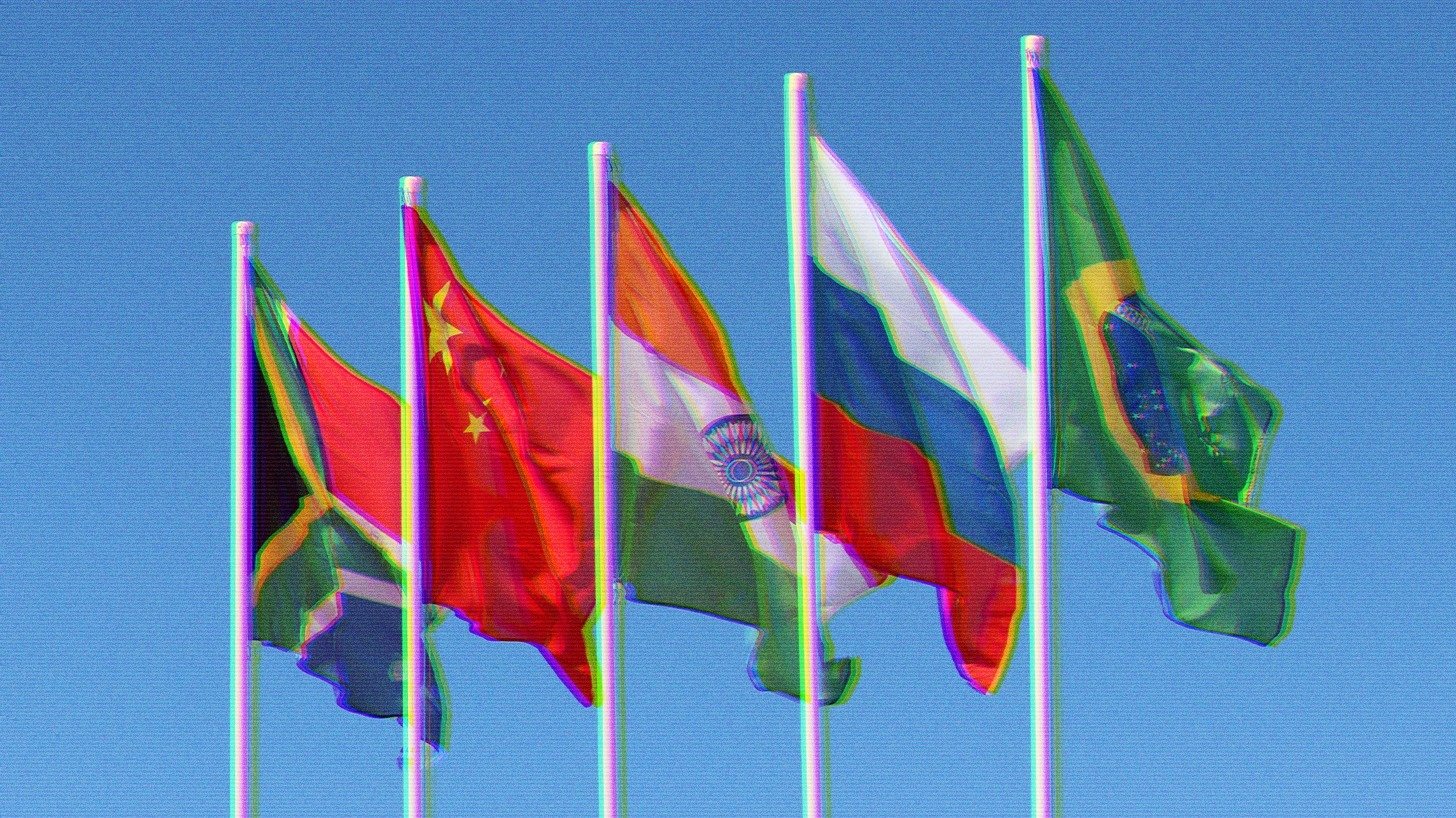 Image Description: Founding BRICS nation flags waving in the air: South Africa, China, India, Russia and Brazil.
In December of 2025, the newest and perhaps strongest economic alliance on the planet went operational.
For 80 years the United States has sat on the throne of economic power as the world’s reserve currency and hegemonic superpower. Others have grown, some have even closed the gap but so long as the world’s business is done in the universal language of the U.S. dollar, we are an immovable force. We are part of everything. Inexorably intertwined with global trade whether people like it or not.Holding onto this exorbitant privilege as it’s referred to is literally the easiest thing to do. To lose it we would have to turn on our allies, start unprovoked wars, cut off the flow of immigration to take an extreme xenophobic stance, withdraw from trade deals, alliances and global organizations, place egregious tariffs on every country in the world, even if they’re only inhabited by, I don’t know, penguins, eliminate poverty and health funding to developing nations, hoard wealth and resources, and generally go out of our way to piss off everyone from Canada to Japan.
This would, of course, be utter madness! But it’s happening, so let’s game it out.
We’ve talked about BRICS before. Brazil, Russia, India, China, South Africa—the original five economies that banded together because they saw the writing on the wall. Indonesia is the most recent entrant, and there are other affiliated nations who are quickly filling in the map with countries like Egypt, Ethiopia, Iran, and the UAE. Together, they represent more than half of the world’s population. And they’ve been quietl and methodically building an alternative to the Western-dominated financial order.
Another thing these nations have in common is that the United States has now placed aggressive tariffs on every single one of these nations. That’s not a coincidence. It’s a pattern. And it’s not just adversaries like Russia and China. We’re talking about India, a natural ally and country with deep historical ties to the West, and they’re absolutely livid at the Trump administration’s trade posture.
India just took over the BRICS chairmanship from Brazil for 2026. And what did they do immediately? They unveiled their agenda. Forget climate initiatives or cultural exchanges. It’s about payment systems. Financialization. Deep economic coordination. The kind of boring, technical infrastructure that most people tune out but that literally runs the world.
The BRICS “Unit”
So what exactly did they announce in December?
The BRICS Unit. A digital currency backed 40% by physical gold and 60% by a basket of BRICS currencies—the real, the yuan, the rupee, ruble, and the rand, all weighted equally in that basket.
Now if we think back to some of our other coverage from last year this might sound like a stablecoin but it’s not exactly that. It’s stablecoin-adjacent, let’s say.
See, a normal stablecoin—like Tether’s USDT or Circle’s USDC—promises you redemption. You can always swap your token for actual dollars. One-to-one. That redeem-ability is the whole point. It’s the anchor. The BRICS Unit is explicitly non-redeemable. You can’t walk up to a window and exchange your Units for gold bars, yuan, or rubles. It’s designed to track that basket of assets, to provide stability relative to those reserves, but there’s no redemption mechanism.
Think of it more like Keynes’s old Bancor concept—a basket-anchored unit of account used for international clearing. The gold and BRICS currencies stabilize the valuation, but they don’t create a direct redemption channel. It’s a wholesale settlement asset, not a retail token. Banks and governments will use it to settle cross-border trade payments, not individuals buying coffee.
But here’s where it gets interesting. Each BRICS nation is independently moving toward digital transactions internally. India’s Unified Payments Interface (UPI) is revolutionizing how money moves in the world’s most populous country. China has been piloting its digital yuan for years. Brazil has Pix. Russia has SPFS. South Africa has SAMOS.
These aren’t just payment apps, they’re fundamental infrastructure. And the Unit is designed to sit on top of all of them, creating a unified rail system that connects these digital ecosystems together.
BRICS Pay is the messaging and settlement network that links all of these national systems with a decentralized messaging layer. This is their answer to SWIFT, the international payment transfer system built on the dollar. These nations, some of our allies included, are building an alternative to SWIFT. Not tomorrow. Not in some hypothetical future. Right now.
Let’s talk about SWIFT for a second, because it’s not something most of us need to think about.
The Society for Worldwide Interbank Financial Telecommunication (SWIFT) is basically the world’s financial text messaging system. It’s how banks talk to each other. When money moves from a bank in Tokyo to a bank in London, SWIFT is carrying the message that says “hey, we’re sending this much money for this person to that account.” It’s archaic. It’s based on technology from the 1970s. But it works. And more importantly, it’s the standard.
To use SWIFT effectively, countries need dollars. Lots of dollars. So they buy U.S. Treasury bonds, which give them dollar reserves, which allows them to participate in global trade. Central banks hold dollars, commercial banks transact in dollars. The whole world runs on dollars, whether they want to or not.
Now, we’ve done pieces about stablecoins (digital tokens pegged to the dollar), and right now, the Trump administration is still pushing Congress to pass legislation that would explicitly prevent the Federal Reserve from issuing a digital currency for SWIFT transactions. Instead, they want to leave it to the private market. Companies like Tether. Like Circle.
And remember—we exposed this early—the Trump family entered into some incredibly shady dealings to create their own stablecoin with shadowy backers from the Middle East. They want to decentralize digital dollar creation away from the Fed and into private hands. Their hands.
The Federal Reserve mints physical dollars and earns what’s called seigniorage, the difference between the cost of printing a dollar and its face value. It’s a huge revenue stream. It’s also a massive regulatory lever. The Fed can oversee, can regulate, can ensure stability in the system.
But if private entities are minting stablecoins—their own digital dollars—then the Fed loses that seigniorage revenue. And it loses much of its regulatory power, because these are technically private companies, not federal entities. The Trump family gets rich. Their Middle Eastern backers get rich. The shadowy crypto exchanges get rich. And the Federal Reserve gets neutered on the global stage.
So in the ultimate twist of irony, in this one specific respect, the BRICS nations are actually more transparent than the system being proposed under the Trump administration. The Unit is explicitly a government-backed settlement instrument. It’s not some private company with murky ownership structures. It’s nation-states saying “we’re going to create an alternative system and run it together.”
The reason some policymakers are okay with stablecoins is that they keep the world partially dependent on the dollar; remember that these digital coins have to be backed one-to-one by a U.S. dollar to qualify, or so the proposed regulations stipulate thus far. In reality, however, we still have to trust the ledgers of these private organizations. Given we also exposed in 2025 how there is a discrepancy between Cayman Islands holdings of U.S. treasury notes to the tune of $1.4 trillion dollars, it’s hard to imagine we’re ready for this kind of move. Again, that discrepancy is between sister entities within our own country: the Federal Reserve and the U.S. Treasury.
Can They Pull It Off?
So let’s talk about what it actually takes to replace a system like SWIFT with something like the BRICS Unit. There are four pillars you need to have in place: technology, adoption, stability, and trust.
The technology is actually now the easy part, relatively speaking. The tech exists. It’s being piloted right now, and India is leading the charge. They’re sharing their UPI technology backbone with countries across the BRICS alliance.
In fact, in December they announced this exact framework with Ethiopia, the fifth largest economy in Africa. Now, Ethiopia needed a bailout from the World Bank and the IMF as recently as 2023, and they’re still recovering from a major crisis. But they just became the first country in Africa to deliberately move to an entirely digital financial infrastructure. Not partially. Not gradually. Entirely.
And now they’re going to do it with Indian technology. India is open-sourcing this process, making it available, encouraging rapid adoption. Why? Because India understands something fundamental: the network effect. The more countries that join, the more valuable the system becomes. It’s the same reason Facebook grew so fast—each new user made the platform more valuable for everyone else, which leads us to adoption.
Ethiopia is the proving ground for BRICS Plus in Africa. But it’s not alone. Egypt is a BRICS member (the second largest African economy), and South Africa is a founding member (the largest African economy). If the system can handle the stress of a recovering economy with limited infrastructure and works in Ethiopia, then adoption across Africa becomes far more doable.
And remember, adoption isn’t just about countries joining. It’s about volume. How much trade actually flows through the system? How many transactions? Right now, we’re seeing BRICS trade—especially Russia-China-India-Gulf flows—increasingly invoiced and settled in non-dollar units. It’s marginal still. It’s not replacing the dollar system wholesale. But it’s reducing dollar demand at the margin for those specific trade corridors. In fact, as of 2026 the dollar share of global currency reserves has dropped to the lowest point since the mid 1990s.
In terms of stability, this will only increase with the level of adoption and on the strength of the economies represented. But it’s worth noting that the Unit is backed 40% by gold. Gold is the ultimate stabilizer, it’s been a store of value for literally thousands of years. The other 60% is split among five currencies, which provides diversification. No single currency dominates, no single government can manipulate the basket unilaterally.
Is it as stable as the dollar? Right now, no. The dollar has 80 years of deep, liquid markets behind it. But does it provide enough stability for cross-border trade settlement? The early evidence suggests yes. Countries worried about dollar debasement, about sanctions, about American monetary policy whipsawing their economies—they’re looking at a gold-anchored settlement unit as a politically safer, more neutral option.
So it’s not there yet, but 2025 was a massive step forward, leaving the final pillar and perhaps the most important leg on the stool: trust.
This is where we still dominate.
The dollar is trusted because America has been—despite all our flaws—a relatively stable, transparent, rule-of-law governed economy for generations. Our courts work. Our contracts are enforced. Our property rights are protected. When you put your money in dollar-denominated assets, you have a reasonable expectation that the rules won’t change overnight, that your assets won’t be arbitrarily seized, that the system will still be there tomorrow.
Can you say the same about China? A country that’s still fundamentally opaque? Not yet.
Can’t say it about Russia. Russia remains a small, highly corrupt economy that’s essentially a petrostate with nukes.
India is brimming with potential, but it’s also brimming with corruption, bureaucracy, and deep structural challenges.
Brazil is solid, but it’s only as strong as the rest of Latin America, and that’s a region with a long history of economic instability.
Trust is the strongest leg of the stool. And it’s the one that will be hardest for BRICS to replicate. It takes decades to build. It can be destroyed in moments, but it takes generations to create.
But even still, even with that massive trust advantage, the stage has been set.
Very few people are talking about this in America. The global financial system is legitimately, foundationally based on the dollar. It’s been that way for so long that it feels permanent. Immutable. Like gravity.
But remember: A couple of years ago, we weren’t talking about artificial intelligence. Not really. Not in the mainstream. And then ChatGPT launched and suddenly AI was everywhere, reshaping industries, threatening to displace workers, to transform how we think about human capability.
A few years ago, we weren’t taking crypto seriously. And we certainly weren’t talking about stablecoins. They were niche. Weird internet money for people buying things they probably shouldn’t be buying. But now? Stablecoin purchases of U.S. dollars exceed those of every country in the world except the top 17. And that ranking is going to change, quickly.
The world can shift faster than we think possible. Paradigms that seem unshakeable can collapse in remarkably short periods of time, especially if you spend all of your time pissing off your foes and allies alike.
And if the last pillar of a currency regime is trust, then what happens if the United States plunges the world into yet another financial crisis? How many more times will these nations stand by and let us do this? What happens if our political dysfunction, our debt levels, our increasingly erratic policy-making destroys the very trust that keeps the dollar supreme?
The BRICS Unit won’t replace the dollar next year. Probably not in five years. Maybe not even in ten. But it doesn’t have to. It just has to be there. And be operational. A credible alternative that’s believed to be stable, transparent, cheap, efficient and just as trustworthy as SWIFT.
And we’re doing everything possible to make sure it does.
Something to keep an eye on. And certainly something to think about.
 Max
Max
Max is a political commentator and essayist who focuses on the intersection of American socioeconomic theory and politics in the modern era. He is the publisher of UNFTR Media and host of the popular Unf*cking the Republic® podcast and YouTube channel. Prior to founding UNFTR, Max spent fifteen years as a publisher and columnist in the alternative newsweekly industry and a decade in terrestrial radio. Max is also a regular contributor to the MeidasTouch Network where he covers the U.S. economy.