
The Year of the Imperial Presidency.
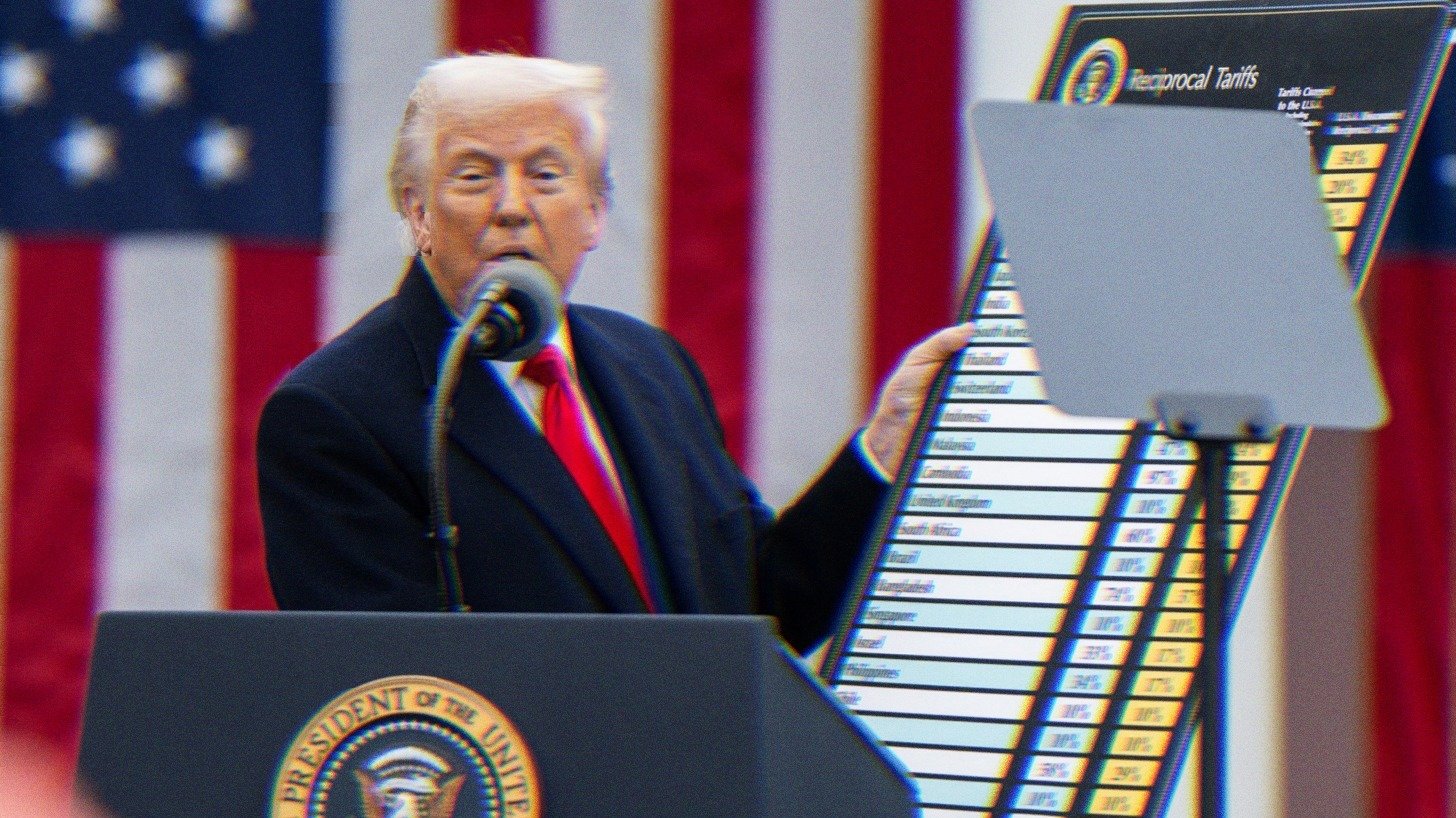 Image Description: Trump standing at a podium speaking into a microphone holding a poster titled Reciprocal Tariffs.
This essay appeared in the Dec. 4, 2025 edition of UNFTR’s premium newsletter. Become a UNFTR member to receive our bonus newsletter each week and for other perks.
Let’s state the obvious: There are few people in American history comparable to Donald Trump. You can have complete contempt for the man, but there’s no denying his ability to consolidate attention, stoke controversy, and rewire how we think about executive power—forcing us to reconsider what constitutes overreach and where the boundaries of democratic norms actually lie.
It’s evil sorcery, really. How else can you explain Americans waking up each morning, the majority without a care in the world about Trump 2.0’s strategy of running roughshod over institutions, Congress, and the Constitution—the ultimate firewall protecting our freedoms from an all-powerful executive, or so we’ve been told.
Indeed, this has been a long year. The second installation of the Trump presidency, while unhinged and seemingly rudderless, has felt like a controlled demolition—of democracy and our ability to sustain targeted outrage.
To test this theory, allow me to recall that early in his term, Trump detained and imprisoned immigrants at Guantanamo Bay—considered a legal black hole—and El Salvador’s Terrorism Confinement Center (CECOT), where more than 200 people were held incommunicado. During any other administration, this would’ve been a firestorm, prompting endless congressional inquiries, earth-shattering investigative stories, and potential resignations. Instead, these were just two in a long line of legally questionable and unilateral policies that have come to define Trump’s first year back in the White House—and they’re potentially not even the most brazen policies. Team Trump is ending the year mired in a shitstorm of its own making, with war crimes allegations being thrust at Defense Secretary Pete Hegseth after he reportedly ordered secondary strikes on survivors after the U.S. military destroyed their boat in the Caribbean. If these were among the abuses committed by the Bush administration during the so-called “war on terror,” Washington would be in a state of paralysis. But not in the Trump era, where nothing matters.
While it may be a bit early for a retrospective, we felt it was critical to take a month-by-month look at the many controversies emerging from the Trump administration to help us fully appreciate—and recoil at—how 2025 became the year of the imperial presidency.
January–February
Nine days after he was inaugurated, Trump issued an executive order turning Guantanamo Bay, which continues to hold people detained during the war on terror indefinitely, into an immigrant detention center—the first time in history that anyone detained on civil immigration charges had been moved to Guantanamo. The ACLU promptly sued the administration after dozens of immigrants were flown in military planes to the naval base in early February, alleging that the government was holding detainees incommunicado.
The majority of the disappeared men were from Venezuela and were alleged to have ties to violent gangs, though little evidence was provided. Eventually, 177 of the men from Venezuela were moved from Guantanamo to Honduras, where they were then transported back to Venezuela.
The GITMO saga came as Democrats were reeling from Trump’s election victory. In contrast to Trump’s first term in 2017, many establishment Dems chose to put up little resistance, partially enabling Trump’s early abuses.
Of course, that wasn’t all that happened in February. Trump, basking in his election victory, signed an executive order ending birthright citizenship for children born to undocumented parents in the United States, a direct assault on the 14th Amendment. The EO was promptly blocked by the courts, setting up a possible challenge in the U.S. Supreme Court.
March–May
In yet another escalation of its nationalist immigration agenda, the Trump administration began disappearing people to CECOT, the notorious megaprison in El Salvador, without due process. According to the National Immigration Law Center: “The people sent to CECOT included long-time residents with U.S. citizen spouses and children, people who recently arrived, and people in the middle of immigration court proceedings on the path to getting asylum or other relief.” If that weren’t enough, the administration invoked the Alien Enemies Act to justify its policy of disappearing immigrants, claiming, as it did with some of the GITMO detainees, that those detained were members of Tren de Aragua. The first flights to El Salvador began on March 15 and continued into April. The most high-profile case involved Kilmar Abrego García, a long-time Maryland resident from El Salvador, who was wrongfully deported to CECOT. He was eventually returned to the United States under court order, subsequently detained by federal authorities, and his case remains unresolved.
It was also in March when Trump’s war on free speech and civil liberties went into hyperdrive, underscored by the arrest and forced disappearance of Mahmoud Khalil, a legal U.S. resident. The prominent pro-Palestine supporter and Columbia graduate was kidnapped from his university-owned apartment building and disappeared to a detention facility in North Carolina over his political views. A federal judge ordered Khalil’s release from ICE custody in June, following more than three months of detention. In yet another unprecedented action, Secretary of State Marco Rubio sought to revoke Khalil’s legal status through an obscure provision in the Immigration and Nationality Act.
Later that month, Rumeysa Ozturk, a Tufts University Ph.D student, was similarly arrested off the streets and detained for the alleged crime of authoring a tepid op-ed in its college newspaper related to the genocide in Gaza. Ozturk was held in ICE detention for six weeks before her release.
As the administration’s free speech war intensified, it directly targeted prestigious universities, such as Harvard, eventually freezing more than $2 billion in grants over government claims of antisemitism.
At the time, the civil liberties battle was being fought on multiple fronts. In May, the New York Times reported that the Trump administration had turned to data-mining giant and sophisticated surveillance outfit Palantir to “analyze” mounds of federal data, sparking privacy concerns. The Times reported that Palantir received up to $113 million in contracts from the federal government since Trump took office.
June–August
The military action that was years in the making finally commenced in late June when Trump ordered multiple strikes on Iranian nuclear facilities without congressional approval. The move prompted fears of a larger conflagration in the Middle East, where the United States has been mired in forever wars since 2001. That it didn’t escalate does not absolve Trump from unilaterally striking a major regional power. And it also came weeks after Tulsi Gabbard, the Director of National Intelligence, testified to the House Permanent Select Committee on Intelligence that “Iran is not building a nuclear weapon and Supreme Leader Khomeini has not authorized the nuclear weapons program that he suspended in 2003.”
This wasn’t the only aggressive military action Trump took during this period. On June 9, he deployed about 700 U.S. Marines to California amid large-scale protests over immigration enforcement, all but sidestepping the Posse Comitatus Act—yet another legal guardrail ostensibly meant to prevent executive overreach. The move came after Trump federalized the California National Guard in what would become an emerging trend over the summer months.
In August, Trump, amid fear-mongering over crime in the nation’s capital, federalized the D.C. police, which gave the federal government control over the department for up to 30 days. To be sure, crime in D.C., as in other cities, has been on the decline.
September–November
On Sept. 2, Trump commenced with his regime change operation against Nicolás Maduro of Venezuela. The administration has since launched nearly two dozen strikes in the Caribbean and Pacific, killing at least 82 people. While the justification for the strikes—without congressional authorization—has been to combat alleged “narcoterrorism,” the evidence for such claims is scant. It doesn’t help that the administration has been very public about wanting Maduro removed from office. Along with military strikes, Trump, according to a Times report in November, approved CIA operations inside Venezuela—raising speculation that the campaign has more to do with regime change than drug trafficking. And there’s also the inconvenient fact that the fentanyl found in the United States doesn’t even originate from Venezuela.
The administration is now mired in perhaps its most explosive scandal yet amid reports that Hegseth ordered strikes on survivors of a Sept. 2 attack. As the Washington Post reported: “Even if the U.S. were at war with the traffickers, an order to kill all the boat’s occupants if they were no longer able to fight ‘would in essence be an order to show no quarter, which would be a war crime,’ said [Todd] Huntley, now director of the national security law program at Georgetown Law.”
As we take account of all that has happened in one year of Trump 2.0, it’s somewhat ironic that a president—and political party—that worships at the altar of “law and order” is so brazenly lawless.
And the year’s not even over.
Image Source
- The White House, Public domain, via Wikimedia Commons. Changes were made.
 Rashed Mian
Rashed Mian is the managing editor of the award-winning News Beat podcast and co-founder of the newly launched Free The Press (FTP) Substack newsletter. Throughout his career, he has reported on a wide range of issues, with a particular focus on civil liberties, systemic injustice and U.S. hegemony. You can find Rashed on X @rashedmian and on Bluesky @rashedmian.bsky.social.