
It’s Just Trump Against the World.
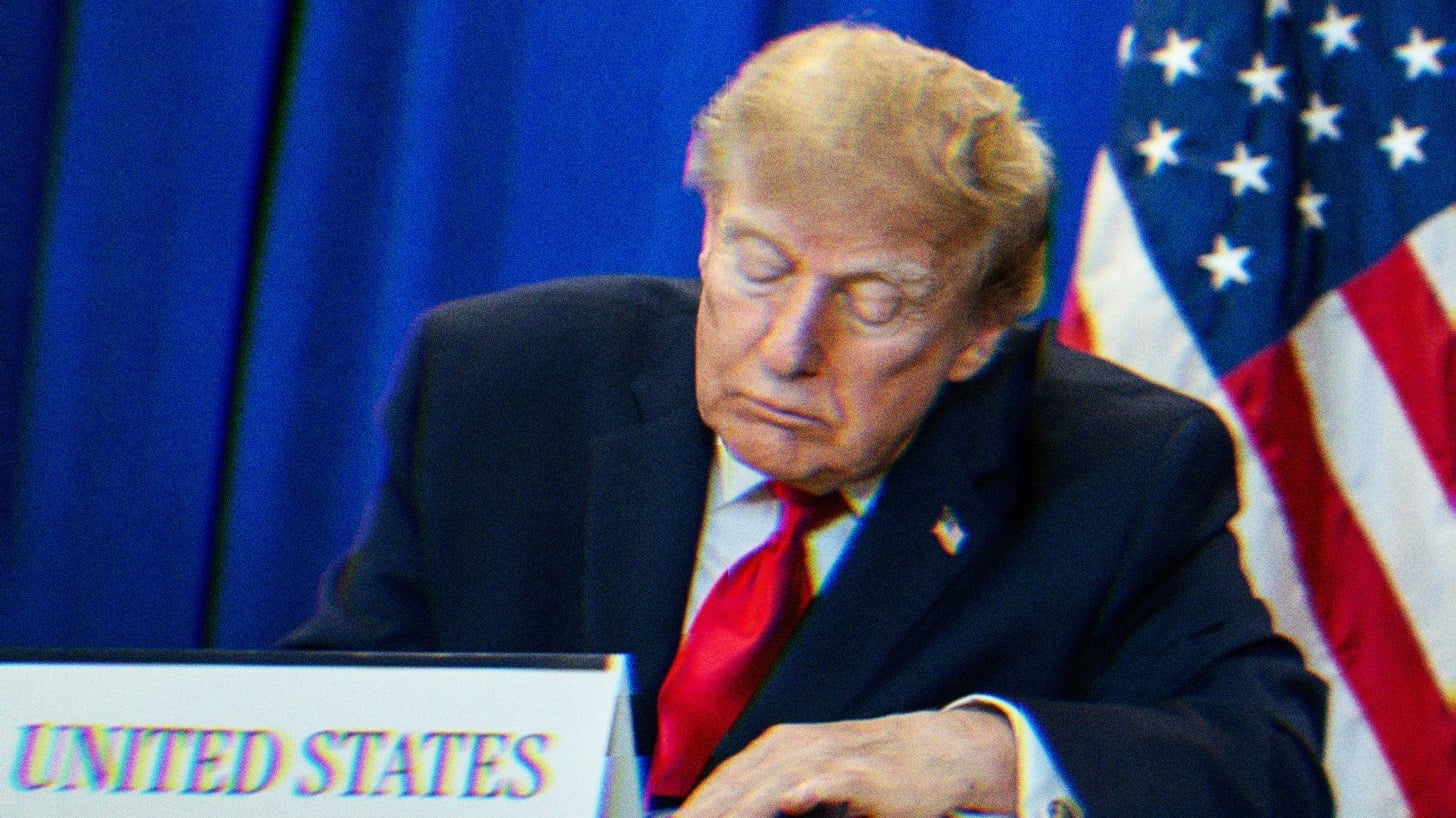 Image Description: Trump at a ceremony, sitting at a table behind a placard reading, ‘United States.’ He is either looking down or sleeping.
An original essay on how Trump will ultimately represent the final chapter of the American experiment. Empires don’t collapse. They crumble. But they’re reduced to a handful of chapters in history texts that depict them in stages with defined beginnings and ends. Donald Trump has already managed to set the stage for World War Three though it looks far different than prior great wars. He is the culmination of the hubris of empire. Here on my thoughts on how this goes down and what comes after.
The EU. Iran. China. Mexico. India. Greenland. Venezuela...Canada? We’re coming after them all. They’ve wronged us in some way. Treated us badly. How? Depends on the day and circumstance. Could be a trade deficit because Donald Trump doesn’t understand economics, or that you need to run trade deficits with certain nations for certain goods and services. Or that our financialized economy actually relies on trade deficits because it’s how we put dollars into the world. Could be a country refusing to allow us to dictate who they can and can’t sell their chief exports to.
They might just have something we want but that doesn’t belong to us.
Maybe we were cajoled by a so-called ally into starting an unwinnable war that is destabilizing the world economy. We are at war with the world now. Because of one guy. No one is out there calling this World War Three, but that’s what’s cooking right now. It doesn’t look like one or feel like one, but this is a new day. Things are different.
But there are two truisms when it comes to world-consuming conflagrations like this.
One. Most people say it can never happen until it does.
And two. They’re not won on the battlefield.
Body Count
Wars don’t end when nations run out of bodies. Leaders are callous when it comes to casualties. No, wars end when the money runs out. The “advanced” nations of the world, who many believed to be too economically interconnected to turn on one another, devolved into the first “Great War,” and for a time it looked as though it might continue until the last soldier perished in a trench.
One can also imagine Germany fighting until all of its children had been conscripted in the second of the great wars. But long before the men in ivory towers and fortified bunkers ran out of expendable men, they ran out of money. Henry Davison of the House of Morgan devised a scheme to finance the Allies for as long as possible, but European gold stocks were eventually depleted in World War One. The German currency Ponzi scheme conceived by Hjalmar Schacht ran its natural course. The factories came to a halt. The munitions were spent. The wars concluded.
In trying to understand where things are headed and when they might end, never underestimate the depravity of power and the willingness to contribute souls to its cause. Always look to the depth of resources of the Treasury.
Right now we have a depraved leader with an unlimited supply of money because a forgotten man named Harry Dexter White fought to maintain the U.S. dollar as the world’s reserve currency.
We tend to think of the world leaders, generals, admirals and commanders who rise to fame in times of war. Rarely do we think of the financial architects who control the purse strings. We’re taught about Wilson, Lloyd George and Clemenceau, not Davison. We study Hitler, Churchill and Roosevelt, not Schacht or White. But the secrets to power are always locked in the vaults of financial institutions rather than the situation rooms and ivory towers.
Much has changed in the modern era. The gold standard is a distant memory. Our alliances are deeper and more intertwined than ever. We no longer require bodies and blood to fight our wars. But the capacity to do harm has only grown. And in an increasingly complex world where our leading corporations admit to building technology they cannot control—a world rife with doomsday weapons, both technological and biological—there exists an ill-tempered man who does not read.
A man who operates the machinery of the world’s most dangerous nation to settle petty grievances and punish his enemies. A slovenly, dimwitted and unworldly man who thinks only of himself, who spends each day finding ways to maneuver around the institutions specifically erected over centuries to deter him and men like him.
A small man. In every way.
Conservative Alchemy
I’ve covered the conservative movement calculus before, but it warrants a brief refresher because it speaks to mindset and intent. There are three factions to the conservative movement that have fused together to produce this administration. A long time in the making.
There’s the libertarian billionaire exemplified today by Elon Musk. He is just another in a long line of bunker-building extremists from Joseph Coors, Charles Koch and Richard Mellon Scaife who believed it their right to lord over a feudal empire of haves and have-nots. To them this was the natural order.
Then there are the end-times doomers, the Christian nationalists who believe in both the worldly prosperity doctrine and an afterlife for the chosen. In either place, they believe themselves ordained to interpret “do unto others” as “do as you see fit.” People like OMB Director Russell Vought, House Speaker Mike Johnson, Pastor Doug Wilson and billionaire libertarian Farris Wilks. True believers and heirs to the social gospel of Rousas Rushdoony, Doug Coe and James Fifield.
And then there are the neocons who believe that power is survival. Those in positions of power and influence who deftly thread the alliance of interests through policy. Allen and Foster Dulles, Henry Kissinger, Dick Cheney and their descendants Ted Cruz, Hillary Clinton, Pete Hegseth and the recently deceased Lindsey Graham. The term neocon might have fallen out of fashion but the spirit remains.
This isn’t an uneasy alliance. It’s a natural and comfortable partnership with differing views on the path but an airtight perspective on the outcome. And they all have access to the true source of power. The Treasury.
The doomer billionaires understand the power of the technology they possess to fundamentally alter life on this planet. Fewer workers required to produce goods. The ability to surveil. To bend the rules to their favor and suppress the masses. Their nirvana comes from the distorted memory of preindustrial times when feudal rules dictated social, political and economic constructs.
The Christian nationalists believe in prophecy. The return of the Israelites and a holy war that precedes the return of Christ. Convert and be saved. Otherwise be condemned for eternity.
And the neocons. The bloodthirsty war hawks who owe their intellectual framework to the Cold War paranoia of old and their disdain for Brown people to the racist and blood-soaked roots of the system they were born to. Their end-times beliefs are rooted in the revelations of their own military engineers and climate scientists from the 1990s whose models of man-made climate disasters predicted the back half of the new century would bring rising seas, mass migration and widespread famine.
Regardless of how or why we get there, the vision is the same. And so the great war must be fought.
The rational voices in positions of authority and the unsuspecting masses they rule believe in the fallacy of better angels. We believe as our ancestors did more than a century ago that economic interdependence would prevent us from committing economic suicide. That has never been the case. In just a few short months, one man has upended the world order.
Paper Wars
Start with the paper war. Trade deficits aren’t a scoreboard. They’re often the price of running the world’s reserve currency, a currency other nations need to hold, which means dollars have to leave the country somehow, which means we buy more than we sell. Nobody explains that to him. Or maybe somebody did once and it didn’t take. Either way, the deficit becomes the grievance, and the grievance becomes the weapon.
Canada refused to fold. So Trump slapped 50% tariffs on Canadian steel, dairy and agricultural equipment. Then he signed five more proclamations under a Depression-era statute to ban Canadian alcohol and dairy outright and strip Canadian firms from $50 billion in federal contracts. Canada didn’t bargain with the madman; they turned to Europe. To be clear, this is not a convenient answer for Canadians. Our long-established cross-border trade is a far superior and more natural avenue. I think people need to understand the riskiness and severity of this pivot.
Ursula von der Leyen used her State of the Union address to open the door for Canada to become the European Union’s first associate member ever, tying its defense industry, its energy grid and its AI sector to Brussels instead of Washington. Trump responded within hours: call that a hostile act and he’ll hit the whole continent with, in his words, “very serious tariffs,” or stop trading with Europe altogether.
China gets the technology war. Polysilicon, the unglamorous material inside every chip and solar panel, now carries a 15% tariff and a price floor designed to strangle a Chinese near-monopoly. China answered with export controls on drones and a security review of American printers. Both sides know the real fight is about who controls the inputs to artificial intelligence, and neither side is winning it so much as making sure the other side loses more.
Mexico’s still tangled in the aftermath of a tariff regime the Supreme Court itself declared illegal, the administration simply reloading with different statutes. India got a partial reprieve after Modi agreed to stop buying Russian oil, proof that this isn’t about principle—it’s about leverage, and leverage bends. But Modi has since worked diplomatic channels through the BRICS alliance to move toward cross-border payment systems that would reduce their collective reliance on the U.S. dollar.
Trump wants Greenland, citing Chinese and Russian shipping lanes that have existed for decades, as though strategic value only became real the moment he noticed it. He’s floated buying it the easy way or the hard way, and there’s a difference between negotiating base rights under a 75-year-old defense pact and threatening to annex an autonomous territory belonging to a NATO ally. When he’s not distracted by building tawdry arches or reviewing plans to demolish the Kennedy Center, he periodically remembers that he has an open threat to invade and colonize another country.
Speaking of hostile takeovers, Nicolás Maduro remains a captive of the U.S. government. An unprecedented action that has no realistic end to it. It was and remains an illegal act and should alone be grounds for impeachment. But no one in Washington cares about the fate of Latin countries filled with Spanish-speaking Brown people. Maduro is being held on narcoterrorism charges but I can assure you that more drugs flow into this country through Canada. Can you imagine us flying helicopters into Ottawa to seize Mark Carney? Our collective lens is so utterly racist and xenophobic that we cannot see Maduro’s capture for what it truly was.
And while we’re on historically racist and paternalistic attitudes and policies, we’re strangling the entire island nation of Cuba. A tightening embargo and new energy sanctions that have cut power to two or three hours a day, an $8 billion hit to an economy that poses no threat to anyone, punished simply for existing on the wrong side of a Cold War grudge nobody in Washington is old enough to remember starting. All so Marco Rubio can declare himself the victor and make his family proud.
And in Gaza, the postwar plan on the table isn’t reconstruction, it’s redevelopment. Jared Kushner’s master plan is to replace refugee camps and 1,000-year-old neighborhoods with data centers, seaside resorts and residential towers. Now that we know for certain that Netanyahu had several weeks to prepare for October 7 based on intelligence directly from Hamas, that his operatives issued the Hannibal directive to kill everyone on site, including hostages if need be, and that a full and unconditional surrender of civilian hostages was immediately in the offering and turned down by him, hopefully the world can finally wrap its head around what the Israeli project in Gaza has always been. And smack dab in the middle of the proposed development fantasy is a Trump hotel.
That’s a litany of hostilities before we even get to Iran. The U.S. and Israel opened a war on Iran and we’re losing badly. Every administration, including this one, was told by the security and intelligence apparatus that Iran would be near impossible to overthrow absent hundreds of thousands of ground troops over many years. But he fucking did it anyway.
And as everyone predicted, Iran held. It choked the Strait of Hormuz and dared anyone to call the bluff. It offered to formally toll the strait it doesn’t fully control, an arrangement so brazen that Saudi Arabia asked to postpone the negotiating session rather than sit across the table. An Iranian splinter group operating inside of Iraq struck a major Saudi pipeline. Refining capacity all across the region has been seriously damaged on top of the damage done in the Russia/Ukraine war. So now diesel prices have reached untested highs. And to be clear, the world economy runs on diesel, not oil or gasoline. Diesel is the engine of global commerce.
The Houthis have been so successful and emboldened that they took the entire Yemeni Red Sea coast and now control the choke point carrying roughly 12% of global trade. So now insurers have even more issues to contend with.
Every one of these fronts was supposed to be contained. None of them are.
This is what losing control of an inflection point looks like from the inside. Nobody declares it. Nobody signs a document that says the guardrails came off. It just quietly stops being one war and starts being everyone’s war, because that’s what happens when a superpower spends its credibility as carelessly as it spends its currency.
We Were Warned
So how does it end? To answer this I think it’s helpful to go back to the beginning. 1944, New Hampshire. Unf*ckers have heard this story often enough, but there’s another element that we haven’t fully explored. A warning acknowledged, but ultimately unheeded.
On one side stood the Europeans. War weary. Broke and broken. The second devastating war that spread throughout the continent. On the other side, the New World. We had taken our lumps during the war but emerged as the lone financial and military superpower in the world. The Soviet Union was fast approaching. China, not yet ascendant. For a spell, it was just us.
John Maynard Keynes, the aging delegate on the European side who was as much a force in American economics as any, came armed with a proposed structure to rehabilitate the world economy. It was a plan to prevent the postwar mistakes of the first Great War and to design a system of interconnectedness that would rebuild Europe, assist in the development of underdeveloped nations and usher in an era of financial stability to guarantee peace among all nations.
On nearly every point, the plan was met with broad acceptance and support. The Americans, however, had the upper hand. A kill switch of sorts. That switch was the U.S. dollar. Rather than the proposed global currency upon which all cross-border transactions would be settled and a global central bank that would alternately infuse and withdraw funds from national accounts, the United States insisted on the U.S. dollar as the settlement instrument.
Keynes understood what it meant in the short run. The United States was the most stable nation in the world and had just gone through a period of stunning industrialization. Not only had it provided liquidity for the war effort abroad, it had positioned itself as the bedrock of banking. New York was now officially the capital of the world. Over 22 brief but grueling days, the delegates created the World Bank, the International Monetary Fund and a new currency settlement regime built on the value of the dollar tied to gold. The old gold standard was dead and a new one had taken its place with the U.S. as the facilitator for world trade. We became inevitable.
What Keynes feared in the long run was that this “exorbitant privilege” was also a tremendous responsibility rife with temptation. The ability to weaponize the dollar by restricting access to it and foreclosing on trades in cross-border settlements meant that the atomic bomb wasn’t the only weapon of mass destruction in our arsenal. At the conclusion of the most consequential 22-day period in financial history, the delegates parted with a gentleman’s agreement that the United States would behave responsibly. Given the choices, it was the only one to make, and so Keynes relented.
Wars shift the balance of power. They redraw borders on maps. From a human perspective there are only losers and bigger losers. But from a balance of power perspective there are usually clear winners. The United States won the major hot and cold wars that mattered most to the balance of power in the last century. Initially we managed to act responsibly where global finance is concerned. And then the cracks began to appear.
Nixon loaded the gun in 1971 by breaking the tether to gold and allowing the U.S. dollar to float freely. We began to tip the scale of influence in the global institutions in a way that favored developed nations and punished the developing ones. We used our leverage through these institutions, backed by the largest military ever conceived, to extract punitive interest payments and natural resources.
At the turn of the millennium we acted as though we were still alone in the world. But we knew others were coming. Deng Xiaoping’s market reforms were producing results and seducing manufacturers from across the world. As a practical matter we had already ceded the manufacturing advantage with the passage of NAFTA a few years before. If cheap labor was available elsewhere we intended to find it. While perhaps ill-conceived, the EU formally adopted the euro in 1999 because it too recognized the shifting landscape. The internet was gaining momentum so globalization of services now seemed as attainable as goods.
So to prepare us for the coming millennium, Wall Street and Washington shook hands on a deal to release the constraints on banking. The great unshackling of the poor bankers. Glass-Steagall was dead. Tied to the post and blindfolded by Republicans; executed at close range by a Democrat.
The financialization of the U.S. economy spread quickly. Reckless deals, debt spirals and perverted instruments described as “sophisticated” turned the markets into Ponzi schemes upon Ponzi schemes and came crashing down shortly thereafter. But we were also in a post-9/11 world when the threat assessments were turned on their heads in the blink of an eye. From that day forward mass surveillance, tech-terrorism and drones became the headline weapons of choice. But the real weapon, sitting there locked and loaded for decades, was finally pulled out of the vault, the safety unlatched.
What Keynes knew was that the long-term probability became a certainty. The United States began weaponizing the dollar. Do as we say or do no business at all. It’s something we don’t really think about, but the Washington Post did an analysis in 2024 that found that 60% of low-income countries were under some form of financial sanction from the United States. In typical “go big or go home” fashion, we levy three times the number of sanctions as anyone else. The biggest offender by far? Joe Biden. Sort of.
Joe Biden was far and away the leader in sanctions volume, concentrating a massive share on Russia after the invasion of Ukraine—more than 6,000 in two years, with roughly 584 issued in his final 20 days alone. Under Trump, the target shifted from Russia to Iran, which absorbed the largest single share of new designations in 2025. But the overall count has fallen sharply: total new sanctions dropped about 30% from 2024 to 2025, and 2026 is on pace for roughly half of last year’s total. Trump has also actively unwound parts of the existing sanctions architecture, lifting dozens of Russia-era designations and terminating the Syria program outright. And he has clearly shown a desire to alleviate sanctions on problematic countries like Russia and Syria, thereby upending diplomatic norms.
Punitive measures remain scattered across the map, but the volume and momentum have clearly moved elsewhere—Trump has migrated to his preferred weapon of choice: the tariff.
The fact remains that the new American century is one of grievance and weaponization. The very paper war that European delegates feared at Bretton Woods.
A Whimper, Not a Bang
So back to how it all ends. We’re taught in school that empires collapse. Micro-sections of macro world history distilled to a few chapters tied together neatly with a beginning, middle and an end. In reality, empires crumble. They dissipate. The Ottomans auctioned off land and lost more to wars. The Soviet Union deteriorated and separated after a very brief time as a unified whole. The United States is a beast of a different nature. After consolidating our territory, the colonial project faded away in favor of a more ambitious project. To dominate the world’s economy. And for a while, we did. We still do.
When Donald Trump was first elected to office, the world was wary of his bluster. Over time it learned his patterns and learned the way to his heart was through flattery. Mostly, however, it took a posture of “this too shall pass.” And for a moment it did.
But the renewed Trump regime is something altogether different. Meaner. More aggressive. Willing to push the boundaries of respectability and international norms. Alliances pissed on and friends publicly berated. All the empty threats of the first term suddenly became all too real. A world leader, kidnapped. The impossible war underway. Immigrants beaten, arrested and thrown in prisons. Trade agreements shredded.
The deficits remain but no longer are they run to provide safety nets for our own; rather we run them to fuel our bloodlust and line the pockets of corporations that have grown reckless and emboldened. We no longer pursue tax cheats. We no longer police emissions or bad behavior. The government openly threatens the fourth estate and it has designs on ending free and fair elections.
And as we’ve said many times—they wrote it all down.
None of this was a mystery, so neither should the world’s response to our insane decision to bring this man back be.
This all ends with a whimper. A slow and painful decay. Even if we rebuild our institutions and prevent Russell Vought and the alchemy of libertarian billionaires, doomsday Christians and old-school neocons from realizing their fetishized end-times fantasies, the world will never trust us again.
Cross-border payment systems are the beginning. Stablecoins pegged to gold and a basket of foreign currencies will follow. Eventually China will lower the opaque veil that shrouds their markets in secrecy and allow others to transparently participate. The world now knows our military is incapable of any serious victory; it’s our tech sector they now fear. And it all goes back to the single idea that Nixon staked our fortunes and future upon. That the entire world economy could operate on the strength, trust and credibility of the U.S. dollar. We may trust in God, but we believe in the dollar.
As the world moves slowly away from the financial backstop we established and develops new compacts, new alliances and new ways to transact with one another we will fade into irrelevance. We have decades left to go as these things take time. But the end is finally visible and it’s taking shape.
All because we chose to reinstate a small, slovenly, illiterate and ill-tempered man to the biggest position possible. So when the history books are read by future generations, assuming there will be any, the American story will also have a tidy ending. The chapter titled Trump. And should we hold an election in 2028 to suffer under the illusion that this will all return to normal, just know that we will simply be living the epilogue. If anyone cares to read that far.
Image Source
- The White House, Public domain, via Wikimedia Commons. Changes were made.
 Max
Max
Max is a political commentator and essayist who focuses on the intersection of American socioeconomic theory and politics in the modern era. He is the publisher of UNFTR Media and host of the popular Unf*cking the Republic® podcast and YouTube channel. Prior to founding UNFTR, Max spent fifteen years as a publisher and columnist in the alternative newsweekly industry and a decade in terrestrial radio. Max is also a regular contributor to the MeidasTouch Network where he covers the U.S. economy.