
The Revenge Porn Presidency.
Trump, Commodus, and the Unraveling of Empire.
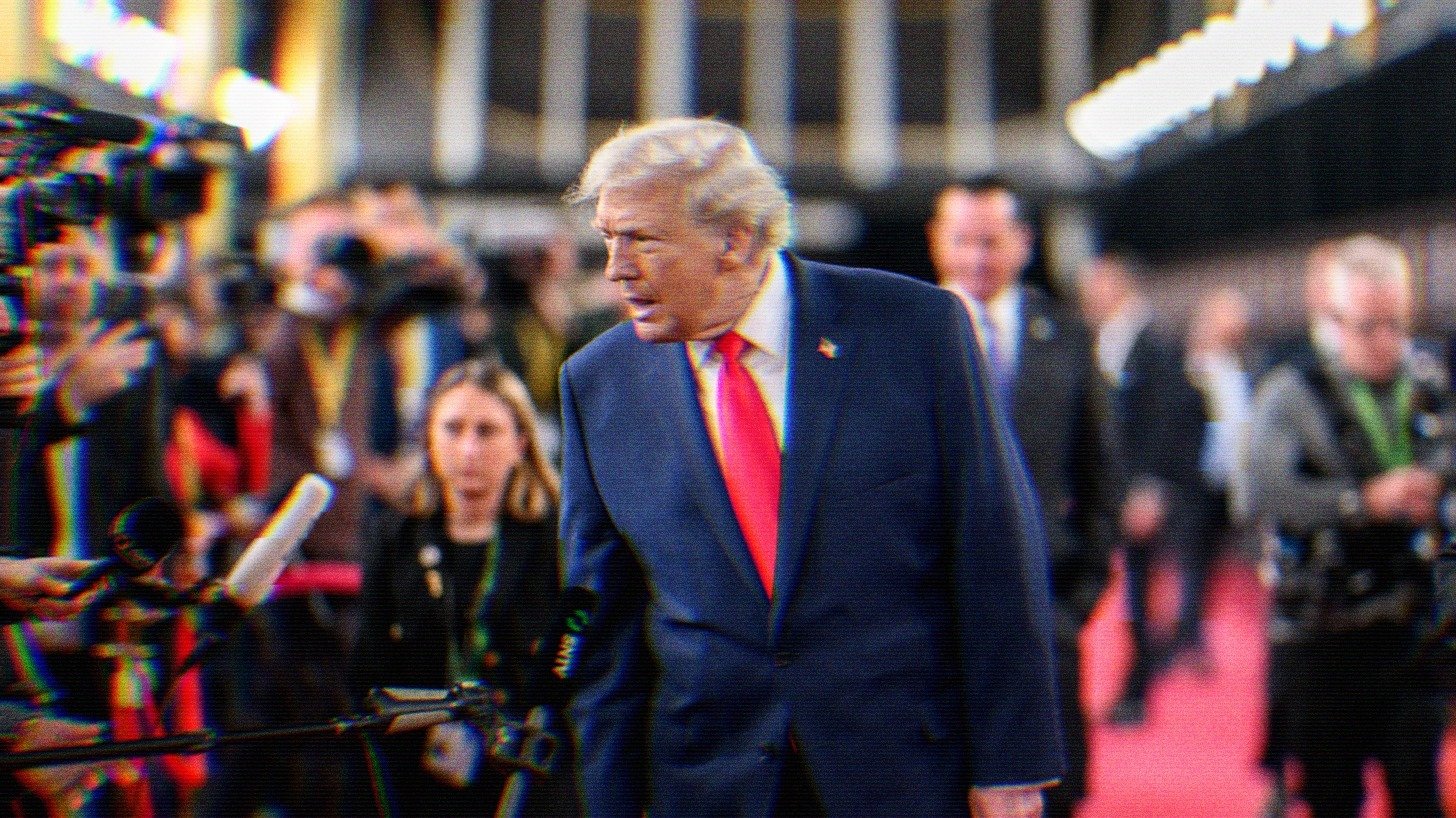 Image Description: Donald Trump on a red carpet with lights and press cameras around him. He leans in talking to the press.
Donald Trump is tearing the nation apart. To place his revenge-filled presidency in historical context we have to reach deep into the annals of history and revisit the tenure of famed Roman Emperor Commodus who historians perceive as the beginning of the end of the Roman Empire. With this second term Trump has entered rarified air that few U.S. presidents have breathed. He has fundamentally altered the culture, the country and its people. Moving past this moment will be our greatest challenge.
If Donald Trump’s first term was characterized by chaos, corruption and COVID, this second one is the revenge porn phase. Determined to settle scores and add to his personal fortunes, Trump is dismantling the state with a ruthless efficiency that belies his disheveled and slovenly persona. He has us so caught up in his personal minutiae and hanging on every bizarre social post or outburst it’s nearly impossible to take a dispassionate view from afar to put him in historical context.
So I’ve attempted to do that as succinctly as possible today. To step back and try to place this man in historical context even though history is unfolding around him. In doing so I can only conclude that his tenure will indeed be historic. I believe his name will live alongside some of the most prominent and notorious political figures in history. His name alone will come to signify something. Machiavelli. Orwell. McCarthy. Names that automatically convey an attitude or sentiment or method. Trump. Trumpian. Trumpism. No matter the iteration I truly believe it will come to stand for something. Something terrible.
People overuse the frog in boiling water analogy but we are heating up. We’re changing. Our perception of the world, of right and wrong, of rituals and norms is demonstrably changing. He’s changing us. That’s the difference.
Culture changes slowly until it doesn’t. Politics can appear revolutionary, but they aren’t. Economies don’t just suddenly collapse. The life-changing events we associate with these sudden changes are more often culminations rather than abrupt shifts—the visible rupture of fault lines that have been cracking beneath the surface for years, even decades.
Perhaps the only true outliers are Pearl Harbor and 9/11. These events shook us to the core and brought about seismic changes seemingly all at once, changes that altered us as a people and fundamentally impacted our national identity. It’s not that they were divorced from context, but what made them exceptional was not that they came from nowhere, but that they compressed what might have been a generation of change into a single morning. Trump is both the president and the presidency in that he has fundamentally changed the office and the country as a result. Perhaps not in a single morning but in a short period of time that rivals any administration in our lifetime.
Presidencies are sometimes viewed as culture-shifting events, but it’s remarkably difficult to determine whether these tenures are reflections of existing sentiments and shifts, or drivers themselves. Does the president change the culture, or does the culture produce the president it needs—or deserves—at that moment? The causality runs in both directions, making clean analysis nearly impossible.
But in the previous century, two presidencies stand out as genuinely transformative in terms of lore, legacy, and determined shifts in culture and attitudes: Franklin Delano Roosevelt and Ronald Reagan. These weren’t just consequential administrations—they fundamentally reordered how Americans understood the relationship between citizen and state, between individual and collective, between government and economy. The bifurcation today, of course, is who you view as the villain or hero in these instances.
Some might argue for Kennedy and Camelot. The imagery is seductive—the young, glamorous president cut down in his prime, the promise of a new generation taking the helm. But the Kennedy presidency was too short, and in retrospect, too unremarkable in its accomplishments to qualify as transformative. The legend exceeds reality. What Kennedy represented was powerful; what he delivered was modest.
LBJ’s time in office, on the other hand, was remarkable for his sheer determination and legislative mastery. There’s no question that his Great Society policies were among the most substantial and enduring domestic achievements of any presidency—Medicare, Medicaid, the Voting Rights Act, the Civil Rights Act. These weren’t incremental changes; they were wholesale reconstructions of the American social contract. But Johnson himself didn’t necessarily change us in the deeper, cultural sense that Reagan did.
Reagan shaped the American political and cultural attitude in a way that transcended policy. He didn’t just change what government did; he changed how Americans thought about government itself, about individualism, about America’s role in the world. Just as Margaret Thatcher did in the UK, Reagan represented a firm break from established post-war norms and attitudes. These were points of no return. After Reagan, even Democratic presidents had to operate within the neoliberal and individualistic framework he established. Bill Clinton declaring that “the era of big government is over” was a concession to the Reaganite worldview.
In the modern era, some might try to argue that Obama represented that kind of fundamental change. The symbolism was undeniable—the first Black president, the promise of hope and transformation. But I think the further we get from his time in office, the greater the realization that what he represented was potentially transformative, but what he delivered was essentially repackaged neoliberalism. The drones kept flying. The banks got bailed out while homeowners went under. The surveillance state expanded. The hope and change rhetoric gave way to the reality of continuity.
But Trump is something altogether different.
His entire political existence was forged in retaliation, born from thin-skinned revenge for a slight at the White House Correspondents’ Dinner in 2011.
At that moment, something calcified. The ultimate grudge was born.
Few people outside of figures like Steve Bannon understood just how ready the country was for a reckless authoritarian. The groundwork had been laid by decades of right-wing media, by economic anxiety morphing into cultural resentment, by the feeling among millions of Americans that they’d been left behind by globalization and sneered at by coastal elites.
Trump wasn’t bound by normal political constraints because he’d never been a normal politician. He had no reputation to protect because his reputation was already built on being brash, obnoxious, and wealthy. An exercise in absurdity became our new normal. President Donald John Trump. Not once, but twice.
When historians look back at this period, I imagine they will view the Biden years as an intermission. An unremarkable pause in the relentless media circus that Trump inspires and requires. Trump loomed over Biden’s four years like a specter, haunting and foreboding. Biden promised a return to normalcy, but normalcy was already dead. It died sometime around 2016, perhaps earlier.
Trump’s comeback felt almost inevitable because this is his culture-changing era. The question is whether it’s the final chapter, whether we’re witnessing the closing act as we approach the 250th anniversary of the republic.
Commodus in Chief
Historians often mark the start of Rome’s decline with Commodus’s reign, and the parallels are instructive. When Marcus Aurelius named his incompetent son Commodus as heir, it destroyed the merit based system of succession and Rome paid the price for it.
As emperor, Commodus undermined political institutions systematically. He alienated and purged the Senate, reducing their authority and executing opponents based on paranoia rather than evidence. He relied instead on a succession of corrupt advisors and Praetorian Prefects, turning the bureaucracy into what historians describe as a “corrupt auction,” where positions and favors were bought and sold to the highest bidder.
Look at Trump’s relationship with Congress, with oversight, with the independence of the Justice Department and intelligence agencies. The purges of inspectors general, the loyalty tests, the installation of family members and sycophants in crucial positions, the transformation of the Republican Party into a purely transactional vehicle for personal power.
Commodus caused economic destabilization. He inherited a well-stocked treasury from his father’s careful management but squandered it on lavish spectacles and gladiatorial games—in which he himself participated, scandalizing the elite.
To fund his extravagance, he devalued Roman currency, which led to significant inflation and economic distress, setting the stage for the catastrophic “Third Century Crisis.”
Commodus neglected military affairs. He squandered strategic gains and left northern frontiers vulnerable to future incursions—a long-term problem the empire could not afford.
Perhaps most tellingly, Commodus eroded imperial dignity. His bizarre behavior—declaring himself the living demigod Hercules, renaming the city of Rome “Colonia Commodiana,” fighting as a gladiator in the arena— delegitimized the imperial office itself.
Just as Commodus set the stage for the Third Century Crisis, the longer we are Trumpified, the greater the risks to the fabric of our political institutions, our culture, and our economic hegemony. With three years remaining in this term, it’s hard to envision how we change course.
But this term signals something even more dangerous than the first. Trump has entered what can only be described as the revenge porn phase, determined to tear it all down.
The pattern is well-documented and systematic. Let’s look at the evidence.
Trump’s DOJ indicted James Comey on charges that many legal commentators described as pure “payback.” A federal judge recently threw out these revenge cases against both Comey and New York Attorney General Letitia James, but the message was sent: cross me and face the power of the state.
The detailed chronologies from NPR, The New York Times and Reuters document dozens of instances where Trump pushed the DOJ or other agencies to investigate or punish perceived enemies—Andrew McCabe, Jack Smith, Mark Milley, Adam Schiff, and many others. These weren’t random targets; they were people who had investigated him, criticized him, or simply told truths he didn’t want told.
He’s settling the score with Obama by systematically undoing his legacy. Trump “methodically” reversed Obama-era rules on abortion funding, environmental regulations, climate policy, foreign affairs, and financial regulation. And he’s basically succeeded in dismantling the ACA, Obama’s signature policy.
Trump publicly accused former Joint Chiefs Chair Mark Milley of “treason” for backchanneling reassurances to China during the transition period, saying that in the past, the “punishment would have been DEATH!” After former National Security Adviser John Bolton published a critical memoir, Trump labeled him a “traitor” and his DOJ indicted Bolton over classified information in what critics called a retaliatory move. Trump has repeatedly targeted former GOP allies like Liz Cheney, vowing political retribution, amplifying messages calling her guilty of “treason,” and backing primary challengers after she joined the January 6th committee.
Reuters documented at least 470 targets of retribution, ranging from prosecutors and FBI officials to academic institutions, media outlets, and journalists. Trump has frequently promised to “go after” opponents, calling for prosecution of Hillary Clinton, Joe Biden, and others, and in his second term, actually leveraging the DOJ to indict state officials who pursued cases against him. He’s ordered troops to cities where governors and mayors have defied him. He sanctioned and tariffed Brazil to defend a fellow insurrectionist traveler Jair Bolsonaro. He’s even settling Marco Rubio’s scores by attacking Venezuela in order to deliver an economic death blow to Cuba.
If not lining his pockets personally, every policy measure is intended to exact retribution and revenge even if it destroys the country he runs in the process. So perhaps the meaning will be that. To “Trump” something will mean do better than, it will mean the ultimate example of cutting off the nose to spite the face. Perhaps the political version of Charles Ponzi. Or just a sad and bloated modern version of Commodus.
The American Rubicon
So we arrive at the central question: Has Donald Trump changed the culture, politics, and economics beyond the point of no return?
It’s why the next chapter will have to itself be remarkable. You cannot unwind this kind of destruction with moderation and calls for unity. A return to the status quo, as promised by the likes of Barack Obama, Hillary Clinton, Joe Biden, and Kamala Harris, is so entirely insufficient for this moment it’s almost laughable. The DNC will sell us safe and normal once again. They’ll try to convince us that any of Gavin Newsom, Pete Buttigieg, Josh Shapiro, Wes Moore, Andy Beshear, Gretchen Whitmer or even Kamala 3.0 will be capable of putting the toothpaste back in the tube. But none of these shallow offerings reconcile the fact that we as a people and as a nation have been fundamentally changed by Trumpism.
Our economy is running on the fumes of financialization and engorged monetary policy that masks a rotting core. The real economy—the one where people make things and provide services and support families—has been hollowed out. We’ve become a nation where wealth is generated not through productivity but through asset appreciation and financial engineering. The gap between the stock market and the street has never been wider.
Think about post-Bismarck Germany, post-Commodus Rome, post-Thatcher Britain. Empires sputtering and seeking relevance in a new world have a poor track record. Reinventions, when they come, tend to fail spectacularly.
The tragedy of a country with natural oceanic buffers, highly developed laws and infrastructure, an educated population, and abundant natural resources losing its way through hubris and greed might be historically unparalleled. Rome fell to barbarian invasions, but at least they had the excuse of overextension and external enemies. We’re eating ourselves from the inside.
But is it inevitable? Here’s where I want to resist the determinism that this essay might seem to embrace. History is not a straight line, and nations can pull back from the brink. The New Deal pulled us back from potential collapse. The post-war consensus rebuilt Europe from ashes. Institutions can be strengthened, norms can be reestablished, and civic culture can be renewed.
But such rehabilitations require leadership that understands the scale of the crisis. It requires a willingness to be as bold in reconstruction as Trump has been in destruction. It requires acknowledging that we can’t go back to 2015—or even 1985—that the status quo ante wasn’t working for millions of Americans.
The uncomfortable truth is that Trump succeeded because he spoke to real grievances, even if his solutions were poison. The deindustrialization of the heartland, the affordability crisis, the sense that the system is rigged—these are legitimate concerns that the establishment ignored or dismissed as whining. Trump didn’t fix any of these problems; he made most of them worse. But he at least acknowledged that they existed.
So what comes next? If we’re lucky, a leader or movement emerges that combines Trump’s willingness to break with failed orthodoxies with an actual commitment to the common good. Someone who understands that the old playbook is burned, but who wants to write a new one that strengthens rather than destroys our institutions. It’s up to us, however, to feed our grievances to the machine and not wait for it to spit out the same half-hearted “soul of the nation”, “hope and change” rhetorical garbage that brought us here.
The Roman Empire, at its height, seemed eternal. Citizens couldn’t imagine a world without it. And yet Commodus’s reign marked the beginning of the end of the Pax Romana, the start of a long decline that would eventually see Rome itself sacked and the Western Empire dissolved.
Trump has proven that it’s possible to break things we thought were unbreakable, to violate norms we thought were sacrosanct, to wield presidential power in ways we thought impossible in a democracy. He’s shown that a determined authoritarian with enough shamelessness and a compliant party can do tremendous damage in a shockingly short time.
I don’t have the answer. But I know this: if we’re going to avoid the fate of Commodus’s Rome, we need to be honest about how close to the edge we are. We need leadership that understands this isn’t a time for incrementalism and triangulation.
Because once you cross the rubicon, there’s no going back. You can only go through, and hope something worth saving emerges on the other side.
Medicare for All. Housing First. A Civilian Labor Corps. A Climate Trust. And Election Integrity. Five Non-Negotiables of the Left that we need to repeat so often they become as inevitable to our salvation as Trump was to our decline.
Image Source
- The White House, Public domain, via Wikimedia Commons. Changes were made.
 Max
Max
Max is a political commentator and essayist who focuses on the intersection of American socioeconomic theory and politics in the modern era. He is the publisher of UNFTR Media and host of the popular Unf*cking the Republic® podcast and YouTube channel. Prior to founding UNFTR, Max spent fifteen years as a publisher and columnist in the alternative newsweekly industry and a decade in terrestrial radio. Max is also a regular contributor to the MeidasTouch Network where he covers the U.S. economy.