
 Image Description: On The Record 4-21-26. How Trump Is Making Us Dumber, Private Credit, Brittany Page, Ka$h & Chavez-Deremer.
Trump Is Killing Our Brain Cells
He can keep this up all day. I’ve been thinking a lot about the significance of Donald Trump’s second term and oscillating between “this too shall pass” and “nothing will ever be the same.” Think pieces in reputable journals have exhausted the subject covering everything from how he has changed the way we speak to the very nature of governance. At this point it seems as though he has been part of American culture since the dawn of time, going from perennial side show to a Vegas-style permanent residency.
The real magic trick is that he perpetually reveals the trick. We all know he’s flooding the zone, and we all promise to look the other way and be serious. Only we can’t. I can’t. No one seems to be able to resist looking at the car crash on the side of the highway.
Where is Nicolás Maduro?
Depending upon the reporting outlet Trump is dying, or at a minimum suffering from dementia; or he’s one step ahead and playing 5D chess. To some he is a heathen whose only accomplishment is being named the most in the Epstein files; to others he is the second coming of Christ, heralding the new Christian world order. He’s weak, strong, decisive, indecisive, crude and amusing. So long as he’s the topic at hand, he’s doesn’t give a flying fuck what you think. Just spell the name right. T-R-U-M-P.
Keeping the Donald in our thoughts (and some prayers) means that something has to give. There’s only so much room in the attention economy and he occupies the penthouse.
What is happening to the ICE detainees?
Of course, it’s an effective branding and marketing strategy. The objective of any earned media campaign is to generate headlines and interest. In the political realm, authoritarians have long recognized the importance of media capture and mindshare, which is why they establish ministries of propaganda and state sponsored media outlets. We’re not quite there yet but the net result is the same if every outlet (yes, yours truly included) keeps up the obsession. If we’re to compliment Trump for anything it’s his duck-like back; he can let anything slide so long as you’re spelling it right. T-R-U-M-P.
Will anyone in America ever pay for the Epstein crimes?
By following Trump into the rhetorical gutter we are actively participating in a crucial element of Project 2025. The miseducation of America. In fact, the great unlearning of facts and history has been part of the neoliberal agenda for the better part of 50 years. Keep the electorate dumb and all that.
We know from the extensive research done by Nancy MacLean (Democracy in Chains) among others that dismantling public and higher education is a core part of the right wing agenda. Betsy DeVos, a longtime critic of public education served, as Trump’s first head of the Education Department and did her level best to tear down the federal system. Under Biden, Miguel Cardona did his level best to put the pieces back together, but even he ultimately acknowledged the difficulties within the education system in the aftermath of COVID lockdowns in particular. By the end of his tenure, the increase in absenteeism, difficulties with financial aid and the failure to pass mass student debt relief opened the door for Trump to pick up where he left off. A disdain for education is how you wind up with an education secretary who mispronounces AI.
What will happen to the 20 million Americans who are losing their healthcare?
In so many ways, Donald Trump has accelerated the decline in education simply by being himself. The decades of chipping away at the legitimacy of higher education and public funding for schools has certainly taken a toll; but perhaps the greatest affront to American education is the reality TV star’s vocabulary and ability to bring us all down to his level.
And as if our critical thinking skills weren’t imperiled enough by our ravenous appetite for Trump’s low IQ gutter talk, we now have AI to contend with. Far from being the productivity panacea it was promised to be, thus far AI has mostly succeeded in amplifying our ability to generate slop. False content is almost indistinguishable from real content, but it’s certainly more enticing. Traps are being set all over the place, and deepfakes threaten to undermine confidence in nearly everything we see and hear. We’re all now doom scrolling through life and it will take a conscious effort to exercise our critical thinking muscles.
The questions interspersed throughout this essay, for example, are incredibly pertinent. They stem from sensational events such as the kidnapping of Maduro, mass disappearances of immigrants at the hands of ICE, the horrific details exposed in the Epstein files and elimination of ACA subsidies and changes to Medicaid work requirements. Each one deserves to be the top story at any given moment, and yet each one fades into the next crisis in the zone flooding era of Trump. It’s all designed to keep us tuned in while preventing us from asking questions.
So, for what it’s worth…
Nicolás Maduro is still being held in a Brooklyn, NY detention center awaiting trial. In the meantime, the Trump administration is the shadow hand at work in Venezuela. The government is being purged of Maduro loyalists and companies are being forced to open their books for U.S. investment. This is no different than the 1973 CIA-backed coup in Chile.
Detainees in ICE facilities continue to suffer in cramped quarters with little access to proper food and medical care. It’s one of the greatest stains on our nation. While our policy makers play politics with homeland security compensation—yes there is still a shutdown in effect for parts of DHS—little is being said about the fact that we’re running World War Two style internment camps.
Epstein revelations continue to be unearthed by journalists and citizen journalists alike, but it’s unclear whether anyone involved in Epstein’s massive conspiracy to traffic young women will ever be held to account in a U.S. court of law.
Heading into 2025, approximately 26 million Americans were uninsured. It’s believed that over the course of 2026, an additional 14 million Americans will lose coverage and, in fact, the mass rolloff has already begun in earnest. The short-term impact of these losses will be difficult to gauge because illness doesn’t run on a schedule. But it’s clear that we’re wholly unprepared for a widespread outbreak of an infectious disease, and that the general health of the population will steadily decline over the months and years that Trump remains in office.
There’s no dopamine hit from digging into these stories to find answers. Moreover, truly understanding the nuances of them requires more than a 30 second reel on Instagram.
I can remember the absurd publicity stunt of having Arnold Schwarzenegger promote fitness during the Reagan years. And how vicious the right wing was when Michelle Obama introduced her Let’s Move campaign. And now we have RFK Jr. on an exercise bike in the sauna with Kid Rock doing push-ups in the background, before guzzling raw milk in a hot tub of course. And, look… promoting physical activity is a fine thing to do. (Though you should probably lose the blue jeans in the sauna. And please don’t drink raw milk.) But the fitness crisis in America isn’t a physical one. It’s mental. And we could all use a bit of exercise.
The Other Looming Private Credit Crisis
By now you’ve likely heard that there’s something going on in the world of “private credit.” (The whole cockroach thing.) And if so, then you’ve heard everything from “this is the next housing bubble-style collapse,” to “nothing to see here.” I think the answer lies somewhere in between.
Despite the fact that private credit is a $1.8 trillion sector, there is less systemic risk to the economy than there was in the buildup to the Global Financial Crisis. The exposure to private credit is mostly on the investor side and doesn’t impact retail consumers in the same way. But there is more risk to the broader economy than the folks on Wall Street like to admit. Credit is both a numbers game and a sentiment game. To understand the true risks associated with widespread private credit defaults you have to think about where the money comes from and where it goes.
In the aftermath of the GFC, regulators and lawmakers put in provisions to manage and mitigate depository lending risks. In doing so they indeed protected consumer deposits. But they also effectively cut off the small and medium sized business market from capital. It’s one of the reasons the economy took so long to recover. Businesses are difficult to underwrite and far more risky than an individual consumer who has assets like cars and houses that can be taken as collateral. And the big guys have the ability to float their own bonds directly to the market. So for many years, the business community was left in the cold.
Then along came private credit and voila, the gap was filled. So that answers where the money went. It was poured into the small and medium sized business sectors. That leaves where the money came from. This part is more complicated. It comes from a lot of places. Hedge funds. Sovereign wealth funds. Pension funds. Wealth management companies. Regional banks. Consumer banks. Investment banks. You name it. Because the sector has run so hot and healthy for the past several years and was throwing off higher returns than traditional banking, the money came flooding in from all over.
Here’s where it gets tricky.
Source: Bloomberg
If the private credit industry is on shaky ground then it’s a harbinger of things to come in the real economy. That’s for starters. So I think we’ve been asking the wrong questions in terms of the systemic risk private credit poses to the broader economy. Private credit is the broader economy, because this is where small to mid-sized businesses and industries that are difficult to underwrite (like software) get access to capital. So if private credit goes belly up it means that the economy already has. We’re looking at it totally backwards.
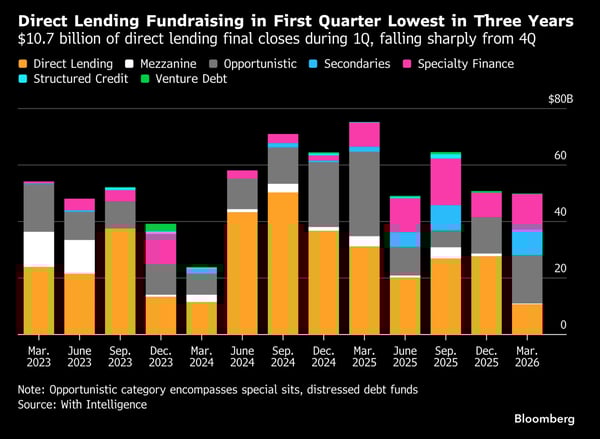
But there’s more to it than that as shown in the chart above. Now that investors are spooked, the private credit firms themselves are having difficulty raising capital for direct lending purposes. So at some point this becomes a self-fulfilling prophecy, and that’s why this is half a capital story and half a sentiment story. If capital investment begins to dry up in private credit then it slowly dries up in the business community. And when credit seizes up, that’s when economies fail. In which case it doesn’t matter whether private credit is the chicken or the egg. It just means that a fox got into the henhouse and murdered them all.
 Max
Max
Max is a political commentator and essayist who focuses on the intersection of American socioeconomic theory and politics in the modern era. He is the publisher of UNFTR Media and host of the popular Unf*cking the Republic® podcast and YouTube channel. Prior to founding UNFTR, Max spent fifteen years as a publisher and columnist in the alternative newsweekly industry and a decade in terrestrial radio. Max is also a regular contributor to the MeidasTouch Network where he covers the U.S. economy.