

Don’t Cry for Milei, Argentina.
U.S. Economic Canary Has Black Lung.
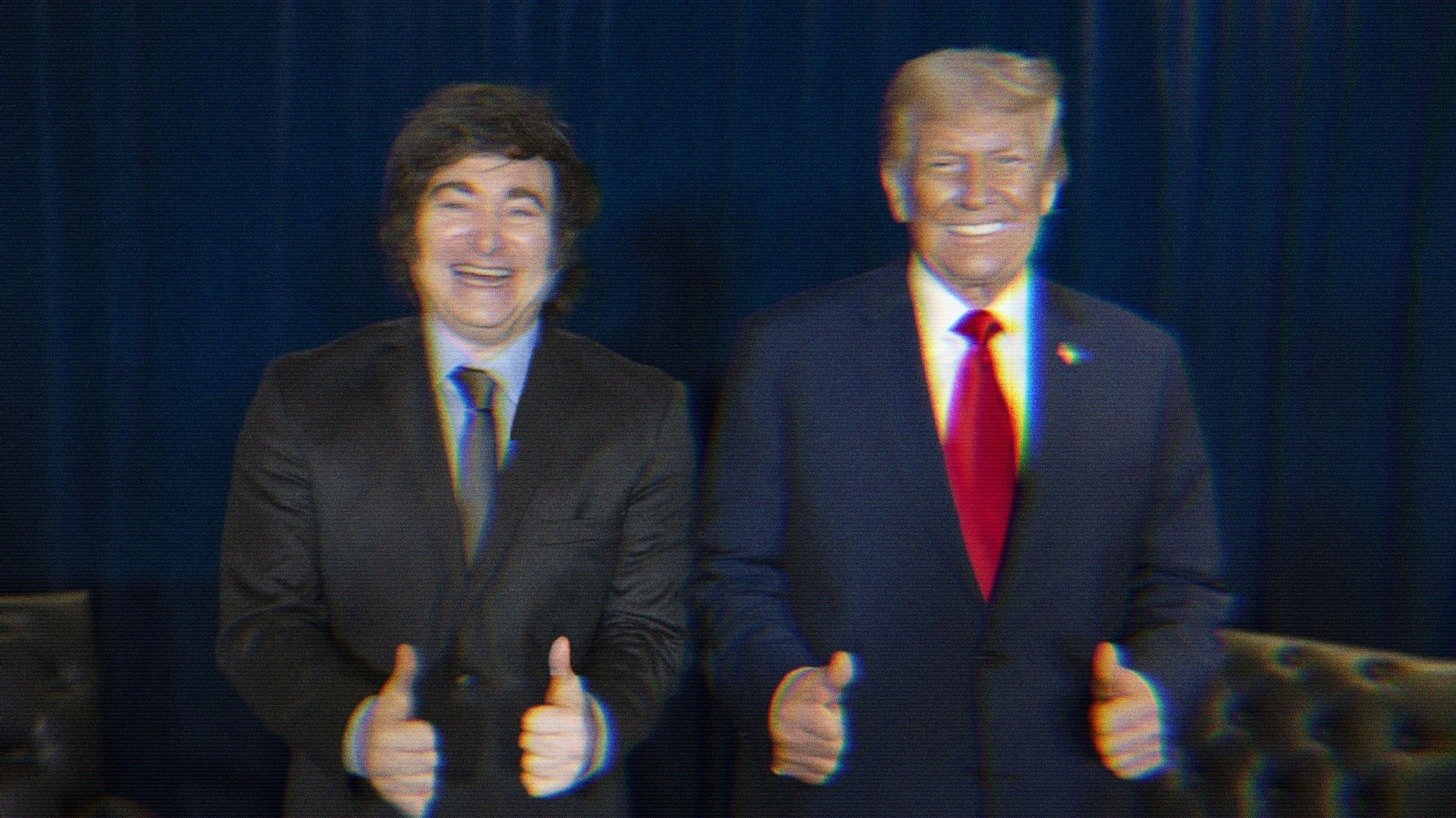 Image Description: Javier Milei and Donald Trump smiling, giving double thumbs up.
Javier Milei is brash and audacious, and he loves Donald Trump. But in many ways Donald Trump is the one who is following Milei. Argentina has an 18 month head start on Russell Vought’s wet dream of implementing a harsh libertarian doctrine. For a while it looked like everything Milei did was succeeding. He tamed inflation, created an export surplus and got back on track with debt service. Economic shock doctrines that rely on austerity for the masses and corporate giveaways always wind up the same, however. It was only a matter of time. The wheels are coming off Milei’s project this year as inflation is back, money is tight and people are pissed. America’s canary came out of the coal mine with black lung.
If you’d like a preview of what’s to come when you run an austerity regime for the people and handouts to corporations with no oversight, don’t look up. Look down.
In many ways, Argentina is the U.S. southern laboratory. Argentinians delivered Javier Milei a mandate to fulfill his campaign promises to crash the peso, fire tens of thousands of government workers, gut public subsidies for electricity, gas, public transit, universities, pensions and disability benefits. He called his own central bank a criminal enterprise. He even refused to meet with the Pope at the time—the Pope was Argentine, by the way—because the Pope was insufficiently libertarian.
Javier Milei and Donald Trump are birds of a feather following the same austerity for the masses and giveaways to the corporate class. So while it might seem distant, Argentina is a snow globe—a self-contained version of what’s being run here. After an impressive initial run, the updated results are coming in, and they’re not what was advertised.
Argentina Untamed
Let me start by giving Milei his due. The Argentina that welcomed Milei to lead it was in dire straits. Any rational person would be hard pressed to defend the institutional bloat, reckless financing maneuvers and systemic corruption.
When Milei took office in December 2023, Argentina was a basket case. Monthly inflation was running at 12.8%. The previous Peronist government under Alberto Fernández had drained the central bank reserves down to nothing in a cynical pre-election sugar dump. The peso was barely a viable currency, so the real economy ran on U.S. dollars. Capital controls were Byzantine. You had an official exchange rate, a blue-chip swap rate, a tourist rate, a soybean rate—they were running a foreign exchange regime that I actually don’t understand.
So Milei prescribed the ultimate shock therapy. He devalued the peso by more than 50% in a single move. He slashed government spending by something on the order of 6% of GDP in a year. He moved the monthly peso devaluation onto a predictable crawling peg—2% a month, then 1% a month—to use the exchange rate as an inflation anchor.
And in the narrow, technical sense, it worked. Monthly inflation fell from double to single digits to, by May of 2025, just 1.5% a month. The fiscal deficit closed. The country ran a budget surplus, which, if you know anything about Argentine history, is roughly as common as a Halley’s Comet sighting. Markets loved it. The IMF loved it. In April of 2025 the IMF signed off on a 48-month, $20 billion support program, and fronted him $12 billion of it up top. All the naysayers, myself included, were forced to be pretty quiet.
Then in October of 2025 he won the midterms. Decisively. His La Libertad Avanza party took 40.7% of the national vote. Markets rallied. Bessent wrote him the $20 billion U.S. Treasury currency swap line as, essentially, a campaign contribution—Trump conditioned the lifeline on Milei winning the midterms, which, by the way, is an extraordinary thing for a U.S. administration to do to a sovereign nation. That’s not foreign policy. That’s election interference with a dollar sign in front of it. But I digress.
Point is: through October of last year, the Milei experiment looked like a success. Inflation tamed. Fiscal house in order. IMF onside. Treasury onside. Midterms won. Business community ebullient. Long-dated Argentine dollar bonds rallying. The economic gains were far more substantial than I certainly anticipated, though the long-term implications for the working class was always going to be dire. But it did seem like Milei might have succeeded in taming inflation, which is the hardest thing to do.
That was six months ago.
Before I tell you what’s happened since, I need to stop and explain something. Because if you still just read the financial media headlines, you’d think Milei is a genius. He is not a genius. He’s running a playbook with a history and a body count.
Shock therapy—the economic doctrine—is built on two pillars. The first is the real economy: fiscal retrenchment, trade liberalization, deregulation, privatization, busted unions, a smaller state. The second is sentiment: expectations management, a credible anchor, a story the markets and the public can believe. Very much like Chile under Pinochet (as recommended by the Chicago School economists). You can also look at Thatcher’s UK strategy in the ‘80s, Poland and Russia in the ‘90s or Bukele and Noboa today in El Salvador and Ecuador respectively.
In the Milei case, the anchor was the exchange rate. The peso gets pegged—first a crawl, then a band—and the argument is: if people believe the peso won’t collapse, they stop dumping it for dollars, and inflation expectations come down, and actual inflation follows. And that part, for a while, worked.
But here is what monetary shock therapy doesn’t do. It doesn’t generate investment and it doesn’t generate jobs or grow real wages. It doesn’t build industrial capacity. It doesn’t restore the safety nets you just sliced up because, as we know, trickle down is a myth. Those things require an industrial policy, a development strategy, an actual theory of how a middle-income country like Argentina climbs the value chain. That’s the fiscal side of the house the Chicago School teaches us to ignore.
Now, to the question of whether Argentina is a fair comparison and the proverbial canary in the coal mine where Donald Trump and Russell Vought’s economic agenda is concerned.
Argentina differs from the United States in a way that matters for our purposes. Argentina is a $650 billion economy, give or take. That’s roughly the size of Michigan. The whole country. The economic structure is narrow—commodities, mostly soy and beef, lithium and some oil, a service sector in Buenos Aires and a battered manufacturing base. When you do shock therapy in a narrow economy, the shock concentrates. There’s nowhere for the pain to dissipate. In this case, the pain went straight to the lower-middle class, the pensioners, the public-sector workers, the small manufacturers—the people who were already barely hanging on.
That’s not an opinion. That’s what Paul Krugman called the “tablita 2.0”—a reference to the 1978 Argentine stabilization under the military junta, which used an exchange rate anchor to crush inflation, and ended in a spectacular 1981 blowup when the peso was allowed to float. It’s also roughly what happened in Pinochet’s Chile in the same era—different country, same playbook, same ending.
So, fast-forward from the October 2025 election to now. Six months of governing from a position of political strength, with a cooperative congress, with IMF money in the account, with Treasury dollars on standby. Six months to show the world what the anarcho-capitalist chainsaw revolution can really do.
Here’s the score.
Inflation, the supposed trophy of the whole project, has not slowed for ten consecutive months. Milei vowed he’d get monthly inflation below 1% this year. March came in at 3.4%. That’s the highest print in a year. On an annualized basis, 32.6%. The Argentine government’s own budget projected 10.1% inflation for 2026. The government is missing its own forecast by a factor of three.
Economic activity in February 2026—down 2.6% on the month. That is the biggest monthly contraction since 2023. Bloomberg Economics had the consensus forecast at -0.5%. The actual number came in five times worse. Year-over-year, down 2.1%, when the consensus was down 0.5%. Manufacturing collapsed 8.7%. Retail and wholesale trade down 7%. Utilities down 6%.
Now, I want to be fair because there is what appears to be a genuine bright spot—on the surface at least. Argentina’s trade surplus in March came in at $2.5 billion. That’s the largest March surplus since 1990. Exports surged almost 20% month-over-month after having dropped 14% in February. JPMorgan put out a research note this week calling it a “dollar deluge,” and framed it as clear evidence of economic momentum.
A trade surplus of $2.5 billion in a month is a real number. It gives the central bank breathing room to rebuild reserves. It relaxes the external constraint that has been choking the peso for two years. In the narrow sense, it is good news. I’ll even grant it’s the best single datapoint Milei has had in six months.
Exports are only one side of the equation, however. Imports are collapsing along with the economy. When your manufacturing sector falls 8.7% and your retail sector falls 7%, it means there’s a slowdown in the purchase of intermediate goods. The trade surplus isn’t just coming from an export boom driven by a dynamic, competitive economy—it’s also coming from an import collapse driven by a recession. That’s what the IMF calls an import compression—it’s a standard feature of a country going through an adjustment, and it is not, repeat not, a sign of health. It’s the same mechanism we saw in Greece in 2012, or Argentina itself in 2002. Surplus goes up because domestic demand goes down.
So when JPMorgan says “dollar deluge” and “economic momentum” in the same paragraph, one of those things is real and one of them is spin. The deluge is real. The momentum is not.
Here’s where it gets both ugly and confusing.
Poverty: the government will tell you poverty fell from 52.9% in the first half of 2024 to 28.2% in the second half of 2025. And that’s real—I’m not going to pretend it isn’t. When you crush inflation, the poorest people stop getting robbed by the hour, and that is a genuine gain. But that number papers over enormous regional disparities, and it ignores the fact that real wages for registered workers are still below where they were in 2017.
The structural poverty of a narrower Argentine economy driven by lack of formal employment, by informal work and stagnant industrial wages isn’t going anywhere. And the government knows it, which is why they are currently having an open political fight about whether to revise the consumer price index methodology itself. Milei is essentially trying to change how inflation is measured because they don’t like what it’s measuring.
On the banking side of things, the central bank has spent most of 2025 and 2026 missing its IMF-agreed reserve targets. That’s why Bessent had to write the swap line. Argentina is still structurally short of dollars.
These fiscal numbers aren’t kitchen table dishes. But you can get a sense of how sentiment is rapidly shifting, because Milei’s approval ratings have dropped from 54% in September of last year to 36% today. Pretty steep, pretty fast. That’s a reflection of 30% inflation, contracting economic activity and collapsing imports.
Now, as much as there is alignment between Milei and Trump—weird hair, unorthodox behavior and economic philosophy—imagine Trump saying this: “We know that the last months were hard. That’s why we’re asking for patience. This is the right path. Changing it would be to blow up what’s been achieved.”
It would never happen. But these were Milei’s exact words because he can read the polls and see the demonstrations in the streets. And he also knows that if his opposition hadn’t been so corrupt, he might not have sailed through the midterms. So he’s no fool. He can read the room.
This is the same guy who, two months earlier, in his state-of-the-nation address, stood in front of Congress and called opposition legislators “ignorant,” “criminals,” and “parasites,” and ran a campaign under the slogan “people don’t hate journalists enough.”
Admitting things are hard and asking for patience isn’t just out of character, it’s a sign that he knows the hourglass has tipped over.
To be clear, Milei isn’t done. He has enough IMF money, enough U.S. Treasury support, and enough legislative cover from the October midterms to stagger on for another year, maybe 18 months, before something genuinely breaks. He is not going anywhere in the short term.
But apart from these tools, he’s going to find it difficult to manage. The problem is bigger than the IMF money runway. Running a small, commodity-dependent, structurally-indebted, chronically-mismanaged economy is hard. So to be fair, there are no easy fixes. Anyone who tells you otherwise—Milton Friedman, Milei, Bessent, any of them—is lying to you or lying to themselves. The Peronists were not going to fix this. The Radicales were not going to fix this. Mauricio Macri tried and didn’t fix it. Alberto Fernández made it worse. This is a country that has been wrestling with the same three or four structural problems since 1946.
But there is a version of “hard” that isn’t shock therapy from below. There is a version where you go at the problem from the top. Where you don’t start the adjustment by slashing pensions and yanking utility subsidies. You start it by restructuring the debt, by renegotiating with the IMF on your terms rather than theirs, by cracking down on the capital flight of the wealthy and the corporate tax evasion that has funded a half-century of dollar-denominated savings accounts in Miami. You do it by integrating regionally, with Brazil, with Uruguay, with Chile—LAC as a block, not as competitors, not as extraction sites for American agribusiness and Chinese lithium companies taking turns picking the country clean.
Argentina, frankly, would be better off aligning more closely with BRICS, not less. The previous government had secured an invitation. Milei rejected it in December 2023, as one of his first acts in office—he turned down a standing invitation to join because he saw it as ideological contamination. And then he quietly renewed the Chinese yuan swap line anyway in April of 2025, because the country needs the dollars, or the yuan, or both, and beggars can’t be ideological. The ideological purity was a performance. The actual economics required him to go hat in hand to the same Chinese he called communists on stage.
And for someone who can read the room, he has to know that the United States is the most unreliable partner possible and that we’re running out of friends and allies. Tying Argentina’s fate to Donald Trump is the biggest mistake he could make.
There is a serious regional alternative. A development strategy built on industrial policy, on commodity-value-chain climbing—you don’t just ship out lithium, you build the battery plants; you don’t just ship out soy, you build the processing capacity; you don’t just sell beef on the hoof, you build the cold chains. You restore the safety nets for the lower middle class because the lower middle class is the demand base of your economy. If you hollow them out, you hollow out the customers for the businesses you say you’re trying to create.This is development economics 101.
Instead of growing the base of the economy Milei is growing inequality, a familiar and destructive feature of resource curse countries that rely solely on monetary policy, tough talk and chainsaws. Look closely into that snowglobe because there’s a blizzard in there. And it’s headed our way.
Image Source
- The White House, Public domain, via Wikimedia Commons. Changes were made.
 Max
Max
Max is a political commentator and essayist who focuses on the intersection of American socioeconomic theory and politics in the modern era. He is the publisher of UNFTR Media and host of the popular Unf*cking the Republic® podcast and YouTube channel. Prior to founding UNFTR, Max spent fifteen years as a publisher and columnist in the alternative newsweekly industry and a decade in terrestrial radio. Max is also a regular contributor to the MeidasTouch Network where he covers the U.S. economy.