
Trump and Hegseth.
Professor Dunning & Corporal Kruger.
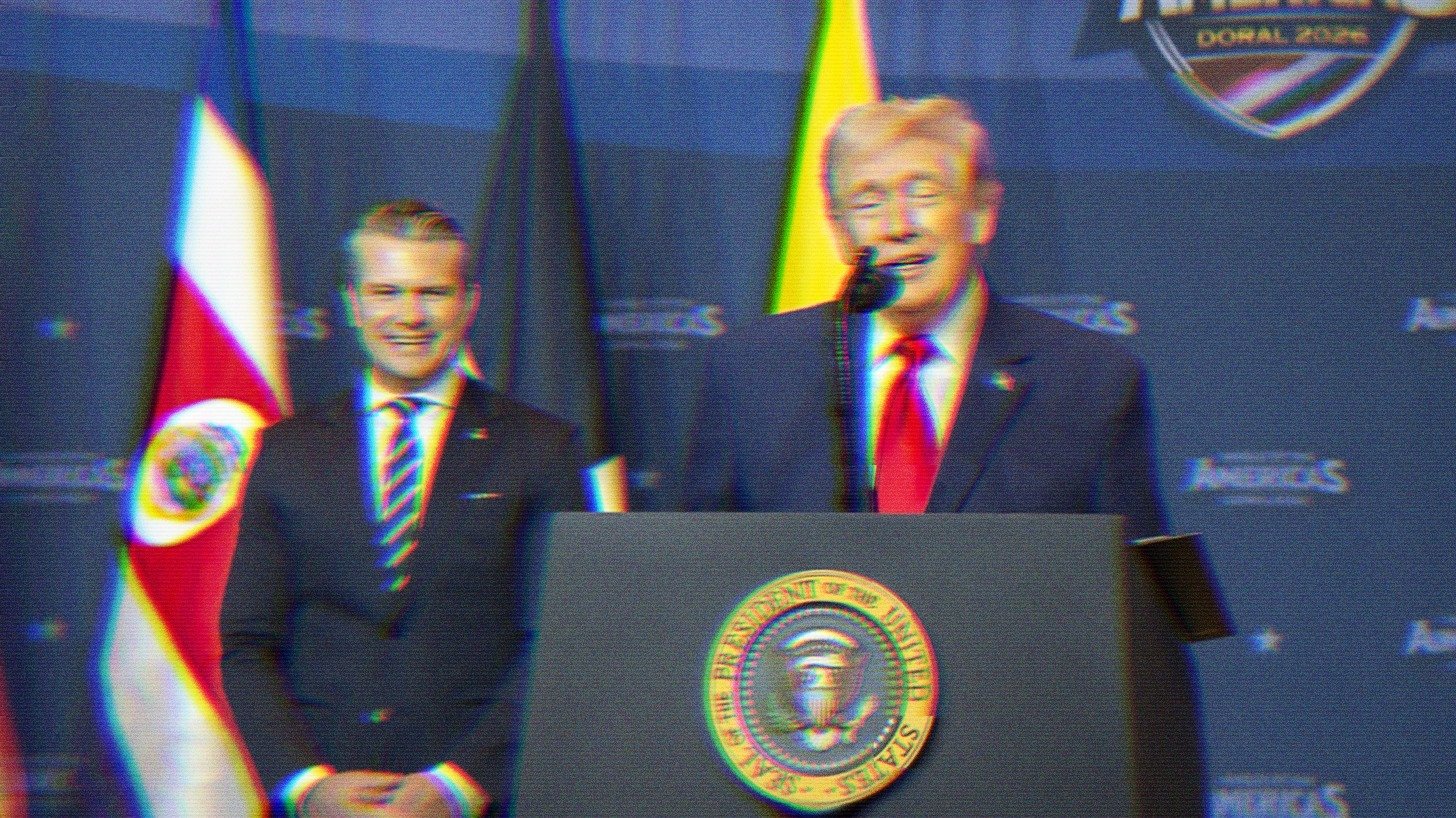 Image Description: Trump is speaking at a podium. Pete Hegseth stands behind him, smiling.
It’s painfully obvious this administration and our military commanders have no fucking idea what they’re doing. To the extent that Trump was making “headway” on his dystopian project to dismantle American democracy and permanently alter our politics and economy, he may very well have kneecapped his own ambitions. Like so many before him, and all along the spectrum of competence, war might very well be the undoing of the Trump regime.Foreign entanglements have long been considered a siren song to U.S. presidents. Even the most domestically-minded candidates tend to succumb to its allure once in office.
Truman was celebrated for ending the Second World War with Oppenheimer’s deadly toy (credit: Sting) before embroiling the military in its first true quagmire of the American century in Korea. His would be the first of several Cold War missteps.
Even though Russia gave the most in blood and Europe gave a generation of men to the war, the latter stage heroics of the American military and the emphatic capstones in Hiroshima and Nagasaki filled the United States with military hubris that fuels us to this day. Kennedy would act on the half-baked Bay of Pigs plans hatched under Eisenhower and send “advisers” into Vietnam. For all of his domestic accomplishments, LBJ’s failure to extract us from Vietnam would lead to his mental and professional undoing. “Hey, Hey LBJ, how many kids did you kill today?” Nixon will forever be linked to the secret bombing of Cambodia even though he negotiated an end to the war in Vietnam. And he would likewise be linked to the rise of the covert U.S. operation regime through plots in Chile among countless Kissinger inspired regime changes.
Carter too fell under the spell of foreign affairs by attempting to undo the nefarious backchannel dealings of his predecessors and opting for open air diplomacy to bring about peace in the Middle East. The hostage situation in Iran, the failed Operation Eagle Claw debacle and failed attempts to negotiate a lasting peace between Israel and Palestine drained Carter of his political capital. Ronald Reagan had the Iran Contra Affair and skirmishes in Central America and the Caribbean. Bush owned the Iraq and Afghanistan wars. Obama inherited them and took far too long to pull out of Iraq. He also presided over a reign of terror through years of continuous drone strikes in seven nations we weren’t technically at war with. The messy withdrawal from Afghanistan was hung around Biden’s neck.
It seemed like Donald Trump—the least prepared, most incompetent and uneducated person to ever hold the office—would ironically go down as the only true isolationist.
Alas, the siren song has proven too powerful for even the most tone deaf man in the world.
And so here we are again. At war with a foe halfway across the world that poses no direct or immediate threat to the homeland. We have more bombs and more guns. More missiles and technology. To hear our Secretary of War tell it, we also have the correct god on our side as well. And yet, we’re losing. Again. Still.
Chris Hedges recently interviewed retired United States Army Colonel Larry Wilkerson who served as chief of staff to U.S. Secretary of State Colin Powell. It’s a departure from the types of conversations we’re treated to in the mainstream because it’s a dry, pragmatic view of Trump’s war in Iran from the perspective of two western individuals with deep ties to the region and prior conflicts. As a war correspondent, Hedges spent seven years in the Middle East and speaks passable Arabic. Wilkerson was in positions of authority and influence during the Iraq War and has been an outspoken critic of our views toward the region, including his own, that led to our multi-decade quagmire.
They had a fascinating and terrifying conversation that highlighted the shallowness of the conversation surrounding this war and how ill prepared we are for any further escalations. In his efforts to surround himself with predominantly white, Christian men who convey only what he wants to hear, Pete Hegseth has gutted the intelligence apparatus within the pentagon. Donald Trump, in his own infinite wisdom, had already hollowed out the intelligence core that was proficient in Middle Eastern history and affairs. Surrounded by sycophants and zealots, the administration has effectively eliminated any internal procedures and voices that would serve as resistance to this failed plan.
Despite the obvious downside risks to the global economy, not everyone is unhappy with how things are progressing. After all, war is big business. There are tremendous profits to be made in wartime and that includes major media outlets who benefit from increased viewership. It’s nearly impossible to disentangle financial interests during times of war and even more difficult to convince Americans to care about what happens in far off places. To the extent that we’re inconvenienced at all in these times of crisis—particularly in the Middle East—it’s at the gas pump.
Of course, we are once again a nation of experts in military affairs. We have become knowledgeable on the importance of Kharg Island and the Strait of Hormuz, and we even have a passing understanding of alliances in the Gulf region as a result of the reporting we see. Just as we learned about Taliban rule, the general location of Baghdad and a surface understanding of the differences between Sunni and Shia Muslims in the first decades of the century. The sooner the conflict comes to an end the sooner we’ll forget it all. But for the professional class of correspondents, officers, operatives and combatants, these facts are the tip of the iceberg.
But a deep knowledge of a region and a people doesn’t guarantee the successful prosecution of a war effort. Donald Trump clearly knows nothing of the Middle East, nor does he appear all that curious about it. He’s being criticized for an epic lack of preparation for the Epic Fury operation, but it’s hard to argue that we would be any better off if he had deep knowledge of the terrain and Iran’s capabilities. There was no shortage of critics leading into the Iraq War, and yet the Bush administration pressed forward with its reckless agenda; one that cost hundreds of thousands of Iraqi lives, tens of thousands of Afghani lives and thousands of American soldiers. Not to mention trillions of dollars when all was said and done.
What struck me the most in the conversation with Hedges was how casually Wilkerson spoke of the war games run by the Pentagon as far back as 2002. Because Israel has been trying to goad the United States into a war with Iran for decades, nearly every modern president has at least contemplated what this would look like. There’s a reason why none prior to Trump ever took the bait.
Wilkerson claims that in the first simulated war game, the United States lost so badly the Pentagon brass thought it a mistake and asked them to do it over. The second time, however, yielded the same result. When pressed for an Iraq-style scenario where we would be able to best the Iranian military, overthrow the regime and install a friendly government, Wilkerson said, “we did come up with a plan and it was two-million men and it was probably five years.” And even still, there was no clarity on whether we would need to continuously occupy the country.
He punctuated a diatribe about the near guaranteed failure of a proposed war with Iran from two decades ago with the observation that Iran has since augmented both its intelligence and military capabilities since then. We, on the other hand, have not.
And so we’re left in a massive predicament. On the one hand Donald Trump isn’t special. He has succumbed to the same hubris of nearly every leader before him, believing in the mirage of U.S. military exceptionalism. The truth is we haven’t “won” a war since the 1940s. We have brought about regime changes and bested other militaries in unprovoked and asymmetric affairs, but none of these proved to be strategically beneficial or moral. If anything, they have served as self-fulfilling budgetary prophesies to expand the war machine. We have simply become a missile in search of a target and where none exists we will invent it.
On the other hand, in each of these previous entanglements we had the ability to generate a strategic narrative and eventually extract ourselves without causing undue harm to the economy or even, unbelievably, to America’s reputation in the world. One can take issue with the latter sentiment, but the fact remains that our bluster continued to carry weight even after protracted blunders and losses. The United States has been successful in reputation management to a great extent given the chaos we have sowed over the past three quarters of a century. Propaganda and spin are our two greatest sister exports.
The United States has no discernible foreign policy outside of “this time will be different.” But we do have a determined economic agenda that is sometimes supported by our foreign policy. In other words, we’re no longer guided by political ideology on the world stage; rather we’re propelled by how best to acquire what’s needed to feed our insatiable appetite for financial growth. As such, our calamitous exploits on foreign soil can always be justified and assuaged by the far more competent core of financial industrialists back home.
Capitalists can find the good in any bad situation.
So what’s different about this moment is the fact that there’s no one left with any experience, imagination or foresight. The extreme forces that got us into every past quagmire are running the current playbook. But there’s no one on the sidelines to review the playcalling or make adjustments. Donald Trump is essentially a drunken madman at this point spewing orders on social media for the world to see. Pete Hegseth has dismissed anyone critical of this plan and is turning this into a holy war. Neither knows anything about Iranian culture, the leadership and power structure, its intelligence capabilities, internal resolve or will of its people. Our leaders are the textbook personification of the Dunning-Kruger effect. They believe in their limited knowledge and infinite abilities. And they aren’t the least bit curious.
Trump and Hegseth allowed themselves to be dog-walked into an unwinnable and intractable conflict by Benjamin Netanyahu who is using this war as a smokescreen to expand Israel’s territory in Southern Lebanon and the Occupied West Bank. We don’t even share the same objectives.
But again, Trump isn’t unique in succumbing to executive hubris and believing in our invincibility abroad. In fact, there’s no daylight between him and every modern president before him in this regard. But Trump has taken things a step further by also dismantling the domestic capitalism regime that typically cleans up the mess.
This war is going to upend the global economy in ways that we have yet to invent. The crisis has already begun in Asia and will work its way across the globe in short order. We’ve already gone past every theoretical milestone that economists said would provoke a recession. So now it’s just a matter of time. What’s unknown at this point is depth. With Iran holding all the keys and Trump falling into predictable escalation patterns, there is growing concern of a worldwide depression. Having built a global economy on multinational trade with a reliance on fossil fuel, the last thing one would deliberately do is choke off a main artery. And that’s exactly what he has managed to do.
At this juncture, we typically crank up the wartime money printing machine. This accomplishes the dual objective of putting people to work by grinding defense manufacturing gears and to run the economy hot. Inflation is an unfortunate byproduct that we deal with down the road. But this isn’t one of those “build more warships and make more bombs” kind of war. We’re fighting against a foe we can’t reach with ground troops. No war in history has ever been won in the air exclusively. We cannot get there by sea because they control the choke point and can take down our war ships with $4,000 drones.
And we already have an inflation problem and it’s about to get a whole lot worse when sustained high oil prices hit the agricultural and industrial cycle. This kind of artificial inflationary boost will have a deleterious effect on the labor market, which means we’ll need money for entitlement programs in a period of mass unemployment.
We have neither the tools nor the personnel to deal with the fallout of this war.
If we’re honest with ourselves, men far smarter and more capable than Donald Trump have brought us into military quagmires. Smarter and more capable military leaders than Pete Hegseth have prosecuted unsuccessful skirmishes, battles and regime changes. Brains and skills apparently have little impact on decisions of war. The difference is what awaits us here at home.
Smart and capable capitalists have had tools to minimize the impact of foreign wars here at home. There’s an argument to be made that we’ve even come out ahead economically. Like I said, war is big business. The only other time we were forced to deal with the fallout of an oil and inflation shock wasn’t the direct result of a war, but the latent effect of a decades old regime change in Iran and the long simmering tensions over an American installed dictatorship. But it wasn’t a deliberate war on our part.
For the first time ever, we started a war that will force our economic chickens home to roost. But we’ve exhausted the normal capitalist wartime protocols. We’ve already over-printed money. Even Volcker level interest rates won’t calm inflation this time around because it’s artificially manufactured. We already spend north of a trillion dollars on military solutions that are ineffective in a vast desert theater.
Donald Trump started a war that was predetermined to fail. One that will bring his domestic agenda to a grinding halt and unceremoniously close the chapter on MAGA. In this way alone he is exceptional. The first president to start a foreign war that will ultimately be lost on American soil.
Image Source
- PresidenciaSV, CC0, via Wikimedia Commons. Changes were made.
 Max
Max
Max is a political commentator and essayist who focuses on the intersection of American socioeconomic theory and politics in the modern era. He is the publisher of UNFTR Media and host of the popular Unf*cking the Republic® podcast and YouTube channel. Prior to founding UNFTR, Max spent fifteen years as a publisher and columnist in the alternative newsweekly industry and a decade in terrestrial radio. Max is also a regular contributor to the MeidasTouch Network where he covers the U.S. economy.