

Demand Destruction and the “Resilience Paradox.”
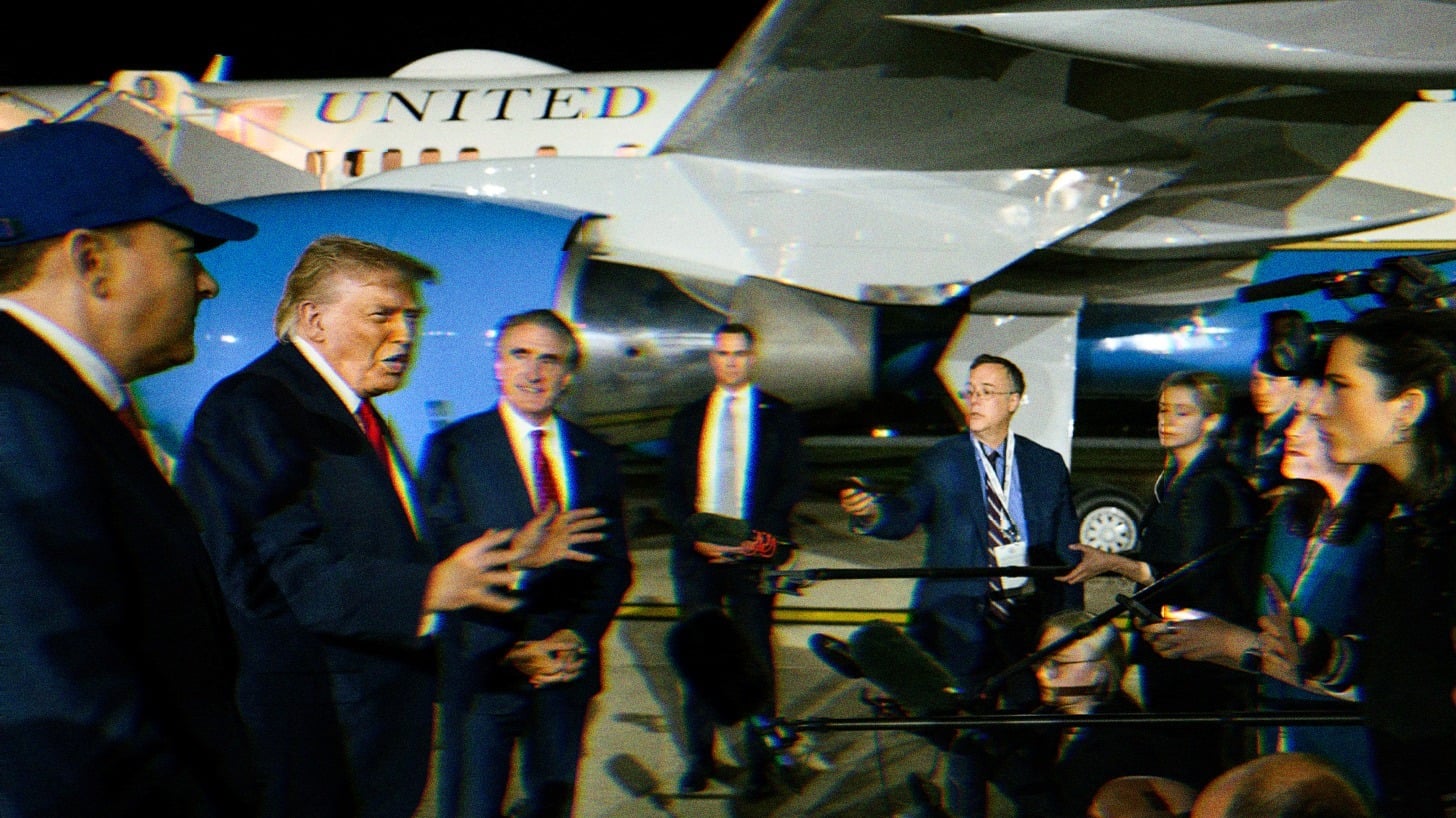 Image Description: Trump talking to reporters before he boards Air Force One, visible in the background.
Donald Trump has already destroyed much of the global economy, but the worst has yet to hit the United States. This “resilience paradox” is the result of early stage demand destruction, something economists fear and policy makers have no defense against. There are multiple factors holding the U.S. economy together in a way that other countries cannot manage. And most of the damage is baked in and irreversible. Thus far, one of the more powerful dynamics has been the market’s hesitation to bet long or short on price movement, because of the fluid and unpredictable nature of Trump’s on-again/off-again announcements regarding the war in Iran and the closure of the Strait of Hormuz. We dissect it all and lay out the scenarios ahead and what it means for the American consumer.
Once again we’ve “reached a deal to end the war in Iran,” with everyone but Iran. Predictably the markets jumped, oil dropped and Trump claimed victory for the 50th time. Time for a gut check because three months ago, everyone had the same nightmare scenario, myself included. It went something like this:
- Iran closes the Strait of Hormuz, oil goes to $150y. Maybe $200.
- The global economy seizes up.
- Recession. Stagflation.
- The whole catastrophe playbook, activated.
Here’s what actually happened. Brent crude is sitting at $96 a barrel as of this week instead of $200.
We reported on it pretty much as is with one enormous caveat: Demand destruction. When does the price pain shock become so intense it reverses the upward trend? So. Are we fine? Did the economists blow it? Am I forever to play the role of Cassandra? Let’s talk about it.
The Slow Burn
Let’s start with oil prices because it’s the most obvious and sensitive leading indicator. The reason oil is at $96 and not at $200 isn’t because the shock was smaller than expected. The shock is in fact enormous and unprecedented. The reason, is because demand destruction is already happening. It just hasn’t arrived on our doorstep. And Americans, bless our hearts, don’t give a flying fuck about what happens elsewhere. The world is buying less oil because the world can’t afford oil.
There are markets that are reeling right now because of a dependency on imports. But the U.S. is a net exporter of oil and gas with tremendous reserves and an ability to, let’s say, quiet some of the noisier ends of the futures market. That said, behavior here has begun to adjust.
Let’s head to the kitchen table before we go to the pocket protector.
Maybe this is your family. You were planning a vacation this summer. Nothing extravagant—a road trip, maybe a week at the beach. You’ve had it on the calendar since January. But then you started looking at gas prices in April and decided to wait. Checked again in May. Still waiting. The vacation didn’t get canceled. It just got indefinitely postponed.
A McKinsey survey from the second quarter of this year found that 40–50% percent of consumers plan to spend less on basically everything discretionary—travel, dining, clothing, electronics. Consumer optimism is at 35%, the lowest in two years.
Meanwhile at the grocery store—the shopper who used to pay with her debit card—is swiping a credit card. Total credit card balances in the U.S. hit a record $1.28 trillion in the fourth quarter of last year, and the bill is coming due. Nearly 5% of all household debt is now in delinquency.
Subprime auto delinquencies—60+ day delinquencies—hit 6.9% in January of this year. That is a 32 year record. Higher than the peak of the Great Recession. The highest since January of 1994.
These are real Americans whose economic situation just got structurally worse. And the reason I’m starting there, before we go global, before we talk about China and Asian central banks and the Eurodollar trap—is that I want you to hold onto that person. Because all the macro analysis in the world is only interesting insofar as it explains what is happening to actual people.
And what is happening to actual people, in this country and around the world, is demand destruction.
What is Demand Destruction?
Demand destruction is the permanent or semi-permanent elimination of consumption—the moment when a buyer doesn’t just postpone a purchase, but genuinely exits the market. They find a substitute, or they do without, or they simply can’t afford it and they stop trying.
The difference between cyclical softness and structural demand destruction is the difference between a hangover and liver damage. The hangover goes away when you drink enough water and sleep it off. The liver damage is still there next week, and the week after, and it changes how you live going forward.
Car repossessed? Take mass transit. Vacation plans cancelled, not postponed. The renter saving for a down payment keeps plowing that money into rent. Breakfast at McDonald’s becomes a luxury and you make toast at home, or just skip breakfast. These are all things that are happening right now; behaviors confirmed by survey data and the corporate executives on earnings calls.
Now, I want to lay down a framework that I think is genuinely useful here. It comes from RSM’s Joe Brusuelas, and he calls it the seven-channel framework for how demand destruction propagates through an economy. The seven channels are:
- Fuel Costs
- Consumer Confidence
- Major Household Purchases
- Monetary Policy
- Food Inflation
- Business Investment
- Semiconductor and Industrial Supply Chains.
Each of these channels activates on a different timescale. Fuel costs and consumer confidence move fast—people feel gas prices within days and they update their confidence within weeks. Major household purchases take a few months. Monetary policy takes six to 18 months. Food inflation tracks energy with a lag. Business investment and supply chain disruption can take years.The danger is when multiple channels activate simultaneously and compound each other.
Now for the pocket protector portion, but I promise to keep it brief.
There are two types of inflation: demand-pull and cost-push. Demand-pull is what happens when too many dollars are chasing too few goods. Cost-push is what happens when the cost of producing or delivering goods goes up regardless of what consumers want to spend. An energy war that cuts off 20% of global oil supply is a cost-push event. Tariffs that raise the price of imported goods are a cost-push event.
The distinction matters because the policy toolkit for fighting demand-pull inflation is to raise interest rates, slow the money supply, cool off consumer spending. That would be the exact wrong suite of tools during a cost-push inflationary cycle. You are making the patient sicker while the disease continues unchecked. The demand is not the problem. The supply is the problem. And you cannot fix a supply shortage by raising interest rates.
This is what makes Warsh’s appointment to the Fed so interesting at this moment. The directive is to lower rates at all costs but the rest of the board is leaning in the opposite direction. The real story is that there is no playbook, because the fundamentals are completely upside down.
Let’s leave tariffs out of the equation for a moment though, to be clear, those are still very much in play right now. The culprit now is the closure of the Strait of Hormuz. We’re all pretty familiar with the story and the problem set by now. In addition to the closure, the damage to refining and storage facilities has also taken a toll. The cost of insurance, rerouting, re-engineering refineries to manage what’s coming to them instead of what was intended, it’s all impacting price inputs.
Bloomberg ran a terrific piece on June 6th with the headline “Why Oil’s Not at $200 After the Biggest Supply Shock in History.” It’s the best breakdown I’ve seen so far frankly. I’ll link the article but here’s the gist of it.
First: The United States opened the taps. U.S. crude and fuel exports in May were more than 2 million barrels per day above the full-year average for 2025. American shale became the world’s swing producer.
Second: The Strategic Petroleum Reserve (SPR). At its peak drawdown rate, the SPR was draining at 1.4 million barrels per day. And here’s an underreported detail: nearly half of those releases went not to U.S. consumers, but to Europe and overseas markets. We were draining our emergency reserve to stabilize the global price.
Third: The Gulf states found workarounds. Saudi Arabia rerouted millions of barrels per day through the East-West pipeline to Red Sea export terminals. The UAE piped oil to the port at Fujairah on the Gulf of Oman. These pipelines have capacity limits—they can’t fully replace Hormuz—but they’re moving significant volumes.
Fourth: Russia and India. Russian crude flows to India hit 1.7 million barrels per day in May—that’s 63% above February levels.
Fifth: Donald Trump. The relentless “deal is around the corner” commentary from the White House has kept oil bulls sidelined. Brent open interest is at its lowest since August. Bulls are holding tiny positions for very short periods. The market is structurally bearish because capital is sitting on the sidelines waiting for a resolution that keeps getting pushed out. In other words, he’s verbally manipulating the markets, which makes any short or long leveraged position on price an even riskier bet than usual.
Trump is basically Mr. Magoo at this point, and has no idea what people are going to do when he opens his mouth. But as long as his precious stock market stays green and oil prices don’t hit $200, he thinks he’s managing the world economy from the palm of his assistant’s hand. And look. To be fair, he is. It’s just that like the pandemic, he can only manipulate the markets for so long with his stupid mouth before the virus catches up with all of us.
Scenarios
And here is where we need to slow it down in all seriousness, because every single one of these workarounds has a hard ceiling.
U.S. inventories shrank to their lowest level in more than two decades last week. The SPR has a finite number of barrels, and we have been draining it at an extraordinary rate while domestic refiners are running at maximum capacity.
Another reason oil is in the $90s is because enormous swaths of the global economy have already begun consuming less oil—not because they want to, but because they can no longer afford to. We are being insulated right now by the economic pain of other countries. The destruction is happening elsewhere, we’re watching the price cap hold, and we are tempted to conclude that things are okay. They are not okay.
China cut its oil imports by approximately 40% in May compared to the prior year average. This single reduction offsets somewhere between 1/3 and 1/5 of all the barrels that have been lost to the Hormuz disruption. China, by itself, is providing a demand-side counterweight.
The question then becomes, why?
A few things are happening simultaneously. China stopped growing its strategic crude stockpile—switching from accumulating to drawing down. China is executing a structural pivot in its industrial base, producing chemicals from coal rather than oil. And the EV boom: Chinese domestic EV sales have structurally reduced gasoline consumption from what it was three years ago. The result: Chinese refinery throughput in May and June is running at around 13 million barrels per day. The last time it was that low was early in the pandemic.
This stasis won’t last forever. When China returns to the market, it will be returning to a market that has already burned through its strategic reserves. If it doesn’t come back, then that means we have a much, much bigger problem on our hands.
Before we get there, let’s expand the Asian outlook and talk dollars and cents. Literally.
Almost all of the world’s oil is priced in dollars. Petrodollar countries that import oil must first acquire dollars to buy it. Japan, South Korea, India, Thailand, Indonesia, the Philippines—all major oil-importing economies—when the price of oil goes up 40% or 60%, their demand for dollars surges proportionally. But their export revenues aren’t growing at anything close to that rate. So they face a current account squeeze: more dollars going out than coming in.
That creates currency depreciation pressure. When your currency weakens against the dollar, the price of dollar-denominated imports—including oil—goes up again in local currency terms.
Japan is the most exposed economy in this dynamic. Japan imports virtually all of its energy. The yen has been under sustained pressure throughout this crisis. The Bank of Japan’s tentative attempt to normalize its interest rate policy after decades of near-zero rates is now being complicated by the energy shock in ways that are almost cruelly ironic. If they raise rates to defend the yen, they slow an already sluggish economy. If they let the yen fall, imported inflation gets worse. Both paths reduce demand.
India has been buying discounted Russian crude, but discounted oil at these prices is still expensive when 85% of your energy is imported. So the rupee is also under pressure. Indian inflation is rising.
You are watching demand destruction happen in real time across multiple Asian economies simultaneously. And from the vantage point of U.S. energy markets, it looks like resilience. It looks like the system is working. But actually, it’s millions of ordinary people in Japan and India and Southeast Asia confronting the math of expensive imported energy and making the only rational decision available: spending less, consuming less, doing without. A harbinger of what’s to come. And we’re already seeing the signs.
U.S. summer bookings are down 10% year over year. And here’s the catch: airfares are actually down 7%. Tickets are cheaper, because demand has fallen enough that airlines are discounting to fill seats. And people are still not flying at the same rate as last year.
That is the definition of demand destruction.
Now we’re entering peak summer demand season for gasoline and energy across the Northern Hemisphere. This is the highest-consumption period of the year for the U.S. energy system. This is the test. Donald Trump just issued his 50th proclamation that the war in Iran is coming to an end, that a settlement has been reached with all the countries in the region. (Except, of course, Iran.) So we’ll have to see what holds but we can game it out.
If the settlement is real, the shock fades by the end of the summer, and there will be very muddled data coming out from every sector—because inflation has already materialized, the labor market is incredibly soft, and it will take several months to build back inventories. And even still, no matter how much demand destruction has occurred across sectors and regions, there will now be a risk premium price on oil and gas above whatever the natural floor might have been had Trump not started this mess to begin with.
If the conflict resumes, which is entirely likely since Israel, Lebanon and the Gulf states are all sitting in an incredibly delicate arrangement—this is not a simple bilateral solution—then demand destruction will become structural, and the world will sink rapidly into a deep recession. If we go late into the year, then we’re looking at food production nightmare scenarios based upon the disruption to feedstocks that impact crop yields.
Here at Home
Set against the backdrop of the largest IPO in history with SpaceX, OpenAI and Anthropic coming down the pike, you would be forgiven for feeling a sense of profound confusion. This is where we need to level-set on the destruction that has already occurred throughout the real economy in the United States. Don’t be fooled by the historic amount of money chasing these deals and continuing to circulate among the wealthiest percentiles. That money is real and growing exponentially due to the trillions upon trillions of dollars that have been printed since 2008; money that circulated through the corporate tier and simply never left.
Retail sales for the most recent month showed a headline increase because people are spending more on gas because it’s more expensive. Strip it away, and everything else is down.
GDP in the first quarter of 2026 was already anemic and was still revised down.
The University of Michigan consumer sentiment index registered a near all-time record low, bested only by the pandemic. Sales are up in areas like luxury cars and SUVs because the upper-income buyers are still buying. Meanwhile, total auto sales are down, and a growing number of subprime auto borrowers were 60 or more days delinquent in January 2026.
For the 45 million Americans who rent, shelter inflation is still running at 3.4%. Of the one 172,000 jobs added last month, healthcare is carrying the entire number. Strip healthcare out and the market looks considerably weaker. When you take out the discouraged labor force and look at labor participation of non-students and military members over the age of 18, only 61% of Americans are working. And many of these are part-time or gig workers. If you take the entire population into consideration, only 47% of us actually bring home an income at a time when social safety nets are being shredded, healthcare coverage is being obliterated and hourly wage gains have officially fallen behind inflation.
This is what the K-Shaped economy looks and feels like.
Here is where I want to land.
The lesson of the Resilience Paradox—and I want to be very specific about this—is not that the economists were wrong about the severity of the Hormuz disruption. The lesson is that the shock is so large that absorbing it without catastrophic price spikes has required the destruction of demand across an enormous swath of the global economy. That destruction is real. It’s in Chinese refinery throughput running at pandemic-era lows. It’s in Japanese yen under sustained pressure. It’s in Indian households paying for imported inflation with a currency that buys fewer dollars. It’s in empty airline seats at airports across Southeast Asia.
Here in the United States, demand destruction is already underway. It’s in the subprime auto borrower who is 60+ days delinquent at a 32 year record rate. It’s in the family that didn’t take the vacation. It’s in the Millennial swiping a credit card for groceries. It’s in the $1.28 trillion in credit card balances and nearly 5% household debt delinquency. It’s in the near all-time low consumer sentiment. It’s in the 40–50% of Americans planning to spend less on basically everything.
The question demand destruction always raises is: who gets destroyed? In a supply shock of this magnitude, someone has to absorb the pain. And the answer in 2026 is very clear: the people at the bottom absorb it. The people at the top are insulated. The same way the United States is insulated from the global shock longer than everyone else—the upper tier of the domestic income distribution is insulated from the domestic shock longer than everyone else.
Last—not never.
This term, demand destruction. Understand how the GOP will weaponize this scenario come the midterms. If oil craters as the result of a massive recession, they’ll say they fixed the oil prices, and that everything will be fine in a matter of months. Do not fall for it. Remember two things and two things always: The stock market is not the economy, and the economy is whatever you feel it is, not what they tell you. Your bank account and purchasing power is the only measuring stick that matters.
Image Source
- The White House, Public domain, via Wikimedia Commons. Changes were made.
 Max
Max
Max is a political commentator and essayist who focuses on the intersection of American socioeconomic theory and politics in the modern era. He is the publisher of UNFTR Media and host of the popular Unf*cking the Republic® podcast and YouTube channel. Prior to founding UNFTR, Max spent fifteen years as a publisher and columnist in the alternative newsweekly industry and a decade in terrestrial radio. Max is also a regular contributor to the MeidasTouch Network where he covers the U.S. economy.

![The definition of economics in the dictionary. Visible text reads [U] science of the pro...sumption of goods; material prosperity.](https://www.unftr.com/hs-fs/hubfs/OG%20Images/The%20definition%20of%20economics%20in%20the%20dictionary.%20Visible%20text%20reads%20%5BU%5D%20science%20of%20the%20pro...sumption%20of%20goods%3B%20material%20prosperity.jpg?width=352&name=The%20definition%20of%20economics%20in%20the%20dictionary.%20Visible%20text%20reads%20%5BU%5D%20science%20of%20the%20pro...sumption%20of%20goods%3B%20material%20prosperity.jpg)