
 Image Description: A closeup of Ben Franklin’s monetary portrait with misc. numbers and scattered red down arrows and green up arrows symbolizing the stock market.
What goes up must come down. Unless the what in question is the U.S. stock market, in which case sky’s the limit baby! Yachts and Cuban cigars for everyone! It’s the question I get the most when covering financial topics. And it’s often used as a retort by conservatives when they’re defending U.S. policy or the Trump administration in recent years. “If things are so bad, then why is the stock market so good?”
It’s a fair question. I mean, maybe Tesla or Nvidia are worth a trillion dollars. Maybe Tim Cook is better than Steve Jobs. Maybe Larry Fink and Jamie Dimon are vastly superior to every other titan of finance who came before them. Maybe. I’ll answer it in a simple way first, then offer a more detailed explanation along with some resources that help contextualize this stunning growth over the past half century.
Before everything else, of course, we have to start with our mantra: the stock market is not the economy.
Money Goes to Money
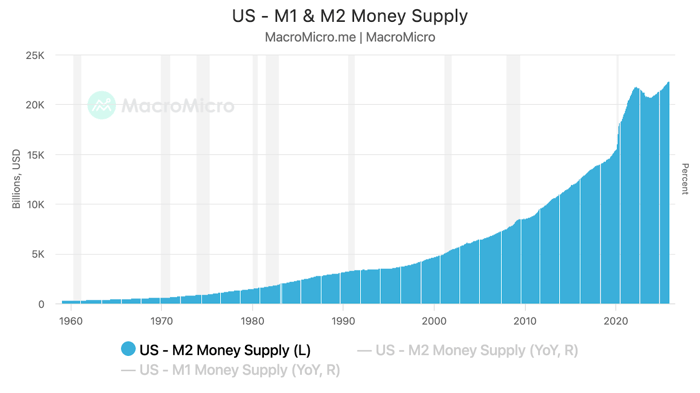
Today is a discussion and not a full blown technical analysis, though I have some resources that I’ll link in the show notes that I used as source material for anyone who wants to dig in further. So to this end, I’m going to share one single chart that explains everything then we’ll dig into the details.
Source: MacroMicro
To understand what’s really happening, we need to talk about the money supply itself. Economists measure money in different ways, from M0 to M3. M0 is the most basic—physical currency and reserves. M1 includes that plus checking accounts. M2 adds savings accounts and money market funds. M3, which the Fed stopped tracking in 2006, included even larger institutional holdings. So what you’re looking at here is M1 and M2, money that is in the system on an absolute basis but not even covering the institutional and leveraged funds that sit on top.
Bottom line, since the Nixon gold standard rip, we have been printing money like it’s our job. And in many ways, that has become our job.
Here’s what matters: the absolute money supply has increased dramatically over the past 40+ years. From 1980 to today, broad money in the United States has exploded from around $1.6 trillion to over $21 trillion. That’s more than a thirteen-fold increase, while GDP only grew about six-fold in nominal terms.
Now, if you pump that much money into an economy, basic economics tells you that you should get massive inflation, right? Hyperinflation even. So why didn’t we?
Because the money didn’t go into the real economy—at least not in the traditional sense. It went to work in investment markets, in overseas holdings, and in financial instruments rather than Main Street. The money was absorbed into the financial system to perform various functions: financing our national debt, purchasing assets, boosting the stock market, inflating real estate values.
We know two things for certain: inequality has worsened dramatically since 1980, and the money supply has increased. These aren’t coincidental. The concentration of money in the hands of the investor class—money put to work by the mechanisms of finance through insurance companies, banks, credit unions, mutual funds, money markets, hedge funds, and real estate—means that while we haven’t had the kind of goods and services inflation you’d expect, we’ve had massive asset inflation.
The data bears this out. The top 0.1% of wealthy households more than tripled their share of the wealth distribution since 1979.
So the simple answer to why the stock market keeps going up? The money has to go somewhere. And when you create trillions of dollars of new money and concentrate it among a small group of wealthy investors and institutions, that money flows into assets—primarily stocks, bonds, and real estate. Asset prices inflate. The stock market goes up.
But let’s dig deeper into how this system was built.
The Three Phases of Financialization
The financialization of the U.S. economy has been divided into three or four distinct phases, depending on which theorist you ask. I’m going to focus on three clear phases in the post-industrial period.
The Nascent Financial Stage through World War II, the post Bretton Woods era from 1944 to 1971 and the Post-Nixon Shock and Reagan Revolution.
The nascent stage was marked by the roaring twenties boom, the 1929 crash, and the Great Depression. During the 1920s, banks increasingly participated in the bond market rather than traditional commercial lending. The share of bonds issued by banks increased from 22% to nearly 45%. Banks were speculating with depositors’ money, leverage was through the roof, and when the music stopped, the entire system collapsed.
This led directly to the Glass-Steagall Act of 1933, which separated commercial banking from investment banking, and established the FDIC to protect depositors. Intense regulation combined with weak foreign competition resulted in what economists call “financial tranquility.”
The post-Bretton Woods era was the period of the most widespread prosperity in American history. The Bretton Woods system established fixed exchange rates tied to gold. Financial regulation was strict and median incomes largely kept up with productivity gains and outpaced inflation.
Importantly for our purposes, the ratio of broad money to GDP also remained relatively stable. Corporate investment was financed through retained earnings and productive borrowing. The market value of equity as a share of GDP was rational, producing an economy that worked for the majority of Americans.
And then, as we’ve discussed ad nauseam, Nixon ended the gold standard, and fiat currency began to float freely. But the real transformation didn’t begin until the Reagan administration in the 1980s. This is when money supply began to heat up asset classes for several critical reasons:
The first of which was stock buybacks. We did a piece on this as well. Prior to 1982, stock buybacks were essentially illegal under SEC rules against stock manipulation. The Reagan administration changed this. Suddenly, companies could use their cash—and borrowed money—to buy back their own shares, artificially inflating stock prices. At the height of the 2007 bubble, corporations paid out 9% of GDP in stock buybacks and dividends—more than 1.7 times their actual earnings that year.
Add Deregulation to the mix and thus began the systematic dismantling of financial regulations. The 1978 Supreme Court decision in Marquette v. First of Omaha Service Corp effectively ended state usury laws. Throughout the 1980s and 1990s, interstate banking restrictions were lifted. The culmination was the 1999 Gramm-Leach-Bliley Act, which fully repealed Glass-Steagall.
The result? The top five banks held 17% of aggregate bank assets in 1970. By 2010, they held 52%.
Then there was the fiscal side of the house. Prior to Reagan it was considered taboo to run large deficits. And when we did they were temporary and generally to fund war efforts. But Reagan dramatically increased deficit spending while cutting taxes on the wealthy—the top marginal rate dropped from 70% to 28%. This pumped money into the economy but disproportionately benefited the wealthy. The 2003 dividend tax cut under Bush similarly benefited wealthy shareholders without bringing any increase in actual corporate investment. These are the infamous Bush era tax cuts that remained in place until Trump cut them even further.
In the 1990s, we supercharged all of these trends. Executive compensation was restructured to favor stock options and performance pay tied to short-term stock price movements rather than long-term value creation.
This fundamentally changed corporate behavior. In the 1950s, ‘60s, and ‘70s, if you looked at corporate borrowing, about 50-75 cents of each borrowed dollar financed productive investment—new factories, equipment, R&D. After 1980? That relationship eroded. We went from long-term value creation to short-term dividend creation. Firms weren’t borrowing to invest in growth anymore—they were borrowing to enrich shareholders.
One can argue that we entered a new phase after the Global Financial Crisis—a phase that accelerated even more dramatically during COVID. This is when we released an unprecedented amount of money into the system.
Here’s what most people misunderstand: the money didn’t just come in the form of cash, like stimulus checks. People lazily blame inflation on those checks, but that’s missing the real story. The bulk of the money came in the form of expanding balance sheets and leverage.
The amount of money U.S. banks were required to hold relative to their loans, known as capital ratios, declined steadily over this period and were relatively low prior to the financial crisis. So one of the key provisions of the regulations was to restore these ratios so our banking system today is well capitalized and highly liquid. But that doesn’t mean that leverage disappeared or even returned to normal. Instead what has happened is that non-banking financial institutions (NBFIs) like hedge funds, private equity and private credit firms have exploded since that time. It’s a giant shell game really, but it enabled all that excess money printing to continue flowing into the corporate sector.
These firms use derivatives, repo agreements, and securities-based lending to amplify their positions. While retail margin debt—the traditional “stocks bought on margin”—represents only about 1.5–2% of total market capitalization, the true leveraged exposure when you include hedge funds, derivatives, and structured products is far larger. The biggest problem is that we don’t actually know because this is all happening outside of the regulated banking environment.
There’s also the government’s role in managing the money supply obviously. Before 2008, the Fed’s balance sheet was under 1 trillion dollars. After successive quantitative easing programs following the financial crisis, it grew to about 4.5 trillion, and during COVID it nearly doubled again to around 9 trillion, before drifting down to roughly 6.5 trillion today—still far above its pre‑crisis size. These expansions reflect the Fed’s use of large‑scale asset purchases and emergency lending to stabilize markets and support the economy when needed.
There was another effect of this expansion. This isn’t money that was created and then distributed to average Americans. This was money created through asset purchases—buying Treasury bonds and mortgage-backed securities. This expanded the monetary base while we had a near zero interest rates policy, which meant investors had to seek riskier assets to find any return at all.
The mechanism works like this: Low interest rates make bonds less attractive. Pension funds, insurance companies, and wealthy individuals who need returns have to go somewhere. So they buy stocks. This pushes up stock prices. Higher stock prices make companies look valuable. Companies can then borrow more cheaply. They use that cheap borrowing to...buy back their own stock, pushing prices even higher. It’s a self-reinforcing cycle. It’s also one of the reasons that the Trump administration is trying to push rates all the way back down even though that’s not necessarily how it works, but that’s for another day.
The big takeaway when it comes to leverage is the multiplier effect. A hedge fund with 3:1 leverage can deploy $3 of capital for every $1 they actually have. When asset prices go up 10%, they don’t make 10%—they make 30%. This amplifies returns for those with access to leverage (the wealthy, institutions) while leaving everyone else behind. 15 to 1. Same thing. 50 to 1. Same thing. You get the picture. These are the areas of the economy that have the most exposure but in terms of the stock market, it’s still a gambler’s paradise.
Too Big to Decline
The reason many economists and financial experts have argued against the financialization of the system via deregulation and excessive money printing is precisely because we’re set up to absorb it at the institutional level. This is why assets continue to inflate. Again, the money has to go somewhere.
And with the federal government committed to backstopping risk assets, it means that the risk appetite increases exponentially along with the leverage in the system. If you know the Fed will step in to prevent a major collapse, you can take bigger risks. Moral hazard becomes embedded in the system.
The one area that is broad, extremely liquid, and very easy to invest in is the stock market. And we’ve blown through all normal gauges of equity health. In eras past we relied on things like the Buffett Indicator: Warren Buffett’s preferred valuation metric—the ratio of total stock market capitalization to GDP—historically averaged around 50–75%. It peaked at 140% before the dot-com crash. Today? It’s over 180%. By this measure, the stock market is the most overvalued it has ever been in history, including 1929 and 1999.
Or the Shiller PE Ratio: Robert Shiller’s cyclically-adjusted price-to-earnings ratio looks at stock prices relative to average earnings over the past 10 years, adjusted for inflation. The historical average is around 16–17. Before the 1929 crash, it hit 30. Today? It’s hovering around 33–35. We’re in the 95th percentile historically.
By every traditional metric—price-to-earnings, price-to-sales, price-to-book, market cap to GDP—the stock market is screaming overvalued. And yet it keeps going up.
Because we’ve entered a new phase: too big to decline.
The Federal Reserve, through its actions in 2008 and 2020, has essentially communicated to markets that it will not allow a sustained major decline in asset prices. Politicians on both sides have staked their credibility on stock market performance. Retirement accounts for millions of Americans are tied to these inflated valuations. The wealth effect—people feeling richer because their portfolios are up—props up consumer spending.
The system can’t afford for the market to crash, so policy is calibrated to prevent it. Low interest rates, quantitative easing, corporate tax cuts, regulatory forbearance—every policy lever is used to support asset prices. The market becomes a store of value, divorced from underlying economic fundamentals.
Now, in terms of civic engagement and societal impact, here’s the key stat: About 58–62% of U.S. households are technically invested in the market through 401(k)s, IRAs, and direct holdings. But the concentration is extreme. The top 10% of households by wealth own about 87% of all stock market wealth. The bottom 50% of Americans own essentially zero stocks.
But here’s where it gets political: Studies show that Republican-identifying households are consistently more likely than Democratic households to participate in the stock market—by margins of 15–20 percentage points. This helps explain the tendency of many Republicans to favor any policy they perceive as beneficial to stocks, no matter what else that policy does. So long as the market goes up, there’s pretty much nothing they won’t support. It’s rational self-interest—their wealth is tied to those valuations.
This creates a political dynamic where roughly 30–40% of Americans (the Republican base with stock market exposure) have a direct financial incentive to support policies that inflate asset prices, even when those same policies—corporate tax cuts, deregulation, deficits, money printing—harm the broader economy and exacerbate inequality. It’s another way to answer questions like, how can 87% of Republicans still support President Trump?
The negative social impact of financialization is a real thing. The equity market sends a false positive signal regarding economic health. When CNBC shows the S&P 500 hitting new records, it looks like prosperity. Politicians point to it as evidence of successful policy. But for the majority of Americans who own little to no stock, this “prosperity” is an illusion.
The other thing about the U.S. stock market is that because it’s liquid, enormous, accessible and seemingly a lock as an investment because our government will never let it go down, we attract money from all over the world. As we’ve covered extensively at UNFTR, when you look at the Treasury International Capital (TIC) flows, you see that foreign investors view the U.S. stock market as a safe haven specifically because of our light regulatory environment, predictable monetary policy support, and strong domestic inflows. The US market has become the parking lot for global capital seeking yield.
The investor class can keep this up indefinitely now that fundamentals are divorced from performance. As long as the Fed stands ready to expand its balance sheet, as long as corporations can borrow at near-zero rates to buy back shares, as long as tax policy favors capital gains over labor income, the machine keeps running.
But to end where we began, the stock market is not the economy. What it is, however, is a reflection of how our economy has been restructured over the past 40 years: to benefit those who own capital at the expense of those who sell their labor. Will it keep going up? Who knows? Is Tim Cook a better CEO than Steve Jobs? Do Larry Fink and Jamie Dimon know something every other titan of finance did before them? Or is it drug dealer rules and the U.S. is just high on its own money supply?
 Max
Max
Max is a political commentator and essayist who focuses on the intersection of American socioeconomic theory and politics in the modern era. He is the publisher of UNFTR Media and host of the popular Unf*cking the Republic® podcast and YouTube channel. Prior to founding UNFTR, Max spent fifteen years as a publisher and columnist in the alternative newsweekly industry and a decade in terrestrial radio. Max is also a regular contributor to the MeidasTouch Network where he covers the U.S. economy.