

Trump is ‘Bored’ With Iran So Now We're WMDing Cuba.
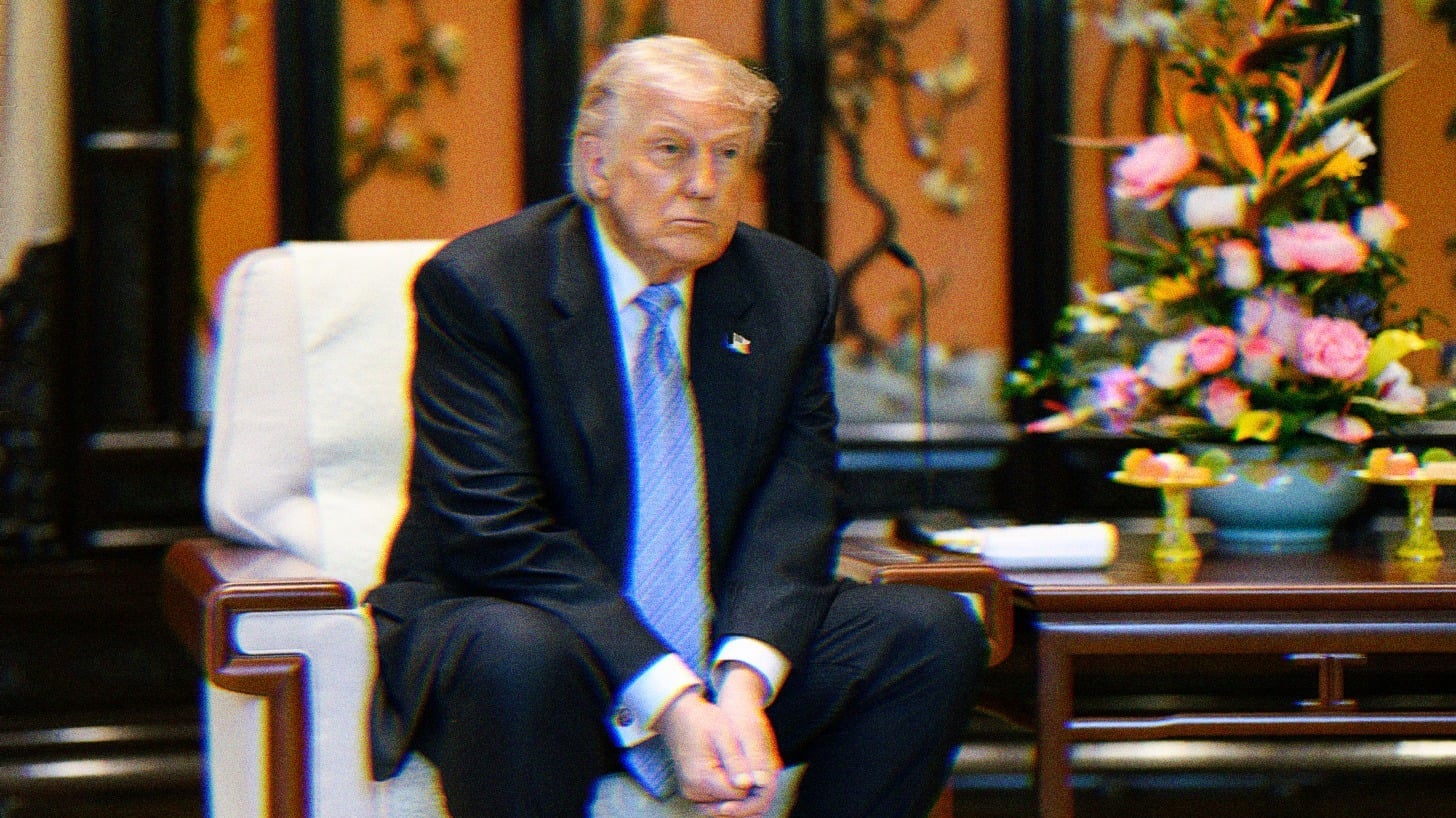 Image Description: Trump sitting in a chair, looking bored.
This essay appeared in the May 21, 2026 edition of UNFTR’s premium newsletter. Become a UNFTR member to receive our bonus newsletter each week and for other perks.
A few weeks ago, President Trump, a Vietnam-era draft dodger, heaped praise on himself for only getting 13 U.S. service members killed amid his war of choice with Iran. He took reporters on a tour of the construction of his ballroom boondoggle project, gushing over its apparent drone-resistant roof—”if a drone hits, it bounces off,” he claimed. An increasingly doddering Trump appears simultaneously aimless and hapless as he tries to dig out of the enormous hole he’s made politically amid record levels of disapproval across various polls.
This comes as multiple outlets have reported that Trump has grown “bored” with the war in Iran. The first sign that Iran was chiseling away at the president’s mental stamina came nearly a month into the war, when the regrettably named cable news network, MSNow, cited an unnamed White House official who acknowledged that Trump was effectively over the war, which the United States started on Israel’s behalf.
“[Trump] is getting a little bored with Iran,” the source told the outlet. “Not that he regrets it or something—he’s just bored and wants to move on.”
The unfortunate thing about digging a hole for yourself and, you know, the globe, is that you have to somehow dig yourself out, which Trump seems incapable of doing. For any of us, screwing up so royally bad would mean weeks, if not months, of stress and regret, not to mention consequences—for Trump, he can just glaze over the entire disaster and pray that his acolytes will just eat his lies.
And so it’s gone. In May, we received yet another report that Trump has, in fact, not been entertained by his Iran problem, with The Atlantic telling us what we all already know all too well: “Patience is not Trump’s strength.” And yes, an “outsider adviser” told the magazine, Trump is “bored.”
Increasingly listless, Trump and his administration appear to be looking for yet another distraction to overtake the news cycle—for Trump’s devolving attention capacity and Americans generally, as survey after survey has revealed people are unsupportive of the war and its associated collateral consequences, none as big politically as skyrocketing gas prices.
What’s the plan, you ask? Well, more imperial escapades, of course.
On May 17, Axios published an explosive report, alleging that Cuba has amassed hundreds of military drones and had discussed “plans to use them to attack the U.S. base at Guantanamo Bay, U.S. military vessels and possibly Key West, Fla., 90 miles north of Havana.”
According to Axios, the assessment was based on “classified intelligence”—wait for it—”shared” with the outlet. It’s important to note that since this was an “official” leak, no one will be investigated or prosecuted for sharing classified information with a news outlet, which wouldn’t be the case if the news were unflattering to the administration. It’s not only critical that we pay attention to these things, but that we call them out, as future leaks that are embarrassing to this or other administrations will inevitably produce Espionage Act probes and further erode adversarial journalism.
The double-standard on classified leaks aside, the Axios piece was littered with astonishing admissions. First, and most importantly, the outlet decided to bury the biggest intelligence finding—and what arguably should’ve been the premise of the piece. In the fourth-to-last paragraph, the outlet, remarkably, undercut its own (and the empire’s) narrative:
“U.S. officials don’t believe Cuba is an imminent threat, or actively planning to attack American interests. But U.S. intelligence indicates the island’s military officials have been discussing drone warfare plans in case hostilities erupt as relations with the U.S. continue to deteriorate.”
In the same section, Axios cited a “U.S. official,” who said: “No one’s worried about fighter jets from Cuba. It’s not even clear they have one that can fly.”
The imagined threat, apparently, comes not from Cuba’s ability or even motivation to engage in hostilities, but from its geographic proximity to the United States—which, in theory, can be used to justify any form of imperial misadventure Trump craves.
Just as important, the same piece contained other shocking revelations—shocking in that we can’t believe anyone went on record making such admissions. Among them:
- Cuban officials are purportedly “trying to learn about how Iran has resisted” the United States militarily.
- There are also concerns within the administration about how successful drone attacks have been against the U.S. and its assets. “Iran’s drones have damaged American bases in the Middle East, helped close the Strait of Hormuz and menaced neighboring Persian Gulf states, along with missile attacks,” Axios wrote.
Not only is the United States using this leak as a pretext for yet another invasion or another war, but to effectively admit that its failings against Iran may have serious repercussions. In short: The miserable war of choice is revealing to the world how vulnerable the empire may be, including in the eyes of a country with barely a fraction of the military capabilities of Iran. No wonder Trump is exhausted!
This all comes as the U.S. siege on Cuba continues to cripple its economy—combined with the decades-old embargo—its infrastructure, including schools, hospitals, and other public services. The Gaza-like siege went into effect in January, after the United States illegally invaded and attacked Venezuela, a sovereign country, in a mission that resulted in the kidnapping of its president. Venezuela had long been a major supplier of oil to Cuba, and the siege, along with a related tariff regime preventing other countries from shipping fuel to the island nation, has sent Cuba into a catastrophic energy crisis. Cutting Cuba off from oil markets has caused food shortages and spawned repeated blackouts, some as long as 20 or 22 hours, which not only have widespread societal implications, but have also crippled Cuba’s healthcare system. Earlier this month, the United Nations said delayed power outages and supply shortages have meant more than 100,000 people, among them 11,000 children, have had surgeries delayed.
If that’s not enough, the Axios report has effectively helped create the pretext for further intervention, and it has the Cuba hawks grinning.
Here was Rep. Carlos Gimenez (R-FL) warning Cuba can attack the Sunshine State: “I know that some of these drones have ranges of 200 kilometers with payloads of 22 pounds, which means just about everyone in the state of Florida is inside the range of these drones.” Scary stuff!
Gimenez’s fellow Floridian and GOP colleague shared similar sentiment on X, posting: “We’ve seen the threat drones pose in the Middle East. Now they are 90 miles from our shores and near critical infrastructure. It’s clear that the Cuban regime is a national security threat.”
And so, the grand propaganda campaign has begun. With Trump’s brain seeking yet a new shiny thing to distract itself with, we’re now WMDing Cuba, after WMDing Iran, the latter of which turned out, yet again, to be complete and utter bullshit.
If the media is going to continue to fail us, it’s up to all of us to rage against the war machine. We can’t get distracted—not like Trump.
Image Source
- The White House, Public domain, via Wikimedia Commons. Changes were made.
 Rashed Mian
Rashed Mian is the managing editor of the award-winning News Beat podcast and co-founder of the newly launched Free The Press (FTP) Substack newsletter. Throughout his career, he has reported on a wide range of issues, with a particular focus on civil liberties, systemic injustice and U.S. hegemony. You can find Rashed on X @rashedmian and on Bluesky @rashedmian.bsky.social.


