
 Image Description: Trump staring forward, lips pursed almost smiling. Rainbow jelly beans are behind him, with one black bean in frame.
There’s a chance we’ve finally figured out how this all falls apart. Meaning, how the economy collapses under Trump. We might have uncovered the black jelly bean in the jar.
If you attended Sunday school, you may have been taught a version of this concept. Some iteration of ‘The Jelly Bean Gospel’ where each colored jelly bean represents a step in the story of Jesus and salvation. That’s not this version.
Disclaimer: Before I continue, my apologies to fans of the black licorice flavor of jelly beans. No offense intended.
The black jelly bean theory was a device that one of my high school teachers used to demonstrate the inevitability of bad decisions. Imagine a thousand jelly beans in a jar, each representing a different outcome. If you’re patient and selective, you can pluck the ones you have a taste for. Stick your hand blindly into the jar and eventually you’ll pick the black one. Even if you have tiny little Trump hands.
There’s a chance you haven’t even heard of what I’m going to explain and for good reason. Unless you work on a Wall Street bond desk or the investment team at a large insurance company, there’s no reason to. But most of us hadn’t heard of a mortgage backed security before 2008 and still didn’t know what it was until Margot Robbie explained it to you in a bathtub.
Well, I’m no Margot Robbie nor am I in a tub, but I’m going to do my level best to explain it.
Economic Jelly Beans
Running the world’s largest and most important economy means you have the biggest jelly bean jar in the history of the world. Red for tariffs, green for treasury bonds, yellow for inflation, blue for immigration, pink for energy and so on. The key to this parable, however, is keeping the jelly beans in the jar. Trump keeps plucking them out, one-by-one, without looking. At some point, he’ll choose wrong.
Although crude oil prices have been elevated since the start of the war in Iran, they’ve been muted against the most dire forecasts. There are three main reasons for this. First, Trump made speculating dangerous because his actions have been so erratic. So speculators stayed short and contained, and didn’t take on long-term price risk. Secondly, the countries blew through their strategic reserves to keep product moving. And lastly, exporters found alternative routes.
Well, we’re running perilously low on strategic reserves, the Houthis just closed off Red Sea access (a crucial release valve after the Strait of Hormuz closed), and traders have figured out what our generals knew all along: Iran has us beat. They always did. Oil is now back above $100/barrel, and Goldman Sachs is predicting $120 by fall.
After the Supreme Court struck down Trump’s blanket tariff strategy, the administration worked quickly to impose a series of short-term tariffs on several nations. Now it has announced a new round of tariffs on 60 nations for 150 days on top of slapping certain Canadian goods with 50% tariffs.
Most economists agree that one of the ways to maintain a healthy working population and economic growth is by increasing a country’s population. Negative migration is considered a death blow to economic development. Last year we experienced a net outflow of migration and are “flirting” with the first population decline in our nation’s history.
Perhaps one of the most significant blows to the average U.S. consumer and working class population has been the impact of inflation. The post-COVID inflation that resulted from supply chain shocks and corporate greed was never corrected.
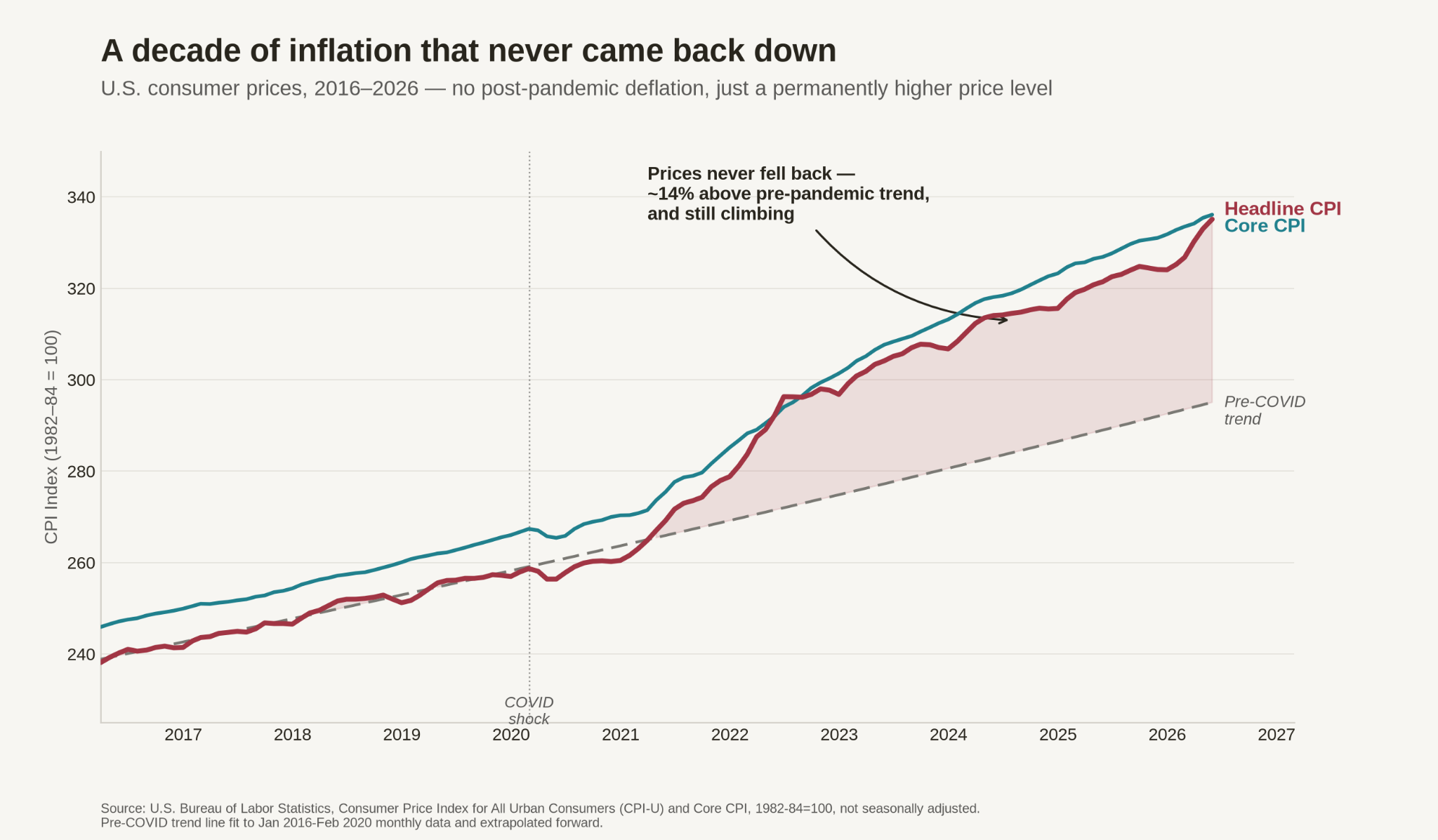
Despite the celebration over a single month drop in core inflation, the overall trend has been positively brutal to the U.S. consumer. Inflation ripped across the globe after COVID and the United States managed it better than most. But then we stopped attacking the problem leaving consumers with persistent high prices for goods and services. And just when monthly core inflation started to cool, Trump announced his tariff regime.
So when the pundits talk about getting back to the Fed’s 2% inflation target it’s kind of bullshit. A 2% inflation rate on a normalized baseline is fine so long as wages keep up with or exceed that. But we’re talking about prices that remain 14% higher than they were pre-pandemic and climbing.
That’s a lot of jelly beans already. And then…He started a war.
Wars of Choice
Pete Hegseth presented himself in front of Congress to ask for more money this week. Apparently the $1.1 trillion budget and first carve out for the Iran war earlier this year aren’t enough for the most lethal, testosterone-fueled fighting force to get the job done. Strange turn of events considering Hegseth said just a few months ago that Operation Epic Fury had effectively destroyed Iran’s military capabilities.
Hegseth danced on Capitol Hill with hat in hand, defiant every step of the way. The upshot here is that Iran has had our number from jump street; something every military planner, foreign policy advisor and former president knew before Donald Trump did Bibi Netanyahu’s bidding. Despite the fact that Wall Street keeps falling for the same line over and over again, no one else on the planet believes that Iran is simply going to roll over. They’re in control of more than the Strait of Hormuz at this point, they’re in control of the direction of this war no matter how many bombs we drop.
Oh, that’s right. We’re out of bombs, hence the begging for money routine.
Unjust, illegal wars that no one wants have a way of eating away at confidence, and that’s exactly what we’re seeing right now. Consumers have certainly had enough, but Trump is stuck because an end to the Iran War means full capitulation. A Strait of Hormuz controlled by Iran. The release of billions of frozen funds. Fresh funds to rebuild their bombed out infrastructure. A complete elimination of sanctions. Maybe even a toll booth in a couple of vital choke points. Trump put the Ayatollah in the driver’s seat, even if he is missing a leg as some have reported.
To be clear, a full capitulation to Iran would bring down oil prices and benefit the dollar, because their product would theoretically be priced in the petrodollar if they’re brought fully back into the trading fold. But that’s never going to happen because we would have to admit total defeat and then some. And so the beat goes on and the further into the unknown we travel. And markets hate the unknown.
So let’s tally our beans before we uncover what might be the black one.
We’ve got persistent and elevated inflation with goods and services on average about 14% higher than they were just six years ago. And wages that haven’t kept pace. We have halted immigration inflows and might experience the first net reduction to the U.S. population in our 250 year history, thereby eliminating one of the key economic drivers by choice. We’re embroiled in an unwinnable war with a foe that holds all the cards and the market is finally pricing in the reality of dangerously low Strategic Petroleum Reserve (SPRs), a damaged Middle East oil and gas infrastructure, brand new choke point in the Red Sea and the potential of an onslaught of Chinese demand that will pressure refining capacity. So oil prices aren’t coming back down any time soon. Red, yellow, purple, green, pink, blue.
Before I tell you about what might be the black jelly bean, let’s talk about scorecards.
There’s how Donald Trump and the mainstream media keep score, and then there’s how Wall Street keeps score. One is the stock market. The other is the bond market.
We know which one Trump favors and it has performed wonders due to a combination of factors. First off, since the Global Financial Crisis (GFC) we have created and circulated in excess of $12 trillion dollars through balance sheet engineering, money printing and fiscal stimulus. And that money has been circulating through the corporate class for nearly 15 years at this point. And for the first few years, they had a guaranteed return on investment from the U.S. government in the form of interest rate arbitrage. Sweet deal if you can get it.
We have also observed from the Treasury International Capital (TIC) data that while foreign investment into U.S. treasuries and agency bonds have been declining—save for a few nebulous Cayman Island sources and allies we’ve arm twisted—the U.S. stock market has continued to see net inflows as the world’s safe haven for capital. And much of this has been for valid reasons. U.S. corporations are raking in monster profit, especially in the tech sector. Just yesterday Alphabet, the parent company of Google, announced that its profit last quarter rose to $112 billion, quadrupling from just a year earlier.
Money goes to money, as they say. And the equities market has the hot hand right now so investors keep piling in.
But the flip side of the coin is the debt market. And this is where the scorecard is beginning to show some strain.
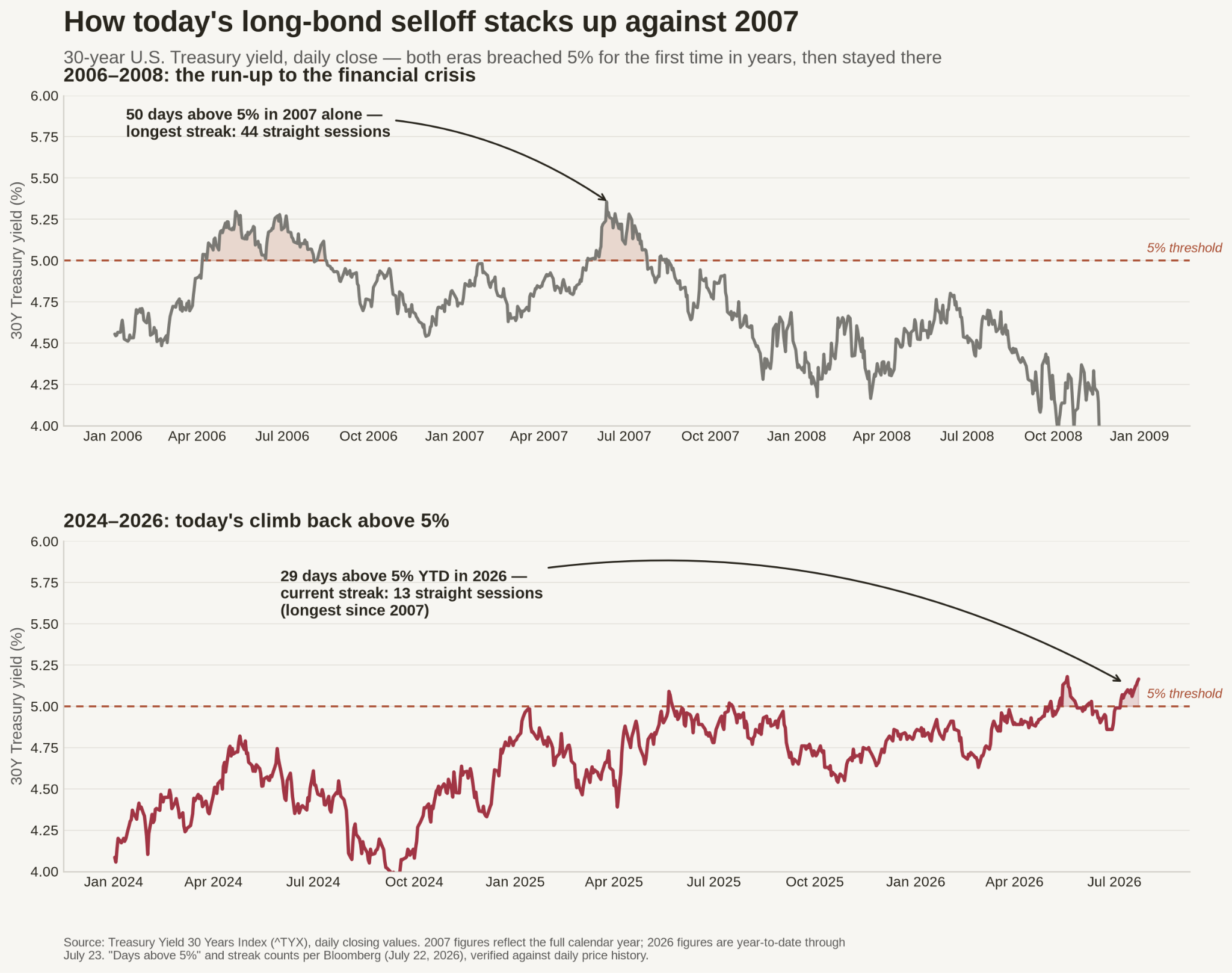
This is where concern is growing. In 2006 and again in 2007 cracks began to appear in the long end of the bond market. The 30-Year treasury yield peaked twice with the 30-Year yield moving above the 5% threshold for 50 consecutive days just prior to the financial crisis. This year we’ve had two peaks already above 5% with the most current stretch at 29 days.
To be clear, there are pockets of Wall Street that are indeed freaking out about this. As well they should, because this isn’t the Federal Reserve. These aren’t speculators or retail day traders weighing in on rates. It’s not the venture capital funds. It’s the global bond purchasing market saying to the United States, “we don’t like where this is all going.” The 30-Year bond is the measuring stick for sentiment, and right now everyone is demanding a premium based on our behavior. Of course it comes at a fairly awkward time for the newly minted Fed Chair who was ostensibly brought in to lower interest rates and shrink the size of the Fed’s balance sheet. Neither might be possible in this environment.
By now we’ve all heard is that the U.S. GDP might be negative if not for the sheer volume of capital being poured into building the infrastructure to support AI—data centers, chips, GPUs and all of the materials required to build these things. The amount of money going in one direction is so tremendous that even the aforementioned Google and its hyperscaler competitors have even dipped into the debt market to finance their ambitions. Before we dig deeper, let me emphasize how unusual this is for companies of this size to issue net debt specifically for capital expenditures. It should also be noted that they’re not getting the best reception, which is something to keep an eye out for.
So you have tremendous concentration of capital in an area that many are now just discovering might not have a return on investment. Sure, AI might be part of the future and might do amazing things, but as a standalone enterprise—such as the internet was for example—it will probably never be a profitable business model. That leaves the existing players like Google, Apple and Amazon—the ones who can use frontier models to enhance their existing business lines as the real winners.
That means that carnage outside of them is going to be fucking massive. And when I say massive, I don’t just mean OpenAI, SpaceX and Anthropic might shit the bed and lose money until they have to be broken up and sold, or maybe even partially nationalized—I mean the money that private equity, venture capital, traditional banks and private credit have paid in through various structured products. A lot of people stand to lose a lot of money here.
The question people keep asking is whether the AI collapse would trigger some sort of systemic collapse akin to the housing collapse in 2008. We’ve addressed the private credit piece saying that private credit doesn’t go belly up first, it happens after. In other words, private credit isn’t the pin, because the bubble will burst long before the cascading loan losses drag down private credit.
It’s important to remember that the private credit firms have a ton of flexibility to restructure loans, take write downs, convert to payment-in-kind (PIK) loans, etc. and they have a level of diversification that allows them to hide losses for quite some time. I see them crumbling more than collapsing. But there’s another debt play that the New York Fed just uncovered that might actually be our black jelly bean.
Sooner or Later
Here’s the black jelly bean, and it’s not sitting on a bond desk. It’s sitting in your life insurance policy.
Insurance is one of the oldest, most boring industries on the planet. Actuarial tables. Conservative bond portfolios. Pay the premium, collect the payout, don’t do anything stupid with the float in between. That was the deal for 200 years. Not anymore.
Insurance companies have become the single largest buyer of collateralized loan obligations (CLOs) in the country. More than banks and hedge funds. According to a New York Fed staff report released last month, insurers’ CLO holdings exploded from $13 billion in 2009 to $271 billion by the end of 2024, and they’ve funded almost 70% of all the growth in investment-grade mezzanine CLO debt since 2011.
This is on top of corporate bond investments that increased 56% from $1.1 trillion to $1.78 trillion between 2009 and 2019. More troubling: by 2019, 52% of their CLO holdings were mezzanine tranches—a rung below triple-A—up from just 40% in 2011, and that’s assuming the ratings agencies are producing quality results, which I’ll get to in a moment.
And CLOs are not home mortgages. They’re bundled corporate loans—leveraged loans to already-indebted companies—sliced into tranches exactly the way mortgage-backed securities were sliced in 2006. Same architecture, different collateral. Bundle a thousand risky corporate loans together, get a model to call it “diversified,” and watch the middle of the stack, the mezzanine tranche, get an investment-grade sticker it never would have earned standing alone. And just like that we’re back in the tub with Margot Robbie.
So how does a 200 year old, risk-averse industry end up holding over a quarter of a trillion-dollar market that’s now majority mezzanine debt on top of $1.7 trillion in direct corporate debt as of the report’s last count more than six years ago, which means even that figure is extremely conservative?
Private equity (PE) bought it. The same Fed research shows private-equity-owned insurers are specifically more inclined toward risky securities—private-label ABS, private placements, the exact instruments we’re talking about—because PE brings a different appetite and, frankly, a different definition of fiduciary duty. Barclays found private credit holdings among life insurers jumped more than 20% in 2025 alone, and PE-affiliated insurers are running exposures north of 15% of their entire portfolio in this stuff.
Who’s rating it? Same story as 2008, new cast. After the crisis we added agencies specifically to break up the Moody’s/S&P/Fitch monopoly that stamped subprime garbage triple-A. KBRA was one of them, and has made real inroads into the exact corner of the market we’re talking about—insurance and structured credit—in part because its own surveillance data brags about it: thousands of ratings actions, upgrades outnumbering downgrades year after year, virtually never a downgrade.
The National Association of Insurance Commissioners’ (NAIC) own numbers show smaller agencies now issue the vast majority of private ratings insurers rely on, and those ratings run systematically hotter than the legacy shops. Regulators were concerned enough that the NAIC actually gave itself new authority in 2026 to challenge any rating that’s three or more notches off from its own assessment. They said they’ll use it sparingly. Which tells you they already know how big the gap is.
Here’s why this is worse than the private credit story we already told you. Private credit funds have banks and permanent capital behind them, and the flexibility to restructure a bad loan, extend it, take it PIK, quietly manage the pain over years. A CLO doesn’t have that flexibility. It’s a fixed structure with fixed tranches, just like a mortgage-backed security in 2007. When the underlying loans go bad, there’s no restructuring the security itself—it just cascades down the stack. Fast.
And insurance companies aren’t regulated like banks. There’s no FDIC, no single federal backstop. It’s 50 different state regulators, 50 different solvency regimes, and if a big enough insurer gets caught holding a trillion-dollar market’s worth of mezzanine paper that turns out to be junk with a nicer name, that doesn’t stay contained to Wall Street. It hits life insurance payouts. It hits annuities retirees are living on. And pension funds, both public and private, are themselves major investors in insurance company paper, so the contagion has a second hop built right in.
Now zoom out, because this bean doesn’t sit alone in the jar. We’ve already established the wreckage: inflation still running 14% above pre-pandemic levels with wages that haven’t caught up. A war with Iran we can’t win, oil pushing back above $100 a barrel with Goldman calling for $120. A record $18.8 trillion in household debt. Tariffs on 60 countries landing on top of all of it. A capital market so concentrated in AI infrastructure that everything outside the hyperscalers is starved for funding. And now a 30-Year Treasury yield spending its longest stretch above 5% since right before the last crash.
Take all of that and ask yourself what happens to a heavily-levered, poorly-rated corner of the corporate debt market—sitting inside pensions and insurance policies, structurally unable to bend instead of break—when even one more of these pressures tips into an actual downturn. It won’t be slow. It wasn’t slow in 2008 either.
The insurance industry might be the black jelly bean. And who’s in charge of the jar? A president who has enriched himself to the tune of $2 billion plus dollars in this term alone. A Treasury Secretary who’s busy fighting antifa. A Fed Chair who wants to withdraw liquidity from the system, who was the voice of opposition during the last financial crisis. And, the architect of Project 2025, who is hell bent on destroying what’s left of the regulatory regime in this country. Fuck the black jelly bean, these guys are smashing the jar.
Image Source
- The White House, Public domain, via Wikimedia Commons. Changes were made.
 Max
Max
Max is a political commentator and essayist who focuses on the intersection of American socioeconomic theory and politics in the modern era. He is the publisher of UNFTR Media and host of the popular Unf*cking the Republic® podcast and YouTube channel. Prior to founding UNFTR, Max spent fifteen years as a publisher and columnist in the alternative newsweekly industry and a decade in terrestrial radio. Max is also a regular contributor to the MeidasTouch Network where he covers the U.S. economy.