
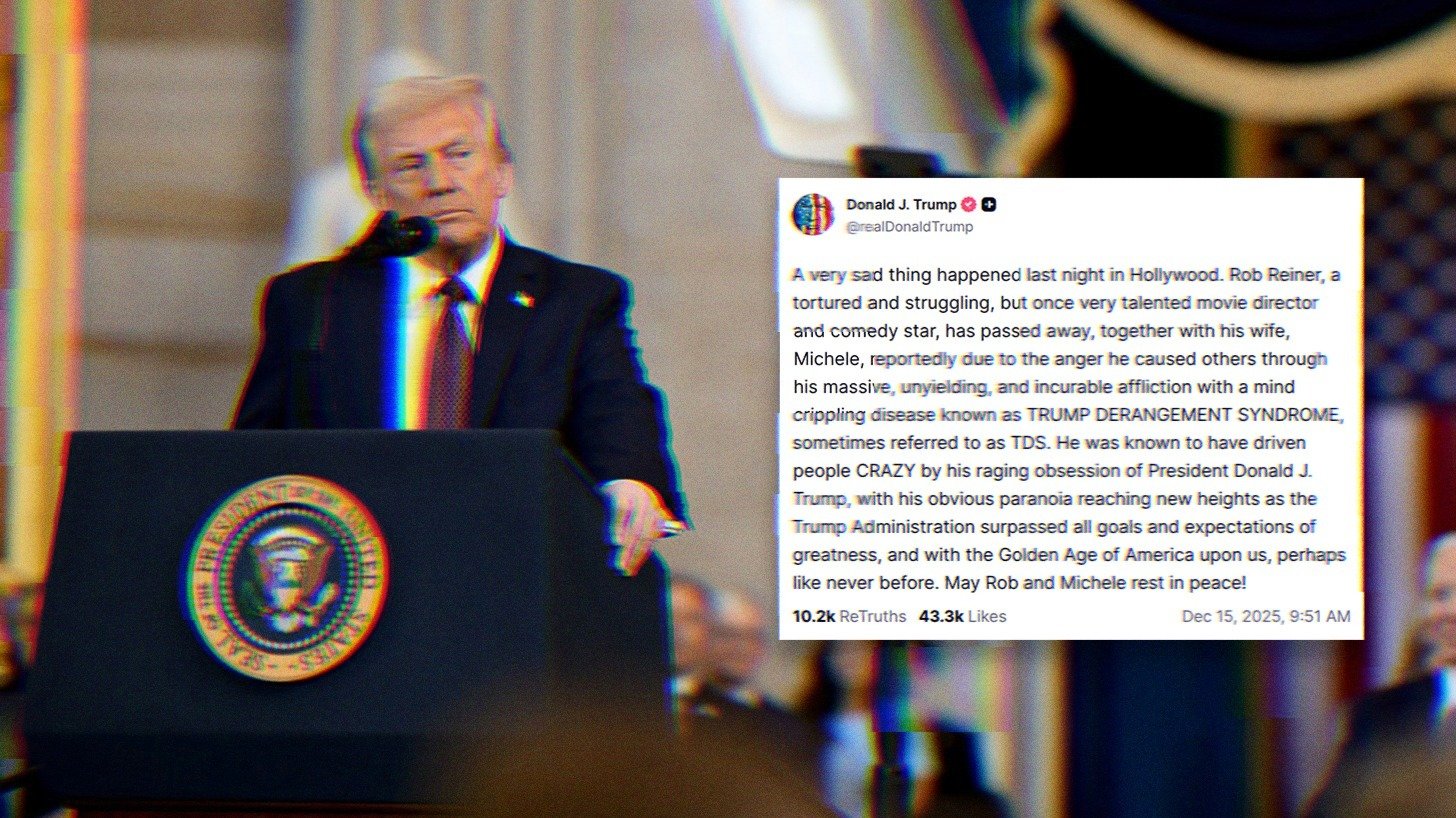
 Image Description: Donald Trump standing at the presidential podium. Alongside the photo is a screenshot of his TruthSocial post from 12/15/25 that reads, "A very sad thing happened last night in Hollywood. Rob Reiner, a tortured and struggling, but once very talented movie director and comedy star, has passed away, together with his wife, Michele, reportedly due to the anger he caused others through his massive, unyielding, and incurable affliction with a mind crippling disease known as TRUMP DERANGEMENT SYNDROME, sometimes referred to as TDS. He was known to have driven people CRAZY by his raging obsession of President Donald J. Trump, with his obvious paranoia reaching new heights as the Trump Administration surpassed all goals and expectations of greatness, and with the Golden Age of America upon us, perhaps like never before. May Rob and Michele rest in peace!" At the time of capture it has 10.2k ReTruths and 43.3k Likes.
The murder of Michele and Rob Reiner is a small story relative to the massacre in Australia and the shooting at Brown University that unfolded over the same dizzying news cycle. I say small because this is a family tragedy. A family story with the most gruesome and heartbreaking of endings.
The tragic nature of the crime and the notoriety of its victims made it a cycle dominating event. But it was Donald Trump who turned it into a cultural moment.
Donald Trump’s response moved me. His reckless musings on the tragedy symbolized something greater than the ramblings of a malignant narcissist. The post itself was an endcap. A punctuation mark on an era that had long been in decline. It wasn’t a eulogy for Reiner, clearly. But it’s part of the American cultural eulogy.
Actor, Director, Producer
Rob Reiner, or more specifically, Rob Reiner movies represent an important moment in popular culture. While his career extended from the 1960s through present day, the peak of his influence was as the director of some of the most cherished Hollywood properties from the mid 1980s to the mid 1990s. Before his directorial debut with This Is Spinal Tap in 1984, he was a marginal comedic actor whose most prominent role was as Archie Bunker’s son-in-law known to a generation as Meathead. It was a fantastic role in one of the most important sitcoms in modern history, but a far cry from the kind of fame and notoriety that his father Carl Reiner enjoyed.
Few would have imagined Rob Reiner filling his father’s legendary shoes but Spinal Tap would change everything.
It’s hard to describe to younger people today how groundbreaking the mockumentary format of Spinal Tap was. “Hello Cleveland,” “Are we going to do Stonehenge tomorrow?” and, of course, “These go to eleven” became shorthand for a new type of humor. While hardly a box office success, Spinal Tap would grow to become a cult classic and influence generations of self aware and absurdist storytellers. It wasn’t the first of its kind but it was the most important and enduring of all time.
Because Reiner appeared in Spinal Tap as well, playing the role of the earnest director, he still had one foot in both camps. But when Stand By Me came out two years later, Reiner officially entered the conversation as a serious Hollywood director. Not only was it critically acclaimed, but it was a box office hit that cemented Reiner as a bankable director with capable hands, and it launched the career of young actors who remain in the conversation to this day.
Reiner followed this up with The Princess Bride, which made a healthy return but certainly wasn’t considered a smash. Few would have predicted at the time that this movie would also become one of the most enduring and quotable films of all time. The mere mention of the word ‘rhyme’ and my mind instantly goes to “Anybody want a peanut?” Writers and directors have been chasing the innocence, humor and charm of this movie to no avail for 40 years.
When Harry Met Sally in 1989 literally established the mold for the modern romcom. A Few Good Men in 1992 was one of the most thrilling courtroom dramas of all time; a big time star vehicle that grossed nearly a quarter of a billion dollars. This led Reiner to co-found Castle Rock Entertainment, which itself became a mega production house.
And then there’s The American President in 1995 starring Michael Douglas as President Andrew Shepherd and Annette Bening as Sydney Ellen Wade, the president’s girlfriend.
In terms of commercial success and cultural significance, this decade is nearly unmatched. While he’s typically not mentioned in the pantheon of legendary Hollywood directors and doesn’t evoke the same critical response as some of his contemporaries, I would argue that two of these films capture the political sentiment of the modern Democratic Party. For better and for worse. And it’s this sentiment that Donald Trump abruptly and unceremoniously buried and laid to waste with the most callous of posts.
The Modern Liberal Mold
A Few Good Men and The American President. To me, these are two of the most important political time capsules from the 1990s. Brimming with self righteousness and sentimentality, these films imprinted a sense of optimism and privilege in a way that brought out the best of intentions while masking unconscionable blind spots. To understand this dichotomy is to understand the political landscape of the ‘90s and the shift that was underway in the Democratic Party.
These were the Clinton years. Before the Lewinsky scandal and during what many consider to be the resurgent era of Democratic Party principles. A young, southern governor with an aw-shucks charm and sincere charisma was reshaping the party and its core values. Clinton was able to somehow build on the perceived success of the 1980s in a way that brought capitalism from Wall Street to Main Street. The Reagan era restored American economic pride and rehabilitated the Republican brand but only for wealthy white individuals and corporate America. Government was the sworn enemy of progress and the working class would be fed by the table scraps of trickle down. For a while, it seemed to be working.
When the economy went into recession after the Gulf War under Reagan’s successor, the mystique of Reaganomics began to wear off with the middle and working classes coming to the realization that the gains were never going to reach them.
Instead of doubling down on working class policies of old, the American future was reimagined by a new generation of Democrats who believed that the financialization of the ‘80s could simply be packaged in the form of entrepreneurship and incentives. In their minds, the flaw wasn’t with the system itself, just in who was allowed to participate in it. The New Democrats with Bill Clinton as the model for change were the ones to declare the era of big government had come to a close.
Over the decade, the corporate establishment benefitted from deregulation set in motion under Reagan, trade agreements like NAFTA set in motion under George H.W. Bush and accommodative Fed policy in the beginning of the ‘90s. The economy did so well by their metrics that Clinton ended his eight years with a fiscal surplus. This is where the mythology of the modern Democratic Party was born. Nevermind that Black and brown Americans would be targeted by vicious laws that put another generation of men behind bars. Or that immigration status was weaponized. That the seeds of the housing crisis that would cripple the economy in less than a decade were firmly planted under Clinton. Or that our military budget continued to expand while entitlements shrank.
Generational setbacks for immigrants and native born Black and brown Americans, increasing inequality and rampant deregulation should have remained hallmarks of the Republican Party but instead they became staples of the New Democrats. A complicit liberal media went so far as to portray Bill Clinton as the first Black president. To celebrate a balanced budget, which any economist will tell you is the death knell of a growth economy. Gays in the military should be protected, so long as they just kept their mouths shut. Even after his affair with a young staffer was discovered, the Democratic establishment and liberal mainstream media ran cover for Clinton because, after all, he wasn’t Reagan.
With the right policy flank now owned by the Democrats, the only obvious path for Republicans was further right. The Overton Window in America shifted once again. To understand how far, one need look only to the reputational journey of none other than Colonel Jessep.
At the beginning of Clinton’s term, A Few Good Men was released to widespread acclaim and was an absolute blockbuster. Three of the biggest stars in the world—Tom Cruise, Demi Moore and Jack Nicholson—went toe to toe in a gripping courtroom drama pitting young principled military lawyers against the corrupt war dogs of yesteryear. The new generation prevailed but so too did the military in its own way. In this film, the military wasn’t viewed as the problem. The old guard and their traditions were the problem.
In many ways it set the stage for the Clinton era view on military affairs. It’s not the killing or forever wars we have a problem with, it’s the internal corruption, misogyny and racism. The performances were so electric and the movie so well crafted that it served to both honor the military and relieve our collective guilt over the way we treated our men and women in uniform. It marked a transition from the gritty realism of ‘70s and ‘80s war and war adjacent films that dealt with the fallout from Korea and Vietnam. It was a time when both parties were reclaiming the military narrative and while A Few Good Men wasn’t precisely a war film, it was a peacetime film that attempted to define a new era of American might. Tough but sensitive. Prepared but progressive.
Just a few years later things changed. We changed. Everything changed. 9/11 moved us all to the right and we have yet to recover. I vividly recall the raw emotion and bloodlust in my own heart. All the liberal sentimentality in my heart left in an instant. I lived in New York City. This wasn’t a shot across the bow, it was a stake to the heart. And it made Tom Cruise and Demi Moore look almost infantile and suddenly Jessup’s words carried new meaning. “You want me on that wall. You NEED me on that wall.” I did. We did. We all did.
This was more than an attack on our soil, it was a devastating blow to the ego. Pretty soon everything would be measured in terms of before and after. The intended lessons from A Few Good Men lived in the “before.” The unintended lesson came to define the “after.” We would never be left flat-footed again. This was now Jessup’s world and with the Democrats owning the “before” and Republicans in place in the “after” the window shifted once again. Never again would the Democratic Party even speak of cutting back on military spending or protecting civil liberties.
In the same way that Gordon Gekko was the villain of the movie Wall Street only to be celebrated as the heroic antihero that inspired a generation of finance bros and Wall Street enthusiasts, ignoring Colonel Jessup’s admonitions became the cautionary tale of A Few Good Men. In the years since, I’ve found it to be almost a litmus test for my generation.
Who did you root for? Cruise or Nicholson?
But the premise of the question was always flawed. Even without our chemically altered post 9/11 brains, the premise was flawed and in this way even Reiner was setting us up for a most violent millennium where we failed to question the existence of the military industrial complex. The desire among liberals in Reiner’s generation to absolve themselves of the guilt they harbored for the mistreatment of soldiers returning home.
The American President—also released before the Clinton sex scandal in the “before” times—had a tremendous impact on the American psyche. It asked important questions and was ahead of its time on issues of gun violence and climate change, but in doing so it too papered over the brutality of its own time period and the violence being perpetrated upon Black and Brown Americans, immigrants and the working class. There were more pressing privileged questions to be addressed.
Andrew Shepherd became the avatar for the Democratic candidate we ultimately found in Barack Obama. In fact, when Obama was under attack by the Republicans the question of when he would have his own “Andrew Shepherd moment” at the podium was raised quite often. The movie itself was the ultimate pre 9/11 alignment of the establishment liberal fantasy team. Aaron Sorkin and Reiner. The DNA of Sorkin’s The West Wing (and some cast members) come from The American President. The witty walk-and-talk. The respect for the office of the president. The idea that great leaders who face existential threats to their own power can rise to meet them with progressivism. It’s all in there. And that’s very much how The West Wing started off. That is, until even Sorkin’s window was yanked rightward with the rest of us in the “after” times.
The West Wing is the more savvy and centrist ideological heir to The American President and a real-time look into the Democratic pivot away from the working class and into its own aristocratic bubble of fast-talking Ivy League do-gooders who have to make paternalistic decisions and hard choices while questioning god above. Fire and white brimstone with just enough Black and Latino characters to check the boxes for the network.
But Rob Reiner films don’t necessarily belong in the prototypical “white savior” Hollywood camp—more like the “saviors just happen to be white” camp.
And understand this isn’t a critique of Rob Reiner the filmmaker nor as cultural icon or political activist. And certainly not of the man. By all accounts he was as kind and generous as he was talented. It’s an acknowledgement of what sells in Hollywood. How we like to view ourselves. His films expressed a modern sense of noblesse oblige, filled with sentimentality about process and dignity and character.
To be clear, I want to live in Rob Reiner films. I cannot overstate the impact these and even several white savior films had on my consciousness and upbringing. Because they occupy such an important place in the “before times” for my generation in particular, I can very easily put myself in that mindset and yearn for stability and incrementalism and liberalism.
But understanding that these are just works of fiction—fantastical notions of American liberalism and not reflections of it—is exactly the concept of being woke. To understand that Harry is never landing Sally and that Sally’s job could never buy such a kickass apartment in New York. To know that Santiago was never getting justice. To know that the Republican Party would become the party of Bob Rumson and that our president was never going to get the guns or have that Andrew Shepherd moment that sacrificed careerism for the greater good. To be “woke” is to understand that the world of The American President has more in common with the world of The Princess Bride than it does America.
That’s why Donald Trump’s post was important to me. Rob Reiner didn’t succumb to Trump Derangement Syndrome (. Nor did he suffer from it in life. The only person who suffers from TDS is its namesake. And that’s the whole point here. My kids don’t have a relationship with these films. My elders might have enjoyed them at one time, but for the most part they too belong to the party of Bob Rumson and want Colonel Jessep on that wall. But for those of us who absorbed the saccharine sentimentality of this very specific era in the “before time” and can easily slip in the warmth of this nostalgia, Donald Trump is here to tell you that not only is it never coming back, it was never real.
The celluloid image of America read in Sorkin dialogue and seen in Reiner visuals exists only on sound stages and Hollywood lots. It’s a vision that papers over reality and now lives in Democratic platforms and DNC talking points and soon on the In Memoriam segment at the Oscars.
We can honor Rob Reiner the family man and promoter of liberal causes who launched countless careers and performed countless good deeds.
We can honor Rob Reiner, the capable director and vibrant storyteller who allowed us to lose ourselves for a couple of hours in a world that never existed with outcomes that never occurred.
We can mourn a family tragedy that stole a husband and wife, mother and father.
And we can be sickened by the words of a disgusting man, a slovenly and unhinged narcissist, filled with hate and avarice who is a danger to our country and the planet. So long as we recognize that he is America’s id and we grapple with the fact that half of us put him in this seat not once, but twice.
I can view A Few Good Men and The American President as fictions reflecting a curated and bespoke world of liberal fantasies and thoroughly enjoy them. Just as I thank god that Spinal Tap and Princess Bride exist in the world. Being woke doesn’t mean you turn off this part of your brain; just that you see things for what they are. And I appreciate Donald Trump continuing to reveal himself for what he truly is and has always been.
Our job is to fight tooth to pull the Overton window as far left as possible. Just know that we’re not looking for Lt. Daniel Kaffee or Andrew Shepherd. The goal is to face ourselves and peer into the cells at Guantanamo Bay and El Salvador’s mega prison where we sent innocent, non-violent asylum seekers. Under bridges and in cars where more than 800,000 of our fellow Americans sleep at night. In the neighborhood restaurant where the Dasher or Uber Eats driver grabs a five minute nap on their feet while they wait for your food delivery on their third gig shift of the day. Into the waiting room where a loved one sits on hold with the insurance company that denied a claim for the fifth time. Or was it the sixth?
Donald Trump personifies our worst instincts, but he’s not us.
Tearing down Trumpism and voting out his acolytes isn’t enough if what replaces it is a thin veneer of professionalism and dignity. The military industrial complex has to be torn down and rebuilt into a civilian labor corps. Our broken healthcare system can’t be ventilated with subsidy extensions, it has to be replaced with universal coverage. We have to recognize that our system of taxation doesn’t exist to pay the bills because we have a sovereign fiat currency that serves as the world’s reserve currency; our tax system exists specifically to redistribute wealth. We lost the opportunity to impact climate change so we better start investing in large-scale climate resiliency, not capital intensive data centers that destroy workers and soak up our precious water supply.
So forget the liberal fantasies and dream bigger. Best the giant, beat the swordsman, battle the rodents of unusual size so that we can honor the smallest requests of our grandchildren by saying, “as you wish.”
Image Source
- The Trump White House, Public domain, via Wikimedia Commons. Changes were made.
 Max
Max
Max is a political commentator and essayist who focuses on the intersection of American socioeconomic theory and politics in the modern era. He is the publisher of UNFTR Media and host of the popular Unf*cking the Republic® podcast and YouTube channel. Prior to founding UNFTR, Max spent fifteen years as a publisher and columnist in the alternative newsweekly industry and a decade in terrestrial radio. Max is also a regular contributor to the MeidasTouch Network where he covers the U.S. economy.