
The Real Story Behind the Castro Indictment.
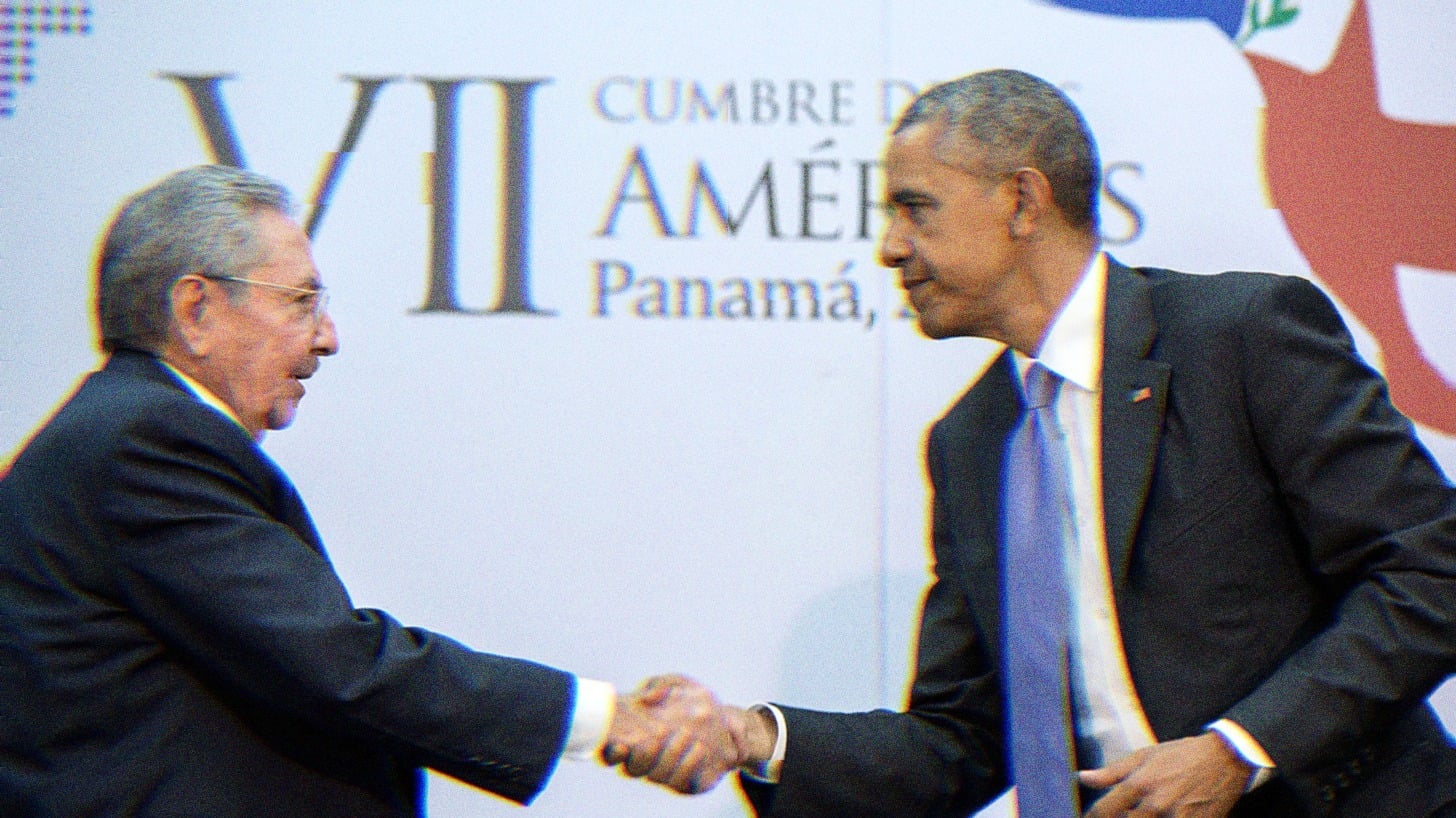 Image Description: Raúl Castro shaking hands with President Obama in 2015.
The charges against Raúl Castro are the pretext for another invasion into a neighboring country in Latin America. Our sick paternalistic attitude toward the LAC region is a cancer on the world, and it’s clearly not in our own power to put an end to it. In this essay, Max discusses the charges, speaks to the Castro regime, the history between our nations after the ‘59 revolution and the hypocrisy of the American media. He appends the piece with a three step plan that would outflank the United States and level the playing field.
The United States Department of Justice, under Todd Blanche, has just unsealed a federal indictment against a 94-year-old former head of state who hasn’t held formal power in almost two decades in Miami. Charges: conspiracy to kill U.S. nationals, destruction of aircraft, and four individual counts of murder. All stemming from an incident that happened 30 years ago where two civilian aircrafts were shot down by the Cuban Air Force, and four men tragically died.
As usual, it’s also a bit more complicated than just that. The blame is being laid on Cuba’s Raúl Castro by Donald Trump’s former personal criminal defense attorney-turned Attorney General. And the grand jury that returned it sat in Miami, in the heart of the Cuban exile community that has been the base of Marco Rubio’s political career for his entire life.
Before we go any further, let’s be clear that Raúl Castro is not a good person by the standard of human rights or liberal democratic values. He is not a victim.
Raúl Castro was the military enforcer of the Cuban revolution from day one, running the armed forces and domestic intelligence apparatus with an iron fist. After the 1959 revolution, while Fidel played the diplomat and the propagandist, it was Raúl who oversaw the tribunals and the executions—Batista loyalists, real and alleged, summarily tried and shot. It was Raúl who purged the ranks when ideological deviation threatened the party. It was Raúl who kept the internal security apparatus grinding for decades, disappearing dissidents, criminalizing Cuban members of the LGBTQ community until shamefully late in the revolution’s history.
All of that is true. And none of it is remotely in dispute. One interesting point of order is that his daughter, Mariela Castro, is the leading voice and advocate for LGBTQ rights in Cuba, so there’s at least some good that came out of Raúl.
But the relationship between the Castro family and the Cuban people is complex. When I traveled to Havana in 2017, I spoke with people who called Fidel a murderous dictator in one breath and a beloved father of the revolution in the next—sometimes in the same sentence. The Cuban experience is complicated in a way that Americans simply cannot appreciate.
But here’s what’s also true: the country that is now charging Raúl Castro with murder and conspiracy has, in just the last several months, incinerated an elementary school in Iran, killed its leader, kidnapped a different sitting world leader and took control of its oil interests, threatened to take over Greenland, and is now causing fuel and food shortages around the world because of its failed quagmire in the Strait of Hormuz.
Closer to home and Cuba, the United States has illegally blown up approximately 60 fishing vessels in the Caribbean over the past several months. It has also imposed an energy blockade on an island nation of 11 million people that has left them entirely without diesel and fuel oil. And now 11,000 children have to wait for vital surgeries, because the hospitals don’t have enough fuel to keep the lights on long enough to perform them.
In the meantime, we have a sitting president who has, in a matter of weeks, been credibly accused of insider trading, created a $1.8 billion slush fund for his criminal allies and whose family is engineering a private central bank through crypto legislation. It was also revealed in Donald Trump’s recent financial filings that his trust—which is not a blind trust, rather it is controlled by his son Don Jr.—made nearly 3,700 stock trades in the first quarter of 2026, with a value of between $220 million and $750 million. And many of the names that were traded were explicitly promoted by Donald Trump in press conferences and open forums.
But the Cuban government is corrupt? Throw stones in a glass house much?
The idea that this government has standing to criminally charge any other head of state for anything is, at this particular moment, a special kind of absurd.
Brief History of a Failed Alliance
Here’s a thing that almost no American history textbook will tell you: the first thing Fidel Castro did after the revolution was try to meet with the United States government. He came to New York in April 1959. He wanted to establish a relationship. The Eisenhower administration refused to meet with him. Eisenhower himself left Washington for a golf vacation, rather than receive Castro. Vice President Nixon met with him briefly, and came away convinced he was a communist and should be handled accordingly.
So here is the sequence of events: we rebuffed him, we organized the CIA-backed exile invasion at the Bay of Pigs, we tried to assassinate him over 600 times (by some counts), we imposed a comprehensive economic embargo that has strangled the island for 60+ years, and then we spent decades asking why Cuba aligned with the Soviet Union and why the Cuban people are so hardened in their opposition to the United States.
Fidel didn’t start as a communist. Raúl was legitimately an ideological communist at the time of the revolution along with Ernesto “Che” Guevara. The fourth member of the original revolutionary crew, Camilo Cienfuegos, was simply opposed to the U.S.-backed dictator Fulgencio Batista. Fidel ultimately embraced communism out of survival because the Soviet Union offered him what we refused to: economic survival and a security guarantee.
Fidel made a Faustian bargain and the Cuban people have been paying the price ever since. Not just for his choices, but for ours.
The Helms-Burton Act of 1996—passed the same year as the Brothers to the Rescue shootdown—doubled down on the embargo and made it even harder for any administration to normalize relations without an act of Congress. It codified our policy of permanent hostility toward Cuba into statute, and created the conditions in which today’s indictment and flirtation with regime change were always possible.
Here’s my thesis, and I believe it in my bones.
Had we normalized relations with Cuba decades ago—had we chosen trade over embargo, diplomacy over sabotage, engagement over isolation—the arc of Cuban history would look completely different.
Cuba’s centrally planned command economy had real structural flaws. But no planned economy operates fairly when the world’s most powerful market economy —90 miles away from us, mind you, which would make us the most logical and significant trading partner—is systematically strangling its trade routes, its fuel supply, its banking access, and its tourism industry. We crushed their economic opportunity at the same time as we hardened the resolve of the Cuban people to defend the very government we were trying to destroy. We created the conditions for the regime to survive by making the enemy at the gates so vivid, so immediate, so real.
And here’s how our internal propaganda campaign continues with funhouse mirror logic. Here’s a passage from a recent Bloomberg editorial, because I think it captures something important about how the American media covers Cuba. See if you can spot the internal contradiction:
“Now, with the country running out of food and fuel, the regime on the brink and anger spreading in the streets, it’s those private businesses—run by once-persecuted, small-scale capitalists—that hold the key to salvaging what’s left of Cuba’s economy. That salvage operation can’t come fast enough for US President Donald Trump’s administration, which has imposed a de facto energy blockade on the Caribbean nation. Trump’s spy chief visited Cuba this week, a day after the country said it had completely run out of diesel and fuel oil, to stress that radical change is needed before the administration begins to dial back the pressure. Havana has frustrated the US over a lack of progress in opening its economy and political system. It’s this narrow stretch—between a punitive Washington and a stubborn ruling class that has held power for 67 years—that small business owners have to navigate.”
Did you catch it?
In the same editorial, the author is arguing that private enterprise is the key to salvaging Cuba’s economy, and that it’s the only part of the economy thriving during the U.S. blockage and sanctions regime. Then he goes on to say that if they would only allow private enterprise to thrive, we would stop. Which is it?
So you’re telling me that private enterprise is thriving in Cuba despite everything, which proves capitalism works, but also that the United States has cut off Cuba’s fuel, trade, and energy supply to ensure that nothing works, government or private? And the framing makes this sound like Cuba’s stubbornness is the problem.
Here’s what’s actually happening.
The private businesses operating in Cuba are surviving in spite of the blockade, not because of anything the blockade has accomplished. And clearly they’re allowed to exist in some capacity. Either way, the reason both the state-run economy and the private sector are underperforming their potential is the same reason it’s always been: we have choked off their trade, their energy, their banking, and their tourism for 60 years. We have tried to murder their leadership. We have tried to overthrow their government. We have funded exile groups. We have run influence operations. And then we turn around and write editorials asking why they’re struggling, and suggesting the answer is that they need to open up to capitalism.
The hypocrisy on the Cuban question is beyond description. So what the author really means, and what we’ve been after all along is our capitalism to thrive there. This is the hangover of Dulles Brothers thinking—the idea that we cannot allow even a whiff of socialism to succeed anywhere in the world because it sets a bad example for us.
So What Are We Actually Doing Here?
The Brothers to the Rescue indictment charges: conspiracy to kill U.S. nationals, destruction of aircraft, four counts of murder. The planes were shot down on February 24, 1996. Four men died. Carlos Costa, Armando Alejandre Jr., Mario de la Peña, and Pablo Morales. Real people. Real deaths.
Now here is what you also need to know about Brothers to the Rescue. The organization was founded by Cuban-American activist José Basulto, himself a veteran of the Bay of Pigs invasion—the CIA-organized attempt to overthrow the Cuban government. Brothers to the Rescue flew rescue missions over the Florida Straits, looking for rafters attempting to cross from Cuba. That is legitimate and honorable work.
But in the period leading up to the shootdown, the organization had also reportedly begun flying into Cuban airspace though they were explicitly warned against doing so, by both the Cuban government and the U.S. FAA. Multiple incursions. Cuba had complained formally through diplomatic channels. The U.S. had warned Basulto directly. On the day of the shootdown, one of the aircraft may have been in international waters. The other, according to Cuban accounts and some independent analyses, may have been in Cuban territory.
None of that justifies the deaths. But it is the context that a prosecution in Miami—the city most invested in a particular historical narrative about Cuba—is not going to voluntarily provide you.
And now we’ve captured Nicolás Maduro. We have Venezuela’s head of state in U.S. custody. Cuba’s closest ally—the country that has provided the Cuban government with security assistance, training, and the oil lifeline that kept the revolution alive—has been decapitated. Its president is gone. The petrodollar and the Rubio family’s generational score-settling are being settled simultaneously.
The idea that we would now indict Raúl Castro and potentially move toward detaining him—a 94-year-old man who hasn’t held formal power since 2018—on charges stemming from an incident 30 years ago, at the moment we are actively strangling his country of 11 million people, is not justice. It is the pretext for the next move.
The right answer is easy. Diplomacy. Economic normalization. Recognition that Cuba is a sovereign nation, however imperfect its government, with the right to self-determination. That’s it.
But right now, I’m more worried than ever before. Venezuela. Maybe Cuba. I mean, is Mexico next? Are we going to parachute into Brazil to jail Lula and free Bolsonaro? If you can imagine the absurd, then we are wholly capable of it, because no one has dared to stop us.
The Castro family—whatever you think of them, whatever crimes they committed, whatever opportunities they squandered—has made it through Eisenhower, Kennedy, LBJ, Nixon, Ford, Carter, Reagan, two Bushes, one Clinton, Obama, and Trump’s first term. Thirteen U.S. presidential administrations. Sixty-seven years. In the face of assassination attempts, the Bay of Pigs, the Special Period, the Helms-Burton Act, the loss of Soviet support, the loss of Venezuelan oil under previous sanctions, the complete isolation of their banking system. They survived all of it through some combination of stubbornness, genuine popular support built on the very siege mentality we created, and sheer luck.
But the current situation is genuinely different. Cuba is completely out of diesel and fuel oil. Not low—out. Maduro is in U.S. custody and Venezuela is in chaos. There are no new sugar daddies on the horizon. China and Russia have their own problems. The island is dark.
And there is no Fidel. There is no charismatic figure around whom the population coalesces, whose mythology absorbs the suffering and turns it into revolutionary pride. There is a technocratic government that the population tolerates more than loves. Open trade with Cuba, allow for diplomatic normalization, and I promise you the Cuban people will take care of their own destiny.
Three-Pronged SOS Strategy
Here are three outrageous moves that could outflank the most powerful nation on earth, protect the Cuban people’s right to self-determination, and call this administration’s bluff, because that’s all you can do to a bully.
One: The Pope sets up shop in Havana. Indefinitely.
Cuba is a predominantly Catholic island. Pope Leo has been vocal about U.S. authoritarianism, about the moral bankruptcy of economic warfare against civilian populations. The Church has real moral authority that this administration, despite its evangelical cosplay, cannot dismiss without political cost. If the Pope is physically in Havana, you cannot bomb Havana. You cannot starve a city with the Bishop of Rome in it. Put up or shut up. Where is the Church?
Two: Canada breaks the blockade and delivers fuel.
Canada has maintained diplomatic ties with Cuba throughout the entire 60-year U.S. embargo. Canadians vacation there. They have relationships, infrastructure, and standing. The Trump administration has been openly hostile to Canada—tariffs, annexation rhetoric, the whole package. Canada has every political reason in the world to give the United States the middle finger on this one. Send the oil tankers. Break the blockade. Dare Trump to sanction his own neighbor’s ships in international waters. Let’s see how that plays with the rest of the world.
Three: The naval armadas of Colombia, Mexico, and Brazil dock at Cuba’s 29 major ports.
These are the pillars of the Bolivarian tradition—the left-leaning governments of our hemisphere that have watched the United States kidnap Venezuela’s president and starve Cuba into submission. Not to mention our history of paternalistic dollar and gunboat diplomacy, countless interventions into Guatemala, Nicaragua, Grenada, Panama, El Salvador, Chile—the list goes on. Colombia under Petro. Sheinbaum in Mexico. Brazil under Lula. They have navies. They have political will. If those ships are docked there, the calculus of any military intervention changes entirely. You are no longer talking about a small island the United States can push around. You are talking about an act of war against three of the largest economies in the Western Hemisphere.
Deliver the fuel. Prepare the fleets. Send the Pope.
I’ll leave you with this.
The revolution that Fidel and Raúl Castro built was deeply flawed. It imprisoned dissidents. It executed people. It ran a surveillance state and suppressed political opposition for more than six decades. None of that is excusable.
But the revolution also built a healthcare system that produces more doctors per capita than almost any nation on earth. A literacy rate that is the envy of the developing world. A population that, through everything, has maintained a fierce and genuine pride in its sovereignty and its identity—a pride that we, through our relentless and punishing hostility, helped to forge.
The Cuban people deserve the right to determine their own future. Not Marco Rubio’s future for them. Not Todd Blanche’s grand jury in Miami. Not a regime change engineered by the same administration that is simultaneously staging a $1.8 billion slush fund for insurrectionists in our own country.
They have made it through 13 administrations. For the love of everything that is decent about this country’s founding ideals, please don’t let the Cuban people’s story end at the hands of this one.
Image Source
- The White House from Washington, DC, Public domain, via Wikimedia Commons. Changes were made.
 Max
Max
Max is a political commentator and essayist who focuses on the intersection of American socioeconomic theory and politics in the modern era. He is the publisher of UNFTR Media and host of the popular Unf*cking the Republic® podcast and YouTube channel. Prior to founding UNFTR, Max spent fifteen years as a publisher and columnist in the alternative newsweekly industry and a decade in terrestrial radio. Max is also a regular contributor to the MeidasTouch Network where he covers the U.S. economy.