The Market Is Going To Crash in Early 2027.
On The Record (11-25-26).
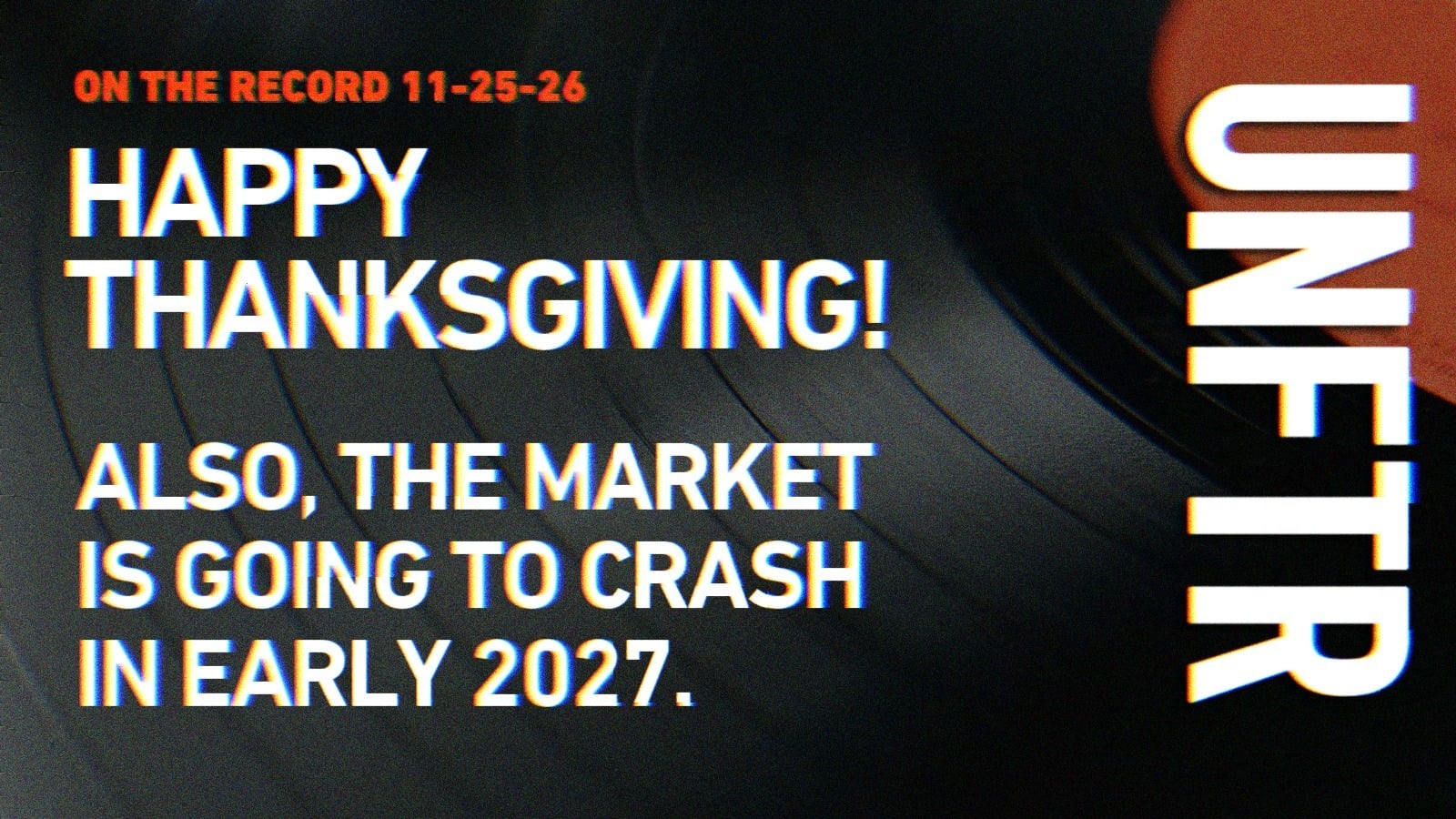 Image Description: On The Record 11-25-26. Happy Thanksgiving! Also, the market is going to crash in early 2027. UNFTR.
The AI trade is unwinding as market volatility spikes. Max breaks down the current economic landscape to prepare you for holiday conversations. Equities market turbulence and rising borrowing costs are leaving investors exposed as short sellers circle. This segment analyzes how these pressures are shifting the financial landscape and what they mean for your outlook as we head into the end of the year. Beyond the immediate numbers, we look at the broader implications of this precarious future. Max provides clear talking points to help you navigate tricky discussions with family and friends about the state of our economy during Thanksgiving.
I left off a couple of days ago on an uncharacteristically optimistic note about our collective future, and today I’m building on it by tearing down the sentiment somewhat. There is a lot happening in global markets right now, and none of it is good.
You may have conversations over turkey and stuffing about the blue wave, the end of MAGA, the goings-on at Nvidia or gas prices. Your rich aunt is probably concerned about the stock market. Your college kids might be worried about getting a job. Some around the table might be killing it, while others are silently suffering and wondering if this is the last big meal they’re going to have. Others might be alone and hungry. Meanwhile, there are good people sitting in detention centers right now, and military members abroad wondering if their boots will be two of the boots on the ground in an expanded conflict with Iran.
The holidays bring strong emotions, complicated family dynamics and uncomfortable conversations. So I’m going to add a little fuel to the fire. I’m not looking to bring anyone down. Our primary mission here is to educate people about the economics of this strange place we call home. There are things brewing right now that can’t be walked back, and if you have time to really think things over heading into the holiday season, I want to offer a holistic way to look at all of it.
Let me start in a weird place. Argentina.
The Milei miracle is coming to a close. Argentina’s economy contracted 0.6% in the second quarter, and the monthly activity data released this week confirms that the third quarter shrank as well. That’s a technical recession, with the official GDP number due Dec. 16.
Argentina has been a hot mess for a long time. Milei’s fix was to manage the currency to bring down inflation: The official peso rate rose only about 6% this year while consumer prices rose 26%, which keeps imports cheap and crushes anyone trying to make things there. Then he cut social services to the bone, with public works spending down 70% in real terms, and cleared the way for outside money to finance the whole arrangement.
It’s a classic neoliberal playbook that always works in these conditions until it doesn’t. The anchor holds as long as dollars keep flowing in. This week the peso hit a record low past 1,600 to the dollar, and poverty is back above 32%.
Magnify that by a thousand and here we are in the United States, where the inflow holding everything up is the river of capital pouring into AI. All the geniuses sitting around the table with you, talking about how they’ve murdered it in their portfolios over the past several years, are about to come face to face with the reality of capitalist economics and market conditions.
Gold is about 37% below its January record, silver is down even more, and bitcoin hit its lowest level in more than two years last weekend. On Nov. 20, stocks, gold and bitcoin all fell more than 3% on the same day. That’s a margin call seen from the outside: funds losing money on AI sell whatever they can to raise cash, hedges included.
The AI trade is coming apart. Nvidia more than doubled its revenue, and the stock fell anyway. Jensen Huang’s return sent it up 31% in a day, and that bump is already fading, down nearly 6% the next day and another 4% today. The short sellers smell it. Hedge funds shorted U.S. stocks every day last week, the heaviest weekly shorting since 2022.
And SoftBank, the most leveraged believer in the story, is imploding: its worst month since 2000, 72% of its Arm stake pledged against a $25 billion margin loan, and the cost of insuring its debt at its highest since 2022.
And borrowing is getting more expensive everywhere. Eight of nine major central banks have raised rates this year as inflation climbs. Here, prices were up 3.7% over the year in September, and the Federal Reserve is expected to hike again in December.
You know why the GOP wants to increase military spending so dramatically? Because it contributes to GDP. If you want to keep the headline number looking healthy, add government spending. Last quarter, defense spending grew at an annualized rate of almost 12%, its fastest since 2020, and added about four-tenths of a point to growth. We’ve demonstrated in prior essays that the true military budget is likely already closer to $1.8 trillion. And now the administration has asked for $445 billion more, a 42% increase, with $350 billion of it routed through a party-line reconciliation bill.
Of course they do. Trump will try to continue this war because he can’t show weakness, and the audience he’s most worried about is the market.
But it won’t matter. The bond market has spoken. Junk bond spreads, the extra interest the riskiest companies pay over Treasurys, just had their biggest weekly blowout of the year, led by the lowest-rated borrowers. The liquidity tide is rolling out toward staples, Treasurys and the dollar. All because we oriented the economy around one investment that promised to either take all of our jobs or destroy us. Either way, it was always going to take all of our money.
This is the result of our push toward a financialized economy, working hand in hand with the never-true narrative that AI will give us all a life of leisure. A financialized economy is built on capital flows, and capital flows when money is cheap and easy. It’s been both of those things since 2008. Money will still be available. It just won’t be cheap.
The banks have lots of money because we forced them to hold onto it, nearly $3 trillion in reserves. The cracks are outside the regulated system, in private credit, which lends to midsized companies. KBRA just counted a record 112 defaults among those borrowers over the past year. Those cracks are about to become chasms that swallow whole sectors, because the capital calls are in. And forced deleveraging at the risky end of the market destroys money outright. A loan repaid with fire-sale proceeds just disappears, and none of it lands in a safe haven.
To paraphrase Warren Buffett, you only find out who’s been swimming naked when the tide goes out. We’re about to see whole sectors tied to the AI trade standing there in the buff.
The so-called investment-grade world will weather this storm: tried-and-true companies, wealthy people who’ve rotated to safety, holders of government paper in mature countries like ours, and the banks. For everyone else, I don’t think we’re prepared for the shock that’s headed our way. This all adds up to demand destruction on the consumer side and a credit freeze in the middle market. That’s where the hole will open up. And once again, like clockwork, we’re going to see a liquidation of wealth in the bottom half of the country on the scale of ‘08 and ‘09.
This will sound egocentric, to say the least, but just over a year ago, I put together our prediction for how this would all go down, and we haven’t really missed a thing. Sadly. So this next part has an air of inevitability to it, because more of us are standing naked just below the tide line than not.
Politically, this will open massive holes in the federal budget, so be prepared for the conversations that follow. Republicans and middle-of-the-road Democrats are already warning that Social Security is running out of money and that interest on the debt is blowing up the deficit. These are distractions. We’ve chosen a capitalist path, and we have to deal with its consequences until we can show a more sustainable path from social democracy to democratic socialism.
But the people around your Thanksgiving table, as strong as that blue wave was, aren’t ready to use those words or have that conversation yet. They’ll have to lose a lot more before they’re ready to entertain these ideas. When they are, we need answers ready and demands made to our representatives. Most of them don’t have this mindset. We have work to do.
Here are the conversations we need to start having, beginning at the dinner table.
Social Security. Easy. Blow the cap. The payroll tax only applies to the first $184,500 of wages, $192,300 next year. A nurse pays on every dollar she makes. Someone earning $1.8 million pays on about a tenth of it. The trust fund is projected to run short in 2034, when it could still pay 83% of benefits. According to Social Security’s own actuaries, taxing all earnings would keep the program solvent for more than 40 years.
They’ve concentrated capital at the top, so that’s where we collect it. You can’t get blood from a stone. Rich people and poor people drive on the same roads, and those roads need to be paved and clearly lined. A dignified retirement belongs in the same category. It’s part of the social contract. So blow the cap. And when Republicans say people should be allowed to invest their Social Security in the stock market, remember that they won’t be singing that tune when the market crashes. Don’t hum along.
Medicare for All. It’s a no-brainer. A new Yale analysis estimates single payer would cut national health spending by about $1 trillion a year. When someone quotes you a multitrillion-dollar price tag, remember we already pay that money in premiums and deductibles. Hospitals keep running, and doctors get to practice medicine. Pair it with a civilian labor corps that moves displaced insurance middlemen into agencies doing productive work the market won’t, and everyone is better off. We can do better for less money. How’s that for efficient?
If your relatives are ready to hear about student debt, start with mass refinancing. Americans owe $1.86 trillion, and more than 9 million borrowers are in default. New undergraduate loans carry 6.52%. Refinance every outstanding loan, public and private, at the federal funds rate. After 20 years of 90% or better on-time payments, forgive whatever’s left. You’d nearly eliminate defaults, and the principal would get paid back. Better for the government, better for students. Then require every school that accepts federal loan money to pay into an insurance fund that covers defaults. With skin in the game, they’ll start thinking about tuition.
And energy. Float a national energy bond and start buying out the private power producers and utilities across the country, so we can nationalize the grid and build a renewable, resilient infrastructure. I have the perfect workforce for it: our brilliant military members. Bring them home and deploy them to harden the grid and make us less reliant on fossil fuels. Paint it as national security, and there you have it.
Every big idea in this country was born in a time of crisis. So if we know we’re heading into one, we should start mapping these ideas out now. As for the market, I’m afraid it’s beyond saving. Let’s make sure we keep electing officials who concern themselves with helping the victims of the giant risk-taking schemers who are about to blow the market to smithereens, instead of bailing them out.
 Max
Max is a political commentator and essayist who focuses on the intersection of American socioeconomic theory and politics in the modern era. He is the publisher of UNFTR Media and host of the popular Unf*cking the Republic® podcast and YouTube channel. Prior to founding UNFTR, Max spent fifteen years as a publisher and columnist in the alternative newsweekly industry and a decade in terrestrial radio. Max is also a regular contributor to the MeidasTouch Network where he covers the U.S. economy.