
The Donroe Doctrine.
Fiction. (But We Wish It Wasn’t.)
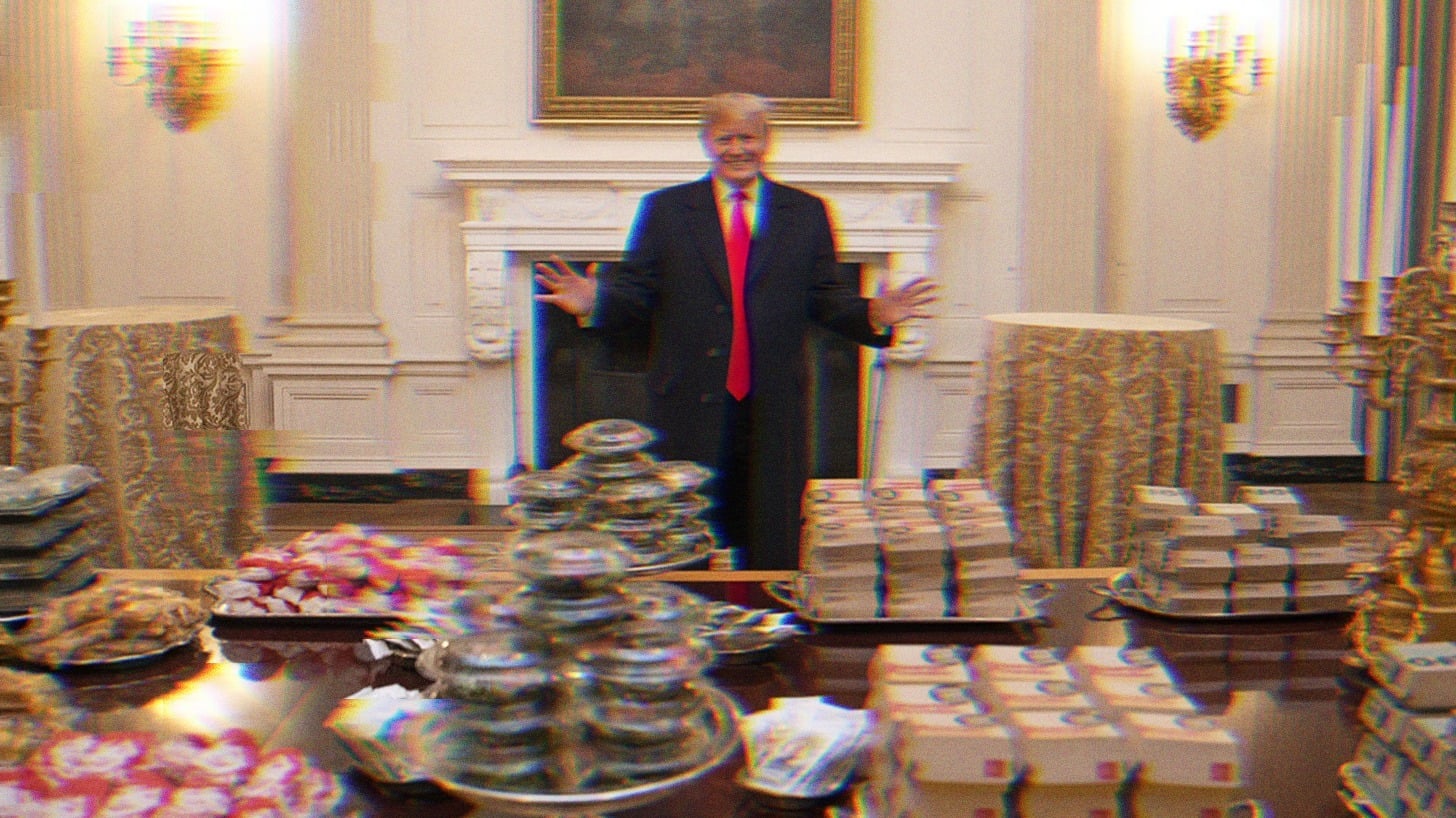 Image Description: Donald Trump in the State Dining Room in front of piles of food from Domino’s, McDonald’s, Wendy’s and Burger King.
FOX NEWS CHYRON
PRESIDENT TRUMP ANNOUNCES BOLD NEW HEMISPHERE DOCTRINE. IS AMERICA GREAT AGAIN OR WHAT?
The Donroe Doctrine, as it came to be known in the chancelleries of the world, though in most of those chancelleries it went by considerably more colourful names, was announced on a Tuesday, because Tuesday was the day Donald J. Trump (J for jenius) held what his press secretary, Karoline Leavitt, a woman with the permanent expression of someone who has just been handed a tarantula and told it was a kitten, called Big Vision Afternoons.
The doctrine was simple, as doctrines crafted by men who have never read a book tend to be. It stated that the Western Hemisphere was the personal property of the United States of America, and that any nation within it that refused to acknowledge this foundational truth would face what the President called ‘consequences,’ a word he deployed the way other men deploy punctuation. That is, constantly, vaguely, and with the barest understanding of what it meant.
‘Cuba,’ the President told a gathering at Mar-a-Lago, ‘is ninety miles away. Ninety miles. That’s like longer than a golf course, but not as long as many golf courses put together. Beautiful golf courses, by the way. I think they should build one in Cuba, they should call me, but they won’t. They’re communist, it’s very sad.’
He paused. The gathering applauded. Several men in suits and red hats began chanting something that was almost certainly not in the Constitution.
‘And so,’ he continued, consulting a sheet of paper that appeared to have been written in crayon, ‘under the Donroe Doctrine, Don Roe, has a nice ring to it, which is like the Monroe Doctrine, but better, because Monroe is dead and I’m not, I am probably the most alive person ever, we are declaring that Cuba must immediately hold free elections, surrender its cigars, which are frankly overrated, I prefer American cigars, we make the best cigars, and acknowledge that the United States is, and has always been, the greatest country in the history of the universe, including space, which as you know, is very big, but also not a country.’
Secretary of State, Marco Rubio, stood behind him wearing the expression of a man who had spent three decades dreaming of a particular moment only to find that someone has replaced it with a box of stale donuts. Despite this, he clapped. He always clapped, clapping was, at this point, his primary diplomatic instrument.
FOX NEWS CHYRON
CUBA CRISIS UPDATE: COMMUNIST ISLAND ONLY 90 MILES AWAY, EXPERTS CONFIRM.
In Havana, President Díaz-Canel read the transcript of the Donroe Doctrine speech three times, before pouring himself a rum and reading it again.
‘He wants us to acknowledge,’ he said to his Foreign Minister, Bruno Rodríguez, ‘that he is the greatest thing in the universe, including space.’
‘Yes,’ said Rodríguez.
‘The man who put children in cages, threatened to annex Canada, referred to Haiti as something I am too polite to repeat, and once suggested the use of a nuclear weapon on a hurricane. This man?’
‘The very same.’
Díaz-Canel looked out the window at the Malecón, where the sea performed its eternal, unhurried conversation with the seawall, indifferent to empires, as it had always been, as it would always be. He was thinking about 1898, when the United States ‘liberated’ Cuba from Spain and then installed its own military government. He then thought about the Bay of Pigs, that magnificent debacle of 1961, when fifteen hundred CIA-trained exiles waded ashore expecting a popular uprising and instead found the Cuban army, which had been expecting them since the operation had been announced, more or less, in the New York Times. He then thought about sixty-plus years of blockade and about Operation Mongoose, the covert programme that had included, among its more creative proposals, an exploding cigar intended for Fidel Castro.
He put down his rum.
‘What is the number for the Vatican?’ he said.
Pope Leo XIV, born Robert Francis Prevost in Chicago, Illinois, shaped by decades of pastoral work among the poor of Peru, elected to the Chair of Saint Peter in May 2025, and immediately described by the President of the United States as ‘weak on crime,’ was in his study when the call from Havana arrived.
He had grown accustomed, in the months since his election, to being described by Trump in terms usually reserved for particularly disappointing restaurant reviews. He had been called ‘terrible for foreign policy,’ ‘a disaster,’ ‘frankly not a great Pope, probably the worst in history, maybe ever, historians are saying this,’ and, memorably, ‘a radical left lunatic, which is very surprising coming from Rome where they dress, let’s be honest, in fantastically, great outfits.’
The Pope had responded to each of these characterisations with the serenity of a man who has taken seriously the instruction to pray for his enemies, though those close to him noted that the prayers, while genuine, had acquired a certain specificity.
He listened to the Cuban President’s proposal and asked him to repeat it. Cuba was requesting the honour of his presence, not a visit, not a tour, but a residence, a Papal seat in Havana, for an indeterminate period, during which time the moral weight of his office would function as what the Cubans diplomatically called ‘a spiritual deterrent to unilateral aggression,’ and what everyone else called: ‘try bombing that, you orange paraquat.’
The Pope, a man who actually knew history, thought about what he had said in his first address from the loggia of St. Peter’s: unarmed and disarming peace. He thought about the long, unbroken tradition of the United States conducting what it called ‘interventions’ in the Caribbean and Latin America: Guatemala in 1954, when the CIA overthrew a democratically elected president to protect the United Fruit Company’s banana plantations; Panama in December 1989, when George H.W. Bush launched Operation Just Cause to arrest Manuel Noriega, who had been on the CIA payroll for years and had simply become inconvenient; Haiti, repeatedly, endlessly, with such regularity that Haitian schoolchildren could probably have drawn a calendar of American interventions from memory. He thought about the blockade of Cuba, sixty-six years old, responsible for incalculable suffering, condemned by every single UN General Assembly vote for thirty consecutive years as a violation of international law, which the United States acknowledged by voting against the resolution annually, with the enthusiasm of a man who has decided that international law, like diets, is for other people.
He called Cardinal Parolin.
‘Pietro,’ he said, ‘I’m going to Havana.’
There was a long pause.
‘Holy Father,’ said Parolin carefully, ‘the diplomatic implications…’
Parolin had to steady himself when he heard The Pope’s south-side Chicago reply.
FOX NEWS CHYRON
BREAKING: POPE TO VISIT COMMUNIST CUBA. IS BIDEN’S FAULT?
The announcement was made on a Friday. By Saturday morning, the President had posted forty-seven messages on Truth Social, a personal record.
They ranged from confused:
Why is the Pope going to Cuba? Cuba is COMMUNIST. Is the Pope a communist? Somebody look into this.
To aggrieved:
Nobody respects America anymore, very sad. Used to be when we said something people listened. I brought back the respect. Now the Pope is going to Cuba. Unbelievable. So disrespectful. The Pope is such a loser.
To theological:
I don’t think Jesus would have gone to Cuba. Jesus was a very smart guy. He probably would have understood the DONROE DOCTRINE. Jesus spoke Spanish. In Spain they call him ‘Hay Zeus.’
To, finally, and most revealingly, personally wounded:
The Pope is American! I’m American! This is a BETRAYAL. Very unfair. I gave him a beautiful painting; such a beautiful painting and he didn’t even say thank you. So UNCHRISTIAN.
Marco Rubio went on three television programmes to explain that the administration was monitoring the situation closely, which was the diplomatic equivalent of standing outside a burning building with a notepad.
JD Vance, a Catholic who had spent the last several months attempting to square his stated faith with his political ambitions in the manner of a man trying to fit an octopus into a string vest, said that while he respected the Holy Father deeply, the Pope’s decision reflected a ‘fundamental misunderstanding of American values,’ and that real Catholic social teaching actually supported strong borders, economic nationalism, and, one inferred, the general worldview of a mid-tier tech billionaire who had read The Benedict Option on a long flight and never quite recovered.
The Pope’s spokesperson issued a three-line statement noting that the Holy Father was ‘committed to the dignity of all human persons, to peace, and to the teachings of the Gospel,’ and that anyone wishing to discuss this was welcome to consult Matthew 25:35, which begins: For I was hungry and you gave me food; I was a stranger and you welcomed me.
Nobody in the administration appeared to own a Bible, other than a Trump Bible (RRP $59.99), which contained no actual scripture but rather page after interminable page of balderdash about Joe Biden, Barack Obama, and Hillary Clinton.
FOX NEWS CHYRON
VANCE STANDS FIRM: POPE’S CUBA VISIT INCONSISTENT WITH BORDER SECURITY.
Pope Leo XIV arrived in Havana on a sultry afternoon in early summer, aboard a plane provided by the Italian government, the United States having quietly suggested that any American airline facilitating the journey would face ‘consequences’, and the airlines, having done the maths on the Vatican’s travel budget versus federal regulatory goodwill, declining with regret.
At José Marti International Airport, he was met by Díaz-Canel, a guard of honour, approximately forty thousand Cubans who had spontaneously decided that today was a good day to be outside, and a brass band playing a mambo version of Beethoven’s Ode to Joy that had clearly been practised with enormous enthusiasm and intermittent success.
The Pope stepped onto Cuban soil, bent down, and kissed it.
The forty thousand Cubans made a sound like a large, warm ocean.
In Washington, President Trump watched the footage on a television wheeled into the dining room, because he preferred to eat while watching TV, one of the few things he had in common with the global working class he claimed to represent. He was eating a cheeseburger.
‘Pete,’ he said, spraying fragments across the table, ‘can we bomb the airport?’
There was a silence of the particular quality that descends on rooms containing a Head of State who has just asked if he can bomb the airport where the Pope has landed.
‘I don’t think so,’ said Hegseth, eventually, ‘we can look into it.’
‘Can we sanction the airport?’
‘There’s already a blockade, Mr. President,’ said Rubio.
‘Can we make the blockade, you know, blockadier?’
The room considered this.
‘We’ll look into it,’ said Rubio.
Nobody looked into it.
‘How far away is Cuba again?’ the President asked.
‘Ninety miles, sir.’
‘I thought it was more like sixty. That’s very close, by the way, someone should have told me sooner it was only sixty miles away.’
Canada had maintained diplomatic relations with Cuba since 1945, a fact that had irritated successive American administrations so consistently that it had become, like hockey and universal healthcare, simply part of the Canadian national character. While the United States had spent six decades trying to strangle the Cuban economy, Canada had spent six decades selling Cuba wheat, buying Cuban rum, and sending its citizens there on holiday, where they could be identified by their apologetic sunburns and the way they said ‘sorry’ to the waiters.
Prime Minister Carney, former Governor of both the Bank of Canada and the Bank of England, a man whose primary qualification as nemesis to Donald Trump was that he had spent his entire career speaking in complete sentences about things that were actually true, convened his cabinet on a Monday morning.
‘The Pope is in Havana,’ he said.
‘Yes,’ said his cabinet.
‘The Americans have a naval blockade.’
‘Yes.’
‘The Pope is, by virtue of his office, a sovereign head of state.’
‘Yes.’
‘So,’ said Carney, with the quiet precision of a central banker who has spotted an opportunity, ‘we are going to send oil tankers.’
His Foreign Minister, who had been thinking the same thing, smiled.
‘We’re going to send a lot of oil tankers.’
They sent seven. The HMCS Steadfast Virtue led the convoy, flying the Canadian flag and, somewhat cheekily, a small pennant depicting a maple leaf and the Keys of St Peter. Behind her came six commercial tankers loaded with heating oil, diesel, and approximately forty tonnes of Alberta cheddar cheese, because someone in logistics had a sense of humour, and also because Cuba had been experiencing a dairy shortage, and besides, who doesn’t like cheese?
The message to the U.S. Navy’s commander in the Florida Straits was simple, Canada was delivering humanitarian supplies to a sovereign nation in the company of the head of state of Vatican City and that any attempt to intercept would be interpreted as an act of war against Canada, a NATO ally, and also, indirectly, against the Pope, whose allies were, arguably, more consequential that NATO. Canada implied the United States would have a hard time explaining to its Catholic voting bloc, roughly 52% of the electorate, why it had blockaded the Bishop of Rome.
The message went up and up the chain of command until it reached someone with the President’s ear, who waited until he was between golf holes.
‘Canada,’ the President said.
‘Yes, sir.’
‘Canada is sending oil to Cuba.’
‘And cheese, sir, apparently.’
‘Canada,’ he said again, seething.
Despite his bluster, Trump’s enduring feud was with a country that remained fundamentally unimpressed by him. He had tried to annex Canada and Canada had responded by electing Carney, who campaigned on ‘Canada is not for sale’ and won by twenty points. Trump kept a mental ledger of grievances that was, by any actuarial estimate, the largest privately held grievance portfolio in the Western world.
‘We could sanction them harder,’ someone offered.
‘They’re sending the oil through anyway.’
‘So, the sanctions’
‘Are not,’ said a general, very quietly, ‘working.’
‘How far is Cuba from Canada?’ the President asked.
There was a pause.
‘Quite far, sir. Several thousand miles.’
‘So, they’re coming from far away to get to a place that’s only fifty miles from us. That’s basically our backyard.’
‘It’s ninety miles, sir.’
‘I’ve been saying fifty. I think it’s fifty, people tell me it’s fifty, has anyone got a sharpie?’
The Canadian convoy crossed the Florida Straits unmolested, the HMCS Steadfast Virtue radioing a cheerful ‘good afternoon’ to the U.S. naval vessels as she passed in the way that Canadians have of being absolutely infuriating while remaining technically polite.
FOX NEWS CHYRON
CANADA SENDS WARSHIPS TO CUBA CARRYING CHEESE. WHAT ARE THEY HIDING: ACCORDING TO SECRETARY HEGSETH: SOCIALISM, PRONOUNS.
What happened next was, depending on your perspective, either a miracle of Latin American solidarity or the most magnificent collective trolling in the history of the Western Hemisphere. Historians would later disagree on which, before concluding that in this particular case the distinction was meaningless.
Colombia sent six warships. President Petro, former guerrilla, economist, and lifelong irritant to Washington, accompanied them with a personal message to Trump that was four pages long, quoted Simón Bolivar three times, and contained, embedded in the third paragraph, a reference to U.S. support for Plan Colombia. The crews docked and immediately went looking for the nearest paladares, because the food in Cuba, whatever else anyone said about the place, was remarkable.
Mexico sent ten ships. President Sheinbaum, scientist, engineer, and the first woman to hold the office, sent them with a statement noting Mexico’s long history of non-intervention in the affairs of sovereign nations, which was, given the circumstances, an act of diplomatic wit so refined it deserved its own museum.
Brazil sent thirteen ships, the largest contribution, not just because Brazil is the largest country, but also because President da Silva, who had been imprisoned on charges a Brazilian court later found to have been procedurally invalid, prosecuted by a judge who was subsequently appointed to the Bolsonaro government, a sequence of events that had given Lula a personal familiarity with the concept of politically motivated justice, had been waiting, with the patience of a man who had spent 580 days in a cell, for exactly this kind of moment.
‘Tell them,’ Lula said, when asked what message should accompany the fleet, ‘tell them, we remember Jango.’
The ships arrived at Cuba’s ports over three days. Docks from Havana to Santiago were draped in flags. Chilean, Nicaraguan, and Bolivian ships arrived uninvited but welcome. Even Argentina, which had under Milei lurched sharply into Trump’s ideological orbit, sent an unofficial delegation of retired naval officers who said they were on holiday and happened to be wearing their old uniforms.
The Pope celebrated Mass on the Malecón with the sea behind him and thirty-six warships of various Latin American navies visible on the horizon, which was not something the College of Cardinals had specifically prepared him for but which he handled, everyone agreed, with considerable grace.
The sermon covered a wide range of subjects from the dignity of the human person, to the moral prohibition against collective punishment and the documented effects of U.S. sanctions on ordinary Cubans’ access to medicine and food. It also reflected on the Church’s teaching on welcoming the stranger, and, in a passage quoted in every newspaper in Latin America, Europe, and most of Asia, the words of a previous Bishop of Rome, who had written that ‘an economy that kills’ was not something any Christian could accept, regardless of what they chose to post about it on social media.
Leo XIV did not mention President Trump by name, nor did not need to.
FOX NEWS CHYRON
POPE’S ‘ECONOMY THAT KILLS SERMON’: ATTACK ON CAPITALISM OR JUST ANTI-AMERICAN COMMUNIST PROPAGANDA?
The situation in Washington could best be described, to borrow from the diplomatic lexicon, as a complete and total meltdown, executed at the highest possible volume. The President posted sixty-three times on Truth Social in a single day, breaking his previous record by sixteen.
The posts ranged from belligerence:
The Pope has no idea what he’s doing. I know the Pope, he’s not a smart guy. I’m Catholic too, by the way, very Catholic, extremely Catholic. More catholic than JESUS.
To historical revisionism:
We never intervened in Latin America, but the FAKE NEWS MEDIA lies that we did. We helped those countries. We helped them a lot. They should be grateful.
To a freeform stream of consciousness suggesting a man whose inner monologue had drowned its last remaining editor:
Cuba is forty miles away, maybe thirty, it’s very close. Does Colombia know how far away THEY are? Very far. What business do they have in Cuba? I did a great deal with Colombia but they said no to everything, so disloyal. And now they’re in Cuba with boats. WHY DO THEY HAVE SO MANY BOATS? We should have boats there. We have the best boats. Nobody has better boats. Get Rubio he speaks Cuban.
Rubio who had been gotten so many times that week was reduced to sleeping in his office to save commute time. He stood before the press corps on Thursday and said, in the tone of a man silently reciting the rosary, that the administration ‘would not tolerate threats to regional stability,’ that the deployment of ‘foreign military vessels in sovereign Cuban waters’ was ‘deeply concerning,’ and that the administration ‘reserved all options’ which is the foreign policy equivalent of saying I’ll think of something.
A reporter asked whether the United States considered the presence of the Pope a threat to regional stability.
Rubio looked at the reporter. The reporter looked at Rubio.
‘We respect the Holy Father,’ said Rubio.
‘But you’re blockading him.’
‘We’re not, the blockade is an existing policy instrument that predates’
‘You’re blockading the Pope.’
‘The policy predates…’
‘Secretary Rubio,’ said the reporter, gently, ‘you’re blockading the Pope.’
Rubio returned to his office and did not emerge until the following Monday.
FOX NEWS CHYRON
VANCE BLAMES RUBIO FOR PAPAL BLOCKADE.
In the Pentagon, a succession of generals and admirals presented the President with options. Pete Hegseth was nowhere to be found. Kash Patel was also absent, weird huh? The options ranged from do nothing and see if this resolves itself to things that had been written down and then crossed out because even the person who had written them had reconsidered upon reflection. The fundamental problem, which the generals danced around with the grace of men walking through a minefield in tap shoes, was that there was no military option. You could not bomb Cuba while the Pope was in Havana any more than you could, as one admiral phrased it, shoot a man being used as a human shield by Jesus Christ himself.
The President asked, again, whether the blockade could be made ‘blockadier.’
It could not.
He asked whether Canada could be sanctioned in a new, different, more comprehensive way that would make them stop being so Canadian. This was investigated but it was determined that Canada, having already been sanctioned, tariffed, and threatened with annexation, had adapted to American economic pressure the way organisms adapt to antibiotics. Canadian approval ratings for the United States had reached a historic low of 12%. The remaining 88% regarded America with somewhere between mild concern and active dislike, a cultural shift expressed most powerfully by the fact that Canadians had stopped reflexively apologising for existing and had begun saying ‘excuse me’ in a tone that meant something else entirely.
The President ate a third cheeseburger while watching footage of the Pope on the Malecón.
‘They’re all in on it,’ he said.
‘Sir?’
‘All of them. The Pope, Canada, Colombia, Brazil, Mexico. All against me.’
‘It would appear, sir, that there is a coalition’
‘It’s so unfair,’ the President said, ‘I’ve done so much for these people. I had the Donroe Doctrine, a great doctrine, maybe the greatest doctrine, and now, this.’
He gestured at the screen.
‘How far away is Cuba?’ he asked, for the fourth time that week.
The aide glanced at the general. The general looked at the ceiling.
‘About twenty-five miles, sir,’ said the aide, who had by this point decided that accuracy was no longer his department.
‘Twenty-five miles,’ the President repeated, with the gravity of a man finally understanding the true scale of the outrage being perpetrated against him.
‘Twenty-five miles and they think they can just…it’s basically Manhattan. That’s closer than New Jersey. I’ve always said Cuba is too close. I said this in 2015, but nobody listened. I said Cuba is in New Jersey. Can we bomb New Jersey?’
FOX NEWS CHYRON
PRESIDENT SAYS NEW JERSEY TOO CLOSE TO CUBA.
On the screen, in the warm light of a Caribbean afternoon, the Pope walked with Díaz-Canel along the Malecón. Behind them the sea glittered and the wave-tips rose and fell like dancing horses. In the harbour the silhouettes of ships from half a dozen nations were visible against the sky. On the street, Havanans watched, and some of them waved, and the old buildings, the beautiful, crumbling, improbable buildings, held themselves against the light as they had always held themselves, as they would go on holding themselves long after all the empires and doctrines and men in red hats had been folded back into the long, patient, unimpressed text of history.
‘Is there anything else?’ the aide asked.
The President said nothing. He finished his cheeseburger in the miserable manner of a man who has just been given the middle finger by the entire southern half of a hemisphere, and who realised, for the first time, that they meant it.
Outside, on the Malecón, the Pope paused, turned toward the sea, and seemed, for a moment, to be listening to something.
Nobody in Washington could hear it.
The Donroe Doctrine was never formally rescinded, it simply ceased, over time, to be mentioned. This is how most of these things end, not with a dramatic reversal, but with a gradual fade from use, until one day someone asks ‘whatever happened to the Donroe Doctrine?’ and someone else says ‘God, do you remember that?’ and they both laugh in the slightly exhausted way of people who have survived something that didn’t need to happen.
Cuba remained Cuba, the Pope remained the Pope and Canada remained infuriatingly, imperturbably Canada. The Latin American navies returned home having eaten well, refuelled, and made a point the region had been trying to make for two hundred years, that the countries of the Western Hemisphere were not, and had never been, the United States’ backyard.
It took the United States another two generations to fully understand this.
But that is also how most things end.
The cheeseburger wrappers were collected and disposed of appropriately. The Truth Social posts remained as a testament to something, though exactly what was left as an exercise for future historians, who would have, it is safe to say, more than enough material to work with.
Image Source
- Trump White House Archived, Public domain, via Wikimedia Commons. Changes were made.
 Robert McDermott
Robert McDermott (known to Unf*ckers as ‘Bobby McD’) has published poetry and short stories in various journals and magazines in both print and online. He won the TESEO short story competition in 2019 and 2020. He lives in Dublin where he teaches English and creative writing.