
The Benevolent Scapegoat.
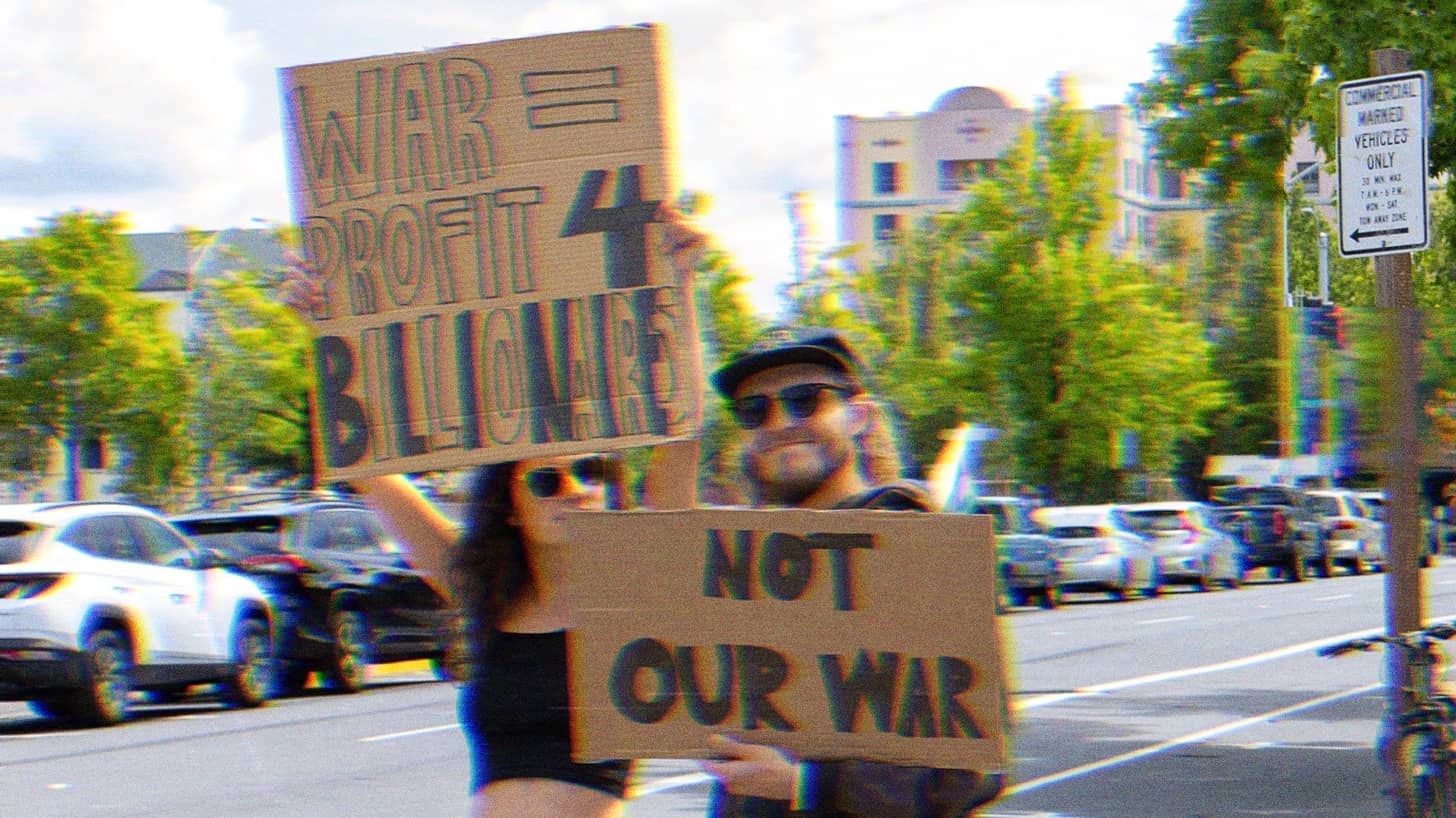 Image Description: Two people holding protest signs. One reads, ‘War= Profit 4 Billionaires,’ the other ‘Not Our War.’
This essay appeared in the May 14, 2026 edition of UNFTR’s premium newsletter. Become a UNFTR member to receive our bonus newsletter each week and for other perks.
What is a neocon to do now? After all, the movement that ushered in the era of forever wars and the unitary executive theory must be in a state of psychological paralysis or complete disbelief after one of its patron saints, Robert Kagan, penned a widely shared article in The Atlantic labeling the U.S. war in Iran a massive L, acknowledging not only repeated U.S. failures, but forecasting a potential new dawn for the Middle East—one in which Iran holds many of the cards.
Titled “Checkmate in Iran,” the article is a piece to behold, and one to archive for the history books. It’s worthwhile to read—again, and again and again. And not just to witness the admission (not implicitly) that the neocon dream was foiled, but to also experience vicariously false realities one of the movement’s chief propagators invented in his head. Kagan, in the article’s lede, no less, attempts to rewrite history about the war in Iraq, claiming the “initial failure in Iraq was mitigated by a shift in strategy that ultimately left Iraq relatively stable and unthreatening to its neighbors and kept the United States dominant in the region.” We’ll get into Kagan and his colleagues’ years-long campaign to push the United States into Iraq in the first place, but for him to simply ignore how Iraq helped spawn a new wave of anti-American sentiment, culminating in the birth of ISIS (which included former members of Saddam Hussein’s Ba’ath Party) is in itself an exercise in deception.
Kagan in 1997 co-founded the Project for the New American Century (PNAC) along with noted neocon Bill Kristol. The group’s “statement of principles,” published in June of that year, was signed by a who’s who of the movement’s most crusading figures: Dick Cheney, Elliott Abrams (remember him from Iran-Contra?), “Scooter” Libby, Donald Rumsfeld and Kagan’s father, Donald, among the many prominent figures pushing for a more hegemonic foreign policy.
“[W]e cannot safely avoid the responsibilities of global leadership or the costs that are associated with its exercise. America has a vital role in maintaining peace and security in Europe, Asia, and the Middle East,” PNAC wrote in its statement of principles. “If we shirk our responsibilities, we invite challenges to our fundamental interests. The history of the 20th century should have taught us that it is important to shape circumstances before crises emerge, and to meet threats before they become dire. The history of this century should have taught us to embrace the cause of American leadership.”
That was followed by a list of demands, including boosting military spending, confronting other “hostile” nations and expanding hegemonic influence—or as PNAC put it: “we need to accept responsibility for America’s unique role in preserving and extending an international order friendly to our security, our prosperity, and our principles.”
The group was notorious for the full-court-press it put on the Clinton administration, lobbying for it to intervene against Saddam Hussein in Iraq. Its letter to Clinton in January 1998 urging a more aggressive posture, which the president rejected, became widely circulated. In an effort to keep up the pressure, it sent a subsequent letter to Congress in May of that year issuing this warning: “Unwilling either to adopt policies that would remove Saddam or sustain the credibility of its own policy of containment, the administration has placed us on a path that will inevitably free Saddam Hussein from all effective constraints.”
And let us not forget the Big Lie they got us into Iraq in the first place, which PNAC trafficked amid its opposition to Clinton’s foreign policy, writing: “As a consequence of the administration’s failure, those nations living under the threat of Saddam’s weapons of mass destruction can be expected to adopt policies of accommodation toward Saddam.”
Of course, the neocon dream went well beyond Iraq, as they envisioned—and eventually created—a global hegemony, which Democrats ultimately embraced. Kagan himself is said to have coined the oxymoronic phrase “Benevolent Empire,” writing in 1998: “[T]he truth is that the benevolent hegemony exercised by the United States is good for a vast portion of the world’s population. It is certainly a better international arrangement than all realistic alternatives. To undermine it would cost many others around the world far more than it would cost Americans — and far sooner.”
The subsequent forever wars would like a word with Kagan, whose very movement is perhaps most to blame for the current calamity with Iran.
What made this week’s piece so jarring was not the fact that Kagan was declaring the war a failure—the focus of much of the coverage of his article—but instead the lack of personal responsibility for pushing the United States on a clearly precarious path to begin with. For his part, Kagan effectively laid all the blame at Trump’s feet (deservedly so)—a strategy, such that it is, that allows the neocon movement to dip into the shadows and regroup.
“There will be no return to the status quo ante, no ultimate American triumph that will undo or overcome the harm done. The Strait of Hormuz will not be ‘open,’ as it once was,” Kagan wrote. “With control of the strait, Iran emerges as the key player in the region and one of the key players in the world. The roles of China and Russia, as Iran’s allies, are strengthened; the role of the United States, substantially diminished. Far from demonstrating American prowess, as supporters of the war have repeatedly claimed, the conflict has revealed an America that is unreliable and incapable of finishing what it started. That is going to set off a chain reaction around the world as friends and foes adjust to America’s failure.”
The chain reaction was set off long before Feb. 28—one that has already impacted multiple generations, not just in the United States, but across borders. How benevolent.
Image Source
- David Geitgey Sierralupe from Eugene, Oregon, CC BY-SA 4.0, via Wikimedia Commons. Changes were made.
 Rashed Mian
Rashed Mian is the managing editor of the award-winning News Beat podcast and co-founder of the newly launched Free The Press (FTP) Substack newsletter. Throughout his career, he has reported on a wide range of issues, with a particular focus on civil liberties, systemic injustice and U.S. hegemony. You can find Rashed on X @rashedmian and on Bluesky @rashedmian.bsky.social.