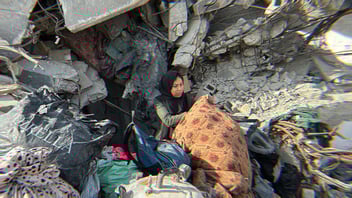

The Shajarah Tayyebe Massacre.
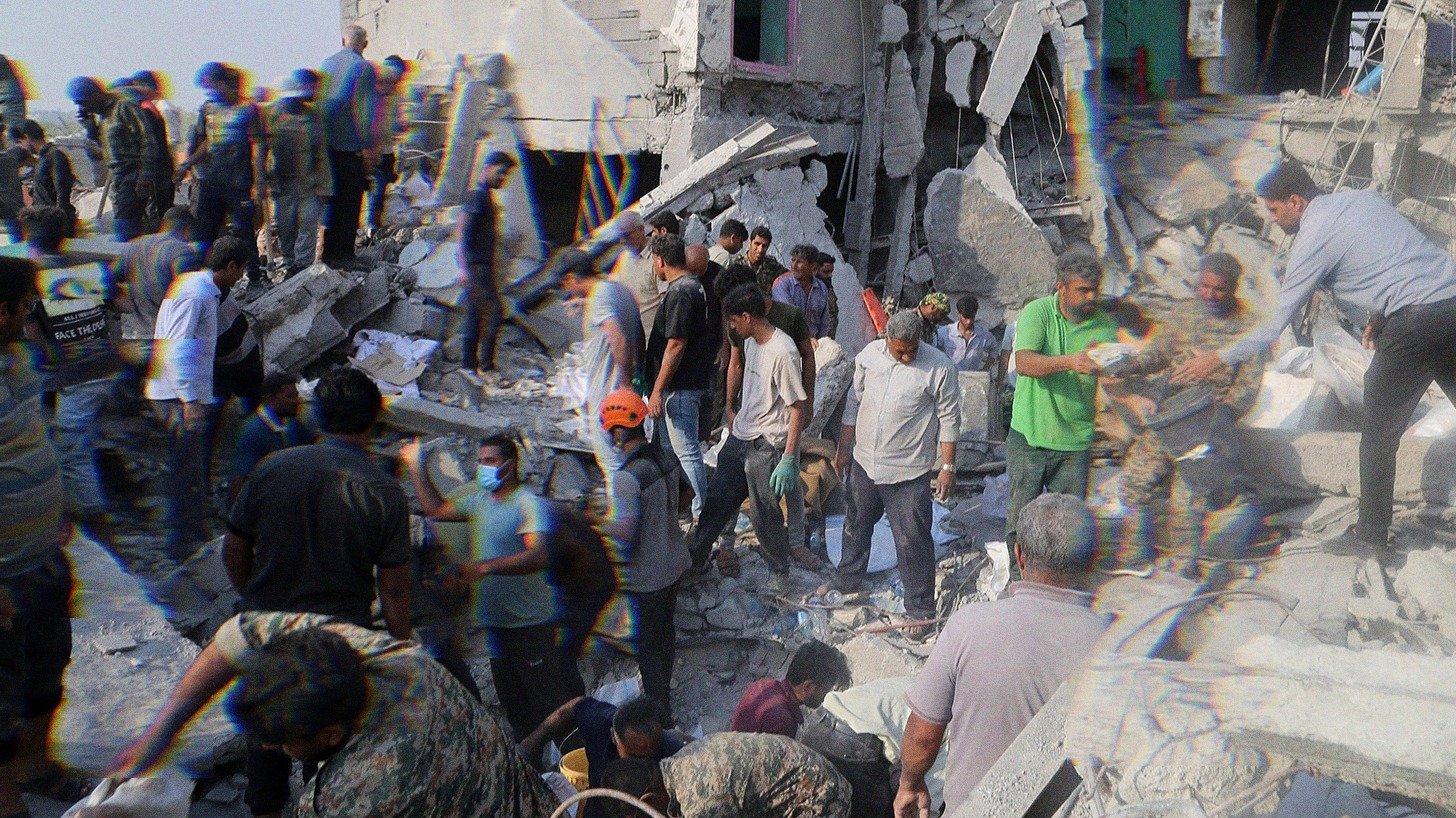 Image Description: People clearing the rubble after the Shajarah Tayyebeh attack.
This essay appeared in the March 5, 2026 edition of UNFTR’s premium newsletter. Become a UNFTR member to receive our bonus newsletter each week and for other perks.
After the essay was published,The New York Times, among other outlets, reported that the United States was behind the strikes that killed at least 175 people, the majority young girls. Still, U.S. officials have yet to publicly take blame for the murders, with Defense Secretary Pete Hegseth maintaining that the incident is being investigated and President Trump suggesting Iran was somehow responsible.
During the wars in Iraq and Afghanistan, a series of deadly U.S. airstrikes against civilians drew widespread condemnation and contempt. Often, the United States initially downplayed the breadth of the attacks, only for us to discover later that civilians were killed in much larger numbers than initially reported.
As drone technology became ubiquitous during the Obama administration, conventional wisdom held that the aerial weapons would decrease the likelihood civilians would be harmed.
“With our extraordinary technology, we’re conducting the most precise air campaign in history,” President Obama said in 2016 amid the war against the Islamic State. “After all, it is the innocent civilians of Syria and Iraq who are suffering the most and who need to be saved from ISIL’s terror. And so when there are allegations of civilian casualties, we take them very seriously. We work to find the facts, to be transparent, and to hold ourselves accountable for doing better in the future.”
An investigation by Azmat Khan for The New York Times, published in 2021, revealed what many detractors of America’s drone wars had long argued: that promises of improved precision and claims of fewer civilian deaths were laughably fictitious.
“The trove of documents—the military’s own confidential assessments of more than 1,300 reports of civilian casualties, obtained by The New York Times—lays bare how the air war has been marked by deeply flawed intelligence, rushed and often imprecise targeting, and the deaths of thousands of civilians, many of them children, a sharp contrast to the American government’s image of war waged by all-seeing drones and precision bombs,” Khan wrote.
Little has changed in the intervening years since that explosive report dropped.
On March 1, when war with Iran broke out amid U.S. and Israeli strikes on the country, 165 people—mostly girls—were killed in an attack on the Shajarah Tayyebe school in southern Iran. To this day, no one—neither the United States nor Israel—has taken responsibility for the heinous assault. When asked about the deadly strike at a press briefing, Secretary of Defense Pete Hegseth said the Pentagon was investigating the incident. When pressed by a rightfully skeptical BBC reporter on how a military with advanced technology doesn’t know who hit the school, Hegseth repeated the same answer.
The chilling attack shocked everyone from leftists to former Rep. Marjorie Taylor Greene, who has been among the loudest critics on the right of Trump’s imperial presidency. According to reports, many of the victims were unrecognizable—some burned beyond recognition, others with limbs torn from their bodies. One report said parents were only able to identify their children by the jewelry they were wearing.
An image of rows of graves ricocheted across social media as Iranians and the world came to grips with the scale of the bloodshed.
Many questions linger, including the most pressing: Who committed the atrocity?
The school sits near an IRGC building, but sophisticated militaries equipped with “extraordinary technology,” as Obama put it, would certainly have known a school was in the vicinity. As The Guardian reported: “There is no indication…that the school is in any sense a military-use building: its classroom building and playground is walled off from the rest of the IRGC compound, and the colourful murals on its walls are visible in some satellite imagery.”
The slaughter grew even more chilling this week when Middle East Eye reported that the attack bore the hallmarks of a “double-tap” strike. Through interviews, the outlet discovered that the campus was hit twice, and that survivors of the initial attack were killed in the subsequent blast.
Here’s from the report:
“When the first bomb hit the school, one of the teachers and the principal moved a group of students to the prayer hall to protect them,” one of the Red Crescent medics said, citing conversations he had at the time with survivors.
“The principal called the parents and told them to come and pick up their children. But the second bomb hit that area as well. Only a small number of those who had taken shelter survived.”
One father rushed to the school to retrieve his daughter, but she was killed in the second strike.
“My little girl was completely burned,” he said. “There was nothing left of her. We could only identify her from her school bag, which she was still holding. She was completely burned.”
Double-tap strikes can constitute a war crime under international law because they often kill medics, journalists, and other bystanders who instinctively rush to the scene of an initial attack.
The school strike took another turn this week when perceptive social media users noticed that a Pentagon-produced map placed Minab at the center of two apparent targeted locations in Iran. Drop Site News characterized it as a “strike map,” adding that it was “proudly displayed” by Hegseth during his press briefing.
It has also been reported that the U.S. military has integrated AI into its systems, unlocking frightening new levels of killing efficiency.
“As planning for a potential strike in Iran was underway, Maven, powered by Claude, suggested hundreds of targets, issued precise location coordinates, and prioritized those targets according to importance, said two of the people,” The Washington Post reported. “The pairing of Maven and Claude has created a tool that is speeding the pace of the campaign, reducing Iran’s ability to counterstrike and turning weeks-long battle planning into real-time operations, said one of the people. The AI tools also evaluate a strike after it is initiated, the person said.”
The accelerated pace of strikes and the use of AI has been a hallmark of Israel’s genocidal war of annihilation against Palestinians in Gaza. While the United States hasn’t been shy about deploying its vast arsenal during the second Trump administration, this would mark the first true test run of AI-integrated weaponry for the United States.
Tragically, Israel has been known to test weapons and surveillance systems in Gaza. And now we’re left to question whether those same systems are being deployed elsewhere, including in the United States-Israel war on Iran.
It’s a reasonable question, and one that Trita Parsi, executive vice president of the Quincy Institute, raised on Thursday.
“Similarities between Israel’s bombing of Gaza and Tehran are growing stronger. In both cases, it appears Israel is using AI without any human oversight,” Parsi wrote on X. “For instance, Israel has bombed a park in Tehran called ‘Police park.’ It has nothing to do with the police. But it appears AI identified it as a target since Israel is bombing all government related buildings. No one in Israel brothered (sic) to check and find out that it is just a park.”
For years, questions about strikes on civilians have effectively gone ignored, save for the committed researchers and dogged journalists pursuing the truth. But, in a way, the world has already moved on from the Shajarah Tayyebe massacre. In the Times’ first piece dedicated exclusively to the attack, it made no mention that the United States and Israel had started a war against Iran. The only time the two countries were referenced was when the paper said they reached out to both for comment—a strange way of implying that a war was being fought.
By Wednesday, the Times published a follow-up that was less than 500 words, mostly consisting of state propaganda: Hegseth saying they’re investigating and Karoline Leavitt, the White House press secretary, suggesting questions about the attack were misguided and only served Iranian interests.
Whether it was the U.S. or Israel is somehow beyond the point. The two work in lock-step, as Secretary of State Marco Rubio effectively confirmed when he admitted Israel forced Trump’s hand.
There used to be a time when tragedies like this would shock the conscience of the world, enveloping the responsible party in drawn-out controversy. In an era of forever wars, this was just another Saturday—those scores of girls the latest victims in the West’s insatiable appetite for more and more carnage.
Image Source
- Mehr News Agency, CC BY 4.0, via Wikimedia Commons. Changes were made.
 Rashed Mian
Rashed Mian is the managing editor of the award-winning News Beat podcast and co-founder of the newly launched Free The Press (FTP) Substack newsletter. Throughout his career, he has reported on a wide range of issues, with a particular focus on civil liberties, systemic injustice and U.S. hegemony. You can find Rashed on X @rashedmian and on Bluesky @rashedmian.bsky.social.