
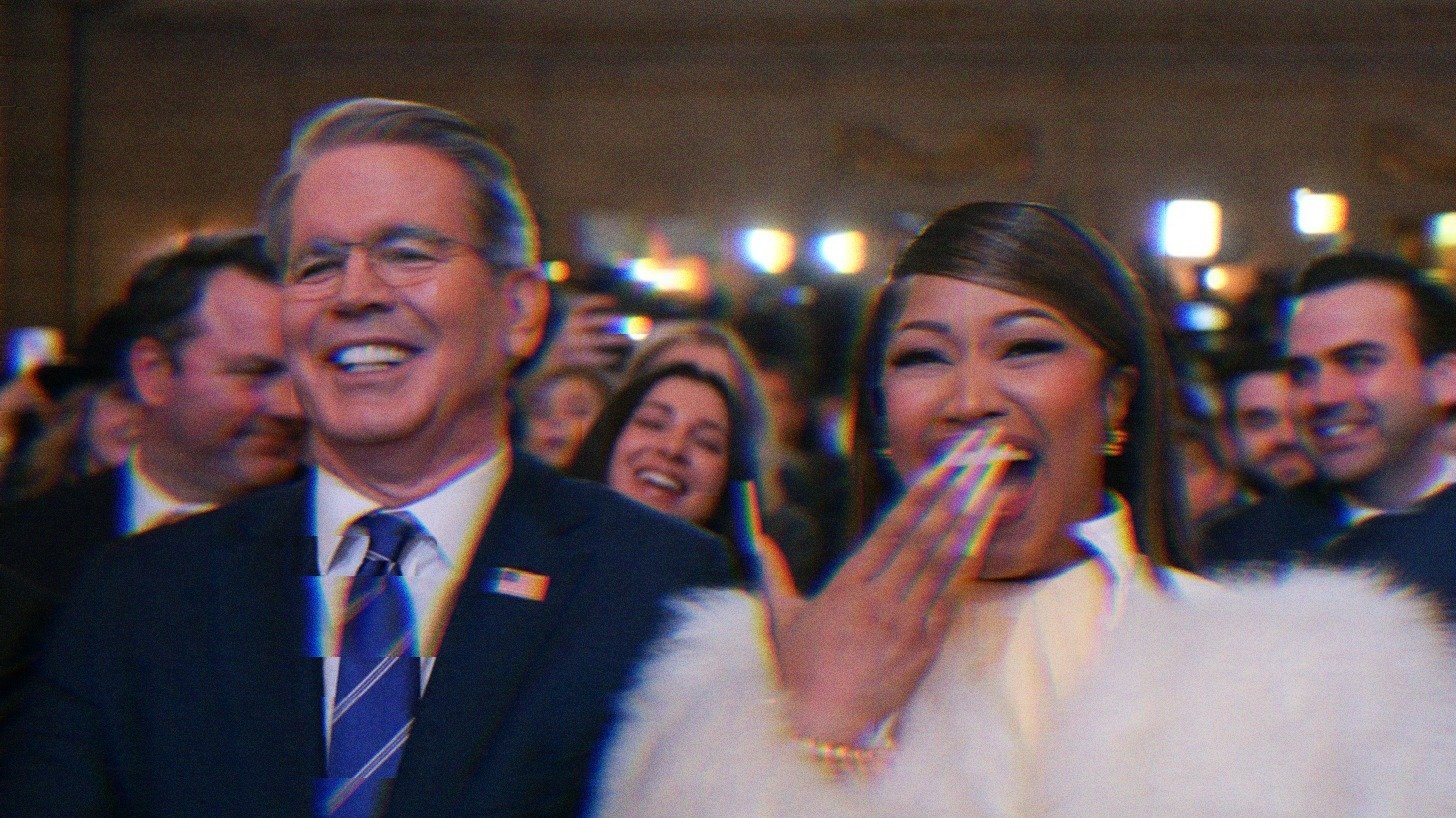
 Image Description: Scott Bessent sitting next to Nicki Minaj. The pair are laughing.
Is Scott Bessent a stupid man? No. Not in the least. But is he behaving in a stupid manner? Unequivocally. Bessent has become the attack dog of the Trump administration, the most overexposed treasury secretary in history if you discount Alexander Hamilton. And he is promoting a vision that he doesn’t believe in and acting out in a manner that is beneath him, unfitting to his position, and deleterious to our global reputation.
An interview of Bessent essentially blaming Alex Pretti for carrying a gun to a protest (and thereby blaming him for what transpired) went pretty viral. It was a tone deaf display of hatred and arrogance that belies a person of Bessent’s background and stature. The right response here was such a layup but Bessent has come increasingly unglued over the past year, and keeps taking fights unnecessarily into the gutter.
Meanwhile, for anyone paying attention to the things that are firmly in his lane, things are falling apart. Consumer confidence has plummeted. Japan is turning into a full-blown crisis. The decline in the value of the dollar is spooking the global market.
It goes on and on. The macro economic outlook for the United States hasn’t been this grim in a very long time and yet he’s on television taking jabs at Democrats that have nothing to do with him or his job.
Here’s the thing about Bessent. He chose this role and then leaned into it. Hard. He made a personal commitment to being the one who covers for the administration’s policies. He’s more than an apologist. He’s owning it in a way that makes him a co-author of what comes next.
When you think about the financial stewards of this administration, it’s a short list of absolute clowns. Stephen Miran, on leave from the administration and over at the Fed is a true believer in the destruction of the administrative state and Fed independence. He’s staked his whole career on it. Howard Lutnick is so compromised as an investor in all the things this administration promotes that he can hardly be considered an objective party. Peter Navarro wrote white papers that quoted ‘Ron Vara,’ a fictitious anagram of his own last name. And Kevin Hassett’s claim to fame was providing an economic model to show that COVID deaths would hit zero by May…of 2020.
I’ve taken down every one of these guys for being career charlatans—basically the bad guys, because that’s who they are. But Scott Bessent? This is not who he is and to me that makes his turn that much worse. Have I lampooned his career as a failed hedge fund manager who couldn’t make it after leaving George Soros’ bosom? Yes, because it’s fun. But now we’re talking about the future of the United States economy and our place in the world, and it’s not fun or funny.
Let’s step back for a second for a massive disclaimer before I offer and defend the central thesis of this essay. In making this critique—and in fact several of the critiques that I’ve given over the past year and a half or so—I’m speaking to the decline of something that A) was already in decline and B) might not be worth saving. The American neoliberal experiment as the world’s hegemonic superpower was always going to hit a wall and ultimately decline. Partly because this is the nature of capitalist systems and partly because we deliberately pivoted from a constructive growth philosophy to a neoliberal policy of extraction and oppression stemming from the Reagan/Thatcher revolution.
Something Bessent is keenly aware of this. More on that later.
I give you this disclaimer because I don’t want my commentary to be misinterpreted as a defense of status quo classical economics. This experiment of ours was always going to end badly. What this administration is doing, however—with Bessent firmly at the policy wheel—is accelerating the decline of U.S. hegemony and he knows it. So the audience for this message is not the core UNFTR audience that understands the broader implications of capitalist systems, particularly those that have been hijacked by a nihilistic core of technofeudalists. This is for the more moderate liberal to slight leftist who believe in social democracy or that capitalism’s worst instincts can be restrained and manage to produce positive outcomes for the majority.
I consider this wing of the Democratic party to be potential allies in progressivism. People who are appalled by the destructive nature of Trump’s neomercantilism and willing to concede that capitalism has its limitations and that other solutions exist. Essentially, the liberal democrat who just a few years ago wouldn’t entertain a Mamdani mayorship or a Bernie presidency but are now open to the conversation. If a few Republicans want to join in the discussion, great. MAGA is beyond rehabilitation.
So here’s the central thesis on which this screed is based.
Economics is everything when it comes to the United States hegemony and future. We are the financial powerhouse of the world and our domestic success—along with the success of most other nations—depends upon our ability to navigate with clarity, stability and focus. And right now we are responsible for the man-made earthquake in the global order and it’s not going to end well for us. As such, the people in charge of our economy play an outsized role in all things that flow from economic success: Labor, social welfare, goods and services, purchasing power, retirement, health care, defense. You name it. The society and government we want can be attained when the economics support it. Conversely, it’s difficult to achieve any of these things when they don’t.
We are at a turning point in the world because we’ve elected a man who is attempting to break the world order by destroying trade relationships and forcing compliance with cudgels like sanctions, tariffs or outright invasions.
So let’s talk about the current state of the economy and the policy prescriptions of this administration that are tanking it.
First off, there was the recent Conference Board Consumer Confidence Index that positively cratered.
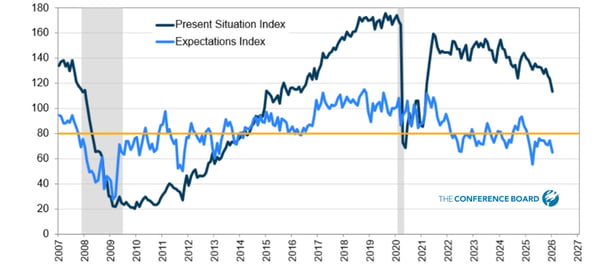
The top line is how people feel right now and the bottom one is where people think things are headed. Both are back to pre-financial crisis levels, which more officials should have paid attention to back then. In a consumer-based economy, this is not a good sign because it portends personal spending patterns.
We’ve gone into great detail about consumer spending to show that the metrics the administration holds out as positive signs are actually negative. What the data show is that high income households are responsible for the bulk of the spending and that the sectors experiencing the most growth are negative GDP indicators like healthcare, insurance, financial services and food. I say negative because these are net negatives for an economy trying to regain its footing in manufacturing and production.
Bessent likes to suggest that manufacturing growth is coming any day now. It’s right around the corner, don’t you worry. Sadly, this is patently false. And it’s even more disingenuous the further you dig into the numbers.
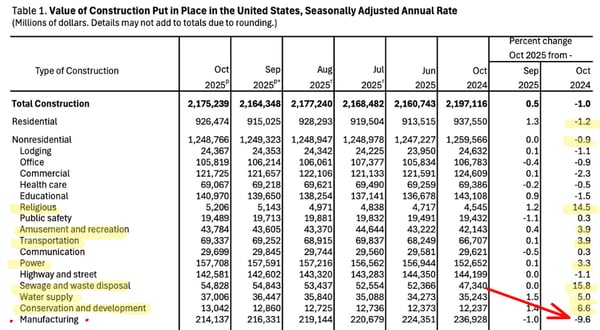
These are the real numbers as published by the census bureau. The headline construction figures are negative. What you’re looking at here is the composite of residential and non residential construction figures and it shows that overall construction is down year over year in both sectors. I’ve highlighted the areas that have experienced growth—religious, recreation, transportation, power, sewage and waste disposal, water supply and conservation. Hold that thought for a moment. The important figure from this slide is manufacturing construction, which is what Bessent is touting. It’s down 9.6% year over year.
Think about that. The entire tariff regime is supposedly designed to reshore manufacturing and get production back in the United States. We’re three full quarters past Liberation Day and the trend is going in the wrong direction, demonstrably. But let’s talk about those growth areas.
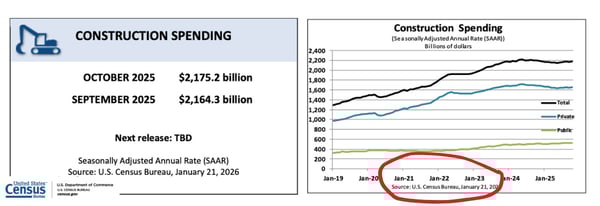
If you look at the growth period you’ll notice that it was in the last two years of Biden’s term. Since then growth has flatlined and private construction spending has actually declined. The only area that has increased marginally is public spending.
So put the two together. The areas of construction growth aren’t from the Big Beautiful Bill or Trump’s tariffs. They’re from the Inflation Reduction Act (IRA) and the CHIPS and Science Act. Transportation, power, sewage and waste disposal, water supply and conservation—these are explicitly agenda items from Biden’s signature bills.
I vividly recall having this discussion with Nick Hanaeur of Pitchfork Economics when we were talking about these bills in the context of Biden’s “Bottom-Up, Middle-Out” strategy, and we both acknowledged at the time that the biggest risk to Biden winning a second term was that they gutted the populist programs like the direct child tax credit payments, renewable energy subsidies and prescription drug coverage plans that would have an immediate impact on household finances and security. But thanks to Kyrsten Sinema, Joe Manchin, and the lack of balls in the Biden Administration, those were gutted.
And that’s the thing about the areas of the economy that are growing. They’re all related to Biden’s industrial policy. Everyone knew that the seeds planted under the IRA needed a full ten years to blossom. So to the extent that green shoots are popping up, they’re because of Biden. He took a gamble and lost, and now Trump is going to take credit for any measure of success.
But for Bessent to claim that these are Trump gains is pure bad faith.
They retained a good deal of IRA spending in the Big Beautiful Bill and have committed further investment into data center construction, but let’s be clear about what they accomplished. The IRA infrastructure investments were overdue because Trump—who claimed to be the infrastructure guy in his first term—did nothing on it. Literally nothing. You might also recall when the IRA passed that our own budget office said that the money was insufficient to cover the domestic repairs we needed, but it was a good start.
But that’s the point here. These construction gains are in the municipal arena, not a reflection of investments into private manufacturing and factories. And now we are all aware of the downside concentration risk of going heavy into data centers, which many argue is the sole reason for our positive GDP growth in 2025. A scary thought in and of itself. Not only is the environmental toll enormous but it has increased energy prices for every American.
So what exactly is the Trump economic and industrial policy if the anemic gains we’re seeing—which all come from Biden-era bills and are concentrated in data centers—aren’t even his? And let’s remember: we’re betting everything on data centers that will either put millions out of work by design if they succeed, or tank the markets when the AI bubble pops if they fail. Either way, it’s a bad bet.
Well, if we think about what Bessent is actually in charge of, then we have to look at the financial markets and fiscal health of the economy. And the thing about being the U.S. treasury secretary is that you’re sitting on the single most powerful economic asset in the world. The U.S. dollar.
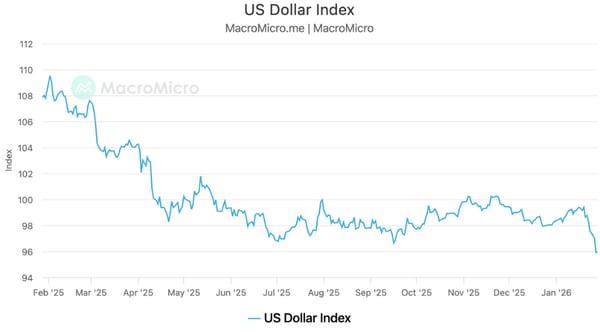
Not sure if he’s noticed, but yeah. The dollar is in freefall right now. And the reason you’re likely hearing a lot about it right now is because it went parabolic to the downside in recent days, which has itself sparked panic in the currency and bond markets.
But here’s the thing: This is actually part of their plan and Trump is pretty pumped about it.
The dollar has cratered since Trump took office; let’s talk about why he is taking this stance so casually and Bessent is defending the long-term outlook. It’s all about manufacturing and the balance of trade. In terms of manufacturing, we know that isn’t working. The idea is to debase the dollar to make U.S. goods more attractive, but Trump’s tariffs have had the opposite effect because countries are deliberately trying not to buy American goods right now. But there’s a more practical aspect to this that makes me shake my head at the timing.
Trump has been talking about a weak dollar for a long time, and to the extent that he understands anything, he is ostensibly correct that a weak dollar makes U.S. goods and tourism more attractive. But timing is everything, and this is why you need an actual industrial policy to coordinate these efforts.
When you’re building a manufacturing environment it benefits you to have a strong dollar because you will have to import raw materials: lumber, steel, copper, minerals, etc. Then way down the road when you have finished goods ready for market, it helps to have a weaker dollar for export competitiveness. During those initial construction phases you want a supportive domestic industrial policy with tax incentives and subsidies. Moreover, they need to be part of a long-term, multi-year strategy because the investor class has to be willing to commit capital for long-term appreciation, and you can’t do that when no one knows from one day to the next what the madman in the Oval Office is going to do.
In fairness, the GOP basically eliminated depreciation schedules, which incentivized industrial purchases, and this helped businesses looking to upgrade and retool. But it didn’t help net new construction of factories and plants because the dollar is tanking and subsidies into growth areas like renewable energy—the industry with the greatest corporate and consumer demand—were eliminated. This is the absence of policy.
This falls squarely on the Treasury, the Commerce Department, Office of Management and Budget and the Executive who craft policy and set the agenda. And because Scott Bessent has decided to be the spokesperson for all things budget related and more, this is now his problem to own.
False GDP numbers built on risky AI investments, a declining dollar, consumer confidence falling off a cliff. Not good. And plenty of blame to go around. But the one area that the Treasury Secretary owns exclusively is how we manage U.S. debt. Well, the single largest holder of U.S. debt is experiencing its own crisis right now, and Scott Bessent has failed at every attempt to manage it.
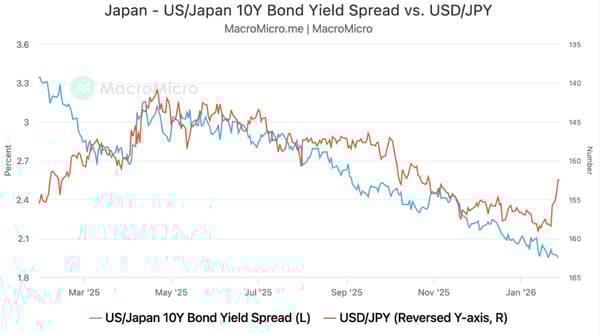
The dollar/yen ripped apart violently on news that Japan conducted what’s called a “rate check” on the United States, leading the New York Fed to respond in kind. This is basically when central banks call major currency desks to check rates, which is really just a signal that there might be interventions in the currency markets. That’s why you see the violent split at the end of the graph here. But the real line to look at is the blue line, which is the spread between the U.S. and Japanese 10 Year bond yields.
Japan is going through a bit of a moment with their own populist leader looking to spur inflation and investment inside Japan. After decades of stagnation, it’s working, but at the expense of the Japanese consumer who isn’t used to dealing with inflation. There is widespread support nevertheless, because Japan is looking to make a huge comeback on the international stage. The reason this is critical for the U.S. is because of the amount of U.S. debt being held by the Bank of Japan and Japanese institutional investors.
For many years, outside of deep recessions and COVID, Japan used the depressed Yen to purchase dollars and in turn use those dollars to buy U.S. Treasuries. But, as the blue line indicates, the difference between our treasury yields is disappearing as bond prices collapse and yields rise. Great for investors, terrible for the sovereign that has to pay out these yields.
The way to think about this if it breaks your brain is that Scott Bessent has one job above all others. Sell treasuries to cover our debt. So it’s in his best interest to have low yields, but our mid and long term yields are blowing out because the world is losing confidence in the United States. So Bessent has had to pile treasuries into short term auctions, but these yields are increasingly blowing out as well. We have successful auctions because everyone knows we’re good for it in the end, but the interest on our debt is getting out of control and now Bessent has to cover 9 trillion in bond sales just this year alone. It’s an absolute nightmare.
So why is Japan a problem? They’re our biggest buyer. The more attractive Japanese bond yields become the less they need ours to find a return.
And this brings me back to the dollar and this idea that a devalued dollar will cure all.
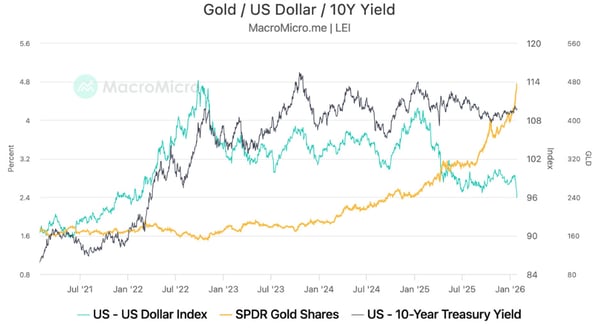
There’s a couple things going on here but this is an important graph to understand. The green line that tails off at the bottom right is the U.S. dollar index. Essentially, this is the value of the dollar as compared to a basket of currencies weighted depending upon our relationship to them. You can see that the steep decline over just a couple of days is extraordinary in its movement and duration. The black line that winds up second from the top right is the 10 Year Treasury, which is the most efficient market sentiment monitor of how the world feels about our financial health. The higher the yield, the shakier it is. And the gold line, the one that spikes at the top right, is the value of gold.
The reason I wanted to show this particular chart is that it shows movement over time. There are ups and there are downs. And myriad factors that impact them in between. The dollar has been strong and it’s been weak. The 10 Year goes up, the 10 Year comes down. They’re important things to follow, and trends are meaningful, but taken independently or taking a couple together doesn’t tell the whole story.
The one line that tells a definitive story all by itself is gold. This is historic.
If you look at the blue and gold lines you can see the relationship between gold and the dollar. As the world’s reserve currency, the dollar rebounded in strength after COVID. It broke out, which is normal. But since Trump took office, gold has gone through the roof and the dollar has fallen in absolute terms. In relative terms, meaning the value of the dollar to the value of gold, it has plummeted.
And this is why this is the biggest economic story of our lifetime. And what makes Bessent and Trump’s economic perspective so catastrophically foolish.
Let’s start with the micro take before zooming out to the macro. And I’m speaking to the American audience right now specifically. Right now, your purchasing power is tied to that blue line. It’s why you might be struggling to make ends meet. Because your world is valued in absolute terms on the dollar, so a weak dollar means everything that enters the country or is made with an external component is more expensive. A weak dollar exacerbates existing inflation in this way, and it’s one of the reasons why we have persistent inflation above the Fed’s 2% target.
If the dollar was stronger and we weren’t going through this tariff nonsense it’s theoretically possible that we would be in a deflationary environment or at least experiencing continued disinflation. Prices would be coming down steadily at the grocery store, the hardware store and the like. Even services might be coming down.
But if we zoom out to the macro view, this is where the future looks bleak. And why the pair to gold is so important to understand.
There is a war raging right now. A war for economic supremacy. For 80 years we have had the upper hand because the world had no choice but to do business in U.S. dollars coming out of World War Two. This dependence only increased when we came off the gold standard in 1971 under Nixon, because it meant that the value, or price of money was built on trust not gold. Built on faith and creditworthiness of the United States treasury, not stores of gold bars sitting in a central bank vault somewhere in the world.
Through thick and thin, recessions and boom times, the major industrial economies of the world built their economic policies around the dollar. Emerging markets did as well, but were highly disadvantaged because they had less to offer for them in terms of trade. Again, downside of capitalism. It’s a system built on extortion. The reason we left the gold peg was over concern that one of these growing industrial economies could someday manipulate the value of the dollar by hoarding and/or liquidating them, so we broke the gold peg and allowed it to float. And that bought us decades of time and allowed us to run exorbitant deficits to fuel our own domestic expansion.
Now imagine a future where all of a sudden the world decided without us to return to the gold standard. Well, if the value of the dollar is suddenly relative to gold then it would lead to a massive revaluation and the United States would suddenly be in the grips of a hyper inflationary shock the likes of which we have never experienced.
The circumstances that could lead to something like this are extraordinary. Almost beyond imagination. For something like this to occur the United States would have to become a pariah nation. Other countries would have to decide en masse and in a coordinated manner to break from dollar dependency and move to another reserve currency. Or multiple alliance blocs would have to do so in a coordinated manner that divided the world. Welcome to the world of digital reserve currencies. Imagine the BRICS nations suddenly aligned with the whole of South America and Africa. The entire Global South. Imagine the EU, Japan and Canada broke rank as well to back a different digital currency. Maybe the U.S. keeps Mexico and the UK in its bloc. Yes, this is the loose plot of Orwell’s 1984 with a rough estimate of Oceania, Eurasia, and Eastasia, except that South America would have rightfully told us to go screw.
The U.S. dollar could have a role in each of these digital currencies. Or not. All of a sudden our sure thing treasury market would be in far less demand, and so would our ability to finance our deficits and growth.
So back to Scott Bessent and how he may have overestimated the world’s anger toward U.S. policies.
From day one of this administration, he has been heralding the arrival of global stablecoins to provide a backdoor to U.S. dollar hegemony. He believed we were so far ahead in the race and so indispensable that stablecoins backed one-to-one by U.S. dollars would provide all the liquidity necessary to fuel our insatiable need for deficit financing. All things being equal, he might have been onto something, given stablecoins as a whole are the 17th largest purchasers of U.S. treasuries. So this is an actual trend.
But if sovereign debt financing moves entirely toward central bank digital currencies (CBDCs), and the rest of the world decides that gold should be the anchor—as it is in the case of the new BRICS unit, which is anchored 40% by gold—then the new global monetary order essentially reverts to the old order, and the U.S. dollar becomes just one of the chess pieces on the board, rather than the key square. And if the dollar value relative to gold remains so far apart then it means we’re screwed.
And that brings me back to Scott Bessent.
When Bessent left George Soros, he named his hedge fund Key Square. A chess reference to a critical endgame move that guarantees a win. Bessent might have been so overconfident that he was moving toward a key square that he missed the bigger picture. The world isn’t falling in line with his vision. In fact, it’s deliberately moving away from us because of it. And here’s the part I can’t figure out about him and the perspective that I promised to give you at the beginning of this piece.
In a 2023 interview we find a more thoughtful, empathic and studious version of Scott Bessent. It’s worth watching for both the content and the epiphany that one of the versions of Bessent is an act. His grasp of macroeconomics and history is staggering. At one point he lavishes praise on Shawn Fain from the UAW. Waxes poetic about the advantages given to capital over labor and how it has led to inequality and should be rectified. You can see him fitting seamlessly into a forum with Janet Yellen, Mark Carney, Tim Geithner, Jerome Powell or Christine Lagarde. There is no daylight between the staunch defenders of globalism and 2023 Scott Bessent. And, I would argue, that if this was your only exposure to him and he was tapped by Biden or Obama to be Treasury Secretary, it would have made all the sense in the world. In fact, if you are indeed a liberal Democrat you might even be psyched.
So when I say “stupid” I’m not talking about him. I’m talking about what he’s doing. There is no way that 2023 Scott Bessent looks at 2026 Scott Bessent with approval. No fucking way.
One of them isn’t real. And that’s what I can’t figure out.
Image Source
- The White House, Public domain, via Wikimedia Commons. Changes were made.
 Max
Max
Max is a political commentator and essayist who focuses on the intersection of American socioeconomic theory and politics in the modern era. He is the publisher of UNFTR Media and host of the popular Unf*cking the Republic® podcast and YouTube channel. Prior to founding UNFTR, Max spent fifteen years as a publisher and columnist in the alternative newsweekly industry and a decade in terrestrial radio. Max is also a regular contributor to the MeidasTouch Network where he covers the U.S. economy.
%2c%20SCOTUS%20F*cks%20Us%20(Again)%2c%20Jeffries%20+%20Kushner.%20UNFTR..jpg?width=352&name=On%20The%20Record%2008-25-26.%20President...Bessent%3F%20Iran%20Sanctions%20(Again)%2c%20SCOTUS%20F*cks%20Us%20(Again)%2c%20Jeffries%20+%20Kushner.%20UNFTR..jpg)