
So…About Chomsky.
Noam Chomsky’s Tragic Coda.
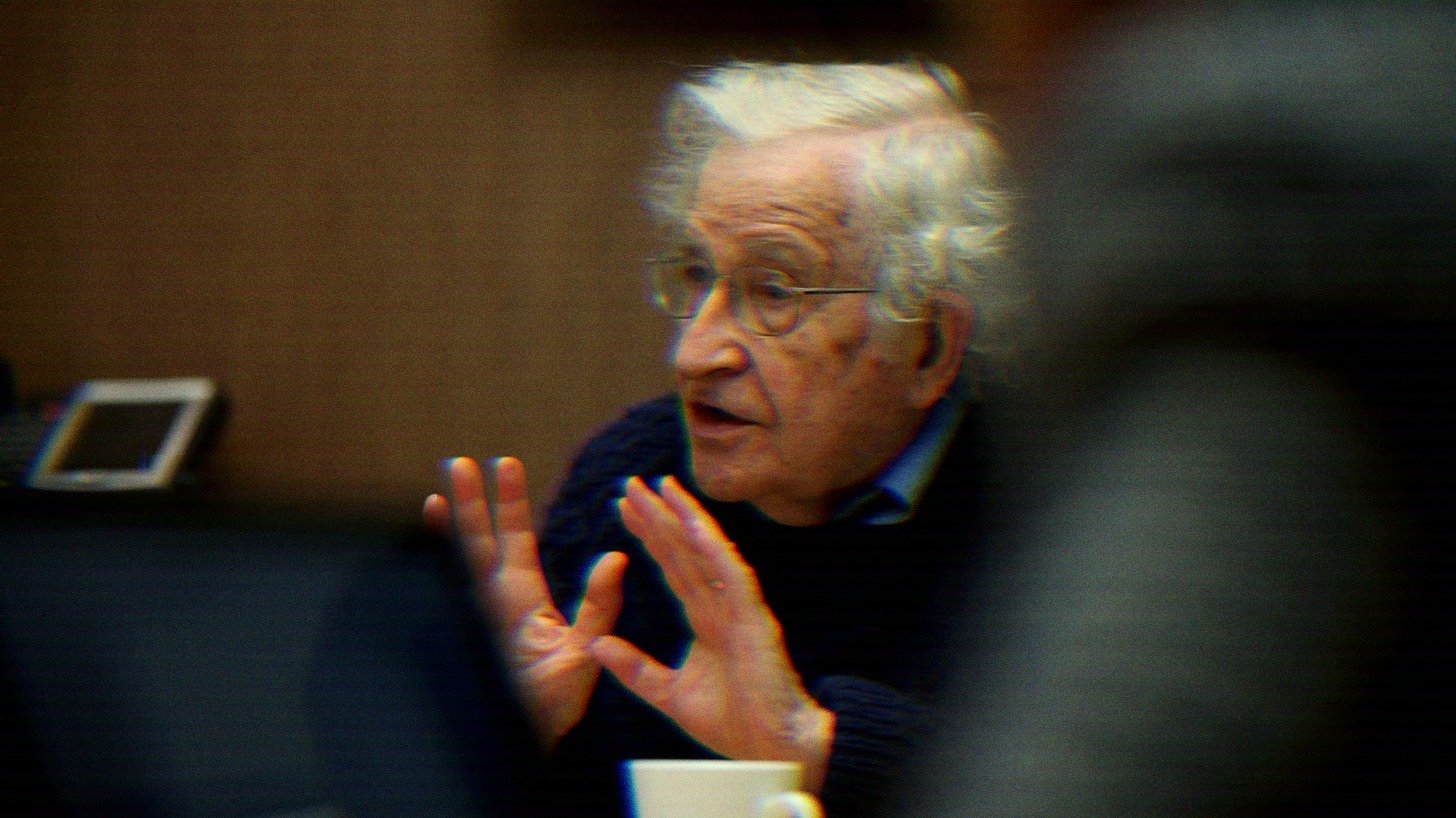 Image Description: Noam Chomsky speaking, his hands raised.
Noam Chomsky’s superpower is his intellect and ability to communicate complicated subjects with clarity. He made politics accessible for multiple generations. Chomsky is the gateway drug to leftist ideology. He’s also close friends with the most prolific child abuser and sex trafficker of the modern era. It’s okay to acknowledge Chomsky’s contributions and even more okay to let them go and bury his legacy.
It’s fair to say that there aren’t many thinkers and theorists I’ve relied on as much as Noam Chomsky. He’s near the top, to be sure. Unlike the right wing movement that is incapable of introspection, the revelations about Chomsky’s relationship with Jeffrey Epstein have caused a bit of a stir on the left. So let’s talk about Chomsky and the nature of hero worship.
Chomsky’s sheen had diminished when it was initially reported that he maintained a casual correspondence with Jeffrey Epstein and once defended his questionable relationships to the Wall Street Journal saying, “I’m unaware of the principle that requires that I inform you about an evening spent with a great artist.”
The artist in question was none other than Woody Allen.
Further insight into his take on hobnobbing with objectively terrible people is found in his response to the Harvard Crimson: “I’ve met all sorts of people, including major war criminals. I don’t regret having met any of them.”
There’s meeting war criminals and social pariahs as part of one’s work and travels. Then there’s choosing to befriend them, even advise them about the very thing that made them a pariah. One of the correspondences leaked in the recent drop was an email that cannot be misinterpreted in any way.
“The best way to proceed is to ignore it,” begins Chomsky. “That’s particularly true now with the hysteria that has developed about abuse of women, which has reached the point that even questioning a charge is a crime worse than murder.”
Like I said, impossible to misinterpret. He is, after all, our most famous linguist.
He is—was—also one of my favorite public intellectuals. I even joined in the fun after the release of the movie Captain Fantastic promoted the celebration of Noam Chomsky Day and incorporated it into our podcast calendar. When one of his children challenges the notion of celebrating Chomsky Day over Christmas, Viggo Mortensen’s character says, “you would prefer to celebrate a magical, fictitious elf instead of a living humanitarian who’s done so much to promote human rights and understanding?”
But here’s where the discussion about hero worship enters the picture. When I first started on YouTube, I toyed with a segment called Heroes and Villains because I was deep into namechecking all of the horrible neoliberal figures responsible for tearing down liberal institutions. To balance the equation, I sought to profile people who offered positive contributions to the project of Unf*cking the Republic. I didn’t get very far as the series contains exactly three entries. Peter Thiel and Ayn Rand as villains, and Noam Chomsky as our lone hero.
Ultimately, I found this style of writing beneath the conceit of our project so I abandoned the series. But rather than retroactively correcting (erasing) this clearly misplaced entry of hero worship I think it’s important to stand up to it and dissect it a bit.
What I value about Chomsky is his ability to pierce the veil of complexity. No jargon or reliance on high minded theories and inaccessible language; just straightforward, unemotional analyses offered with moral clarity. And, yes, I just wrote “moral clarity” unironically. That’s not to say his political views were infallible. For example, many have criticized his reluctance to clear up prior stances on major events like the atrocities of the Khmer Rouge once evidence mounted to contradict his statements. But these missteps were few and far between in an otherwise long and prolific career.
So clear were his investigations that Chomsky became a gateway drug for burgeoning leftists. He was the oracle of common sense. The easily quotable gut check on endless inquiries that were complicated by the likes of his leftist contemporaries like Michel Foucault or Slavoj Žižek. He wasn’t caustic or biting, though he could be dismissive and disagreeable. And he was accessible in literal and figurative terms—I’m one of seemingly hundreds of thousands of people who can genuinely claim to have had a personal email correspondence with the man.
As the author of countless books and lectures, Chomsky has become one of the most quoted people in history among names like Plato and Freud. But his antipathy toward structures of power and his critiques of capitalism made him an outsider to the mainstream culture that portrayed him as a crank and a Marxist. He is neither.
Chomsky’s true superpower is a photographic memory. His ability to retrieve names, dates and facts made him the perfect interlocutor, and a nightmare for anyone who dared oppose him in a public forum—something William F. Buckley found out the hard way, which is why Chomsky was rarely invited to participate in the modern debate culture.
He is disarming yet not charming. He is dispassionate yet stubborn. He suffers no fools yet is willing to engage with anyone. His monotone presentation, a surefire cure for insomnia. Throughout his career he cared little what anyone thought of him and appeared not to engage in the sort of careerism that someone of his stature might fall victim to. In fact, he maintained the disheveled professor persona for decades and appeared to care little about the trappings of fame or fortune.
And then along came Jeffrey Epstein.
It turns out Chomsky was deeply fallible after all. This was more than Chomsky responding to anyone who reached out to him. This was a personal relationship that he apparently cherished. So much so that he was more than willing to overlook one of the worst crimes a person could commit, he minimized them and offered advice on how to navigate the negative publicity associated with them. He nourished the friendship, sought personal advice and accepted lavish gifts of private jet rides and accommodations. And he did so after it was fully apparent what Epstein had done. This wasn’t a blind spot. It was an absolution.
Before the full scope of their relationship came to light, I too found myself offering excuses. I said things like, ‘John Lennon was an abusive asshole but it didn’t make the music bad.’ History is rife with people who did extraordinary things for the world but who lacked character. Liars, cheats and scoundrels who we celebrate to this day are lauded for the lasting impact of their work, not their lapses in personal judgment. Franklin Roosevelt, Martin Luther King Jr., John F. Kennedy, to name a few.
So is this really any different?
Yes. I think it is.
These other figures, and men (mostly) like them, sought power as the head of governments or movements. Whether you think it’s a fair grouping to put people like FDR, MLK and JFK together is less relevant than what they mean to the culture and history. We forgave them their personal sins because of who they fought for. We overlooked their philandering ways to see the bigger picture. But Chomsky was the bigger picture. He wasn’t asking for power, he was giving it to us. He was guiding us to see the true nature of corrupting power and giving us the tools to dismantle it with moral clarity and objectivity.
His seminal contribution outside of his chosen field of linguistics was the concept of Manufactured Consent and how the powerful use it to oppress and silence. And his final act was to personally advise one of the most powerful and evil men of this era on how to manufacture consent while absolving him of the most egregious acts a powerful man can perform. There’s no difference, in my mind, between this behavior and that of the Christian nationalist leader who absolves Donald Trump through the Prosperity Doctrine that suggests that wealth and power in this life means that Jesus already favors you.
Noam Chomsky remains a potent gateway to leftist ideology because his prose is plain, direct and clear. So it’s there if you need it. In my original piece on him I referenced a Bill Moyers profile on Chomsky from 1988 in which Moyers asks Chomsky whether it takes special access, training or education to positively impact political and social discourse and Chomsky responds by indicating that it’s different than the sciences. That it’s completely accessible if one can think critically and behave honestly.
It’s this understanding that ironically empowers us to bury his legacy for good. There’s nothing special about this discipline. No super intellect or photographic memory is required to see things clearly. But turns out honesty is harder to come by.
Image Source
- Cancillería del Ecuador from Ecuador, CC BY-SA 2.0, via Wikimedia Commons. Changes were made.
 Max
Max
Max is a political commentator and essayist who focuses on the intersection of American socioeconomic theory and politics in the modern era. He is the publisher of UNFTR Media and host of the popular Unf*cking the Republic® podcast and YouTube channel. Prior to founding UNFTR, Max spent fifteen years as a publisher and columnist in the alternative newsweekly industry and a decade in terrestrial radio. Max is also a regular contributor to the MeidasTouch Network where he covers the U.S. economy.
%20Over%2c%20Humanoids%20Are%20Dumb.%20Consumer%20Sentiment.%20UNFTR.jpg?width=352&name=On%20The%20Record%205-26-26.%20The%20AI%20Black%20Hole-%20OpenAI%2c%20SpaceX%20and%20Anthropic.%20The%20War%20Is%20(Not)%20Over%2c%20Humanoids%20Are%20Dumb.%20Consumer%20Sentiment.%20UNFTR.jpg)