
Rubio Sells the Empire.
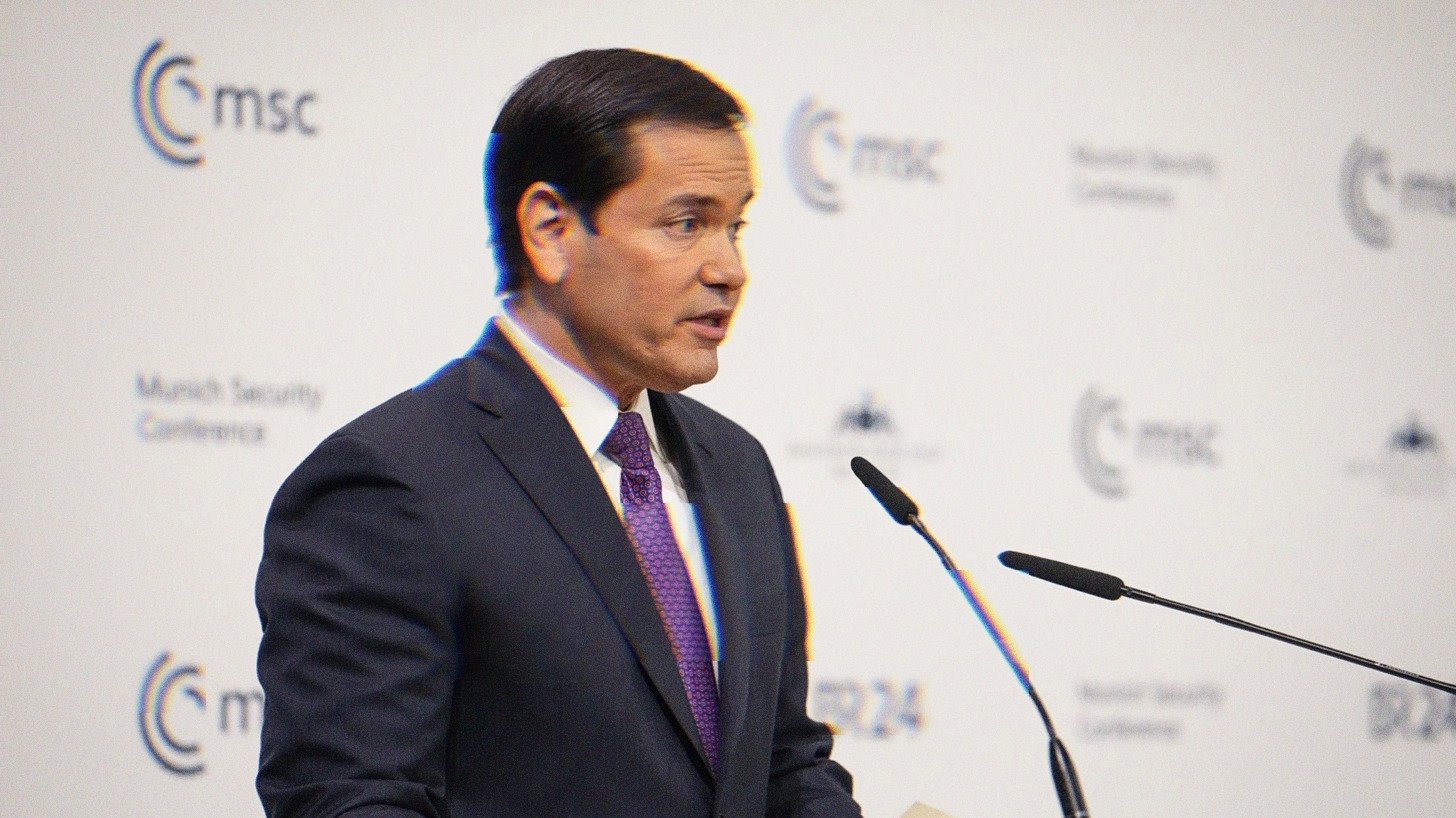 Image Description: Marco Rubio speaking at the 2026 Munich Security Conference.
This essay appeared in the Feb. 19, 2026 edition of UNFTR’s premium newsletter. Become a UNFTR member to receive our bonus newsletter each week and for other perks.
In the end, all they want is a pat on the back, a gentle reminder that Daddy occasionally respects them, that their past glories—however damaging—remain unblemished in the eye of their fellow conquerors.
So they stood and rapturously applauded Marco Rubio, once belittled as “Little Marco” by his now-boss, who has made him the most powerful diplomat since Henry Kissinger.
Rubio, the U.S. Secretary of State and National Security Adviser, delivered an unapologetic defense of colonialism during last week’s Munich Security Conference—the same event in which Rep. Alexandria Ocasio-Cortez, who, sorry to remind folks, helped traffic the lie that the Biden administration was working tirelessly to end the genocide in Gaza, failed in trying to establish her personal foreign policy bona fides.
Somehow, Rubio, who was routinely slapped down by Trump during the 2016 race to the White House, walked out of Munich a conquering hero, the wind at his back and, seemingly, Europe brought to heel.
It was a reminder that the supposedly Trump-tormented Europeans remain very much tethered to their long-held colonial aspirations despite their audible angst over Trump’s bullying of the European Union’s states. They rightfully decry the illegal Russian invasion of Ukraine, yet have little to say about the big-bad United States kidnapping the president of a sovereign nation. Or about the United States vigorously banging the drumbeats of war to intimidate Iran on behalf of Israel, who is still prosecuting a genocide of Palestinians in Gaza and is seeking to annex the West Bank.
In his speech, Rubio referenced “civilization” a dozen times. The repeated messaging appeared to resonate with the anxious audience, as he framed it in the context of their collective “survival” and in recalling past European glories.
“This is why we do not want our allies to be shackled by guilt and shame,” he said. “We want allies who are proud of their culture and of their heritage, who understand that we are heirs to the same great and noble civilization, and who, together with us, are willing and able to defend it.”
What, exactly, they’re defending is, on the surface, unclear. As it relates to the United States, Venezuela isn’t—and never will be—a threat to the homeland. Ditto for Cuba, currently under a Gaza-like siege, spawning a humanitarian crisis. Dudes on boats? The only purpose that serves is to test the limits of extrajudicial killings outside of known war zones. Iran? The impending war is Israeli Prime Minister Benjamin Netanyahu’s dream intervention—with the U.S., which has already committed billions to his genocide, footing the bill with manpower and weaponry. (Recall his cries to invade Iraq in the 2000s and how that turned out.) The same can be said for the Europeans. Call me naive, but why would Russia, which has suffered enormous casualties and was unable to conquer Kyiv, suddenly declare war on the rest of Europe, whose combined military is, by comparison, leaps and bounds more sophisticated than what Ukraine has to offer?
Perhaps because the “defense” Rubio is talking about has little to do with militaristic threats from outside forces.
The “civilization” Rubio is referencing can easily be interpreted as one of supremacy and imperial might. Of ensuring hegemony. Of quashing the voices protective of immigrants and the environment.
“We increasingly outsourced our sovereignty to international institutions while many nations invested in massive welfare states at the cost of maintaining the ability to defend themselves,” Rubio said. “This, even as other countries have invested in the most rapid military buildup in all of human history and have not hesitated to use hard power to pursue their own interests. To appease a climate cult, we have imposed energy policies on ourselves that are impoverishing our people, even as our competitors exploit oil and coal and natural gas and anything else—not just to power their economies, but to use as leverage against our own.”
There’s no coincidence that the Trump administration’s new colonial project comes amid the genocide in Gaza—a characterization currently being scrutinized by the International Court of Justice and voiced by various human rights groups and genocide scholars. There’s something to be said about a country being allowed to prosecute a war of annihilation with little consequence or accountability. Left to its own devices by the so-called rules-based order, Israel has effectively rewritten arbitrary red lines intended to serve as a check on warring parties. Consequently, the laws of war, international rules and moral boundaries have all been muddied, if not obliterated. With the world in a state of paralysis after witnessing such cruelty and bloodshed, the Trump administration is free to stretch the limits of U.S. might, as it has with the extrajudicial killings of at least 144 people in the Caribbean and Pacific, the kidnapping and military assault in Venezuela, and the strikes in Iran last year.
This is the “civilization” Rubio speaks of—one in which the great powers write the rules, create geopolitical turbulence, and direct illegal attacks.
It has put every country on eggshells, as they’re anxious about massive tariffs and—who can blame them—threats to their sovereignty.
“When great powers begin carving up the world, we find ourselves no longer at the table, but on the menu,” Gabrielius Landsbergis, the former foreign minister of Lithuania, told The Atlantic.
Perhaps that thinking is what inspired Rubio’s agenda in Munich. As he sought to be conciliatory—and delicately walk back Vice President J.D. Vance’s speech in Munich last year—he indulged their fantasies of superiority.
“We do not seek to separate,” Rubio said, “but to revitalize an old friendship and renew the greatest civilization in human history.”
In an era of belligerence, all, it seems, are welcome.
Image Source
- U.S. Department of State, Public domain, via Wikimedia Commons. Changes were made.
 Rashed Mian
Rashed Mian is the managing editor of the award-winning News Beat podcast and co-founder of the newly launched Free The Press (FTP) Substack newsletter. Throughout his career, he has reported on a wide range of issues, with a particular focus on civil liberties, systemic injustice and U.S. hegemony. You can find Rashed on X @rashedmian and on Bluesky @rashedmian.bsky.social.