
 Image Description: On The Record 07-21-26. The Right Is Too Stupid for The Odyssey. Clavicular in Israel. Hegseth Wants Buff Dudes. Trump Photobombs FIFA. UNFTR.
The Hero’s Journey
$250 million to make, $125 million to market. Now that is an odyssey in and of itself. Christopher Nolan has another hit on his hand and like millions of others, I forked over 20 bucks to secure my seat in the theater. Apart from the lady next to me who had never seen a movie in a reclining seat—“It’s like we’re having a sleepover!”—and who also had many questions for me during the five times her husband got up to pee—“What’s this actress’ name again?”—I was positively absorbed and enthralled the entire time.
There was even a spontaneous burst of applause when the credits rolled, something I haven’t personally experienced in a theater in quite some time.
Of course, The Odyssey is not without controversy. Nothing that costs $375 million to bring to market and potentially around $650 million to break even is without issues. The one quarrel that has yet to be revealed is the lawsuit I plan to bring for my hearing loss. (Seriously, Chris. Dial it in brother.) This minor inconvenience aside, there were two controversies that plagued the film’s release, though one vastly overshadowed the other.
The one that should have drawn more attention was Nolan’s decision to film four days on location in Western Sahara, considered the last colonized territory in Africa. Actor Javier Bardem tried to raise awareness of the issue stating, “For 50 years, Morocco has occupied Western Sahara, expelling the Sahrawi people from their cities. Dakhla is one of them, converted by the Moroccan occupiers into a tourist destination and now a film set, always with the aim of erasing the Sahrawi identity of the city.”
I’ll come back to this shortly.
The bigger public row ahead of the Odyssey’s release was the conservative backlash against “woke” casting. A Black woman as Helen?? A trans person as a warrior?? A goddamn puppet as the Cyclops?? What is the world coming to?
Watching the air fizzle out of the right wing rage bubble as the film crushed the opening weekend box office and none of the “woke” tropes panned out the way they thought was fun. Don’t get me wrong. Apart from that, however, I’m not sure Homer’s timeless lessons were ultimately heeded.
Nolan’s Odyssey is a fucking triumph. I’m not a literary classicist or a film reviewer but I’m a fan of being swept away by tremendous accomplishments. And it’s important that we have the opportunity to have big conversations surrounding culture-moving events. I haven’t revisited Homer’s epic work in about 40 years and yet the story is all too familiar because of the enduring legacy of its themes and fables. It’s little wonder why it remains one of the greatest stories ever told.
And while Nolan certainly isn’t the first to attempt to capture it on film, there is perhaps no one more fitting to the task. Homer’s non-linear format (Memento), the hero’s long journey home (Inception and its many themes), man’s struggle with self-destruction (Oppenheimer). Nolan’s filmography is a testament to Homer’s work and the proving ground in preparation for The Odyssey.
But it wouldn’t be a Hollywood blockbuster without heavy-handed messaging. Multiple invocations of “Zeus’ Law”—essentially the Golden Rule—enforce the timeless lesson of The Odyssey. It wasn’t simply that Troy was destroyed in some ancient battle, it was the manner in which it was done. Nolan relies heavily on narrative rather than visuals to relay the atrocities committed during the war. (Considering the movie was given an “R” rating, it frankly didn’t need to shy away from it.) The traumatized and guilt-ridden Odysseus is punished by the gods for his role in an event that came to symbolize the collapse of the Bronze Age. Climate catastrophes, mass migration of hungry populations, disintegration of trade, starvation, disease and ultimately war brought an end to this period.
In Nolan’s version, Odysseus speaks bluntly to his wife Penelope upon killing the many suitors of Ithaca:
“The breaking of Zeus’s law, spreading like plague. Our age of bronze is collapsing, and maybe he couldn’t bear to see the ruins of what he’d done. Anywhere. Least of all, his home.”
The Odyssey is a hero’s journey, yes. But it’s a journey that doesn’t end with reconciliation between Odysseus and Penelope. The ancient texts diverge on many things, including the fate of Odysseus. But Nolan chooses to portray the couple heading toward exile, toward the western sun. The west is where the fallen soldiers wait in Hades to be honored by Odysseus, but it’s clearly a metaphor for the sun setting on civilization. In the closing dialogue between Penelope and Odysseus she asks, “why will the stories only be sung,” to which he responds, “because song will be all they have to remember those of us who could write.”
While not faithful to the text, this is faithful to the era as the Dark Ages washed away written language.
We have a president who does not read. A military leader who thinks America is Sparta. Leaders all throughout the cabinet who exist to violate Zeus’ law by casting out immigrants and refugees. Smoke filled skies, flood waters, droughts, hurricanes and tornadoes threaten vital infrastructure. The lessons of Homer echo as loudly as Nolan’s deafening soundtrack, and yet the right is too occupied with culture war issues to realize they’re the bad guys in all of this. To wit, they even missed a perfectly relevant opportunity to call Nolan out on his decision to film in a colonized territory, instead opting to fear monger over the ethnic portrayal of historical figures who may or may not have existed.
And to my theater buddy sleepover friend, the actress in question was Charlize Theron. And she’s African. Wait until the right finds out. Oh wait, she’s the good kind according to them.
Two Economies, One Chart
Hot off the presses we have the Leading Economic Index from the Conference Board. Traditionally this is one of the most reliable indicators of recessions we’ve had, but the bifurcation between the normalized index and what’s called the coincident economic index has been increasing of late. What makes this useful is the number of variables; ten different indicators—manufacturing hours, jobless claims, building permits, stock prices, the yield curve, consumer vibes—all mashed into one number that’s supposed to tell you where we’re headed before we actually get there.
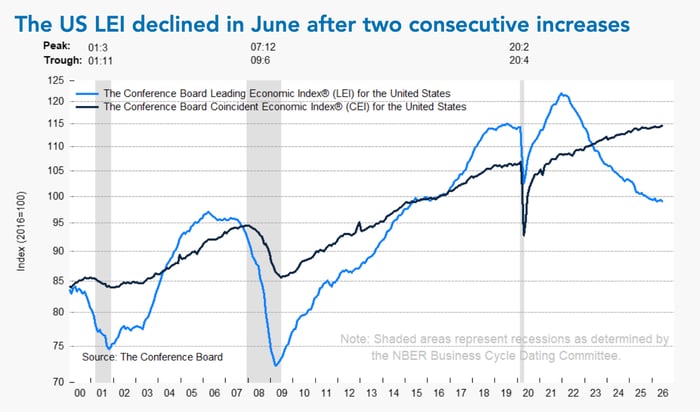
Source: Conference Board
Quick primer for the uninitiated: the Leading Index is trying to predict where the economy’s headed—it’s built to move first, months before the broader economy actually turns. The Coincident Index is the opposite. It’s not a forecast, it’s a report card—payroll jobs, personal income, industrial output, that kind of thing—measuring what’s actually happening right now. And right now those two numbers are telling two different stories: the coincident index just climbed for a third straight month, up to 114.6, while the leading index has been rolling over for years.
Once again, it’s the tale of two economies. It’s the investor versus the consumer. The only thing propping this index up at all right now is Wall Street. The yield spread and the stock market are holding steady month after month, while two things quietly drag in the other direction—consumers, who are telling researchers flat-out they feel like garbage about where this economy is going, and builders, who pulled back on permits across nearly every category they track.
That’s the split screen of the American economy in one chart. The market’s fine. The C-suite’s fine and relentlessly pouring money into AI and data centers. But the person actually building your house, or the person trying to buy one? Different economy entirely. Same country, two timelines.
And the folks at the Conference Board know it. They’re not calling a recession—they even nudged their GDP forecast up a tick for the year—but they’re telling you outright that consumer spending is the soft underbelly here, and it’s the AI capital spree that’s the only thing keeping the lights on.
 Max
Max
Max is a political commentator and essayist who focuses on the intersection of American socioeconomic theory and politics in the modern era. He is the publisher of UNFTR Media and host of the popular Unf*cking the Republic® podcast and YouTube channel. Prior to founding UNFTR, Max spent fifteen years as a publisher and columnist in the alternative newsweekly industry and a decade in terrestrial radio. Max is also a regular contributor to the MeidasTouch Network where he covers the U.S. economy.