Phone A Friend: Nick Hanauer.
Host of Pitchfork Economics, and Co-Author of Markets Built for Humans.
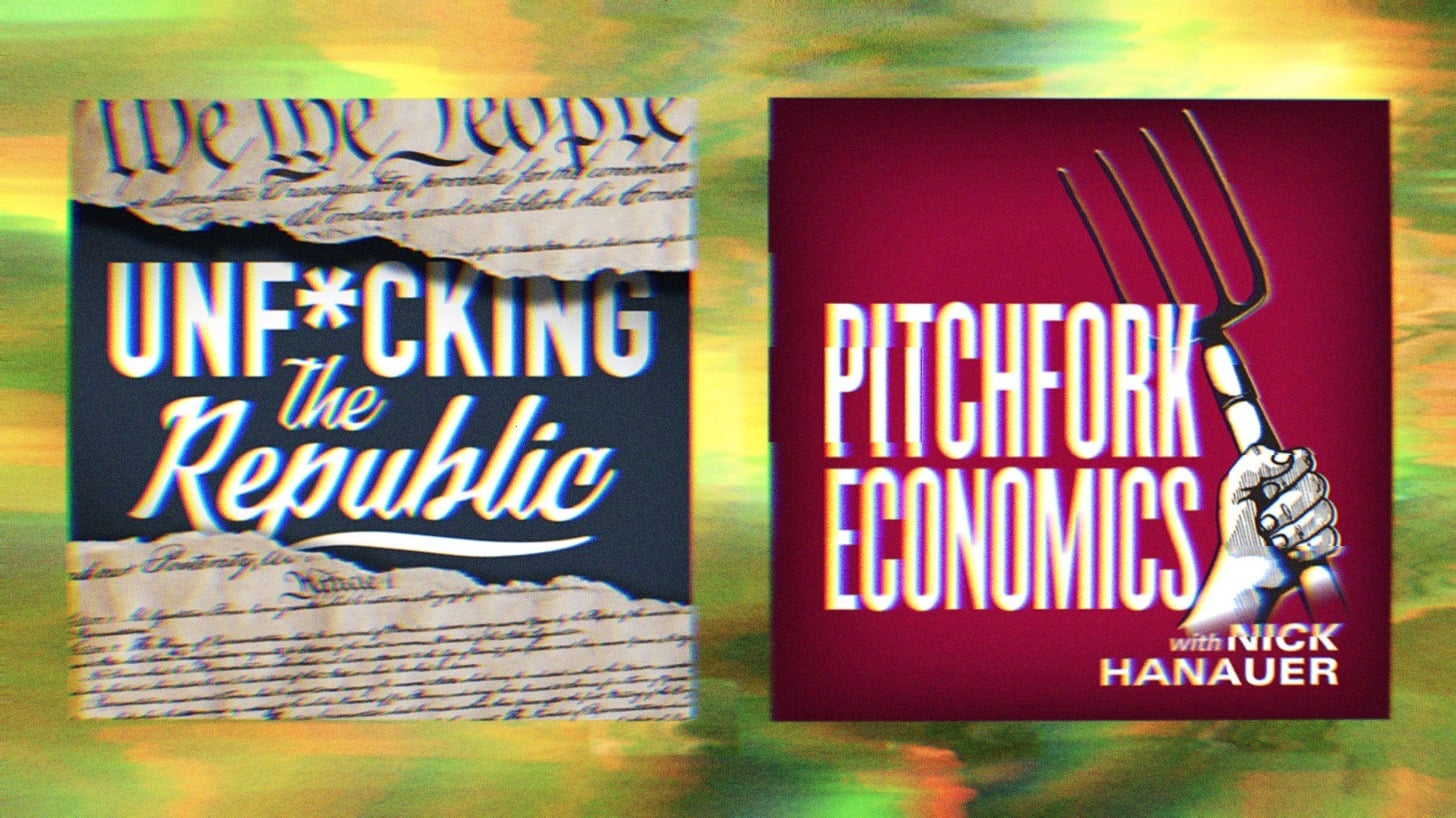 Image Description: Unf*cking The Republic Logo and Pitchfork Economics Podcast logo on a rainbow background.
Nick Hanauer of Civic Ventures and the Pitchfork Economics Podcast sits down with Max for a lengthy discussion on economic systems. For the past few years, Nick has worked closely with economists from around the world to develop a new framework called Market Humanism to fundamentally shift the current post-neoliberal paradigm toward something more beneficial for the masses and away from the one percent.
Max: All right, Unf*ckers, another special day. This is a continuation of a conversation that started, I think, during the pandemic, if I’m not wrong. But it started many, many years ago, and I’m excited to kind of catch up. We’re going to do a little bit of, you know, connecting the dots from where we left off. But there’s so many new things, sadly, to cover in this discussion today, with successful entrepreneur and financier, co-host of the popular Pitchfork Economics podcast, the founder of Civic Ventures, so many other things, but most importantly, the ultimate traitor to his class. That’s right, it’s Nick Hanauer. Nick, how you doing, buddy?
Nick Hanauer: I’m great, thank you, Max. Doing well. Great to see you.
Max: So we originally bonded through Pitchfork Economics, when we were just the podcast, before YouTube, over our mutual antipathy for Milton Friedman.
Nick: Yes, indeed.
Max: It’s a very niche bonding experience.
Nick: It’s a very niche thing to hate Milton Friedman
Max: No doubt. But what it did was it set up, I think, a long conversation for us to get into today, which is, we are through the neoliberal experiment. We’re on the other side of it now, and we’re in something totally new. Before we address what you’ve been doing lately, I actually want to go back to the last conversation that we had, because it was so prescient at the time. You made an analysis that a lot of what the Biden administration was doing coming into its first year—
Nick: Right.
Max: —and in the bridge between year one and year two, I actually see a lot of it in your work today. It was way more progressive than many of us had anticipated. It was not the full suite of programs and policies that a lot of us obviously hoped for, but I think on balance we approached it with this genuine, like, curious optimism, like, hmm, okay, this might be better than we thought. However, your conclusion on it all was that the biggest threat to this agenda will be if he does not get reelected, because a lot of the seeds that were planted could be stamped out if they didn’t have the ability to germinate over at least two terms, probably beyond.
Nick: Correct.
Max: Incredibly prescient. So what I would love to do is, can you start us off by describing the moment that we’re in right now? Put us in this place and time, in how you would evaluate the general market structures and the general type of economy that we have, if we are indeed in this bridge between the end of neoliberalism and whatever comes next.
Nick: Well, I mean, Max, that’s a terrific question, and I guess it would never have occurred to me that we could enter this autocratic, corrupt craziness that we’re experiencing with the Trump administration. Like, I was prepared to battle neoliberalism—this kind of corruption, craziness and criminality, there’s no playbook for that, right? Like, that’s not in the textbooks, or not in the kind of textbooks that I’ve been reading, right?
And I think that, you know, you are of course seeing the results of 50 years of neoliberalism that are expressed by this sort of extraordinary inequality that we’re seeing, the incredible difficulty that most Americans are facing in terms of their personal finances. And I think culturally, what you are witnessing is the sort of cultural and personal instantiation of the neoliberal ethic in these people who are now dominating our economy, like Elon Musk and Jeff Bezos and Mark Zuckerberg and Marc Andreessen and the rest of them, and just how disgusting this behavior is, right? Just how tone deaf and just, you know, just awful it is.
And I say that because one of the most terrible things about the neoliberal framework was its cultural implications. Because if you take this nonsense seriously, right? If you take—by the way, if you take Econ 101 at Harvard and take Greg Mankiw’s textbook seriously, you end up believing that because markets are efficient, the rich deserve to be rich and the poor deserve to be poor. You end up believing that somebody who makes seven and a half dollars an hour is paid that because that’s all they’re worth, and somebody who makes $250 million a year securitizing imaginary assets makes that because that’s the value they create in the world, right?
And those ideas turn into a culture that makes people at the very top think that they deserve everything that they have, and the difficulty that everyone else is having, that’s on them, that’s their fault. And I think that the economic impact is horrendous, but the cultural impact, the corruption that so typifies what’s happening at the top, is also part of that framework, right? These things are inextricably intertwined.
And, you know, shareholder value Max, right? That idea that Milton Friedman cooked up in—was it 1972? I think it was, right—that the only legitimate social purpose of the corporation is to enrich shareholders. Well, if you believe that, you become Elon Musk. You become a guy who thinks it’s perfectly okay to spend $500 million trying to block a political process that may try to constrain you. It’s perfectly legitimate to lobby to lower the minimum wage and prevent the overtime threshold from increasing, and prevent any policy that would benefit people generally, and feel good about it.
Max: Right, right.
Nick: And feel good about it, like you’re doing god’s work, because markets are perfectly efficient. The rich deserve to be rich, and the poor deserve to be poor. And that’s the thing that I find right now just to be so dispiriting.
Max: Yeah.
Nick: So dispiriting is the way in which the most powerful people in the country have just fallen in line behind Trump.
Max: Yeah.
Nick: Right? Like, they’re like, fascism, fine, as long as it’s good for profits. And I guess—does that answer your question?
Max: Well, it does, because, you know, we have to start with the problem statement. And I think a lot of what we do at UNFTR, a lot of what you and Goldy have been able to accomplish at Pitchfork Economics, is to really turn the problem statement into tangible, real-life issues where people can basically deprogram themselves and be like,“Oh, you know what? That isn’t right, and that isn’t moral, and it isn’t normal.” This has been manufactured, like, cooked over a long period of time to the point where we almost don’t see it. So we do have to go through this reeducation process, which brings you to where you are.
Nick: I think the word“deprogrammed” is dead on. Dead on.
Max: Yeah.
Nick: Dead on. Yeah, because, you know, Max, I don’t know about you, but I’ve gone through a period of deprogramming.
Max: Of course.
Nick: Like, I used to believe that crap. Yeah, like 20 years ago, I believed that crap. You know, and then all of a sudden, you start looking at it and you’re like, wait a minute, maybe this isn’t true. Like, it sounds good, but it’s not true. And it took me years of sort of thinking about it and turning these things over in my head to realize, wait a minute, we were sold a bill of goods. We were sold a bill of goods.
And look, as you know, I have benefited from this arrangement enormously, and I can tell you that as a person like that, these ideas are so easy to believe because you want to believe them. Like, everybody has to be the hero of their own story, right? You want to believe that if you made a ton of money, buckets of money, that it was righteous and just, that you deserve it. You want to believe that when you drive past all those homeless people that they deserve that, right? And it takes a certain amount of psychological honesty and a little bit of courage to start to say, wait a minute, maybe that’s not right. Maybe this is just a narrative designed by and for rich people to make rich people, you know, better off and everybody else worse off, which is the truth. That is where we’re at.
Max: Yeah, but I think—so what’s interesting is that, and we’ll get into the policy side, we’ll get into the think tank side of this thing, but in the real world, in the investor class, you have been in these rooms. Like you said, it’s been to your benefit. You’ve seen how it operates, but you’ve also been exposed. I’ve just—
Nick: I’ve just been in the rooms, dude. I am the room.
Max: That’s right. It is. And so you know what the chatter is like. You know what it sounds like. You know how the engine is greased. And I think that that has given you a different level of insight than anybody who’s sort of like—and listen, I’m the ultimate armchair warrior. I’m lobbing bombs from the sidelines.
Nick: Yeah.
Max: But you’re actually planting explosive devices inside the system.
Nick: Yeah.
Max: Through the area. And this is where I want to get into what you describe as the paradigm shift that’s necessary for us all to be thinking differently and behaving differently in the new modern economy. This idea that we can no longer exist as a planet, as a society, and even a functioning economy if we continue on this path is something that you are seeing in the real world. And when we get to Civic Ventures and we get to a lot of the material we’re going to cover today, you’ve retreated back into this knowledge systems framework that some people might look at and say,“Great, another white paper. I can’t feed my family. I don’t have time for this bullshit.” However—
Nick: Which is fair enough. Yeah.
Max: —but it misses all of the work that we’ve done talking about neoliberalism, because neoliberalism was cooked up in the same places, and then it was infused into the halls of academia, and then it was infused into the justice system, and then it was infused into the policymakers, the National Bureau of Economic Research, and so on. So it worked its way through the system like a disease.
The reason I’m saying that is that I applaud this type of knowledge work because it’s absent on the political stage. If you look at the RNC’s platform or the DNC’s platform, or you look at any of these systems that we have right now, there is no power base that’s thinking in these types of critical terms. So I say that to our audience to say, don’t dismiss the knowledge work out of hand. You might think that this is hyper-theoretical, but somebody has to write it down for somebody else to follow down the road.
So with that, can you sort of give us your—we’ve put ourselves in time. We’ve described what happened, how we got here. We know we’re in this sort of nebulous no man’s land right now. Can you describe the paradigm shift that you believe is necessary, and then we’ll get into some of the details going forward?
Nick: Yeah. So you and I have followed similar paths in terms of sort of figuring out that this neoliberal thing was a pack of lies and had taken us down a road that was good for a few and terrible for everybody else. And we’ve been at this long enough to see how bad it can get, right? Like, because it’s a lot worse today than when we first spoke, and probably before, you know, when we first both mutually realized that this was going wrong.
But what I was fortunate enough to do was connect with some heterodox economists, principally a guy named Eric Beinhocker, who runs something called the Institute for New Economic Thinking at Oxford University, and go from critic—which is crucial, right? And look, you and I, to a certain extent, need to take credit for the fact that at least people recognize what the problem is today.
Max: Yeah, you can’t go past it if you can’t describe it.
Nick: That’s right. You know, we did a lot of work. You did a lot of work to get people to see, like, hold it, you know, there’s a thing there, that’s bad. But what we realized is that criticizing a paradigm does not make it go away. You have to have an alternative.
And so almost 15 years ago, I got to work with this guy Eric Beinhocker and a constellation of heterodox economists from around the world to try to organize an alternative to the neoclassical slash neoliberal framework. And not to get technical, but an economic framework is a way to understand cause and effect. That’s the whole point of it, right? Is, if you do this, then that will happen. And the neoclassical framework is based on a bunch of assumptions about the world, about human behavior, about the dynamics of human social systems, about what prosperity is and where it comes from, that is internally consistent and mathematically elegant, but that we knew 15 or 20 years ago was just objectively false. The assumptions, most of them were cooked up some 100 years ago, 200 years ago.
Utility theory, by way of example, which holds the whole framework together, was cooked up in 1787 by a guy named Jeremy Bentham, who was very smart, but by all accounts kind of on the spectrum. Not a man who understood other people. And he ran no experiments. There’s no empirical evidence that people are utility maximizers. It just sounded good, and you could mathematize it, so they went with it.
And so what we realized is that if you substitute these ideological, old-fashioned assumptions about human behavior—so, humans as reliably selfish and rational, that’s homo economicus, right—if you substitute these assumptions for what we now know using empirical science are true, you come up with a completely different paradigm, a completely different way to understand economic cause and effect that will take you in a very different direction.
And so that is what we have spent the last 15 years doing: excavating all the modern scholarship and organizing it into a new framework. And we call that new framework, the new economics, market humanism. And it’s a way of understanding economics that I think is based—you know, market humanism is what you get when you build a framework from the empirical evidence up, not ideology down, and dedicate the framework to human flourishing, not capital appreciation.
And the signature feature of the neoliberal and neoclassical framework is that the only thing that matters, the moral framework that is embedded secretly within that framework, is capital efficiency, right? That’s the only thing in our current system that matters. That is privileged above everything else.
Let me just give you an example. If we want to raise the minimum wage in a place, you have to do 10 university studies to affirmatively prove that it will cost no jobs. But there’s $50 billion a year in Wall Street bonuses, and no one has ever done a study on how many jobs that kills. Right? Because in our economic framework today, any intervention that is good for ordinary people requires you to affirmatively prove th at it will do no harm, and anything good that happens to rich people is an unalloyed good. $1.5 trillion in stock buybacks this year—
Max: Yeah.
Nick: —and not one university has done a study on how many more jobs we would have if that $1.5 trillion was wages and not stock buybacks. And by the way, the answer is millions and millions and millions of jobs. Just to be clear.
Max: As you point out—actually, I can’t remember if it’s in the full pamphlet that you put out, or if it was in the journal piece—but as you point out there, the knee-jerk pushback to this also goes back to some very unscientific wage-price spiral thesis of, if we put the buybacks or we put the bonuses into everybody’s wages, it would cause inflation. Inflation is the worst thing that an economy can experience. Ergo, nobody can have anything good, right?
Nick: Exactly. But this is so crazy, right? Look, a ham sandwich in Somalia costs like 25 cents. In Switzerland, it’s 25 bucks. What economy do you want to live in? Right? There is no doubt that a high-wage economy will be more expensive than a low-wage economy. But where do you want to live, right?
And by the way, here’s the really funny part: where do the people who have the capital want to run their businesses? Right, they want to run their businesses in high-wage places, because in low-wage places you can’t sell anything because there’s nobody with any money.
Max: That gets back to—I got tired of having the conversation. Having lived in New York for a long time now, I got tired of having the conversation after every major event of how this is the one that’s going to put the nail in New York’s coffin. Understand this: there is no nail big enough for New York. You cannot keep it down, because it’s the center of global finance, and it’s also where the wages are the highest per capita. So it will continue on. And COVID won’t take it down, and 9/11 won’t take it down, and the Koch ‘70s won’t take it down. You can keep calling for the death spiral, and by the way, it ain’t gonna happen.
Nick: I can tell you that, like, you know, I have kids in their early 20s. Every kid I know is moving to New York. Everybody wants to be there. Like, everybody. It’s the coolest place in the world, right? Like, everybody wants to be there.
Max: My daughter’s living the dream. She’s living downtown in a one bedroom, and there’s three of them, because that’s what you do right now.
Nick: My son is living—my son’s living in Brooklyn with two buddies.
Max: There you go. We should introduce them. We’ll do that off camera.
Nick: I’d love to do that.
Max: Anyway, the point is, it is thriving down there. It is absolutely amazing. I cannot believe the number of young people. But the disparity between what’s happening in these places and what has unfolded already in every other place in this country, it is just astounding.
Nick: That’s right. That’s right. And as much as they want to be in New York, I mean, when I consider the difference in their possibilities and trajectories versus, you know—I’m older than you, but it’s just so much harder. I mean, the idea that my kids would be able to buy a house on their own, like—
Max: Nope.
Nick: No. Not in a million, dude. I bought my first house, a gorgeous Tudor with a view, in Seattle for $120,000.
Max: Wow.
Nick: You know, like, I mean, and today it’s worth $500 million, yeah, or whatever, you know. But my kids couldn’t afford it. That’s for darn sure. So, so anyway—
Max: You hit on something before, though. Yeah, I want to, before we go on to what the actual policy prescriptions are, of which you have a lot of them—
Nick: Yeah.
Max: —this idea of measuring success by human flourishing is something that is thematic, I think, in a lot of new thinking. We interviewed an author named Tad DeLay who had put out this wonderful book on climate change, and he was making a similar argument, which was that this measurement of GDP—which again, you point out a great example of this, which is cigarette sales and then the cost of actually doing cancer research from cigarettes. Both of those contribute to GDP. So the way that we wrap our minds around growth, and whether it’s, you know, nominal or not, is itself corrupted by this idea of capital, because capital doesn’t care where it goes so long as you measure it and give credit, you know, to whoever has the most.
Nick: Dude, cancer turns out to be a pretty good business.
Max: Tremendous. Right. Absolutely right. Like, that’s why I don’t believe that AI is gonna figure out how to cure cancer.
Nick: Cancer is a really good business.
Max: So, this idea of measuring by human flourishing, is that one of the bedrock assumptions of how we need to actually manage through this paradigm shift?
Nick: Yeah.
Max: Because GDP—now you’re going back to Adam Smith. You want to talk about fully baked into us, this idea, this notion that GDP is the measuring stick that we care about the most is so fundamental to capitalist systems.
Nick: Yeah.
Max: —that it goes back to the progenitor of it.
Nick: Yeah, well, not really. I mean, GDP was invented in the 1940s by a guy named Kuznets. He was an economist. And the funny thing about that is that after he invented it, he implored people to not use it as a measure of welfare. He’s like, whatever you do, don’t use this as a measure of welfare. But of course we did, because, first of all, it’s simple, you can easily measure it. And, you know, I mean, often the world is governed by things we can measure, right? Easy things to measure get measured, and all of a sudden we’re chasing the wrong thing.
But let me just say a couple of things about the paradigm to give it more clarity. In terms of flourishing: in the conventional view, prosperity is, like, if you have a lot of money, we get a lot of GDP. And that is just not true. A much more robust way to understand what prosperity is, is understanding it as the accumulation of solutions to human problems.
So, you know, this object, this iPhone, is incredibly difficult to put down because it contains so many tools and solutions. I can tune my guitar with this thing, right? Like, who’d’ve thunk it, right? I can measure walls. I can call people. And that is why it’s so valuable to us.
And the difference between a poor society and a rich one is not how much money there is. You could be king of the jungle, for example, Max, and you could have a pile of, whatever it was, shells as high as a house, but those shells are not going to buy you air conditioning or antibiotics or a comfy bed and, you know, something you find very, very easily in a modern society.
And when you understand prosperity as solutions to human problems, you unite moral and economic concerns, because now every economic act is a moral choice. Are you solving people’s problems, or are you creating more problems than you’re solving? And so that aligns prosperity with human flourishing. That, for example, allows you to distinguish between a company that does a billion dollars a year causing cancer and a company that does a billion dollars a year curing cancer. These two things are different. We should regard them as different. But in GDP world they’re absolutely the same. It just doesn’t matter. And that’s the first thing.
And the second thing I think that’s very important that distinguishes this modern paradigm from the old one is, in the old one we have this belief that the only thing that matters is competition, and that that’s why markets work—that markets work through competition and they allocate scarce resources. And this is, I mean, true to a certain extent, but not why markets are such a remarkable social technology. Markets are important to human societies because they enable large groups of people who do not know each other to combine their knowledge and know-how in an evolutionary system to solve complex problems cooperatively.
98% of what happens in an economy is cooperation. All of the things that go on within the firm are cooperative, and cooperation is humanity’s superpower, not competition. It’s not that competition isn’t part of markets—it is—but cooperation is the thing that is so very important. And cooperation only works if there is trust, and trust is a byproduct of justice, fair arrangements.
And so if you understand the economy as effectively a cooperative evolutionary system aimed at solving human problems, you have radically aligned the economy with human flourishing, because now you’re optimizing for that, not making some sociopath richer, right? You’re optimizing for an entirely different thing.
Max: So what’s interesting about the analysis—which now I really want to dive into—the, or not even an analysis, but the framework itself and what you’re prescribing, because you are putting prescriptions post this diagnosis. You are putting your money where your mouth is, for sure. The idea of calling this market humanism, to me, is interesting because it reclaims this idea of markets from the vice grip of capitalism, because I think that one of the successful orientations of capitalism is that it has co-opted the idea that markets only exist within capitalist systems, whereas markets have actually always existed. I think I found that—
Nick: Yes.
Max: So I love that about this. What I found really interesting is, I was thinking about it, going through the larger thesis that you put together is—so there’s two pieces that I’m going to link here. The first is the one that you had shared with me before we got together, which is an article in Democracy: A Journal, and it’s Market Humanism: A New Paradigm for a New Era. And then the longer PDF, which—it looks like it’s going to be a book. Is that correct? Beautiful.
Nick: That’s it. I love it. Really, I really feel bad that we didn’t send you some hard copies.
Max: I read it. It’s okay. I got through it. Send a hard copy, that would be great too. I love that you call a 140-page production a pamphlet. That is so old school. I love that. That is, like, 1700s shit.“Here’s my pamphlet. Read it.” No, it’s a book, dude.
In the article, the word“capitalism” does not appear. In the pamphlet, it appears three times. Was this deliberate?
Nick: Wow, dude, no, and I didn’t know that. Okay, what do we call that? A Freudian something or other? That’s amazing. I absolutely did not know that. But I love the fact that you figured that out, and I think it’s a marvelous way of underscoring the point that you’re making, which is, we can organize markets. Markets can be organized in any way, in an infinite number of ways. You can organize a market economy to make a few people richer, or you can optimize a market economy to benefit people broadly. Now, what you cannot do is optimize a market so that everyone gets the same, no matter what. That will not work. That will collapse.
Max: Why is that?
Nick: Because you do need some incentives in the market so that people work hard and they strive and so on and so forth. Human behavior is what it is. We are both deeply reciprocal and cooperative, but also selfish. Those are both parts of our inner workings.
Max: Now, before anybody in my audience goes crazy: Marx would agree with you. Marx agrees with you, rather.
Nick: Yeah, yeah, yeah, yeah. Like, this is just human behavior.
But what you want to do is, you want to set up—so what we’ve done is we’ve set up a market system that encourages people to be their worst selves, their most selfish selves. But you can set up a market economy that encourages people to be their best selves. And in that second framework, will there still be bastards? Of course. Of course. You are never going to rid yourself of the terrible people.
Max: Go to a local schoolboard meeting.
Nick: Yeah, exactly.
Max: Go to the most egalitarian thing that you have in your community, and you’ll find an asshole.
Nick: Yes, you will. You will. You will. And, you know, definitely, there are lots of studies that show that CEOs of companies over-index for sociopathy, right? That’s just a fact, right? But what you can do is organize a society that constrains those people and encourages better behavior. And that’s what I think is really, really important. And so that’s all market humanism is—it’s just organizing a market economy so that it broadly benefits people.
And here’s the thing I just want to underscore so much, is that all of the empirical evidence suggests that when you do that, you don’t get less economic growth and less innovation. You get more. So I’m not suggesting that we should change to a system which is fairer but will generate less prosperity. What we’re saying is, all the evidence suggests that by making the economy fair, we’ll get more prosperity and more innovation.
And look, the evidence for this is everywhere. When tax rates were highest, when union density was strongest, and when corporations were highly constrained, in the ‘40s, ‘50s, ‘60s, we had GDP growth rates almost double what they are today.
Max: Right.
Nick: Four and a half percent. And as soon as the neoliberals took over, right down. And how could it not be, right?
Max: So what I appreciate about this idea of eliminating capitalism, but being able to have an elevated discussion about market systems, is that it does speak to how the political apparatus trains us to sometimes have the wrong fight, because it’s a misdirect. If you’re mad at capitalism and you want to destroy it, or you promote capitalism, which is now, of this election cycle, the litmus test—for example, Abdul El-Sayed had to come out and specifically state that he was a proponent of capitalism.“No, no, no. I’m good. I’m a capitalist.” This has become the test between the two parties: are you anti-capitalist or pro-capitalist? Because it’s the wrong—
Nick: It’s a false choice.
Max: It’s a wrong conversation to be having. So I love the idea that it wasn’t part of this—
Nick: And I did speak to Abdul about this specifically.
Max: You did? Is that right?
Max: Absolutely. Yeah, yeah.
Max:I think this is a great discussion for us to have. Now I’m gonna press you.
Nick: Yes, yes, sir.
Max: So the links I’m gonna put in the description are sort of a cascading view of economic thought. I’m going to link the Democracy Journal piece, and of course the PDF, Markets Built for Humans. And then I’m going to put in Thomas Piketty’s Global Justice Report that just came out in June of 2026. And I know that he is one of the economists that you cite, and you rely on his data work, because his data work frankly is incomparable. He has done an unbelievable job at giving us all a proper baseline to do these analyses.
But then I’m going to link the socialist critique of Piketty’s work. The socialist perspective on Piketty is that it was—let me see what they said—that it’s an experiment that atones for empire instead of fighting capital. Which is to say that your framework, all the way even into Piketty’s framework, where yours talks about reorganizing and managing the system that we have today, Piketty is saying we need to be redistributive toward the global South in order to battle the existential threat of climate, which means we do need to enter a period of degrowth, which is, again, another discussion, but it’s an important one to have. Whereas the socialist critique of all of this is that being redistributive doesn’t make capital less rapacious.
And so even on what I would consider the broad version of the left, we are still having three different fundamental conversations. Where I see you sitting is the non-accelerationist view of what comes next, which is why I was really pleased to see that you quoted Schumpeter, because to me this is the intellectual inheritance of Schumpeter’s work. What you’re doing right now is really continuing—
Nick: A bit.
Max: —his fundamental thesis.
Nick: A bit.
Max: But it’s wrapped into a Keynesian idea of, how do we support and continually modify the system that we have to produce the best outcomes, because it remains the best market invention that we’ve had in human history. So I would love for you to put your model into the intellectual bucket in which it deserves to be placed, and answer whether or not you see it as the end, or the bridge again to something different.
Nick: Holy cow, there’s a lot there. So, I’m not exactly sure what you mean by Piketty’s framework. So Piketty, Piketty’s big contribution was historical. Capital in the Twenty-First Century didn’t outline a new economic framework. It simply characterized what had happened, and postulated that when the rate of returns are greater than growth, capital accumulates, which is true. And in his later incarnations, he said, like, yeah, we have to redistribute, we have to have wealth taxes and all that stuff, which I all agree with. But what Piketty never—
Max: But he’s doing it on a global scale, where he’s saying, yeah, the wealthy global North is going to have to, like, purposefully redistribute to the global South, because the resource imbalance is too extreme.
Nick: So that question, that issue, hurts my brain. I just have to tell you, he’s right, and I can’t fix that.
Let me just try and explain what I mean by that. When we cooked up the $15 minimum wage—do you remember that I was part of this cabal of people who created the $15 minimum wage and ran the first campaign in the city of SeaTac, and then we went to Seattle, and then across the country? There are, I don’t know, 20,000 professional economists in the country. Not one wrote in support. Zero.
I was on a call a month or two ago with one of the most prominent left-leaning economists in the United States, a name you would recognize, and he told me that at the time that we cooked up 15, all the lefty economists had a conference call, and they all thought we had lost our minds. I met with dozens of Democratic lawmakers, dozens of policymakers, dozens of economists. They all thought it was lunacy.
The federal minimum wage is still $7.25 an hour, $2.13 plus tips. We can’t even fix that. Like, we can’t even fix that.
Max: Yeah.
Nick: Like, by the way, if you’re listening to this podcast and it does not piss you off that there were zero economists in America with the courage to stand up and say, we should back this thing, this is obvious, we should do this—if that doesn’t piss you off, I don’t know what does. Like, it pisses me off. It makes me angry.
And so I have to admit to you, Max, that my interests are far more provincial. I want to fix that. Like, I don’t even know how to think about the global South yet, right? Like, my brain hasn’t gotten to those sets of problems, because, you know, we’re still so backwards in this country. It boggles the mind. And I will assert—and this is contestable, but I believe it—that if we can’t get the United States of America on the right track, the rest of the world is screwed, and we’re seeing that unfold right now. Right? And so I really—I mean, I know there’ll be people who are listening to this who’ll be like, what a loser, but I just can’t. I don’t—
Max: No, not at all.
Nick: Yeah, I don’t.
Max: We’ve made similar assertions, that the only way to change hearts and minds and begin to shift paradigms is to give concrete examples that are politically feasible and economically attainable within a short period of time. And our example for that is, if Medicare for All isn’t the tent pole of any political project going forward, then the rest of these things cannot flow from it, because it’s the easiest, most tangible, most economically productive and society-changing thing that we could do to show people that we can do it.
Nick: We are so far removed from what is possible. Johnson’s Great Society, FDR—like, forget it, we’re so far removed from it.
Max: Yes. And now those things have become vessels for attack by the right, because they see that—it’s not that the systems are crumbling, they’ve been able to steal our faith in the systems from us. And so I am in agreement with you, but I’m giving you the broader critique, that even Piketty, who talked about redistribution of capital and surplus to the global South in order to help us combat the results of climate change, but also just the great imbalance that leads to mass migration—
Nick: Of course.
Max: Has some critics on the left who say, you’re still not getting to the root of the problem, because the root of the problem is that the pursuit of capital is rapacious to the planet, and everybody’s missing the larger existential threat of climate change. So they would say to you, you’re putting Band-Aids on our system, and our system still, by definition, can only function if it is soaking resources from other parts of the world, that is contributing to the acceleration of climate change and poverty.
Nick: Yeah. So, there’s—god, there’s so many things to untangle in all of this. So, one of the beauties of going from measuring GDP, or thinking of GDP as the measure of welfare, which is largely how much stuff we burn, right, to solutions to human problems as the measure of welfare, is it allows you to begin to dematerialize the economy. Because, you know, a massage does not create climate change—
Max: Yeah.
Nick: And a world in which we buy less stuff but get more massages is a world that maybe is better. That’s probably a ludicrous example, but you know what I mean.
Max: Absolutely.
Nick: And I do want to directly address the deeper criticism that I think I hear you leveling, which is that we should somehow banish self-interest. Because that’s what we’re really talking about. Like, capital—
Max: Self interest is—even that is part of a proper Marxian framework for looking at this. I think the critique that’s being leveled is, this is all going to come back to haunt us if we don’t—let me put it even simpler. We can’t save the planet unless we figure out how to go through degrowth. So what they’re talking about is, you can measure—
Nick: Yeah, I disagree. I disagree with that.
Max: Great.
Nick: I disagree with that. So, degrowth. So here’s the thing: we live on planet Earth, and on planet Earth there are humans. And let me just remind everybody that a majority of the humans in the United States of America were so dumb that they voted for Donald Trump in the last election. And if you think you’re going to talk that group of people into not improving their circumstances in order to save the planet, I have a very big bridge I would like to sell to you.
Max: Yeah.
Nick: So I’m a realist. Like, market humanism is not utopian. I believe—and again, this is contestable, but I believe—that the best that we can do as a human society is a market-based economy that is completely dedicated to human flourishing and constructed in a way that everyone who is willing to robustly participate in that, to actually go to work, can live a life of dignity, security and happiness. And that does not mean that we’re all the same.
Max: Yeah.
Nick: But it does mean that we have a super high-functioning society and a thriving democracy, and that people are generally happy because they feel like they’re included. To me, that is likely the best that we can do on planet Earth.
And I do not believe we will ever end up in a society where everybody has the same thing and capital doesn’t exist and we all live happily ever after. You know, I’ve never seen an example of that, and everybody who’s tried that, it just hasn’t worked out, right? Communism didn’t work. It’s a stupid system, and it just is, right? Like, it didn’t work. And so I think that capital, in all its forms, is necessary in an economy, but it shouldn’t be the point. It should be a tool, not the objective.
Max: These are the words that we use today that have become traps.
Nick: Yes.
Max: Capitalism as a notion is now—
Nick: —is about capital.
Max: It’s a trap in the discourse. Just as I would argue to you that communism itself is a trap in the discourse, because communism, as it was imagined to be, we’ve never actually seen. It actually was never properly implemented in the way that it was imagined. And if you want to take a Marxian view of it, capitalism, even in Marx and Engels’ writings, was never actually defined. It was defined as whatever the stage after socialism would be, where the state actually disintegrates. We’ve had no such thing. China is not communism. The Soviet Union was not communism. Cuba was not even communism. But we’ve walked into these traps that are very helpful for the elite members of our society who organize capital to be able to pit us against one another.
However, the reason I’m pushing you here is because these are the conversations that are happening on the left all the time, right?
Nick: Yeah.
Max: The left is known for eating itself, and it’s known for debating itself into the ground, and that’s fine. However, my argument about market humanism is that we can see it—you can see it as the point we need to get to, I can see it as a necessary step to get to something beyond it, and altogether we can argue that whatever your endgame is, it is not possible unless we pass through this paradigm shift first. Because if you do not agree with that, that means that you are a de facto accelerationist, that all of this is going to have to come in on itself, we’re going to have to see mass starvation, mass migration, degrowth through depopulating simply because of disease and the ravages of climate change, in order to get to something else.
Or we can all collectively work together for childcare access, crowding in strategic supply chains, progressive taxation, all of the things that you’ve measured here.
Nick: You know, a healthcare system that works. We can have those things.
Max: Read this. Imagine us having nice, good things that allow us to dream about what’s next. We can. We don’t have to agree on the endgame to agree that this is a better way to get there. Is that fair?
Nick: I think that is fantastic. And so, Max, you put that so beautifully. And again, you said a lot of things that really made me think in this interview. And I absolutely agree that it is plausible that there is an economic system that is beyond market humanism that would be even better. But I would confidently argue that market humanism would be a huge step forward for our society and most societies in the world. And certainly for myself, I would feel like if we got there, we would have made a lot of progress, and I think that the vast majority of Americans would agree with that statement.
A world in which every family, you know, was economically secure, had access to healthcare and childcare, had four weeks of paid vacation every year—like, all of these things are totally within our grasp. We could have these things. Just kick these idiots out who are running things right now and put some people—well, people like El-Sayed, you know, and James Talarico and others. Like, these are the people that we need leading the country towards a better future. I definitely believe that.
Max: And if, as we argue all the time, politics is a reflection of sentiment—if you think that AOC and El-Sayed and Talarico aren’t liberal enough, then that means that we haven’t done the job to shift the sentiment to show what is possible. These are the gateways to show what’s possible, so you can have those explorations. The Trump voters that you’re talking about, they’re voting out of fear. They’re voting out of fear and economic precarity, and so it’s easier to other somebody than it is to just weigh in on the hard steps forward.
I think that there is a responsibility to have these discussions. Before we go, I have two questions for you.
Nick: Yes, sir.
Max: If you have the time.
Nick: I have all the time in the world.
Max: One is, I think, difficult and existential, and the second is a fun thought experiment. The first is, as you’re developing this framework over the last several years—and I recognize this is a lot of fucking work. This is so well sourced. I was so happy reading it, because it wasn’t just that the diagnosis was so perfectly crafted. It was that it made the prescriptions very logical and made a lot of sense. And I want people to read this. It’s very well executed.
Nick: Fifteen years in.
Max: In the last piece of that, as you were delivering this, though, we have been in the midst of this—what some people think is either the biggest bust in the history of capital, or the thing that will transform the economy to just sort of take care of all of our worries on its own. The AI conversation. How did that impact your thinking as you’re preparing to deliver this missive? Did it impact your thinking at all? And how are you thinking about it today?
Nick: Yeah. So, it’s very difficult to predict what the impact of AI will be. But what we knew for sure is that, in a neoliberal world, it would be an accelerant of all the worst things. All AI is going to do in a world governed by neoliberal principles is make all the bad things worse faster. And that’s why I think this moment is so important.
Look, if the only thing you’re optimizing for is capital accumulation, then who cares about how many jobs are killed? Like, you know, neoliberalism just optimizes for all of the wrong things. And within that context, a new technology like artificial intelligence just accelerates it all. And that’s why it is so important today for us to collectively dedicate ourselves to an economy that is optimized around human flourishing, where we privilege that affirmatively—not like, maybe, possibly, if that’s an outcome.
You know, like, I think we’re at a very dangerous point. And again, I’m a tech guy, so I know more than the average person about AI. But I’m certainly not—I’m not running an AI company right now, and so I don’t know as much as some. But, you know, I guess that’s my worry. There are a lot of risks at play, but, you know, it is going to be very disruptive. And if we are not organized to manage through those disruptions in a way that benefits us all, then, oh my gosh, it’s going to be terrible. It is going to be really bad. And, you know, I hope that we can avoid the worst of it. But, you know—
Max: You can’t see it. You might perceive it, but I am exercising incredible restraint not to continue on this line of thinking, knowing that I’m sitting in front of one of the greatest tech investors in history. I’m going to stop that. I’m going to hold myself back.
Okay, and get to the quick thought experiment before we go. Who would you put on your Mount Rushmore of economists? It’s a piece that we’re putting together right now, and I have thoughts, obviously, but I’m curious from your—
Nick: I mean, honestly, I mean, it’s self-serving, but my colleague Eric Beinhocker, who I think is one of the most original thinkers in economics, who runs something called the Institute for New Economic Thinking at Oxford. Can I list them, or just one.
Max: You got four on Mount Rushmore, brother. So you got three to go.
Nick: Daron Acemoglu. Joe Stiglitz.
Max: Oh man! Just the fact that you call him Joe. Now I know you’re friends with him. Fuck me.
Nick: Joe?
Max: Yeah.
Nick: Yeah, yeah, yeah.
Max: God damn! I mean, come on. Who has that kind of friend? Nobody should be friends with him. He should be in a museum somewhere. He’s friends with Joe.
Nick: He’s such a cool guy. I get to spend—okay, you want to—okay, okay, really want to know something crazy? I got to spend a weekend with Joe Stiglitz a couple of years ago at George Soros’s house.
Max: I mean, what is even happening right now? How crazy is that? hat’s a pinch-me moment, right? That’s where you steal the monogram towels.
Nick: That’s a selfie moment. Like, look, look. Yeah.
Max: You take the monogram towels and the guy’s letterhead, and you run.
Nick: You steal the sheets.
Max: Hey, you got one more?
Nick: Oh my gosh. Oh, you’re killing me. You really put me on the spot. I’m gonna hurt the feelings of somebody now.
Max: That’s right. Well, you know what? Pick a dead person, makes it a lot easier.
Nick: Well, for sure, Keynes. You know, Keynes. Although—yeah, yeah, Keynes. Although, I just want to say, the only thing I want to say is, Keynes was a genius. But people equate what we’re doing to Keynes, and it’s similar but profoundly different, because Keynes didn’t understand the economy as a complex adaptive system, right? He was in an old paradigm. He was just like, common sense: if people have no money, no one will buy anything, and it will be bad, right? Like, this is a very simple observation.
Max: I do think what people miss about Keynes is that he personally was more adaptive than people give him credit for. Everybody thinks that he had a system and a framework and he ran with it for his entire life. He actually was pretty malleable. And in some cases—like, that’s why you go back and you can watch interviews with Hayek, and he’ll be like,“No, I agreed with him on that.” And he’s like,“Oh my God, yeah.” You know, none of these things are set in stone.
So I’m going to link as much as I can in the description, and especially in the order that we talked about them today, because I think it’s really important. But I have to encourage people—our audience loves this stuff. This is why we’re here together.
Nick: Yeah.
Max: I think that as a gateway into the larger—what you call a pamphlet, normal people call a book—reading that article is really important.
Nick: Yeah the Democracy Journal article.
Max: Yeah, it’ll kind of train your ear to prepare for the larger pamphlet. But I am going to link that, and I hope—
Nick: A nd then you can download this for free. For free. Markets Built for Humans.
Max: That’s right. Yeah, that’s right. Nick Hanauer, thank you, brother. I appreciate you taking the time.
Nick:Thank you so much. Fascinating conversation.
Max: And I’m looking forward to the next conversation. And I hope you have tremendous success with this book.
Nick: Thank you so much.
 Max
Max is a political commentator and essayist who focuses on the intersection of American socioeconomic theory and politics in the modern era. He is the publisher of UNFTR Media and host of the popular Unf*cking the Republic® podcast and YouTube channel. Prior to founding UNFTR, Max spent fifteen years as a publisher and columnist in the alternative newsweekly industry and a decade in terrestrial radio. Max is also a regular contributor to the MeidasTouch Network where he covers the U.S. economy.