

No King.
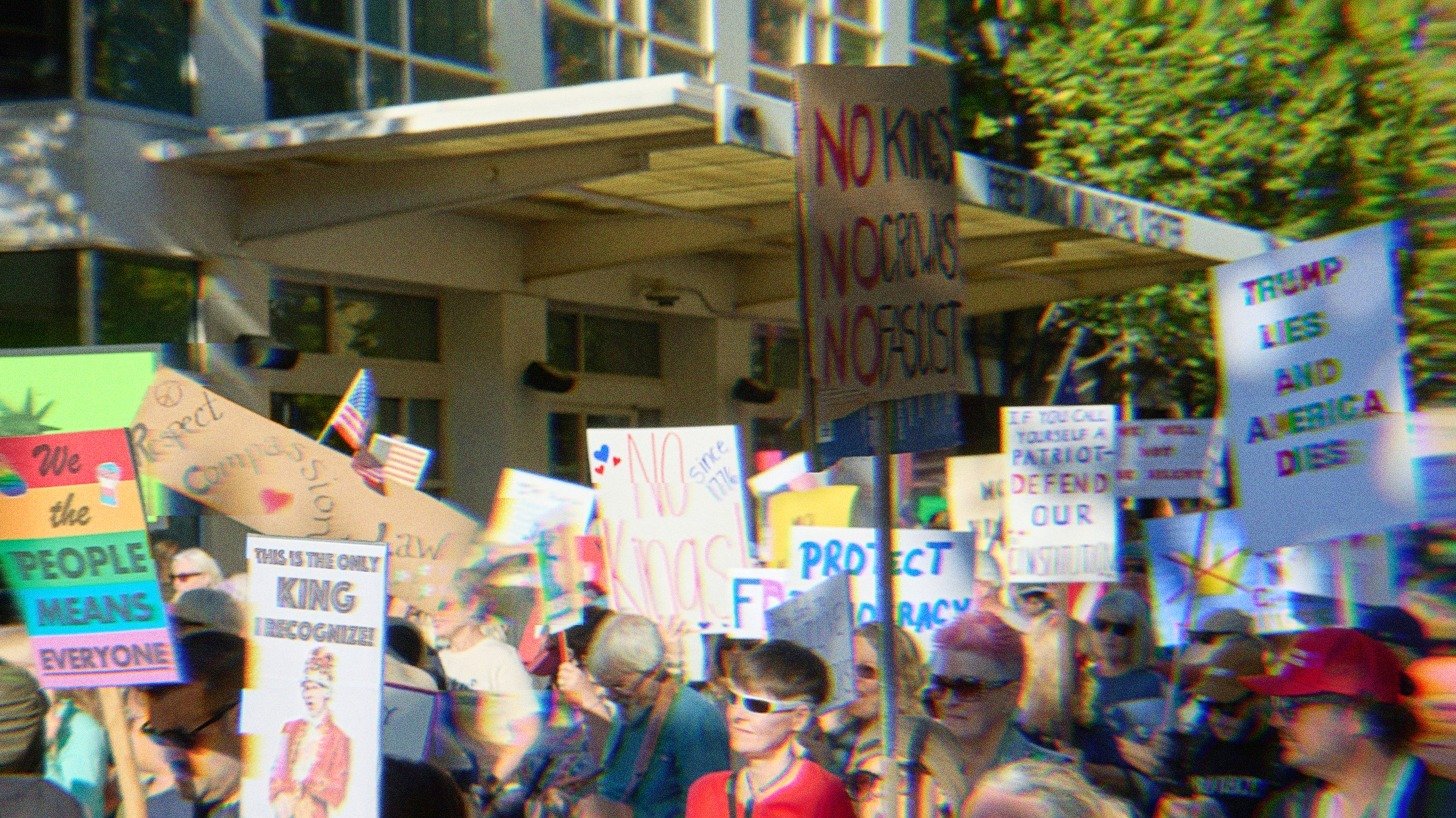 Image Description: Protestors in California at No Kings, holding signs that read ‘We the people means everyone,’ 'No Kings, No Crowns, No Fascist,’ ‘Trump Lies and America Dies,’ and more out of view.
The No Kings rallies fanned out across the United States in protest of Donald Trump’s increasingly dangerous, erratic and autocratic regime. Cuba remains in darkness, the war in Iran has already turned into a quagmire, the economy is cratering and Americans are feeling powerless in the face of Trump’s rule. In this episode Max ruminates on the liberation of “America” from a different era as told by the life and times of Simón Bolívar, one of the great military commanders and political leaders of the post-Enlightenment era. His was truly a revolution of “no kings.” In Bolívar’s approach we can learn about combating despotism.
Let’s talk about our would-be king, Donald Trump.
I’m back from a week or so of vacation where I had plenty of time to ruminate on our dear leader and consider what comes next amidst all of this madness. While I was away, somewhere in the neighborhood of nine million Americans took to the streets to reinforce the notion of American independence, just in the nick of time to celebrate 250 raucous years as a nation. Sadly, I returned home to find that King Donald was still on his gold plated throne. So I thought I would share a story about American independence, just not the one we’re trying to maintain.Burnout comes in many forms. I didn’t recognize mine until I forced myself to stop for a long-planned getaway to celebrate my 25th wedding anniversary. It wasn’t until we were in the air with New York fading from sight that it hit me. A wave of exhaustion that had nothing and everything to do with work. It wasn’t the amount of it, it was the nature. The endless river of chaos and ugliness flowing from our nation’s capital. The skullduggery of this administration and the emotional trauma it continuously inflicts on even its most loyal subjects.
For the first couple of days the voices in my head were audible no matter what I did. I should be on the flight to Cuba. We’ll miss the No Kings rally. Is this war a smokescreen for Israel to take Southern Lebanon? How do I model when we go from supply and price disruption to demand destruction? Jesus. Stop. Just...fucking stop. If there’s a heaven my wife is headed there. She’s smarter and eminently more capable than I am and exceedingly patient with my brooding.
Gradually the sun, sand and cocktails did their thing. It was our first time away without our kids in a decade—that last trip was to Cuba, ironically–and we both needed to drop the bag of bricks slung over our shoulders and just be a couple for a minute. When I finally took control over my thoughts and was able to be present in the moment, it was the elixir I needed to recharge my batteries.
One of the ways I tend to cope with the present is to immerse myself in history; it has a way of making the world today a bit smaller and the people who run it a bit more insignificant. I finally committed myself to the whole of Simón Bolívar’s biography, a book I’ve started and stopped at least half a dozen times.
It did the trick.
I first read of Bolívar when researching the rise of Fidel Castro. When my wife and I visited Cuba in 2017 I was struck by how deeply the Bolívarian Revolution was ingrained into the culture. Though Cuba wasn’t liberated during his campaign, he was connected to the island and its people. Embarrassingly, it was all new to me.
In American schools we learn about the Cuban Missile Crisis and the failed Bay of Pigs invasion and little else. We’re taught nothing of Latin American history apart from times when American interests intersected with those of European powers. Remember the Maine! Remember the Alamo! We’re taught European history as though it’s the sum total of world history, while passing reference is made to empires; hashmarks on timelines and portraits of leaders unfurl in banners along classroom walls. A chapter here, a lecture there. Mostly offered as a time stamp; events in Black and Brown parts of the world were used as a frame of reference for the real history unfolding in white dominions. I don’t think we covered a single African empire.
I’ve covered a fair number of Latin America & Caribbean (LAC) issues for an American outlet, I suppose. But I’ve done so through an ethnocentric lens, and without an appreciation for the breadth of its history. A mere half-century after the United States won its independence from Britain, one man galvanized the whole of Latin America to break its colonial chains from Spain. You want to talk about a No Kings rally? This is your guy. His biographer was careful to explore the storylines of supporting characters that facilitated this triumph (and those who would ultimately betray Bolívar) but the picture that emerged of this great “Liberator” as he was known, was vibrant and undeniable. Again, I’m ashamed of my own ignorance but am grateful to have had the time to begin overcoming it.
The depictions of war, the depravity of slavery and colonialism, the brutal nature of combat, and ruthless acts of retribution by all sides at times made me audibly gasp. For all the evil that surrounds us today—and there is plenty—there is almost nothing that approaches the level of barbarism depicted in both the colonization and liberation stories of Latin America. The fact that Bolívar isn’t held in the same regard as the great leaders and generals of the post-Enlightenment era is a sin of academia. His accomplishments on the battlefield were both greater and more enduring than Napoleon. His personal feats in battle rival those of Genghis Khan. His devotion to self-determination and independence exceeds that of George Washington.
Simón Bolívar could quote Voltaire and Jefferson, Rousseau and Machiavelli. He could ride for days on end without rest, earning him the nickname “Iron ass” from his troops. He could dance for hours and hold court with royals, and he could sleep on the ground and go weeks without food in the harshest conditions on the planet. He was flawed, brilliant, ruthless, compassionate, shrewd and promiscuous. He accomplished more in his 47 years than nearly anyone in recorded history. And while he was unable to ultimately fulfill his grand vision of a unified America, he remains the great Liberator who gave his fortune and life to free the people of the continent he loved dearly.
Bolívar’s struggle was against monarchical rule and colonization. Throughout his trials, he looked to the American revolution for inspiration as it was fresh, palpable and proximate to his own struggle. He repeatedly appealed to his North American compatriots in liberty for assistance and support, whether militarily or by decree. But the American revolutionaries were hesitant to bless the South American efforts, because they believed the mixed race population to be ungovernable. Bolívar would conquer nearly the whole of South and part of Central America before earning the grudging support of his northern counterparts through the auspices of the Monroe Doctrine. A paper victory, and in time perhaps a pyrrhic one.
While Bolívar himself would ultimately submit to the reality that a unified Latin America was unattainable and that its population was too diverse and damaged by centuries of colonial rule, he was successful in driving Spain from power and introducing the concept of self-determination.
I finished his biography while still on vacation and on the day of the No Kings protests across the United States. Millions of Americans gathered in the streets of cities and towns to protest the profoundly erratic and incompetent rule of an impossibly clownish regime. Our patriarchal view of the LAC region persists to this day, as does our racialized view of the world. Outside of this, little of Trump’s reign would be familiar to the likes of Bolívar. Living in this period, even for a moment, was inspiring. Not because the Bolívarian revolution was fully realized. But because history is cruel to lotharios, charlatans and frauds. Like Donald Trump.
History will be monumentally unkind to our sitting president and would-be emperor. We’ve had corrupt presidents before. We’ve had our share of folly, crassness and ineptitude. Never has the republic been led, however, by a man who embodies them all. Our system managed to vomit up bile from the depths of our intestines and deposit it in the Oval Office. It will take years to remove his name and likeness from the nation, and decades to clean the stain he has left on our image in the world—if we recover at all.
The best Donald Trump can hope for is to be forgotten; to be reduced to a footnote, an error. In the worst case, he will be seen as the president who broke the republic.
What he will never be is great. He is no emperor. No ruler. He is the temporary commander of a military with the world’s biggest arsenal and little else. He has a small mind. A limited vocabulary. No sense of history and he has no vision or plan. No ideology or beliefs.
He purportedly reeks. It’s said he has shit himself during meetings. We’ve all seen him fall asleep in public. He is slovenly and boorish. Racist, misogynistic and stupid. A narcissist and a rapist. A convicted felon and a cheat. These are the undeniable, confirmed attributes of the man chosen to lead us in these times.
But he is, to be sure, no king.
But I’ll tell you what he is. He’s the Baba Yaga. The fucking bogeyman. He fully occupies the furthest recesses of our minds. He is the most famous person on the planet. And at this moment, the most destructive. He is the destroyer of reputations. A kidnapper and a war criminal. But he is no king. He will not rule absolutely and forever, the country will not be passed along his bloodline. There will be election interference and attempts at mass disenfranchisement, and these are legitimate concerns, but power will change hands. Unfortunately, when the baton is passed it will—at this moment—theoretically be passed to a shapeshifting miscreant like JD Vance or Marco Rubio, or some cardboard cutout democrat with polished talking points about restoring civility, democracy and the rule of law.
I’m not minimizing the No Kings rallies or even the messaging. But I would like to characterize the fight ahead a bit differently. In the Bolívarian spirit, perhaps. When we rally against No Kings, we’re really taking a shot at Trump and stamping out every seed he plants about remaining in office. Fine. But in the same way that the Democrats continue to run a “Not Trump” playbook, our protests are rooted in the same concept. They are negatively situated in our minds. He has painted such a clear picture of what we don’t want that we’re unable to envision what it is that we do want. I hope that makes sense.
The longer and louder we yell about Trump, the more we keep his name alive. The more he dominates the news cycle. If we’re to continue with the theme of monarchy, then Trump can be considered more of an autocrat, or a tsar ruling over our conscious minds and our systems. This falls more into place when you realize that the ruling roadmap at this moment is Russell Vought’s white Christian nationalist design, as written in Project 2025 by his own hand. He is the Rasputin to Trump’s court, or Russputin as we’ve nicknamed him.
It’s on Vought’s project that the most nefarious gains have been made. And it’s his designs that have the potential to live on long after the tsar has been deposed. As Bolívar discovered, it was ultimately easier to liberate than to govern effectively and cohesively. So Russell Vought, through the auspices of Trump’s reign, has begun to dismantle the pillars of our increasingly fragile democracy and it is his program that must be eradicated.
To accomplish this we must first root out the cancer then head down the path to recovery. The democrats only have a plan for the former, proposing radiation and chemotherapy to focus on excising the tumor but leaving the body politic weak and susceptible to further decay. That’s what consultants like James Carville and organizations like the DNC and Third Way Democrats have in their medicine bag. What’s required to nurse our democracy back to health is to marry holistic and traditional therapies to deal with the tumor but then bolster the immune system of democracy. This can only happen by developing a long-term recovery plan.
That’s why when we developed our 5 Non-Negotiables of the Left, we built it around the hierarchy of needs, democracy edition. Shelter, jobs, healthcare, election integrity and climate resilience. For a number of reasons, the centerpiece of any plan moving forward should be Medicare for All. It’s proven, attainable, affordable and necessary. It should be the tentpole for the Democratic Party, to the extent that we have no other choice but to rely on the infrastructure of the two-party system to meet certain demands and have a shot at winning anything ever again.
I’ve said it many times before. We don’t elect people. We elect ideas represented by people. Politicians are fungible. Secondary. They exist to respond to and represent sentiment and sentiment can only be developed by the masses. So in this example, if I were to wave a magic wand it wouldn’t be to bring millions of people into the streets to protest a negative like “No Kings,” but to affirm an aspiration. Just as Bolívar wasn’t simply asking to rid the continent of colonial forces but to demand self-determination, we must endeavor to find the language to affirm our desires. Medicare for All is what breaks the dam. More than any other policy or movement, Medicare for All has the power to both instantly improve the lives of every American and reignite a New Deal-style fervor for collectivism and shared public benefit.
Whether it’s a lifetime of Big Macs that does the job or the natural course of elections, Trump’s tsarist rule will one day conclude. Our imperative is to generate the healing sentiment for our recovery journey or we risk Russell Vought’s cancerous agenda coming out of remission and attacking the system down the road, perhaps sooner than any of us realize.
Just some vacation thoughts on kings, revolutions and new beginnings.
Image Source
- Frank Schulenburg, CC BY-SA 4.0, via Wikimedia Commons. Changes were made.
 Max
Max
Max is a political commentator and essayist who focuses on the intersection of American socioeconomic theory and politics in the modern era. He is the publisher of UNFTR Media and host of the popular Unf*cking the Republic® podcast and YouTube channel. Prior to founding UNFTR, Max spent fifteen years as a publisher and columnist in the alternative newsweekly industry and a decade in terrestrial radio. Max is also a regular contributor to the MeidasTouch Network where he covers the U.S. economy.