
Murder on the High Seas.
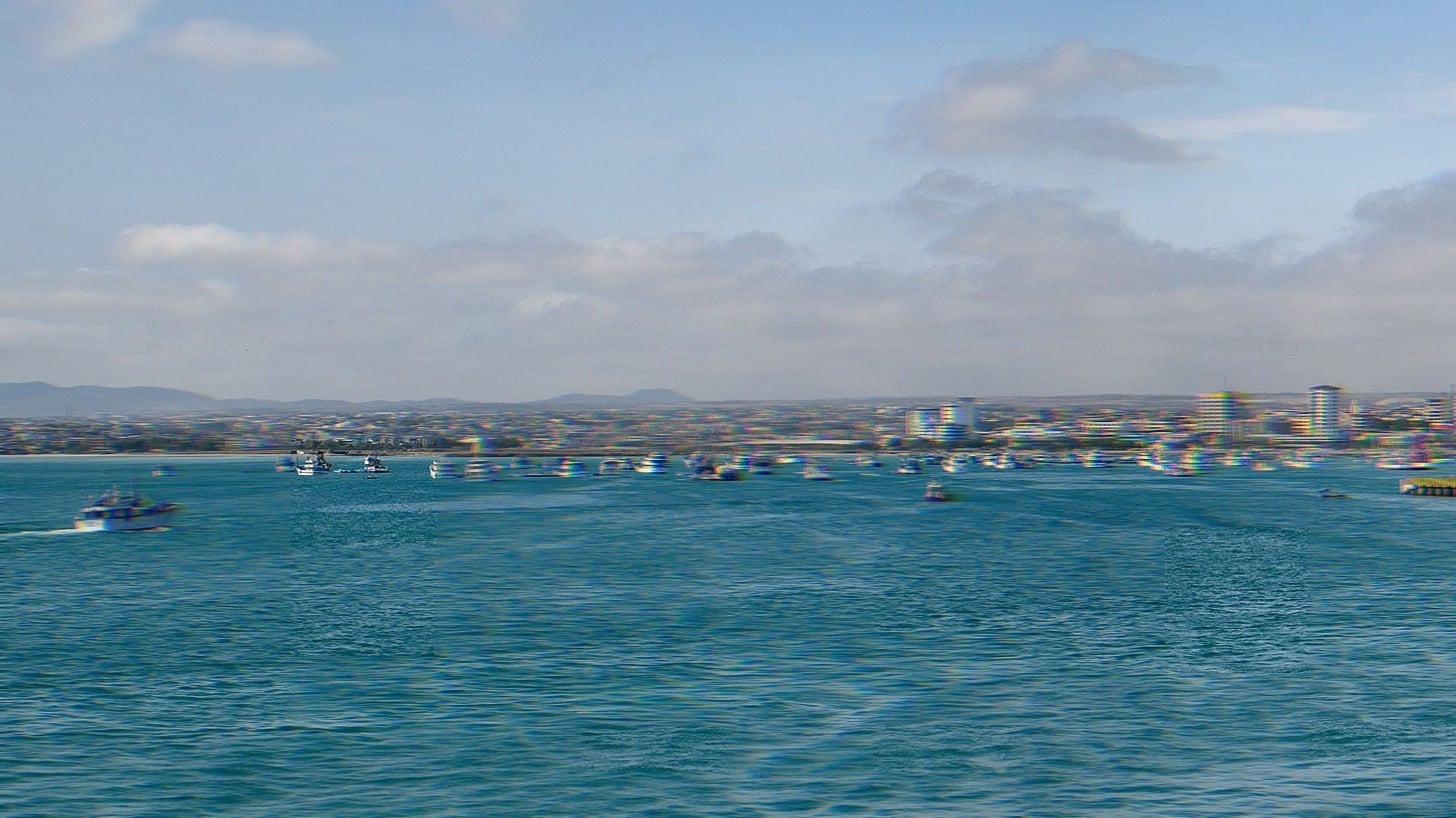 Image Description: Wide view of the city of Mantua, Ecuador taken from the sea.
This essay appeared in the April 23, 2026 edition of UNFTR’s premium newsletter. Become a UNFTR member to receive our bonus newsletter each week and for other perks.
In an event that went mostly unnoticed in March, respected human rights experts and civil liberties groups convened in Guatemala City to present their concerns to the Inter-American Commission on Human Rights (IACHR) on the Trump administration’s extrajudicial and unchecked killing spree in the Caribbean and Pacific, of which the death count stands at 182.
Billed as the first hearing of its kind, the gathering included representatives from the ACLU, Center for Constitutional Rights, International Crisis Group, and UN experts.
“This hearing carries utmost significance because it is about holding the United States to the same international legal standards that apply to every country in the region,” Jamil Dakwar, director of the ACLU Human Rights Program, testified. “No country, no matter how powerful, has the right to engage in illegal military strikes that cause death, violence, and harm to people and communities.”
The testimony from legal experts came at a crucial point in the Trump administration’s purported crackdown on drug trafficking, which curiously coincided with its pressure campaign on Venezuela and, specifically, its president Nicolás Maduro.
At the time, there had been 45 reported attacks in international waters. And while media coverage of the attacks and associated legal consequences had cratered even prior to the illegal war with Iran, the pace of attacks had actually picked up before the hearing.
In January, U.S. Southern Command launched one attack in the Eastern Pacific that killed three people. In February, there were eight known strikes by the United States, killing 25—the most since December, when the Trump administration killed 40 in international waters.
Critically, scant, if any, evidence has been presented by the U.S. linking any boaters to so-called “narco-terrorist” groups, the chief allegation the Trump administration has used to justify its brutal killing scheme.
Various human rights and legal groups have decried the strikes as the acts of an administration normalizing wanton slayings.
According to an ACLU lawsuit filed in January on behalf of two men killed on Oct. 14, 2025, the administration “has made threadbare claims that the lethal boat strikes are lawful under the laws of war.”
The lawsuit points to a secret memorandum from the Office of Legal Counsel that purports to claim the U.S. is engaged in “non-international armed conflict” against drug cartels.
“Whatever that secret memorandum states,” the ACLU wrote in its suit, “it cannot render the patently illegal killings lawful.”
The legal questions are reminiscent of the Obama administration’s attempts to keep secret its legal memo in the killing of U.S. citizen Anwar al-Awlaki in Yemen. And while the Obama administration was ultimately forced to release that memo, its legal analysis didn’t generate widespread media coverage despite the target being an American citizen.
The same could happen in the case of the dozens of attacks in the Caribbean and Pacific, especially if media scrutiny—or lack thereof—continues at this dismal level.
Among those invited to the IACHR hearing was Ben Saul, the United Nations’ Special Rapporteur on the promotion and protection of human rights and fundamental freedoms while countering terrorism.
In his prepared submission, Saul listed the myriad ways in which the Trump administration’s lethal campaign is completely untethered from international law. Among these: They violate the “right to life” under international human rights law “since there is no evidence that those targeted posed an imminent threat of causing death or personal injury,” and that they “lack authority under the international law on the use of force, since the vessels targeted were not engaged in any armed attack on the U.S. which could give it a right of national self-defense.”
Trump and Defense Secretary Pete Hegseth have publicly celebrated the attacks against various ships, treating declassified footage as state-sponsored smut.
As recently as March 26, the Trump administration targeted a fishing vessel known as the Don Maca carrying at least 20 Ecuadorian fishers, according to reports.
“We were just working, waiting for the last trawler to return,” Jhonny Sebastián Palacios, one of the fishers, told The Guardian. “Everything was perfectly fine.” Then two drone strikes hit the vessel, striking the bow and the antenna, The Guardian reported. “When I heard an explosion, my eardrums ruptured terribly...I was covered in blood from the shrapnel,” one of the men told the outlet.
The men were then forced to board a U.S. patrol boat and had their phones taken, with photos and videos of the strikes and their aftermath reportedly wiped. They were later transferred to a Salvadoran patrol boat and transported to El Salvador, where they were held at a military base. They were eventually returned to Ecuador without charges, raising even more questions as to why the United States targeted the Don Maca to begin with.
“They were arbitrarily hooded and later abandoned on the Salvadoran coast,” a lawyer representing the crew told the Guardian. “Any apprehension followed by incommunicado detention constitutes an enforced disappearance.
“It was a form of psychological torture, not knowing what’s really going to happen to your life and having your face covered.”
As has become the norm since Congress abdicated its authority during the war on terror era, there’s been little effort to hold the Trump administration accountable, but at least two families have turned to the courts for redress, accusing the government of violations of the High Seas Act and the Alien Tort Statute. This includes the family of Chad Joseph, who was killed on the Oct. 14 strike. According to the suit, Joseph, 26, lived in Las Cuevas, Trinidad and would travel to work in Venezuela as a fisherman and on a farm—work that would often keep him in Venezuela for weeks and sometimes months at a time. The family lost communication with Joseph on Oct. 12, unusual for someone who would speak to his family daily.
Joseph and Rishi Samaroo, the other man killed in the attack, were not affiliated with any drug cartels, the lawsuit states, noting that the Trinidadian government said it had no information linking the pair to illegal activities.
“[T]he United States’ killings of people aboard boats in the Caribbean through missile strikes are wrongful and violate international law regardless of which international legal regime applies,” the suit states. “First, because there is, in fact, no non-international armed conflict with the drug cartels purportedly targeted in the strikes (and no evidence that the boats targeted are associated with cartels), the killings violate the bedrock prohibition against extrajudicial killing and are simply murders on the high seas. And second, even if there were a non-international armed conflict between the United States and drug cartels (and even if there was evidence that the boats targeted were associated with the cartels), the strikes would constitute war crimes under the laws of war and federal law.”
And yet the strikes have only continued, with the most recent on April 19, killing three.
Image Source
- Gordon Leggett, CC BY-SA 4.0, via Wikimedia Commons. Changes were made.
 Rashed Mian
Rashed Mian is the managing editor of the award-winning News Beat podcast and co-founder of the newly launched Free The Press (FTP) Substack newsletter. Throughout his career, he has reported on a wide range of issues, with a particular focus on civil liberties, systemic injustice and U.S. hegemony. You can find Rashed on X @rashedmian and on Bluesky @rashedmian.bsky.social.