
In a War of Choice, Lies & Obfuscation Are the Ultimate Weapon.
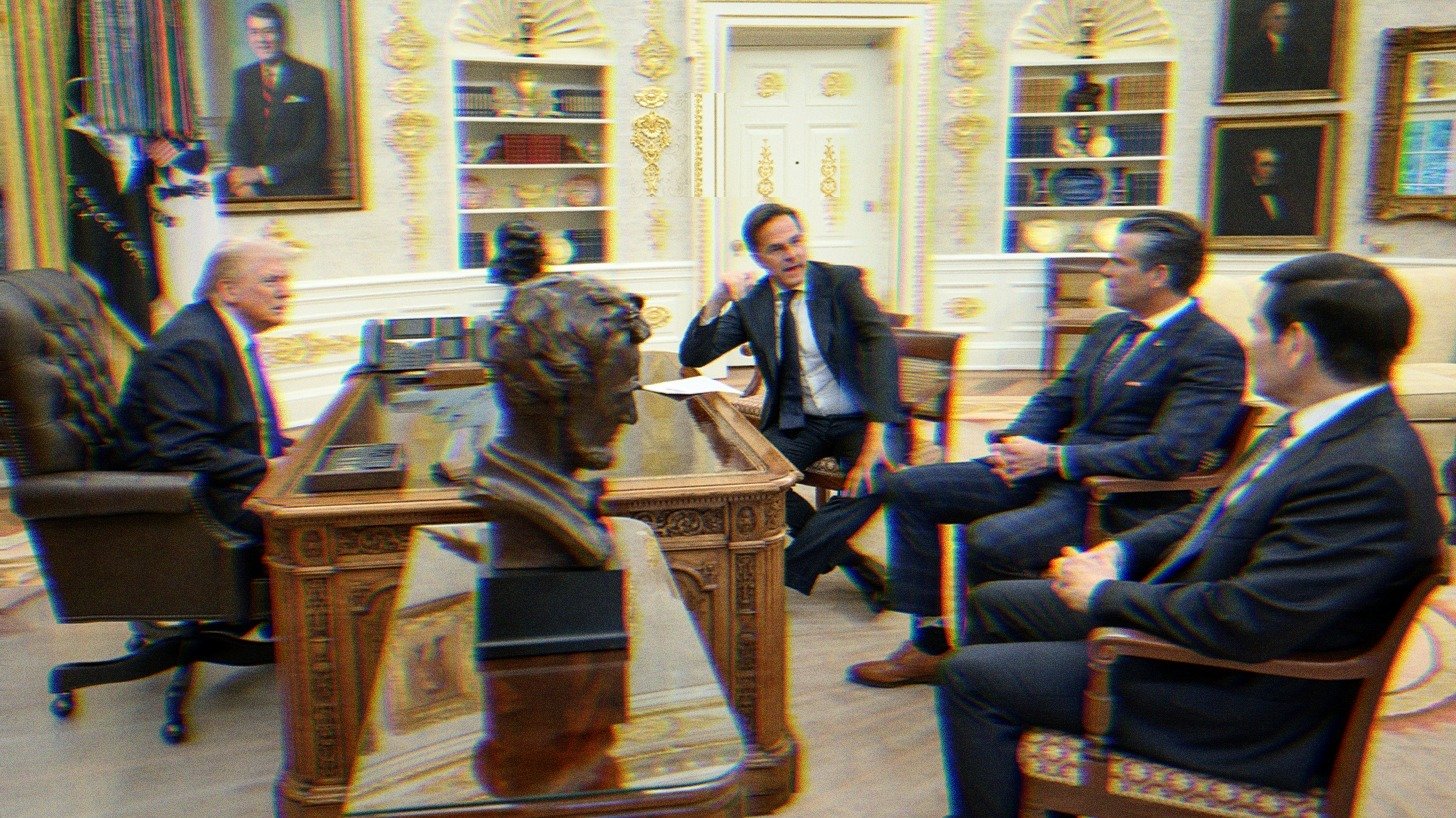 Image Description: Donald Trump meeting with Mark Rutte, Marco Rubio, and Pete Hegseth in the Oval Office.
This essay appeared in the May 7, 2026 edition of UNFTR’s premium newsletter. Become a UNFTR member to receive our bonus newsletter each week and for other perks.
While it’s easy to get numb to the Trump administration’s overly rosy assessment of its war of choice against Iran, it’s critical that we don’t lose grip on reality and remain vigilant in calling out the lies, deceit, and obfuscation that continues to define this already spiraling quagmire.
Remember how this war started. As the United States and Israel rained down missiles on Iranian targets on Feb. 28, an Iranian school was struck, killing nearly 170 people, the majority children. The United States has yet to take responsibility for the war crime despite vast amounts of evidence connecting it to the horrific attack. It appears the Trump administration is just hoping the slaying of more than 100 children fades away, falling back on its position that the slaughter is under investigation. Not only has Trump refused to take accountability—at one point, he suggested Iran was responsible, a comically absurd allegation considering Tomahawk cruise missiles (the weapon used in the attack) aren’t even in Iran’s arsenal.
The opening salvo of the war itself was preceded by deceit, as has been well documented in this newsletter and elsewhere. If anything, that’s been the through line of the war—false claims about Iran’s nuclear capacity and diplomatic bargaining position have now evolved into false claims about the extent of the damage to U.S. military outposts, injuries to U.S. service members, whatever is happening at the Strait of Hormuz, how Iran is actually faring economically and militarily, and everything else in between.
What’s more, the cocktail of bravado and obfuscation, combined with whatever Trump word salads on any given day, has made chaos the norm—underscored by his vow to destroy an entire civilization, an example of reality imitating art in the most bone-chilling way.
Since there’s so much to sift through, let’s take some of the most important narratives one by one:
1. This isn’t a war, thus Congress doesn’t have to take action. Trump is effectively following in the footsteps of his predecessors, as the so-called “War on Terror” has been defined by wars that the executive branch refuses to define as such in order to consolidate more and more power. Congress, which has abdicated its duties time and time again, should’ve been the one authorizing this war—yet they were happy, once again, to defer to the executive, offering no check on presidential war authority. With the war more than two months old, Trump and his administration are now engaging in a preposterous claim that Congress has no authority to act under the War Powers Resolution because there’s a so-called “ceasefire” in place. It would be helpful if someone reminded the Trump administration and Congress that the United States’ blockade in the Strait of Hormuz constitutes an act of war, underscoring the need for feckless and cowardly lawmakers to force a war authorization vote.
2. What’s really happening with U.S. service members, anyway? The administration is doing its best to obscure the physical toll the war has taken on members of the military in the region. According to the Defense Casualty Analysis System, 403 service members have been injured as of May 7, including 272 from the Army alone, and 13 have been killed. But that doesn’t tell the whole story. In early April, The Intercept reported that nearly 750 U.S. troops had suffered war-related injuries—significantly more than the “official” count. The same article included an allegation from a “defense official” that the Trump administration has been engaged in a “casualty cover-up.” That same source added: “This is, quite obviously, a subject that [War Secretary Pete] Hegseth and the White House want to keep under major wraps.” The Intercept’s source wasn’t done there, criticizing Hegseth for his bombastic press appearances and for seemingly not doing enough to protect troops in the region.
“Iranian strikes have forced U.S. troops to retreat from their bases to hotels and office buildings across the region, according to the two government officials. The defense official was livid about the Pentagon’s failure to adequately harden the bases and ridiculed Hegseth’s Tuesday prayer at a Pentagon press conference. ‘May god watch over all of them, each day and each night. May his almighty and eternal arms of providence stretch over them and protect them,’ said Hegseth.”
“Why didn’t Hegseth protect them?” the defense official asked. “Anyone with a brain knew these attacks were coming.”
On April 22, The Intercept also reported that “the Pentagon is playing a numbers game with American casualty statistics, adding and subtracting from the count as questions about the human toll mount.” The administration is making a concerted effort to obscure the reality on the ground and the implications of the war for America’s sons and daughters amid an unauthorized conflict. Lawmakers and administration officials will go out of their way to profess their support for the troops, but they’re all too cowardly to officially declare war—because they don’t want their names attached to this calamity.
3. U.S. military outposts have suffered far more damage than the Trump administration has reported. Early in the war there were reports that U.S. troops were being moved from bases in the region to hotels and offices—it’s unclear whether that was a proactive step or a response to Iran’s strategy of asymmetric warfare, pounding targets in U.S.-allied Gulf nations. Among the hallmarks of the Iranian counter-air campaign has been the use of comparatively cheap drones, forcing the United States to burn through its critical supply of interceptors. We got further confirmation of the breadth and apparent strength of the Iranian strategy this week when the Washington Post reported that Iran has “damaged or destroyed” more military assets than initially suspected. Experts who reviewed The Post’s analysis said the damage suggested that “the U.S. military had underestimated Iran’s targeting abilities, not adapted sufficiently to modern drone warfare and left some bases under-protected.” The outlet said at least 228 structures or pieces of equipment at various locations throughout the Middle East have suffered damage or were destroyed—contradicting, yet again, the administration narrative that the war has been one glorious success after another. Critically, WaPo had to rely on Iranian satellite imagery for its analysis, as commercial firms “have complied with requests from the U.S. government—their biggest customer—to limit, delay or indefinitely withhold the publication of imagery of the region while the war is ongoing.” If Iran has the capabilities to strike these targets, one can only surmise they have the ability to confirm whether their attacks were successful. That begs the question: What’s the strategic incentive for keeping this out of public view?
4. Iran’s economic position and military capabilities are stronger than the administration is suggesting. Sensing a trend here? The administration has boasted about how Iran’s navy and other assets have been decimated. It seems those claims, too, have been exaggerated. Credit once again goes to the journalists at WaPo, who reported today that the administration’s public portrayal of the naval blockade’s impact is at odds with an intelligence assessment delivered to the White House this week. Here’s how the outlet characterized the secret assessment:
“A confidential CIA analysis delivered to administration policymakers this week concludes that Iran can survive the U.S. naval blockade for at least three to four months before facing more severe economic hardship, four people familiar with the document said, a finding that appears to raise new questions about President Donald Trump’s optimism on ending the war.”
“The analysis by the U.S. intelligence community, whose secret assessments on Iran have often been more sober than the administration’s public statements, also found that Tehran retains significant ballistic missile capabilities despite weeks of intense U.S. and Israeli bombardment, three of the people familiar with it said.”
One U.S. official went as far as to say that the assessment may be underrepresenting Iran’s ability to survive the economic shock—in part because, as the paper also reported, Iran is storing some of its oil aboard tanker ships and may be moving oil by rail to circumvent the naval blockade.
All this to say, lies and obfuscations have been used as a weapon of war—all to our detriment.
As one official told The Intercept in April, “These numbers, it is obvious, are important. That they don’t want the public to have them says something. That’s the definition of a cover-up.” In more ways than one, it seems.
Image Source
- The White House, Public domain, via Wikimedia Commons. Changes were made.
 Rashed Mian
Rashed Mian is the managing editor of the award-winning News Beat podcast and co-founder of the newly launched Free The Press (FTP) Substack newsletter. Throughout his career, he has reported on a wide range of issues, with a particular focus on civil liberties, systemic injustice and U.S. hegemony. You can find Rashed on X @rashedmian and on Bluesky @rashedmian.bsky.social.