
 Image Description: Benjamin Franklin on the hundred dollar bill blowing a bubblegum bubble.
Let’s start with the short answer to our query: Is private credit the pin that will pop the market bubble?
Answer: No.
I actually think it’s the wrong question, because it’s backwards. Hopefully by the time we’re done, I’ll have made that case.
We’re going to walk through the what, the where, and the how of private credit—what it is, where it came from, how it’s structured, how exposed it is, and who’s holding the bag if things go sideways. Then we’re going to answer the hardest question of all: the when. When does this become a problem?
“What,” “Why,” and, “How Big”?
A small manufacturer needs a line of credit to buy raw materials.
A regional hotel group needs a loan to renovate.
A mid-sized software company needs capital to grow before it can go public or get acquired. The question is always: who provides that money, and on what terms?
For most of the 20th Century, the answer was: the bank. You walked in, presented your books, and if the bank liked what it saw, it gave you a loan. The bank held that loan on its balance sheet, earned the interest, and hoped you paid it back.
Then two things happened that changed the game.
The first was securitization: the ability to bundle loans together and sell them as securities. Banks realized they didn’t have to hold loans anymore. They could originate them, package them, sell them, and get back to making more loans. This financialization of lending reached its logical and catastrophic conclusion in 2008.
The second thing—and this is the direct origin story of modern private credit—was the regulatory response to 2008. The Dodd-Frank Act, Basel III capital requirements, stricter lending standards; regulators looked at what banks had done and said “never again.” They required banks to hold more capital against risky loans. They limited how much exposure banks could carry to certain categories of borrowers, particularly middle-market companies, which are businesses too big for a small business loan but too small or too risky for the big public debt markets.
And here’s where private credit stepped into the vacuum.
If banks can’t, or won’t lend to a certain category of borrower, someone else will, as long as the price is right. Private credit funds raised money from investors, deployed it into loans to exactly those middle-market companies the banks were now avoiding, and charged a premium for the service. They weren’t banks. They weren’t regulated like banks. They didn’t have to hold capital reserves or report to the Fed the way banks did.
That’s why people refer to it as a shadow banking system. But unlike the pre-2008 shadow banking system—which was built on opacity, leverage, and the illusion of safety—the new private credit model was built on a simple, explicit premise: high risk, high yield, and long lockup. Investors supposedly understood what they were getting themselves into.
The point is: private credit exists because banks left a gap. Regulation created that gap, and a lot of very smart people with a lot of capital decided to fill it.
Measuring the private credit market is harder than it sounds. Visualizing how money flows might help demonstrate why.
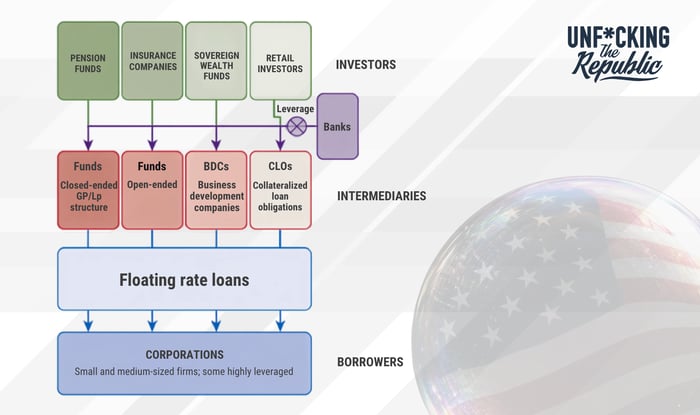
At the top of the investment funnel you have pension funds, insurance companies, sovereign wealth funds and retail firms that manage money from wealth managers to 401ks and IRA. Their job is obviously to invest funds for a return on behalf of themselves or their clients. In the mix between the investment vehicles, you have banks providing liquidity through loans, which is where the waters muddy a bit. These funds wash into the private credit funds—some privately held, some publicly traded. The public ones are called Business Development Companies (BDCs).
These funds will then set rates for loans to private and publicly held companies that don’t necessarily qualify under the stringent guidelines banks have to adhere to post-financial crisis. Doesn’t mean they’re bad companies, it just means it’s hard for them to get big loans at competitive rates and they’re typically more complicated to underwrite. These rates are called floating rates, meaning they’re tied to an underlying rate like the Prime Rate or the Secured Overnight Financing Rate (SOFR). So let’s say SOFR is sitting at 4% and the floating rate is 5%, the interest rate on the loan on that given day is 9%. These loans are given to small and medium-sized businesses or large businesses that are too risky for the banks.
In attempting to estimate the total market value of these loans, The International Monetary Fund, as of 2024, put global private credit assets at approximately $2.1 trillion. The Federal Reserve’s own research put the U.S. market alone at $1.34 trillion by mid-2024. Morgan Stanley estimated the global total at $3 trillion as of early 2025. Like I said, all over the map.
The reason these numbers don’t agree is that the industry is partially opaque by design, and the market is growing so fast that any number you publish is stale within months.
Here’s what we can say with confidence: private credit is now roughly comparable in size to the entire U.S. leveraged loan market and the U.S. high-yield bond market—each of which is about $1.3–$1.6 trillion. In other words, this is not a niche. This actually is a shadow banking system.
The simplest way to think about a private credit fund is this: it’s a very sophisticated, very well-capitalized loan shark with in-house underwriters and a law firm on speed dial. That’s meant to demystify it, not to disparage it. The model is straightforward: you raise money from investors, you lend it out to companies at a higher rate than you paid for it, and you keep the spread.
These are not cheap loans. But for companies that can’t access the public bond markets and can’t get a bank to write a check, this is the price of admission.
Here’s the math that makes the model work even with defaults.
The spreads are so wide—especially on the riskier end—that a fund can absorb a meaningful number of defaults and still come out ahead. Plus, private credit funds have more tools than banks do for managing distressed loans. They can convert debt to equity and take ownership stakes. They can extend loan terms. They can loosen covenants—the conditions borrowers must meet. They can allow payment-in-kind (PIK), where instead of paying cash interest, the borrower adds that interest to the principal balance. More on PIK in a minute, because it’s become a key stress signal.
One thing I want to reinforce is the role of the banks. When people hear “private credit,” they sometimes think the banks are out of the picture. They are not. Banks are deeply involved—they’ve just moved to a different position in the capital stack. Banks lend money to private credit funds, providing them with revolving credit lines and term loans that the funds then redeploy into the market. According to Federal Reserve data, total bank and nonbank lending to private credit entities is estimated at $410–$540 billion.
The banks are also involved in another way: they originate loans and then sell or syndicate portions to private credit managers. For example, Goldman Sachs runs its own BDC. Morgan Stanley runs a direct lending fund. The banks are not outside the tent. They are deeply, structurally enmeshed with private credit—they’ve just engineered the relationship so they sit in the senior, secured position. If a private credit fund blows up, the bank gets paid first.
That said—and this is what the Fed’s own research acknowledges—if a lot of private credit vehicles draw on their credit lines simultaneously, say, in a stress scenario, that correlated drawdown could ripple through the banking system in ways that are hard to fully predict. The Fed estimates the full drawdown scenario adds about $36 billion in exposure to the large banks, roughly 2% of their core capital. Manageable on its own. Less manageable if it coincides with stress everywhere else.
Risk Assessment
Private credit comes in two basic flavors. The first is genuinely private: closed-end funds, often structured as limited partnerships, with multi-year lockup periods, no public market trading, and minimal public disclosure. Pension funds and sovereign wealth funds are the primary investors. If you’re in one of these funds, your money is committed for years, and you learn almost nothing about the underlying portfolio until either things go wrong and end up in bankruptcy court—at which point documents become public—or the fund voluntarily discloses.
The second flavor is the BDCs. These are publicly registered investment vehicles—some publicly traded on exchanges, some non-traded but still registered with the SEC. BDCs are required to file quarterly reports with the SEC. They have to value their portfolios and disclose their holdings.
And that transparency has become a problem. Not for the BDCs themselves, necessarily, but for the whole industry. Because when investors and analysts look at the BDC filings and see rising non-accrual rates (loans where the borrower has stopped paying cash interest), rising PIK adjustments, term extensions, covenant modifications, they get nervous. And they start assuming, reasonably, that what’s visible in the BDC universe is also happening in the truly private funds that don’t file quarterly reports.
This is the dynamic that’s been driving the redemption wave of 2025 and 2026.
The first real stress signals appeared in the fall of 2025, with the twin collapses of Tricolor Holdings and First Brands Group. Tricolor was a Dallas-based subprime auto lender—the kind of business that loans to borrowers with limited or no credit history, often immigrants, using AI-based underwriting. Tricolor filed for Chapter 7 bankruptcy in September 2025.
First Brands (the company behind FRAM filters, Prestone antifreeze, and a range of other auto parts brands) filed for Chapter 11 the same month. Creditors alleged that approximately $2.3 billion had essentially vanished. First Brands’ founders were charged with fraud in January 2026.
JPMorgan took a $170 million charge-off on Tricolor, a number CEO Jamie Dimon called, “immaterial” to its balance sheet, but still felt the need to address.
And then Dimon said the thing that got quoted everywhere:
“When you see one cockroach, there are probably more.”
It’s the quote that won’t go away. Whether Dimon was right about the private credit world specifically, or whether he was making a more general point about late-cycle credit excess doesn’t really matter. The perception landed. Redemption requests at the major BDCs started climbing. And the thing about perception in credit markets is at a certain point, it becomes reality.
Non-traded BDCs and interval funds—the ones that retail investors and family offices put their money into—started getting hit with withdrawal requests they couldn’t fully honor. These funds have standard 5% quarterly redemption caps, meaning even if 15 or 20% of investors want their money back, the fund only has to return 5% that quarter. The rest gets rolled to the next quarter, which means the same people who got partially redeemed come back the next quarter, plus new redemption requests, and the cycle builds on itself.
By mid-2026, here’s where things stood: Ares Strategic Income Fund capped redemptions after 14.4% of shares were requested for withdrawal. Apollo Debt Solutions capped after 16.8%. Cliffwater’s flagship fund hit 17%. Blackstone’s BCRED—one of the largest private credit funds in existence, at $50 billion+ in assets—capped redemptions for the first time ever after investors tried to pull 10%. Morgan Stanley’s North Haven Private Income Fund: 11.6%. BlackRock’s HLEND: 13%. Blue Owl: 22% in Q1, before gating.
For the first time in the history of this industry, in Q1 2026, total redemptions exceeded total new inflows.
The funds say their portfolios are fine. They say these redemptions are sentiment-driven, not credit-driven. Some of them are probably right. The publicly traded BDCs have opened their books, and the numbers, while showing stress, are not showing catastrophe—non-accrual rates around 2–3%, loans marked at roughly 98.7¢ on the dollar as of early 2025. That’s not panic territory. But it is enough to make people nervous, and nervousness in credit markets has its own momentum.
In terms of exposure, it’s a mixed bag.
The investor base of private credit breaks down roughly like this, based on AIMA research: pension funds make up approximately 30% of the investor base. Insurance companies, 18%. Sovereign wealth funds, 9%. High-net-worth individuals, family offices, and retail investors via non-traded BDCs make up roughly 24% and are growing fast, up from essentially nothing a decade ago.
The pension fund exposure is the one that makes people most uncomfortable, because pension funds represent the retirement savings of ordinary people. Public pensions committed roughly $47.4 billion to private credit in 2025 alone—though that’s across 348 tracked transactions, and it represents about 24% of their total private markets allocation. In context, most pension funds dedicate a low-to-mid single-digit percentage of their total portfolio to private credit. It’s not trivial. But it’s also not so concentrated that a bad year in private credit wipes out a pension fund.
Insurance companies are the exposure point that has drawn the most regulatory attention, and we’ll come back to this in a moment.
The retail investor exposure—via non-traded BDCs and interval funds—is the most recent and, arguably, the most precarious. These are products that were sold to wealthy-but-not-institutional investors on the promise of private equity-like returns with some liquidity. The fact that 24% now comes from this channel, up from roughly 5% a decade ago, matters. Because retail investors have shorter time horizons, are more sensitive to news, and are far more likely to request redemptions when sentiment turns—exactly what we’re seeing.
Is the Risk Systemic?
This is the $64,000 question. We get that investors are on the hook if private credit breaks bad. But does this scenario pose the same widespread, systemic risk to the entire financial system in the way the housing collapse did?
The argument that private credit does not pose systemic risk goes like this: these funds don’t take deposits. They’re not banks. If a fund blows up, the investors in that fund take the loss—sophisticated institutions and wealthy individuals who knew the risk. It doesn’t create a run on deposits. It doesn’t trigger a cascade of margin calls in publicly traded securities. It’s bad for the fund, bad for its investors, and that’s roughly where it stops.
The counter-argument has a few moving parts. First, the banks. We’ve established that banks are providing hundreds of billions in credit lines to private credit vehicles. If private credit funds start drawing on those lines simultaneously—because they’re all facing redemptions at the same time and need liquidity—that’s a correlated stress event for the banks that provided the lines. The Fed’s stress scenario puts the additional bank exposure at about $36 billion under a full drawdown—manageable for the large banks in isolation. The concern is correlation. What if private credit drawdowns happen at the same time as other NBFI drawdowns, and the cumulative effect overwhelms bank liquidity buffers?
Second, the collateralized loan obligations (CLO) parallel. The Boston Fed draws an explicit comparison between BDCs and CLOs. The capital structure looks similar: banks hold the senior, lowest-risk tranche—they get paid first; other investors hold the riskier tranches below them—subordinated debt. Before 2008, the systematic component of credit risk embedded in the AAA-rated tranches of collateralized debt obligations (CDOs) was significantly underpriced. The Boston Fed explicitly notes that, “such tail risk may be underappreciated,” in the private credit context today. They’re essentially warning that some of these packages echo the toxic instruments from the housing crisis.
Then there’s the leverage question. Public BDC leverage has increased from roughly 40% of assets in 2017 to 53% in 2024. Covenant-lite loans now represent 70% of private credit loans, up from essentially nothing before 2008. PIK interest—the kind where the borrower doesn’t pay cash but adds interest to the principal—now represents more than 20% of BDCs’ net investment income. Half of those PIK loans are in the technology sector. Remember, the BDCs are public so this is just what we can see. We don’t know if this holds true for the closed end funds.
So here’s the honest answer to “is this systemic?” Probably not in the isolated-fund-going-under sense. Increasingly maybe, in the correlated-drawdown-during-a-broader-market-stress scenario. And definitively unknown, in the sense that the opacity of truly private funds means the full picture is not visible to any single regulator, and probably not to the industry itself.
When the banks almost collapsed in the Global Financial Crisis, it’s because they held all the paper. So when the drawdowns came all at once, basically a bank run, they were holding the bag and depositors—meaning you and me—were along for the ride.
Today’s banking system is significantly better capitalized. The Fed’s stress tests show the banks can absorb significant private credit drawdowns without breaching capital requirements. Private credit funds are also less run-prone than banks, because limited partner capital is locked up contractually for years. You can request a redemption, but you can’t get your money back today.
Private credit also has more flexibility than banks to manage distressed loans. A private credit fund can hold a PIK loan, extend a term, convert debt to equity, and wait. Banks, under capital requirements and supervisory scrutiny, have less room to maneuver.
And the private credit industry actually demonstrated this during COVID. When high-yield bond markets and leveraged loan markets essentially froze in March 2020, private credit kept lending—facilitated, the IMF found, largely by its relationships with private equity sponsors who wanted to protect their portfolio companies. Importantly, the IMF also noted that private credit providers did not have access to central bank facilities during COVID. The government backstop didn’t apply here. So the lending continued on its own merits.
Now there is a wrinkle. A part of the story that doesn’t get enough attention: insurance companies.
U.S. insurers held $276.8 billion in CLO holdings at year-end 2024, according to National Association of Insurance Commissioners (NAIC) data. That’s more than doubled since 2018. Life insurers hold 82% of that exposure. These are the same insurers who are also significant investors in private credit funds, and in some cases are affiliated with private credit managers, meaning they’re underwriting insurance products that backstop the same assets their affiliated manager is lending against.
The NAIC is not sounding the alarm yet. Eighty percent of insurer CLO holdings are considered investment grade. But here’s what makes the AIG comparison from the financial crisis worth a mention, even if imperfect: AIG’s failure in 2008 came not from its insurance business but from its financial products division, which had written credit default swaps—essentially insurance on mortgage-backed securities—without setting aside adequate capital. When those securities failed, AIG owed money it didn’t have. The U.S. government ultimately provided $182 billion in support.
The question today is: do large insurers have dual exposure, both as investors in private credit and as underwriters of products that depend on the same underlying assets? And if private credit goes through a sustained period of elevated defaults and writedowns, do insurers find themselves simultaneously holding depreciated assets and paying out claims? That’s not the same as AIG. But it’s not nothing, either. And again, the opacity of the system means the honest answer is: we don’t fully know.
While the insurance exposure doesn’t get a lot of attention, the software sector sure does. In fact, it’s where the immediate, news-driven panic lives.
Starting in early 2026, a specific fear took hold: that private credit funds were dangerously overexposed to enterprise software companies—the SaaS businesses that charge recurring subscription fees and have historically been viewed as stable. The worry is that AI is disrupting those business models. If AI agents can do what specialized software does, what happens to the companies that sell that software?
The trigger was Anthropic’s unveiling of new agentic AI tools capable of performing complex professional tasks, the kind SaaS companies currently charge for. Within weeks of those announcements, investors sought to pull over $10 billion from private credit funds over software exposure concerns.
Software and tech exposure across direct lending portfolios runs at roughly 26%, and that’s significant. But it’s worth saying what the bears and the bulls both acknowledge: this is a concentrated problem, not a universal one. A defaulting mid-market SaaS company is not the same as a defaulting mortgage backed by a synthetic CDO of CDOs. The underlying assets have real businesses attached to them. The question is whether a wave of software sector defaults—if it comes—triggers a broader loss of confidence that causes the money flows to stop. Because that’s the mechanism. Not the defaults themselves.
Closing Thoughts: Turn the Question Around
So. Here’s the upshot. Here’s why I told you at the top that the question is backwards.
Private credit is the real plumbing of the economy. Not the financial system. The economy. It’s how business gets done. Every loan, every line of credit into the non-investment-grade corporate world is actually a lifeline to Main Street. The headlines focus on software and AI exposure—and yes, that’s real. But it’s a fraction of the story.
The real story is the home builder. The HVAC company. The marketing firm. The hospitality group. The businesses that employ millions of people in everyday jobs that make the world go around. They’re not fancy. They’re fundamental.
Forget the word private in private credit. It’s just credit. Credit makes the economy run. It greases the wheel, makes the engine hum. And as such, credit is a reflection of the real economy. If it stops—if it seizes up—it’s because the ability to pay has gone beyond the threshold of profitability for these massive funds. Not just because there’s money on the street that isn’t covering the nut, but also now because of the massive leverage built into the funding flows themselves. These private credit firms are leveraged to the hilt with private and institutional capital. And trust me: if the returns are there on a consistent basis, the money will be there as well. The BDCs already open their books because they have to. The private ones will do it to keep money coming in.
The point is, if private credit fails, it means the bubble has already popped. Those loans that are in trouble—the PIK adjustments, the refinances, the term extensions, the loosening of covenants—all manageable given the vast sums involved. And private credit is actually more incentivized to be nimble and forgiving exactly because there is no government backstop. They can keep the plates spinning longer than banks, in reality.
It’s when the market dries up on the business side that private credit defaults. When there are fewer and fewer creditworthy companies in search of financing because they’re upside down or out of business. The economy isn’t failing because there’s too much credit or even because it’s too expensive. It’s failing because the consumer who originates the transaction—the baseline of the consumer economy we’ve built—when that person stops spending, the whole thing comes apart.
The pin that pops the bubble isn’t private credit. It’s you.
 Max
Max
Max is a political commentator and essayist who focuses on the intersection of American socioeconomic theory and politics in the modern era. He is the publisher of UNFTR Media and host of the popular Unf*cking the Republic® podcast and YouTube channel. Prior to founding UNFTR, Max spent fifteen years as a publisher and columnist in the alternative newsweekly industry and a decade in terrestrial radio. Max is also a regular contributor to the MeidasTouch Network where he covers the U.S. economy.