
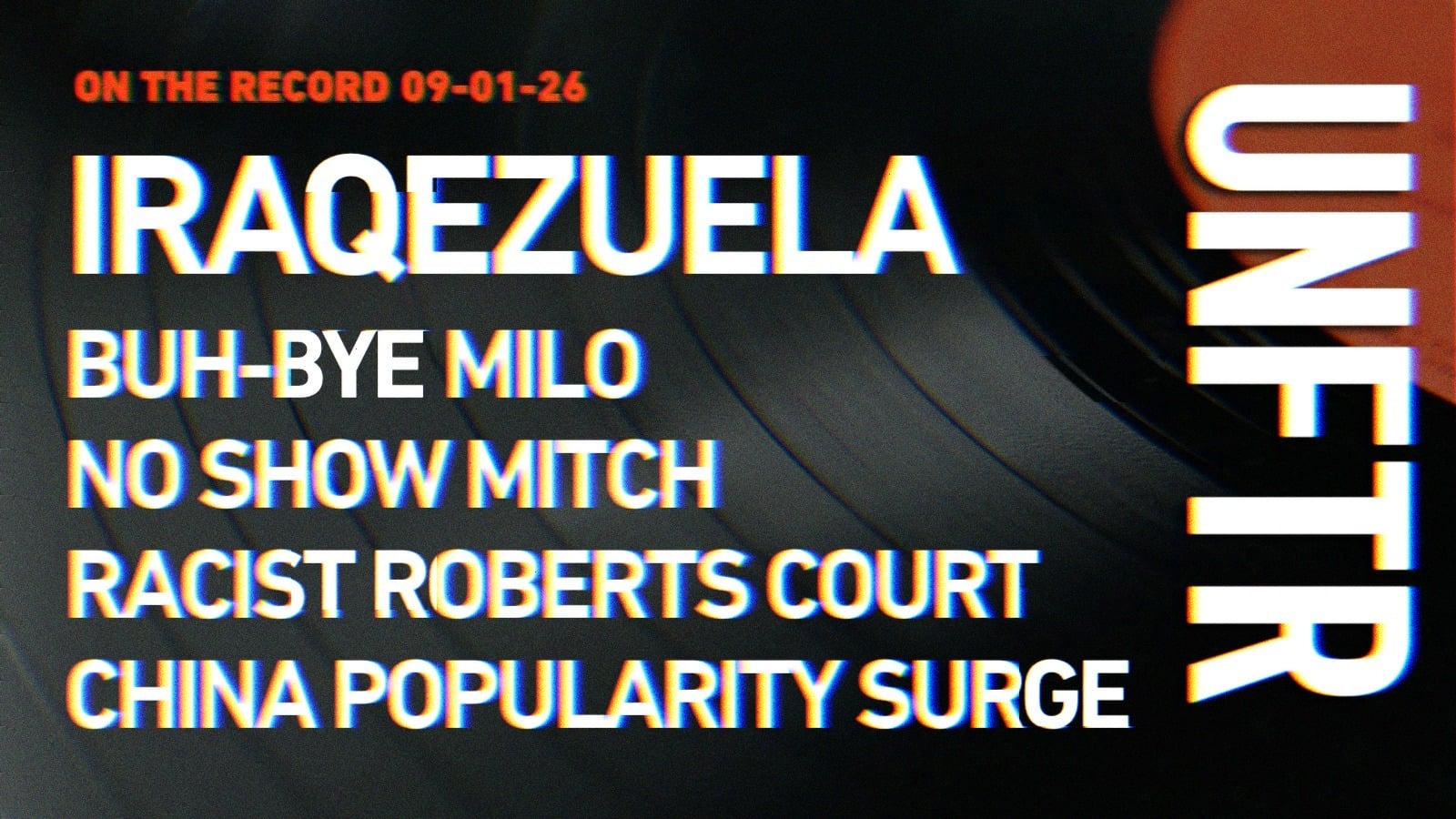
 Image Description: On The Record 09-01-26. Iraqezuela. Buh-Bye Milo. No Show Mitch. Racist Roberts Court. China Popularity Surges UNFTR.
“The World’s Gas Station”
I just published a piece on Reagan that traces how the Heritage Foundation basically wrote the intellectual back end of the neoliberal turn—the Mandate for Leadership, the 1981 blueprint that told the incoming administration exactly what to gut and how, the direct intellectual ancestor of Project 2025. I bring that up because I want you to train your ear to the specific frequency of bullshit that comes out of this organization’s mouth.
I recently watched a Bloomberg interview with Victoria Coates, VP of Heritage’s Davis Institute, during which she makes a number of spurious claims with little pushback. In speaking of the announcement by the Trump administration that we’ve made a “deal” for Venezuela’s oil, Coates claims that it’s “the biggest oil deal in world history,” that the United States will be the “world’s gas station,” and that the oil deal needed to be cemented before Venezuela could hold elections.
Stunning. All around.
This is how Heritage plays dirty pool. They call themselves a “think tank,” write policy papers, draft model legislation to support their papers, and then dispatch soulless minions like Coates to sell its agenda on mainstream media outlets. Rinse, repeat.
First off, the argument that U.S. control of proven oil reserves in another country will somehow contribute to lowering energy prices is as absurd as it is fallacious. Just ask OPEC. Oil trades on a single global market. Brookings has said flatly that the odds of new drilling meaningfully moving prices are “really low” because whatever comes out of the ground goes to the world market and gets priced against global demand. So the gas station line is a lovely slogan and that’s all it is.
Further, the idea that oil contracts with the United States needed to be secured before Venezuela can hold elections is pure colonialism. That much should be obvious. But even this so-called “deal” doesn’t add up. Delcy Rodríguez, standing in for the interim government that cut this deal, said Venezuela gets roughly $209 billion over 25 years. Simple back-of-the-napkin math—which apparently ignores price fluctuations—puts Venezuela’s take at around $8.4 billion per year. In 2011, the best year under Hugo Chávez, Venezuela’s state oil company PDVSA took in around $124.9 billion. Give me a fucking break.
Of course, Coates couldn’t leave the interview without blaming the entire Venezuela collapse on socialism. A massive lie of omission, to put it mildly, because it ignores both sides of the economic equation under Chávez.
To begin, Chávez used oil to fund housing, healthcare, and literacy programs that together saw poverty fall substantially through the 2000s. Not everyone was happy with this, obviously. The bourgeoisie in Venezuela, its corporate sector, and U.S. partners weren’t fans of this redistribution of natural resource revenue. But the poverty reduction under Chávez cannot be ignored.
The flip side of the economic coin is that Maduro ran a kleptocracy. PDVSA had begun to decline when Chávez took ill, and his project to diversify the Venezuelan economy didn’t take hold in the way he hoped. Maduro’s takeover ushered in a wave of corruption and mismanagement that was exacerbated by U.S. sanctions and a collapse in oil prices. To blame Venezuela’s economy on “socialism” is easy and lazy and misses the point entirely. But it goes without pushback because “socialism bad” has been inculcated into American media.
Then there’s this idea that we should somehow have a say in their elections because we illegally kidnapped their leader under bogus charges of narcoterrorism. Within days of the kidnapping, the U.S. was already directly controlling and selling Venezuelan oil exports through an executive order that nominally called the proceeds “sovereign Venezuelan property” while Washington held the checkbook. And now, eight months later, we get the actual deal: a new joint venture, majority U.S.-controlled, rights to 65 billion barrels across 17 oil fields, for up to 100 years. All of this was necessary, according to the Heritage Foundation at least, before contemplating who should lead Venezuela next.
This is reminiscent of our playbook in Iraq—excuse me, the Heritage Foundation playbook in Iraq to justify our invasion. When American forces took Baghdad in 2003, the National Museum got looted, the National Library burned, and ministries across the city got stripped to the studs. One building didn’t. The Oil Ministry came through untouched, ringed by American soldiers, while Iraqis stood outside and laughed at the idea that anyone still believed this wasn’t about the oil. Within weeks, foreign oil majors were being courted back into a country whose national assembly hadn’t even reconstituted itself yet.
Iraq was never really about September 11. Kidnapping Maduro was never really about drug trafficking. It’s the oil, it was always the oil, and Coates said as much herself, out loud, unprompted: 65 billion barrels of proven reserves.
What partisan hacks like Coates don’t tell you is that even Maduro—corrupt, authoritarian, and actively strangling his own country’s institutions—never kicked American oil companies out. Chevron has been operating in Venezuela the entire time, sanctions and all, under special licenses. Other majors had already settled their disputes with Caracas years earlier—ConocoPhillips won a legitimate $8.7 billion arbitration award back when Chávez nationalized in 2007. And that’s noteworthy because even Chávez’s version of nationalization let companies stay on as minority partners with 40% stakes.
That’s not what’s happening now. What’s happening now is the U.S. taking possession of the reserves outright, and inviting American companies to sink hundreds of billions of dollars into rebuilding drilling infrastructure that’s been rotting for a decade, in exchange for handing Venezuela a paltry slice of what comes out of the ground.
A huge amount of the unrest that’s defined Venezuela for the last 25 years traces straight back to American intervention—sanctions, asset freezes, the isolation campaign—layered on top of Venezuela’s own inability to escape the resource curse. Dutch disease, in the textbook sense: an economy so dependent on a single stream of resource revenue such as oil that it never built the manufacturing base, agriculture, and diversified private sector that could have survived a price crash or a leadership vacuum.
And by the way, the Orinoco Belt crude sitting under those 65 billion barrels doesn’t make that easier—it’s extra-heavy crude that needs years of expensive upgrading infrastructure just to be refinable, let alone exportable at scale. You don’t fix Dutch disease by handing an outside power your last remaining asset. If anything, this deal locks Venezuela deeper into the exact single-resource dependency that broke it in the first place, only this time with a landlord.
Adding insult to injury, Coates even acknowledged in the interview that Heritage, along with Marco Rubio, is screening candidates for leadership in Venezuela, including María Machado, the woman who won the Nobel Peace Prize before ceremoniously giving it to Donald Trump. We’re not even fucking pretending at this point.
This is all ridiculous enough. But there’s more to it. The deal itself is a load of horseshit.
Trump’s version, according to his Truth Social account—thanks, Natalie—is that this is “the biggest oil deal in world history.” A little light on details, so I guess we’ll have to take Delcy Rodríguez’s word for it: a 25-year bilateral energy project, $100 billion in promised investment, and $209 billion in Venezuelan tax revenue over the life of the deal.
But even taking Rodríguez’s own numbers at face value, the math still doesn’t work. $8.4 billion a year, against a country that used to run well over $100 billion in a single year off the same resource, back when oil was priced near $100 a barrel. And no one has answered what happens if oil prices crater again. Is this a guaranteed payment or a projected average? No one knows.
And all of this presupposes that U.S. oil companies are even interested in playing ball. (Spoiler: They’re not.) We’re talking about hundreds of billions of dollars being committed over several years based on a social post from a president with only two years left in office. And the conditions of Venezuela’s oil infrastructure guarantee that net new product won’t hit the market until Trump is out of office in the best-case scenario.
And through all of it, the accounting has been a black box. Since the U.S. started directly controlling Venezuelan oil sales back in January, roughly 100 million barrels—between $8 billion and $13 billion worth—have moved through this system with, in the Council on Foreign Relations’ own words, no meaningful transparency and minimal oversight. And the traders handling those sales, Vitol and Trafigura, both carry prior bribery convictions.
We could be having an honest conversation about Venezuela right now. About the real limits of Chavismo, about how much of the country’s collapse is homegrown corruption and how much is decades of American sanctions and interference, about what a genuine transition might look like. It’s a conversation worth having. But nothing about this deal should be mistaken for the United States suddenly caring about free and fair elections or Venezuelan self-determination.
Self-determination would mean normalizing economic relations across the hemisphere and then actually letting Venezuelans choose their own path—not installing a compliant interim government, extracting the country’s largest asset before a single vote gets cast, and outsourcing the casting call for acceptable future leaders to a Washington think tank.
This is the same patriarchal, paternalistic posture the U.S. has taken toward Latin America and the Caribbean for over a century. And it’s the shortsightedness of an administration that looked at a successful kidnapping and mistook “easy” for “wise”—so emboldened by how clean the Venezuela operation looked on television that it walked straight into Iran, a conflict that’s now dragging on for months with no resolution in sight, and one that’s made large-scale oil investment more expensive and more tenuous everywhere, including, ironically, in the very Venezuelan fields this deal is supposed to unlock.
Somewhere down the line, historians are going to look back at both of these interventions as among the dumbest, most shortsighted moves in the long, ugly history of American intervention abroad. And given that history, that is genuinely saying something.
How It Starts
I don’t fall into the camp that believes the end of the U.S. dollar is nigh, but I can see how it will happen. Someday. And it starts with charts like this.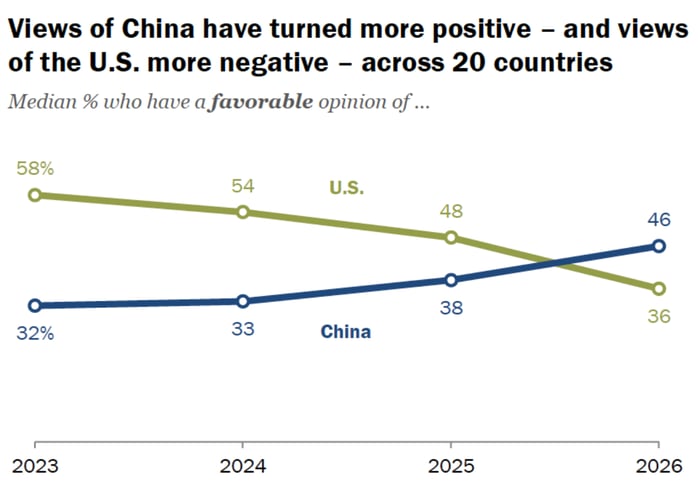
Source: Pew Research
To replace the U.S. dollar as the world’s reserve currency and reduce the world’s dependency on the United States as the center of global finance, a lot needs to happen. First and foremost, there needs to be a replacement. Or several, for that matter.
The latter is more realistic if we continue on the path toward digital currencies as settlement vehicles. But they will still need to hold a value peg, which would likely be gold along with some other currencies and assets that hold stable value over time. The narrative, of course, is that China is posturing to be the singular figure in financial markets.
But China has a transparency problem that will relegate it to the sidelines for years, if not decades, to come. Also, it doesn’t appear too anxious to inherit the debt issues that come along with being the world’s reserve currency. It’s more than happy to run us out over the long haul. China would need to reduce interventions in its own currency market (the pot calling the kettle black for sure) and open its bond market for global trading before being considered a meaningful pillar of the global economy. Don’t get me wrong, it’s the most important already in terms of size, trading, investments and momentum. But don’t underestimate the importance of the dollar as the international instrument of value.
Having said all of that, the road to Chinese dominance over the United States starts outside the financial markets. And this chart is exactly that starting line. It begins reputationally. The more Trump trains the world to look elsewhere for stability and rational decision-making, the less China has to do to earn its stripes.
 Max
Max
Max is a political commentator and essayist who focuses on the intersection of American socioeconomic theory and politics in the modern era. He is the publisher of UNFTR Media and host of the popular Unf*cking the Republic® podcast and YouTube channel. Prior to founding UNFTR, Max spent fifteen years as a publisher and columnist in the alternative newsweekly industry and a decade in terrestrial radio. Max is also a regular contributor to the MeidasTouch Network where he covers the U.S. economy.