
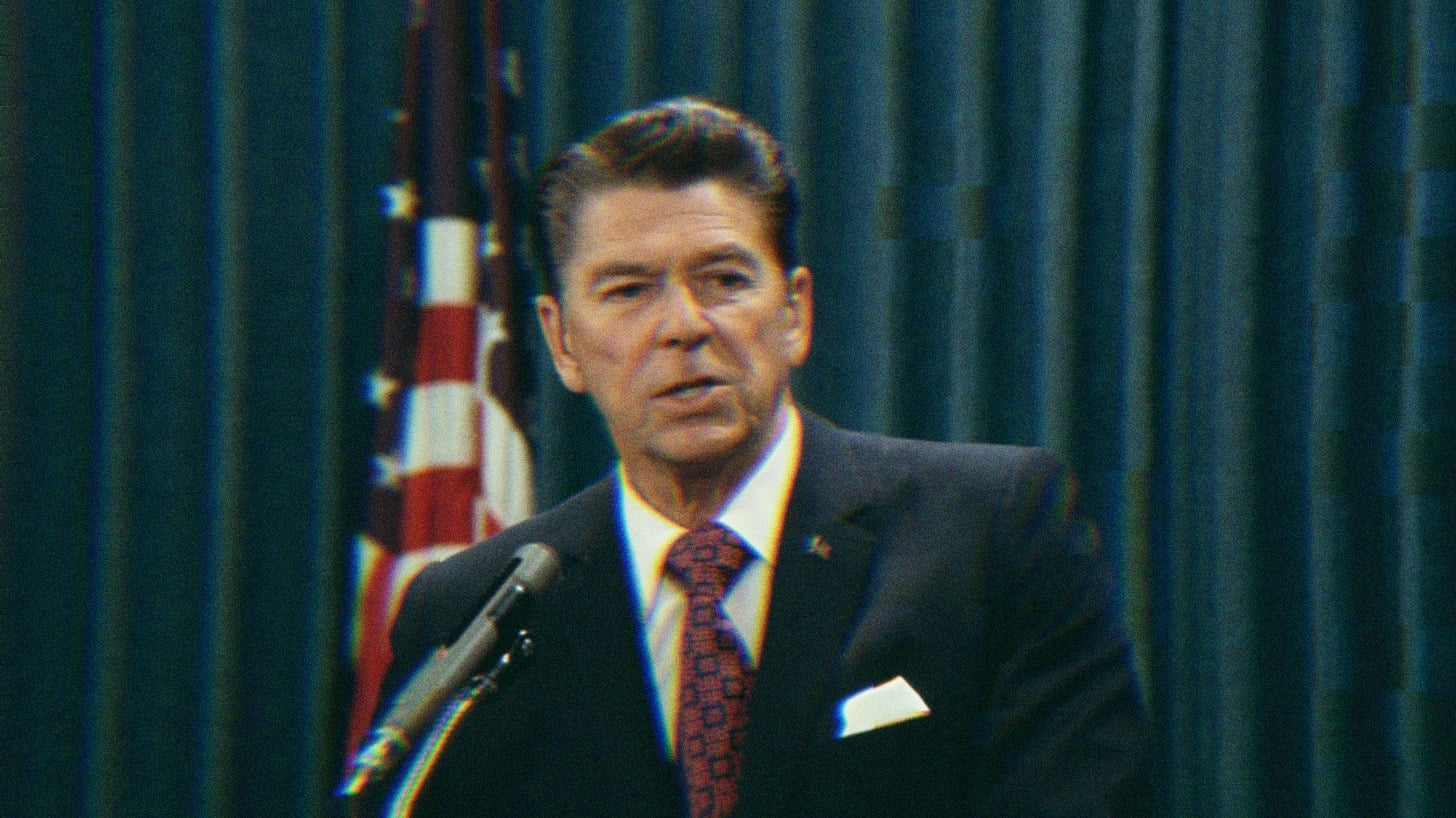
 Image Description: Ronald Reagan standing at a podium, speaking. An American Flag is visible behind him.
Ronald Reagan. Champion of neoliberalism.
To some, the man who lifted the spirits of a nation and restored a sense of pride and optimism after a period of despair. Today’s right regards Reagan as the patron saint of the party. The Reagan Institute, which I’m sure isn’t at all biased, recently issued a statement on the 250th anniversary of the nation saying that even young MAGA voters hold Reagan and his movement in high regard.
To others, the Reagan years marked the death of liberalism. A dark turn toward unfettered capitalist exploitation and the decapitation of working-class movements and civil rights.
So, which is it?
Was Ronald Reagan responsible for ushering in an era of prosperity and restoring national pride as his boosters maintain? Or was he indeed the harbinger of doom and the reason we have Donald Trump today? Like most things, it’s complicated. But there are three ways in which Reagan fundamentally altered the trajectory of the United States to the detriment of most American families.
We’ll walk through each of them, then offer a bit of context for the era, and end with an example of a modern political figure who borrows from Reagan’s political playbook but with a twist: this time it’s to do good in the world.
The Road to Power
Reagan wasn’t the GOP’s preferred choice for the 1980 nomination. Just as he wasn’t in 1976 when he ran a close second to incumbent Gerald Ford, who would go on to lose to Jimmy Carter. At the time, there was a fear in the Republican Party that Reagan was far too radical, too conservative to carry the presidency. It’s strange now to think that the popular former governor of California, of all places, would be characterized in such a way.
But this was indeed the sentiment toward Reagan, whom many regarded as a B-list actor who needed cue cards to read and didn’t possess an original thought. In 1976, prominent GOP figure Jacob Javits, the liberal Republican senator from New York, said that a Reagan nomination would push the party toward “extinction as a national governing alternative before the year is out.”
It was during the ‘76 concession speech that Reagan pretty much locked up the nomination for 1980. In his speech, he galvanized the convention, saying the Republican platform was “a banner of bold, unmistakable colors with no pale pastel shades.” This kind of soaring imagery was pervasive in Reagan’s rhetoric and would prove to be an effective weapon in the years ahead as he willed the United States into a winning mindset and in stark contrast to the bleak years of the late 1970s under Jimmy Carter.
Reagan’s critics were only partially correct when they painted Reagan as a mere actor with no real bona fides outside of California. They might have assumed that his conservative stance on big “gubmint,” as he pronounced it, was just an act. But Reagan was a simple and straightforward ideologue who believed that government was bloated, inefficient, and overly generous.
For Reagan, the welfare state was the problem and he saw it as his mission to dismantle it. Fortunately for him, and unfortunately for the rest of us, there was an entire movement gathering momentum in the shadows that had a prepackaged playbook ready for him to implement. And the main author of it was none other than The Heritage Foundation—the same organization that prepared Project 2025.
The more things change, the more they stay the same.
Anyway, throughout Carter’s term, Reagan busied himself by building a political coalition and apparatus with the energy of the heir apparent. The more the situation under Carter deteriorated, the greater the disparity between their personalities became. Until this happened.
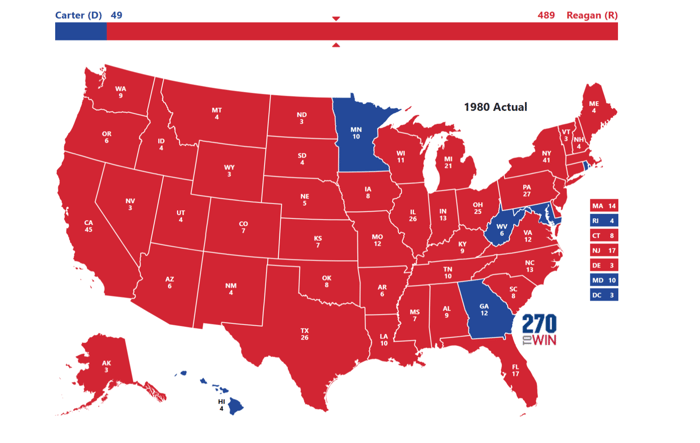
Source: 270toWin
It wasn’t even close. In our multipart series on Jimmy Carter, we went into great detail to contextualize the tsunami of domestic and global forces that wore down the Carter presidency. The legacy of Nixon’s currency shock, the oil embargo, global recession, and the Iran hostage situation put Carter in an impossible situation, and the American spirit heading out of the 1970s was indeed in need of revitalization.
With a cowboy hat and horse beneath him, Ronald Reagan strode into the Oval Office promising to restore American glory as the shining city upon the hill, a refrain he leaned on throughout his political career.
The early years were difficult as Reagan maintained continuity with Paul Volcker as Fed chair. This meant punishingly high interest rates to break the inflationary spiral, a controversial move that we’ve examined before. The recession of the early 1980s was even deeper than the one he inherited as he worked to implement the Heritage Foundation agenda to cut taxes, loosen regulations, build the military, and dismantle social welfare programs.
When the recession finally broke, as they eventually do in the capitalist system, the nation emerged more prosperous on paper toward the end of his term. There was more work available. Credit began to flow again. The stock market kicked off its historic run. And our chief competitor in the world had finally folded. On the surface it appeared as though the Reagan revolution had won. Below the surface, the cracks began to widen just as the nets that were pinned below them were being taken away.
Strip away the jingoism. Look past the “greed is good” mentality. Ignore the revisionist history of how we broke the back of the Soviet Union by projecting strength they could never match. And instead train your eye on the politics of the era and the seismic shifts to the political and economic project concocted by the neoliberal think tanks and enacted by the Reagan administration, and you have your answer as to which vision stands the test of time.
Here are the three policies that fundamentally altered the country for the worse.
Tax Cuts & Deregulation
Let’s start with the original sin, because everything else in this story flows downstream from it.
In August of 1981, less than seven months into his presidency, Reagan signed the Economic Recovery Tax Act at his ranch above Santa Barbara. It was a 185-page bill that slashed personal, corporate, and estate taxes, and it did so overwhelmingly for people who were already at the top of the income ladder. The top individual rate came down from 70% to 50%. Of the 95 million Americans who filed taxes that year, the biggest windfall from the cut to unearned income—dividends, interest, the stuff rich people live on—went to about 82,000 taxpayers. That’s the richest sliver of the richest 1%, and they got a collective $6.7 billion a year, worth about $21 billion today.
This was supply-side economics, or as George H.W. Bush memorably called it while running against Reagan in the 1980 primary, “voodoo economics.” The theory, cooked up by economists like Arthur Laffer, was elegant in its simplicity: cut taxes on the rich and on corporations, and they’ll invest that money back into the economy, creating jobs and wages that trickle down to everyone else.
Reagan doubled down five years later with the Tax Reform Act of 1986, which he signed with the kind of triumphant swagger that defined his presidency: “I feel like we just played the World Series of tax reform—and the American people won.” The top rate fell again, from 50% to 28%, the lowest it had been since before the Great Depression.
As we now know, nothing trickled down. It poured up. In 1980, the top 4% of taxpayers earned as much as the bottom 39% combined. By 2019, the top 4% earned as much as the bottom 57%. The top 10% of Americans now hold three times the wealth of everyone else in the country combined.
And crucially, the growth that did happen accrued to capital, not labor—to the stock market and asset ownership, not to paychecks. If you owned stock, you won. If you cashed a paycheck, you treaded water for 40 years while the cost of housing, healthcare, and education outran your wages. This is the entire story of modern American wealth inequality in one policy decision, repeated on a loop by every Republican administration since.
And that loop is now codified into the GOP platform. In 1985, a 28-year-old conservative operative named Grover Norquist founded a group called Americans for Tax Reform, and in 1986, explicitly to lock in Reagan’s rate cuts, he created what’s known simply as “The Pledge.” Sign it, and you are promising, in writing, to “oppose any and all efforts to increase” tax rates, full stop, for as long as you hold office. Forty years later, it is still the standard for the GOP. Look at the pattern: George W. Bush’s first major legislative act was a tax cut. Trump’s first term, first major act, tax cut. Trump’s second term, same play. Doesn’t matter what else is on fire—the deficit, a pandemic, a war—cutting taxes for the people at the top comes first, every single time.
And this is where the accumulation of capital stopped being just an economic story and became a political one. Because once you concentrate that much wealth at the top, it doesn’t just sit there—it goes to work to acquire more by exerting influence. Over the following decades, a series of Supreme Court decisions systematically dismantled the guardrails on money in politics, culminating in 2010’s Citizens United v. FEC, which ruled that corporate spending on elections is a form of protected free speech and can’t be capped. The wealth Reaganomics concentrated at the top found its political outlet. The same class of shareholders and executives who benefited from the 1981 and 1986 tax cuts became the same class empowered to spend unlimited money protecting those cuts from ever being reversed. It’s a closed loop: cut their taxes, they get richer, they spend the money buying the politicians who keep cutting their taxes.
Importantly, none of this happens without the other half of the Reagan project: deregulation. Reagan didn’t invent deregulation—Carter had already started unwinding price controls on airlines and trucking—but Reagan turned it into doctrine. Within days of taking office he lifted the remaining price controls on oil and gas. He gutted enforcement of the Clean Air Act at the EPA. He loosened restrictions on the savings and loan industry that would, within a decade, blow up into a financial crisis that cost taxpayers over a hundred billion dollars to clean up—a preview, as we’ve documented before, of the recklessness that would eventually produce 2008.
All of it came from the same source: the Heritage Foundation’s 1,100-page Mandate for Leadership, handed to Reagan’s transition team before he even took office, laying out a room-by-room blueprint for gutting the federal government from the inside. It’s the direct ancestor of Project 2025. Same author. Different decade.
War on Welfare
If tax cuts were the carrot for the people at the top, the second Reagan project was the stick for everyone else. And it worked by attacking two things simultaneously: the dignity of work, and the safety net underneath it.
Start with labor. In August of 1981, roughly 13,000 members of the Professional Air Traffic Controllers Organization (PATCO)—federal employees, technically barred from striking—walked off the job over pay, staffing, and working conditions. Reagan gave them 48 hours to return. When most didn’t, he fired them all, more than 11,000 people, and banned them from federal employment for life. It’s worth noting that PATCO had actually endorsed Reagan in 1980. It didn’t matter. The message wasn’t really for the controllers. It was for every CEO in America watching: the president of the United States will personally help you break a union, no consequences.
Private-sector employers took the hint immediately, and union density in this country has been in freefall ever since. This is the moment historians point to as the beginning of the end for organized labor’s leverage in the American workplace.
At the same time Reagan was making work more precarious, he was also demonizing the alternative to work. This is where the phrase “welfare queen” enters the American lexicon, and it’s worth understanding exactly where it came from, because the true story is even uglier than the myth. On the campaign trail in 1976, Reagan told crowds about an unnamed woman in Chicago who had defrauded the government of enormous sums using dozens of aliases. The woman was real—her name was Linda Taylor—and she probably was, per Josh Levin’s definitive reporting, also a kidnapper, and possibly worse. But she was a singular, spectacular criminal, not a representative case. As Levin put it:
“Linda Taylor’s larger-than-life example created an indelible, inaccurate impression of public aid recipients...Her case did not prove that, as a group, public aid recipients were fur-laden thieves bleeding the American economy dry.”
Government reports at the time couldn’t even agree on how much welfare fraud actually existed—one estimate put actual overpayment fraud at roughly the same low rate as unemployment insurance fraud: under 2%. It didn’t matter. The image stuck, and it stuck specifically as a racialized image: an idle, cheating, implicitly Black woman living large off your tax dollars. It was never really about fraud. It was about making an entire class of people—disproportionately Black and Brown Americans—synonymous with laziness and dependency, so that gutting the programs that helped them looked like fiscal responsibility instead of what it actually was.
Here’s how this shows up throughout business and economic cycles and why it’s even more dangerous than just the obviously racial component. When the economy is humming and everyone who wants a job can find one, none of this looks particularly cruel. But strip away the social safety net and then hit a recession—which, again, happens regularly and predictably under capitalism—and suddenly there’s no floor. It protects the historically white, historically male, white-collar workforce during the good years, and abandons everyone else the moment things turn. That asymmetry is the entire point, and it’s still the design principle behind conservative welfare policy 40 years later.
And while this seems disconnected from the attack on welfare protections, the drug war is definitively tied to it. Nancy Reagan’s “Just Say No” campaign was the folksy, PTA-meeting public face of it—a First Lady on television telling kids to say no to peer pressure. Meanwhile, her husband’s Justice Department was building the legal architecture of mass incarceration. The 1986 Anti-Drug Abuse Act created mandatory minimum sentences, and one particular provision became infamous: the sentencing disparity for crack cocaine versus powder cocaine was set at 100 to 1. Crack, associated culturally with poor Black neighborhoods, and powder, associated with white, wealthier users, were pharmacologically almost the same drug. The prison population exploded. And the racial disparity wasn’t an accident of the policy—it was, functionally, the policy.
Now here’s where it gets even worse. While the administration was building this machine to criminalize crack cocaine specifically, it was also running a covert war in Central America—arming the Contra rebels against Nicaragua’s Sandinista government. In 1996, journalist Gary Webb published a three-part investigative series in the San Jose Mercury News, later expanded into the book Dark Alliance, alleging that Contra-connected traffickers moved cocaine into Los Angeles with the knowledge of, and in some tellings the assistance of, U.S. intelligence, and that the profits helped fund the Contra war effort. The CIA’s own inspector general later acknowledged that the agency had documented, credible information about Contra-connected drug trafficking, and had continued financial relationships with those networks regardless. Webb’s reporting was fiercely attacked at the time by the establishment press, and some of his specific claims remain disputed to this day—but the broader picture it revealed, of an administration that knowingly looked past drug trafficking by its own allies in service of a Cold War proxy fight, holds up. Webb paid for that reporting with his career and, many believe, his life.
And this wasn’t even the administration’s only illegal covert operation running at the same time. The Iran-Contra affair, which broke publicly in 1986, revealed that senior Reagan officials had secretly sold weapons to Iran—an enemy state under embargo—and funneled the proceeds to the same Contra rebels, all without congressional authorization, all illegal. So the Reagan administration was dismantling domestic welfare programs and building a mass incarceration machine specifically targeted at Black communities, while simultaneously running illegal covert operations that armed proxy militias with drug money. Crack didn’t fall from the sky onto American cities. It arrived, in part, as a byproduct of foreign policy choices made in Washington, and then the same government turned around and declared war on the people who ended up using it.
Wealth inequality in this country isn’t just an income statistic. It runs straight through this decade, and it runs along racial lines that were drawn, or redrawn, on purpose.
The Untouchable Military Budget
The third pillar is the one that gets talked about the least, and usually only in terms of deficit spending. Reagan came into office pledging “peace through strength,” and he backed it with real money. The defense budget jumped from $171 billion in 1981 to $229 billion in 1985, the highest level since Vietnam, and it kept climbing from there. The official narrative, then and now, is that this arms race is what bankrupted the Soviet Union and won the Cold War.
The real story is far more complicated—Soviet economic collapse had internal causes decades in the making that have nothing to do with Reagan’s checkbook—but that’s a different story. What matters here isn’t whether the theory is true. What matters is that everyone believed it, and belief is what changes policy.
Because once “we beat the Soviets by spending” became the national mythology, it did something structural to the federal budget that persists to this day: it made the military budget untouchable. Not just large—untouchable. Separate from the normal rules of fiscal politics. Every other line item in the federal government gets litigated, means-tested, sunset, and fought over in committee. Defense spending gets treated as an article of national faith. This has deep roots in classical liberal thought, going back to the physiocrats: the idea that the legitimate function of the state is to protect private property and defend the nation, and beyond that, government should get out of the way and let markets sort everything else out.
Reagan didn’t invent that idea. But he’s the one who put a trillion-dollar price tag and a photogenic face on it.
Dwight Eisenhower famously warned about exactly this in his 1961 farewell address, coining the phrase “military-industrial complex.” Reagan is the president who took Eisenhower’s warning and, instead of heeding it, fully funded it, branded it, and made it politically permanent. Logically, once the Soviet Union collapsed in 1991, you’d expect the peace dividend to kick in and that spending to come down. It never really did.
Today the United States spends somewhere north of a trillion dollars a year on the base defense budget, intelligence, veterans’ care, homeland security, and debt service tied to past wars, and likely far more than that, arguably approaching two trillion by some estimates. That’s more than the next several highest-spending countries in the world combined, and we’re still fighting wars we don’t win.
But this is bigger than the Pentagon’s budget line. It’s about militarism as a mindset. But it wasn’t relegated to foreign interventions and entanglements. There was a domestic aspect to this mindset as well. In 1981, Congress passed the Military Cooperation with Law Enforcement Act, carving the first major hole in the Posse Comitatus Act—the 1878 law that had, for a century, drawn a bright line against using the military for domestic policing. The justification, explicitly, was the war on drugs.
That crack in the wall is exactly what later got widened into the 1990s 1033 program, which to this day transfers billions of dollars in surplus military hardware—armored vehicles, assault rifles, night-vision equipment—directly to local police departments. The same administration criminalizing Black communities through crack sentencing disparities was simultaneously opening the door for those communities’ local police departments to be armed like infantry units. Cops started looking like soldiers because, by design, they were increasingly being treated like soldiers, fighting a domestic war against their own citizens.
This didn’t begin on September 11. That’s an important correction to make, because the popular narrative treats the surveillance state and militarized policing as a post-9/11 phenomenon, a response to a specific external threat. The groundwork was laid 20 years earlier, under a president who was busy rehabilitating the image of the military itself. “Be All You Can Be” wasn’t just a recruiting slogan, it was cultural engineering, tying military service to the rugged individualism at the center of the entire Reagan mythology.
Once you’ve built a culture where the military is sacred, the budget for it is sacred, the tools it produces flow downhill into domestic policing, then the entire apparatus of the surveillance and security state becomes normalized as simply what a serious country does. And once you turn your whole country into a hammer, every single problem you face—at home or abroad—starts looking like a nail. We’re still living inside that logic.
There’s so much more. The decline of mental health services. The degradation of healthcare in general. Making it easier to pollute by rolling back EPA guidelines. The dictatorships we propped up abroad. The war on unions. Banking deregulation that led to the savings and loan crisis and further set the table for reckless financial market behavior. The shameful handling of the HIV epidemic.
The list goes on. But the point is to highlight three ways in which the Reagan era not only did generational harm to specific communities, but also shifted our mindset. It changed the American cultural narrative in a way that we thought at the time was just about pride and winning. But it was really subterfuge for the conservative project to accumulate wealth, protect the patriarchy, and allow corporations to lord over economic and political matters.
But here’s the optimistic note that I want to leave you with, because it really does rely on narrative and framing. That’s why words matter. Teaching matters. Challenging our own assumptions and developing the language of dissent in order to shift perspectives. You can’t change policy until you change people’s minds and their outlooks. You have to speak first to the things that cause real pain. Name the pain, speak to the problem. Identify with it and let people know that it’s not their fault. It’s the system. Then show them, in simple, direct but meaningful and tangible ways, how you intend to address it. And be realistic and firm, and do it with a sense of optimism that’s steeped in pride.
Then, do it. Do all of it and make a big show of it.
That was the genius of Reagan. That was his gift. The playbook wasn’t his, but he was a hell of a pitchman because that’s how he was trained. His rhetoric was steeped in Christian language and dripping with patriotic fervor. But most importantly, it was rooted in optimism and pride.
Clinton got the part about identifying pain right. Obama got the part about optimism right. But Zohran Mamdani has it all. He identified the pain points, validated people for their experiences, and met them in the trenches where they were by knocking on doors and showing up. He made bold future promises but only after he promised to take care of the immediate pain points. Sewer socialism. Fix the potholes, remove the scaffolding and graffiti, pave the roads, fix the Brooklyn-Queens Expy, freeze the rent, make the buses a bit faster and someday free if he keeps this up.
Make it easier to build more affordable housing and promise to put a grocery store in your borough that sells healthy food at reasonable prices. And steep it all in a tremendous sense of pride. The Knicks winning was the Miracle on Ice. Mamdani didn’t hoop and Reagan didn’t skate, but both of them gave the impression to the players and the fans and the citizens of the world that, fuck it, anything is possible if you believe.
New York is just one city. And it’s not even the shining city upon the hill in Reagan’s analogy, but it could be. After all, a waterfall begins with only one drop of water.
Dream big because winning begets winning. Just ask the Gipper. Only this time we win for all and not just for some.
Image Source
- United Press International, Public domain, via Wikimedia Commons. Changes were made.
 Max
Max
Max is a political commentator and essayist who focuses on the intersection of American socioeconomic theory and politics in the modern era. He is the publisher of UNFTR Media and host of the popular Unf*cking the Republic® podcast and YouTube channel. Prior to founding UNFTR, Max spent fifteen years as a publisher and columnist in the alternative newsweekly industry and a decade in terrestrial radio. Max is also a regular contributor to the MeidasTouch Network where he covers the U.S. economy.