
 Image Description: On The Record 09-08-26. JD Vance is a Psycho. Trump is melting. Wage-price fallacy. Uh oh, Germany. Plus Nathan J. Robinson. UNFTR.
JD Vance Is a Psycho
In the immortal words of Hannibal from The A-Team: “I love it when a plan comes together.” Or, in this case, “I love it when several of our recent episodes come together in such a way that a douchenozzle from this administration perfectly exhibits the dystopian ways the conservative movement in this country manifests.” (It’s clear why I was never invited to write for television.)
JD Vance—the resident hillbilly hypocrite in the White House—is apparently behind a new rule that would shift child care benefits away from single parents and toward married spouses who stay home to raise their kids. Details in a moment.
The first tie-in: The Heritage Foundation.
The same foundation from our Reagan episode, referenced again in our healthcare episode and at the center of every shitty policy that makes life difficult for poor and working folks. The group behind Project 2025 has also spent years engineering ways to incentivize marriage and promote the “tradwife” vision—the stay-at-home mom who supports her man and pumps out kids for a living.
Tie-in number two: It’s nearly impossible to make it on a single income anymore, as we laid out in our labor data episode. This is an economic admission of guilt. They know that our system forces households to operate with two incomes. So instead of evaluating policies that would alleviate this need, conservatives have decided to reward those who live in accordance with their value system.
And, for the trifecta, the throughline in most of our reporting: this administration will do anything to strip benefits from communities of color.
Here’s what the proposed change actually does.
The Child Care and Development Fund (CCDF) was created under Bill Clinton. Its whole purpose was to help low-income and working-class parents afford child care so they could work or go to school. Today it’s a $12.5 billion program, helping about 1.3 million kids in 870,000 families. 80% of those families are single working parents—most of them mothers. The subsidy runs about $9,000 per child per year—which is roughly what child care actually costs, meaning even families who get it are barely made whole.
It was a watered-down block grant version of a bill Congress had been trying to pass since the Nixon years. Nixon’s reason for vetoing the bill foreshadowed this move by Vance. As the National Women’s Law Center writes:
“Despite bipartisan support in Congress, the bill was vetoed by President Nixon, citing the need to preserve the traditional ‘family-centered approach’—a veiled attempt to block societal shifts, including racial integration efforts in schools and more white women entering the labor force.”
The new rule creates “parent-based child care,” which sounds benign and administrative, but it means that now a married couple—one spouse working 35-plus hours, the other staying home—can collect that same subsidy for the stay-at-home parent to watch their own kid. The problem is that they’re not increasing the pot of money.
Unmarried couples don’t qualify. Nonworking single parents still don’t qualify. This is built for one household type: married, one earner, one stay-at-home parent. A single working person technically still qualifies, but since the budget isn’t increasing, it means that they’re now competing with a married couple with an existing income and presumably a greater chance of managing the bureaucratic paperwork that comes with provisions like these. So now it’s the Hunger Games.
Here’s where our recent work really locks together.
The preponderance of single parents in this country are Black and Latino—an economic and political phenomenon rooted in structural racism—and if you have quarrels with that terminology, read or watch our episode on The Economics of Racism. It’s material, and it shows up sociologically.
Roughly 47% of Black mothers are single parents, versus 25% of Hispanic mothers and 14% of white mothers. This is an astonishing statistic that on its own, devoid of context, is extremely alarming. It is. Social, political and economic structures have failed Black and Brown communities for generations. In absolute population terms, however, the majority of single mothers in this country are white. Like I said, context is crucial. This is why we have to evaluate these policies in relative terms. Conservatives can cite the total number of white mothers and say, “look, we’re not singling any one group out.” And on the surface, it would seem rational. But when you look at it in terms of racial demographic groups, this disproportionately impacts communities of color.
No matter how you slice it, it’s an assault on single moms.
The point is that this rule, handing the new benefit exclusively to married households with a stay-at-home spouse, is, by definition, going to skew whiter and wealthier than the population this fund exists to serve. There’s also little we can do about it until we kick these guys to the curb. Because this is mostly discretionary spending, the rule change doesn’t require congressional approval. Trump and Vance can direct the funds as they see fit.
And it’s already failing the people who need it. Black children have the highest CCDF eligibility rate of any group—and 79% of eligible Black children get nothing. This program already badly underserves the people who need it most. Now they’re pointing a chunk of its money somewhere else entirely.
This is a win-win for Vance, who’s chasing two audiences at once—the evangelical wing and classical conservatives. Reagan’s “welfare queen” narrative of Black and Brown people who are gaming the system never left. They just swapped in scripture.
It’s amazing that the man who once said Trump is “America’s Hitler” and whose entire origin story is being raised by a single mother is the one pushing an agenda item that runs directly counter to his own life. But that’s who JD Vance is.
The man who said on a Christian podcast that the end times are near and that he’s fine with it if his own work pushes us there. Who held Erika Kirk a little too long, a little too close, at a very public memorial. Who said out loud he wishes his Hindu wife would convert. JD Vance is opportunism in human form—a man who made a deal with the devil to publicly honor Jesus while doing everything in his power to betray his actual teachings.
Regardless of his disgusting motivations, the fact remains that the economics of it all are bad. The program already falls massively short of curtailing poverty and providing assistance to single parents. Further dividing the pie and shifting funds around won’t make a material difference; it’s all just a show.
Look at the lengths people already go to just to get by. There’s an entire cottage industry of advice on strategically divorcing—or just never marrying—to qualify for financial aid or benefits. Financial planners write articles about it. This is a real, documented strategy in the wealthiest country on earth—restructure your family on paper because the system punishes you for staying together. It’s also fraudulent, but it doesn’t stop financial advisors from saying things like, “hypothetically speaking…”
And now Vance wants to take payments away from people like his own mother to hand them to married couples, in the name of keeping the workforce male and the “tradwife” at home.
Or maybe he just wants Usha in on it since they had their fourth kid.
Phone A Friend
Nathan J. Robinson of Current Affairs Magazine
Max from UNFTR: Hey everybody! Welcome into the feature that I promised you we would bring back, and that is our Phone A Friend feature. Basically, when I’m stuck or too stupid to understand an issue, why not reach out to the experts? And that’s what I’ve done today. I want to have a conversation about socialism, about the rise of DSA in the country, the spate of victories that they’ve been racking up, which you wouldn’t necessarily know from mainstream media. All you would know from mainstream media is that a guy named Hasan Piker is a problem, but in reality, there’s a lot more to talk about in a movement that has been burgeoning and bubbling under the surface for many, many decades now. So I thought I’d reach out to the man who conservative media now seems to believe is synonymous with socialism in this country. And personally, I think that’s a very good thing. It’s my good friend Nathan Robinson from Current Affairs magazine.
Nathan J. Robinson: Hello, Max. Great to be with you.
Max: So I want to talk first about the victories that were chalked up over the summer months in all of the primaries. If one just consumed mainstream media—and I’m not talking about conservative media, I’m talking about mainstream, so-called liberal-leaning media—you would think that the progressives won in blue cities and lost everywhere else. That’s generally the impression that I got from consuming mainstream media. In reality, whether they’re DSA-aligned candidates or just pure progressive candidates, because remember we have people like El-Sayed that are out there saying, “I’m not part of DSA. I am a progressive person. I’m my own man.” Either way, it seemed to me like it was a pretty good run. Can you speak to that run and just how substantial the wins were?
Nathan: Yeah, and the other thing is when people like El-Sayed have won in places like Michigan, which is where the prediction has been that progressives can’t win because, as you say, the narrative we heard is, okay, well, Mamdani might win in New York, AOC might win in New York, but try winning in Michigan, try winning in Florida, try winning in Colorado. Well, you know, he won, and not only did El-Sayed win in Michigan, but he did so against, I think, the largest amount of outside spending ever spent in a Senate race. Just an extraordinary amount of money. And I was in Michigan reporting on that race, and I saw up close the effects of that absolute tidal wave of money. You couldn’t turn on a TV in Michigan without seeing the “Abdul hates women” ad in every single commercial break. So it was extraordinary. So that makes the victory even more extraordinary than it otherwise would have been.
But we also saw a very near win in Wisconsin with Francesca Hong’s campaign, who probably could have won with just a little bit more support from the sort of national left. We also saw Angie Nixon win in a primary in Florida. And obviously these people have not yet won general elections, so there’s still an argument that you run too far to the left in a state like Michigan or Florida and you’re going to lose in a general election. I mean, it’s hard for a Democrat to win Florida in a general election anyway at the moment. But it is certainly true that in these places, the majority of Democratic voters are rejecting this idea that progressive candidates are bad candidates for them to run. They are rallying in support of people who are not supposed to be the people that you support if you’re in Michigan or Florida.
Max: Well, you have people like obviously the James Carville side of the party, or my congressman, for example, or Josh Gottheimer out there saying that this is a false project because they should just be running their own parties and their own elections, and they should stay out of the Democratic Party because they don’t represent us.
Nathan: Yeah, we know how much they love when you run third party, right? You know, we know how much James Carville clamors for a Green Party candidacy. I mean, the whole point of running in the Democratic Party was actually in response to what they had said, which was that when you run third party, if the left runs third party, they act as spoilers who empower Republicans. Look at the Ralph Nader campaign in 2000. If Ralph had run in the Democratic primary where he should have run, then George W. Bush wouldn’t have been the president. We wouldn’t have had the Iraq War.
I think Bernie Sanders demonstrated that the way in which you successfully contest for power is not to run third party in a general election, where you’re probably going to get 5% of the vote, maybe a bit more. I mean, there are races where third parties might stand a chance. I’m open to that theory of politics, you know. But Bernie entered the Democratic Party. He said, “Okay, well, let’s have this contest within the Democratic Party primary. And if the majority of Democratic voters support me, well, then clearly they want the party to go in a different direction, and you don’t actually represent the party.” This is what’s often left out by people like Carville, who kind of conveniently ignore the fact that these candidates have to get elected. They have to win the primaries. So if you’ve won the primary, you’ve successfully convinced Democratic voters that James Carville is wrong and that in fact you do belong in the party.
Max: You’ve been invited on with increasing frequency to conservative media. It seems to me to try—and I don’t know if they think they’re gonna get a viral gotcha moment where they catch you tripping up on something about socialism, bad this, you know, whatever their bugaboo is of the moment. But from what I’ve seen, you wind up actually sort of explaining pretty rudimentary philosophy to these hosts who don’t really have a retort.
Nathan: Well, they’ve grown so complacent and confident that they think that when they invite a leftist on and ask them questions like “How are you going to pay for that?” that they’ll go, “I never thought about that. I have no idea how we’re going to pay for it. I’m a moron.” And the thing is that actually that can be quite successful because if you don’t prepare for these things and they start hitting you with these questions and they’re only giving you 30 seconds to answer, it’s very high pressure because you realize there are 2 million people watching who hate you on Fox News, and the segments are like three to five minutes long, so you don’t have—and they cut you off, so it can be very high pressure, and you can in fact get really flummoxed.
So I have to practice for these, like all day before I go on to do them because I know what they’re trying to do, and they’re trying to do exactly that, where they’re trying to ask you what sounds like a basic question, like how does the math add up? And then you’re like “uhhh” and then they go, “Aha! See, the left doesn’t know math.” But you know, come prepared.
Max: When I was invited to go speak to Chris Cuomo after we had done a podcast, I was invited to go to NewsNation to talk about Trump’s crypto schemes because it was bubbling up at the time and it became kind of a big story. And when I went in there, I remember I hadn’t been on television in, I don’t know, maybe 18, 19 years, and I was terrible at it the first time. And then I realized as I was sitting in the chair, I was like, oh my god, I do not belong here just because I can record YouTube videos. I was so nervous. When he took his seat and I was looking at him, he said, “How you doing?” And I said, “Honestly, I think I’m gonna throw up.” And he goes, “Cool, do it that way. We’re on in 10.” And then somebody was chattering in my earpiece, and I didn’t have time to actually throw up, thank goodness. But it is so difficult to convey anything intelligent. And I was in a very friendly space. I wasn’t in enemy territory at all. There was a genuine curiosity about Trump’s crypto gambit. So I can’t even imagine what it’s like to be in the line of fire under that.
Nathan: I write stuff down beforehand, right? I write down every answer, every question they could give me, and what I would say in response. Because I mean, I don’t think well on my feet. I don’t want to think on my feet, right? I like to come prepared. I’m a writer. I like to go through 10 drafts before I say anything. So if I’m going to go into a space like that and have any confidence and not throw up during the thing, I am gonna go in prepared with, okay, this guy has about four brain cells, and these brain cells are capable of generating 10 different questions. We know what the questions are. They are things like, “Do you condemn Hamas?” “How are you going to pay for it?” And that’s the only thing that can come out of the mouth, right? It’s like a—you press a button, you pull the string, and it says a thing. So okay, when you pull the string and it says this, what are you going to say?
And the way I think about it is like, yeah, okay, you only get 30 seconds, but that’s the length of a political ad. So just write the script for a political ad in your head. Have your talking points and try and get out your ad for the things that you believe in in the brief moment that they give you to speak to a couple million people.
Max: So let me ask you, because it does occur to me that you are being asked with greater frequency to appear on conservative media, and there is this idea that if they’re not going to cover it honestly, they are covering the fact that the Democratic Party is shifting to the left and how dangerous that is. So the media is telegraphing that it’s aware that there’s a moment here, right? And they need to figure out how they’re going to position it. My question for you is: you’ve been a devoted social—I don’t have it here, I have it at home, but you wrote a book called Why You Should Be a Socialist. You’ve been devoted to this idea, to this project, for your entire career. Why do you think it’s happening now? Why do you think that the mainstream is picking up on it? That obviously voters are picking up on it in the ether? That the youth does not have the same relationship with the word socialism as generations before? What’s happening specifically now that you can perceive that you’re tapping?
Nathan: Well, it’s kind of the same thing that was happening in 2016 when Bernie Sanders’ campaign caught fire, which is to say, it’s a pretty simple thing of the unpopularity of the two major parties, the feeling among people who would vote Democratic that the leadership of the Democratic Party is incapable of successfully stopping the far right, and also the understanding that when they do get into power, they are incredibly disappointing. There’s that, and then there’s the fact that people’s lives are just incredibly hard and frustrating, and socialists are the ones who come along and have economic arguments, and socialists are the ones who are listening to them.
I talked to Mamdani actually early in his campaign, like when he was polling at 3%, and I didn’t think he had any chance. But we interview everyone, and I was like, “What are you doing to try and actually win this thing?” And he was like, “Well, I’m listening to New Yorkers about the things that they care about, and I’m adjusting, you know, what I’m saying to fit and provide solutions for the things they’re caring about.” You’re like, “Oh, wow! What a radical idea! What a crazy idea that a politician would actually listen to you and then craft an agenda that is responsive to the things that you say you’re interested in.” And it turns out that the socialists are the ones doing that, right?
So then, you know, Biden was immensely disappointing. The economic message coming out of the Biden administration was like, actually, the economy is better than you think it is, which is just a terrible thing to try and tell people. And Trump is the same, right? Trump is like, “Affordability? What’s that? That’s a made-up thing. I love the inflation. It’s great. If you have like $2 instead of $30, that’s fine. I don’t care. I’m rich.” That’s his messaging. So when you have a cartoon capitalist, like a guy who literally looks like an early 1900s Thomas Nast illustration of like Mr. Moneybags running the country, it really opens up some fertile territory for a socialist to organize in.
Max: It’s amazing to me how many things this man says that would have ended any other political career, including something as seemingly innocuous as, “Well, you’re not going to get $30; you’ll get maybe $2, maybe.” Like anybody else who just said that—that person is burnt. They’re spent. They’re out of the political process. He has truly changed our expectations forever, I think.
Nathan: You know, my next book is on JD Vance, and JD Vance had some quote that was like, “Well, you know, Watergate,” he was basically like, “we do 12 of those a day.” Because that wouldn’t be a scandal now. Like, we do a Watergate three times before breakfast.
Max: Yeah, yeah, it’s wild. And he was most recently talking about—yeah, I think the Antichrist is out there.
Nathan: He also said, “If I bring about the end times,” he was like, “I’m doing God’s work. If he brings about the end times, meh.”
Max: What a pass, right?
Nathan: Okay, well, I’d like to be alive in the future. I did, you know.
Max: Yeah, yeah. What a pass, though. He gave himself the ultimate pass. Listen, if I do a great job and the world doesn’t end, I’m amazing. If it does end, it was prophecy. So either way, you need me.
So, skipping past the midterms, and we’ll close on this because I don’t want to keep you forever. But if we skip past the midterms and we can imagine that we haven’t actually completely set the world on fire and everything hasn’t gone so terribly wrong that we do still hold elections in 2028: the calculus, my assertion is that at this point, because I’m going to be disappointed, I almost don’t care who’s on the top of the ticket so long as we get somebody like Sherrod Brown, who represents labor and represents a swing state and has at least a modicum of progressive values, in at that second slot. Because this air of inevitability that the DNC is just going to surface all of the wrong choices for us feels inevitable.
Nathan: Yeah, but don’t you think what would happen then is if you get someone who’s disappointing, and then they get into power, and they’re really disappointing and unpopular, they would then tank that excellent vice president who’s been unable to do anything because the vice president has no power, and they have to go down with the ship?
Max: But can you imagine if you can imagine for a moment that Joe Biden held the moral and righteous position on—
Nathan: Very hard to—I’m using all of my imaginative powers here to envisage the situation that you describe.
Max: If you can imagine that for a moment, and you can imagine also that the messaging about the economy was, A, more realistic and, B, more, I think, empathetic—because they really did seem out of touch—and then, C, that he didn’t just sort of wander around aimlessly, if it wasn’t just on display: are we having a different conversation about the success of the Biden years? Are we in Biden’s second term right now?
Nathan: Yeah, I don’t know. Right, if it had been, you know, Pete Buttigieg or whatever, and the things that clearly are the major factors in tanking Biden—which, I agree with you that they could have done better even with the economy as it was. What actually hurt them the most was like the seeming denial of the problem, right? That going like, “Well, the chart says that actually you’re happy,” and you go, “Well, then I don’t believe the chart,” and they’re like, “What? Are you economically illiterate? Are you a moron?” That was like the impression that I got listening to Biden’s economic advisors.
So yeah, maybe it’ll be fine. I mean, but the thing is that I don’t think the kind of people that would get in are good at this kind of messaging. So, like Pete Buttigieg, for example, the East Palestine thing, which I’ve actually been writing about for the JD Vance book, because JD Vance was really good at outmaneuvering the Democrats on this. Pete Buttigieg made a huge messaging mistake there, where he’s like, “Well, 1,000 derailments happen every year,” and you know, JD Vance and Donald Trump went to East Palestine and were like meeting with all the residents. And you know, Buttigieg—this will come up again in 2028. If he was the nominee, and he ran against Vance, he’d make a big deal about Buttigieg and the East Palestine disaster in his time as transportation secretary. And of course, he’s not going to be any better on Israel. So yeah, in a hypothetical world, obviously they will have a candidate this time who can speak, we hope—unless it’s Kamala Harris, who, you know, the words come out, but the meaning is a little, you know, the meaning isn’t there.
Max: Pete Buttigieg is such an— he’s such a— I’m so fascinated by him because, just the hubris of saying, “Well, listen, I was a mayor of a small town, and then transportation secretary. Obviously, I’m the choice to lead this nation.” That is incredible hubris. So at least he checks the narcissism box that’s required to run.
Nathan: He has a beard, and beards are relatable. This is how JD Vance and Ted Cruz realized that if you have a face that makes people dislike you instinctively, get some hair.
Max: Oh, oh, oh my—wait, what?
Nathan: No, I’m not saying all men with beards. I’m saying that some men without beards find this to be a solution.
Max: So, in the last minute that we have here, let’s work backwards from that time. If in 2028 we’re still looking at these lesser choices for the top of the ticket, does that imply that the momentum that DSA has right now petered out?
Nathan: Maybe, but I think one of the arguments that I keep emphasizing is that it’s remarkable that we win at all. There’s a kind of moving of the goalposts where, like, when there’s a narrow loss, people are like, “Voters repudiate socialism,” and you’re like, do you understand that in the year 2004, I mean, we got nowhere? The Bernie Sanders campaign, which nearly won the primary in 2016, hugely outperformed expectations. It’s very, very hard in the face of the kind of total blackout of media coverage, or all they’ll ask you is “Do you condemn Hasan Piker,” and all the money like that was going into the Michigan race, for instance—you know, $60 million. It’s extremely hard to come anywhere close to winning. So I don’t think it’s a sign that if we don’t win a presidential primary, that the momentum has petered out. The question is, where are you relative to where you were four years ago or eight years ago? And I think on that metric, the DSA has a lot to be proud of, because every year they’re making more advancements.
They’re starting to win Senate primaries in Florida, which is crazy. You would never—and that took everyone completely by surprise. Vindman was so confident that he didn’t even think he was running in a primary. I mean, there’s a quote attributed to him where he’s like, “I don’t have an opponent,” and then he lost. So they’ve got to be careful, because the DSA is organizing. They’ve captured the mayorship of New York City, the most important city in the country. I mean, that’s really quite extraordinary. So yeah, maybe they won’t.
Max: And that was just uttered by a guy who’s in New Orleans.
Nathan: Yeah, and I wouldn’t— they’re not doing as well here. Although we do have a DSA member who’s in the Louisiana State Legislature. So even here they’re making some inroads.
Max: Here we go. Make sure to subscribe to Current Affairs’ YouTube, to their podcast, but most importantly, if you can, if you are in a good financial position to be able to do it, I would encourage you to subscribe to the physical media, the magazine itself. It is beautiful. It is erudite. It’s fun. It’s all of the things that you would want bundled up neatly, delivered to your mailbox. I know that might seem anachronistic to some of you, to you kids out there, but trust me, if nothing else, it’s nostalgia hip. Am I right?
Nathan: Oh yeah.
Max: So do that.
Nathan: Also, if you’re not in the financial position to subscribe—if you are, we would love to have your subscription. But if you’re not, we do put our entire issue archive online for free. That’s the old stuff. And for the new stuff, we even have a hardship subscription. If you say, “You know, I can’t afford a subscription,” we’ll give you a free digital one for a year, so you can still get it for free if you are hard up. We want to make sure everyone can read Current Affairs, so there’s no reason not to subscribe, because there is a free subscription option as well.
Max: Nathan, thanks for coming on Phone A Friend. I appreciate you as always, and I look forward to whatever the next thing is that you do to upset the apple cart in conservative media.
Nathan: Thanks, Max.
The Wage-Price Spiral Fallacy
I really took my time with this one and, full disclosure, I used Perplexity to help develop the graph. In honor of Labor Day, I wanted to create a visual that debunked the wage-price spiral. Here’s the Investopedia definition for reference: “The wage-price spiral is a phenomenon where increasing wages boost consumer spending, leading to rising prices, which in turn prompts further wage increases.”
Unfortunately, this notion is taken as gospel in neoclassical and neoliberal theories, so the capitalist class holds tightly to the idea that workers’ wages must be held in check at all costs. You know, because inflation is the most deadly of the deadly economic sins.
I find this to be one of the most destructive and apocryphal notions in all economics for a few reasons.
The first is that it’s not true. Secondly, it deflects from the real culprit: corporate profits. Lastly, our entire policy framework is literally built around this falsehood. Both fiscal and monetary policy in the United States are designed to keep wages in check while running every other aspect of the economy hot.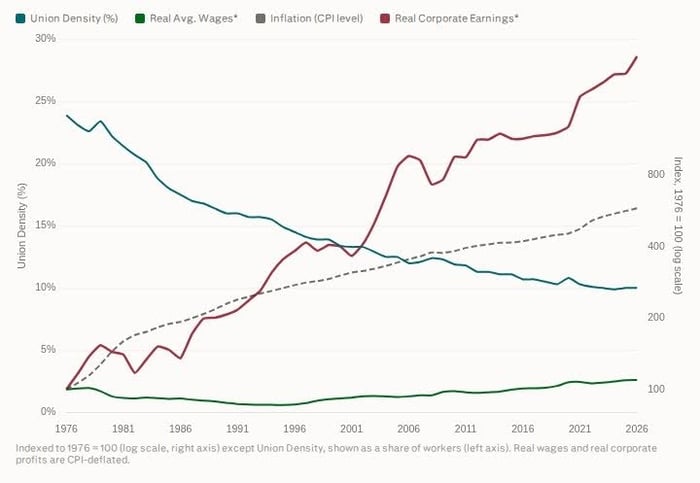
As the chart indicates, real wages (wages adjusted for inflation over time) have barely moved over the past half-century. Inflation, on the other hand, rises steadily. It’s one of the smoothest and most predictable trends. Monetary policymakers see this as a victory of interest rate and money supply management. So long as the Fed’s 2% inflation target is achieved over time, they clink their champagne glasses and pat themselves on the back. It’s such bullshit.
The gap between real wages and inflation is the loss of purchasing power that shows up in household debt. (Non-housing debt just broke another record.) Further, in honor of Labor Day, the long-held notion that unreasonable union demands are responsible for inflation is debunked by the math as well. These two lines are completely inverted, and therefore the correlation simply doesn’t exist.
The one line the Fed doesn’t want to talk about is the one that goes straight up and to the right. Corporate earnings have been on fire over the past 50 years, but for some reason policymakers just don’t want to acknowledge it. Maybe it’s so high they can’t see it. But we can. Fuckers.
 Max
Max
Max is a political commentator and essayist who focuses on the intersection of American socioeconomic theory and politics in the modern era. He is the publisher of UNFTR Media and host of the popular Unf*cking the Republic® podcast and YouTube channel. Prior to founding UNFTR, Max spent fifteen years as a publisher and columnist in the alternative newsweekly industry and a decade in terrestrial radio. Max is also a regular contributor to the MeidasTouch Network where he covers the U.S. economy.
%20Over%2c%20Humanoids%20Are%20Dumb.%20Consumer%20Sentiment.%20UNFTR.jpg?width=352&name=On%20The%20Record%205-26-26.%20The%20AI%20Black%20Hole-%20OpenAI%2c%20SpaceX%20and%20Anthropic.%20The%20War%20Is%20(Not)%20Over%2c%20Humanoids%20Are%20Dumb.%20Consumer%20Sentiment.%20UNFTR.jpg)