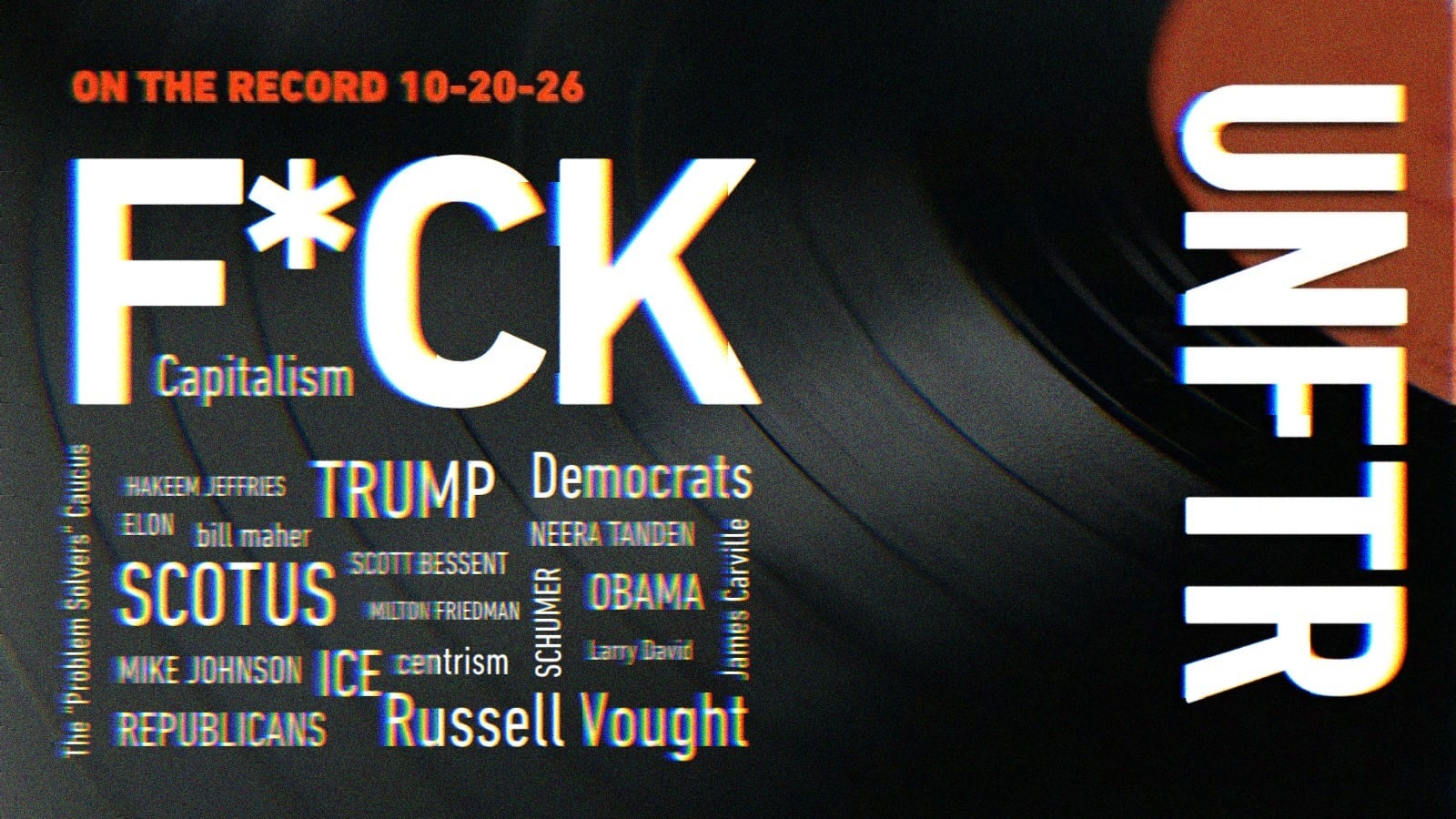
 Image Description: UNFTR On the Record 10-20-26. F*CK Capitalism above a word cloud of topics and figures including Trump, Democrats, Republicans, SCOTUS, ICE, centrism, Russell Vought, Obama, Schumer, Scott Bessent, Milton Friedman, Mike Johnson, Hakeem Jeffries, Neera Tanden, Elon, Bill Maher, James Carville, Larry David, and the Problem Solvers Caucus.
Disaster Privilege
Elections come fast and furious in America, and money has amplified the ability of the political class to bombard us with messaging more often over longer periods of time. What used to punctuate life is now a constant state. And we’re always in the most consequential election of our lifetimes.
And, oh how grand and expensive this theater has become. Elon Musk is digging through seat cushions in his Tesla for loose change to support Republicans in the midterms. He’s committed between $270 million and $360 million, depending on the reporting outlet, to maintain the Republican majority in Congress. This has contributed massively to the polarized divide of our politics and spectacle of it all. Forget baseball or Monday Night Football, politics is the new official national pastime.
Widen the lens and you realize that we’re not alone. People the world over are agitating over conditions we’re very much responsible for.
We’ve abandoned distasteful allies such as Saudi Arabia amid the destabilizing conflict we brought to the region, and now the House of Saud is in crisis. Deepened alliances between BRICS nations that seek to displace us as the center of global trade and monetary policy. Left the Europeans to fend for themselves and held a gun to their heads to increase austerity measures while contributing more to defense spending. Continued to fund the barbaric activities of Israel in Gaza, the West Bank and Lebanon. Worsened the spread of disease and poverty in the Global South by stripping funding and aid to dependent regimes.
Trump has gone rogue once again and invited Russia back into the trade fold, sparking panic among European nations with a much bigger vested interest in containing Putin’s appetite. Protesters have set the streets of France ablaze for several nights in a row, setting the stage for the right-wing government of Marine Le Pen. Lula might be on the precipice of losing to the highly corrupt son of the imprisoned former leader of Brazil. The far-right AfD party in Germany recently stunned by winning a state election. The conservative province of Alberta put secession on the ballot in Canada. Thankfully it was rejected because Albertans now dislike Trump more than the elites in Ottawa. That’s one good thing Trump has done, I suppose.
There are so many channels bombarding us with political and economic information that it feels as though the pendulum isn’t just swinging harder, it’s going faster like a metronome on the highest setting. But it’s actually worse than that. Our perception of left-right dynamics in this country has fundamentally changed over the course of the last half century. It’s as though a wedge or a doorstop has been jammed in the bottom of the pendulum, offering the impression that the middle is as far left as it can go.
It’s why centrists such as Bernie Sanders and Alexandria Ocasio-Cortez (AOC) are portrayed as the radical left. Any serious investigation of their beliefs and voting records belies this impression and yet here we are.
So why do we have such difficulty placing policies on the political spectrum? Consider the campaign of Abdul El-Sayed.
A Muslim man running for Senate in Michigan has had to defend his faith in the capitalist system and disavow the so-called socialist wing of the Democratic Party as though it exists. Much of the electorate isn’t buying it because of his devotion to Medicare for All, the centerpiece of his campaign. This extremely anodyne and sensible policy, adhered to by every other developed nation on the planet, is somehow the distinguishing feature of leftism according to the American electorate.
This is the same electorate that barely registered the overtly racist posts from our president who repeatedly referred to him as “Mohammed.” That his name is Abdul isn’t enough. It must be further lampooned to ensure that we all get it. Can’t be too careful. After all, we elected a man president with the middle name of Hussein. Drawing attention to a Muslim man’s name by calling him by another stereotypical Muslim name is as deft as it is horrifying.
In much the way that our ears aren’t tuned to Islamophobia, we cannot wrap our minds around critiques of capitalism. The fact that it has immiserated so much of the world’s population and still enjoys the warm embrace of both major parties in this country is telling. And yet, one of the most galvanizing forces in this election is an anti-capitalist organization that boasts a membership of a third of 1% of the country. Dismantling capitalism isn’t a foreign concept in the United States. This was once a vigorous debate in this country. But we’re so far removed from the conversation that socialism is the myth of the invisible ship on the horizon. Our eyes can see it in the distance, but our brains cannot conceive of what it is.
The short-term goals of the Democratic Socialists of America (DSA) are aimed at making life more tenable for the working class and providing political agency to underserved voices. They are pragmatic and human. It’s a simple and winning strategy epitomized by the Mamdani campaign.
And yet, I’m sure many who align with DSA today aren’t prepared to co-sign some of the core tenets of the organization’s platform to overhaul the U.S. Constitution and abolish the Senate and Supreme Court, among other institutions. At its core, DSA is part of the Marxist International tradition, but it has playbooks that develop over long periods of time. Both conservatives and liberals have seized upon these convictions to portray DSA as radical and dangerous.
The difference is that conservative movements want to do the same thing. Only the liberals are fighting for the status quo. The right-wing alliance of techno-fascists, Christian nationalists and neoconservatives would also like to alter the Constitution. Except they would prefer to replace it with a feudal monarchy. The only thing they cannot agree upon is whether the new king will be a tech bro, priest or general.
Overlaying every narrative is the weighted blanket of capitalism. It smothers some, warms others. The true consensus in this country isn’t around democracy. It’s capitalism. That’s why a campaign built around “saving our democracy” doesn’t land in quite the way the political consultant class thinks it should. We’ll take more or less democracy so long as our hallowed markets are protected by the state. We’ve all got bills to pay and have been told there’s only one way to pay them. The devil we know and the like.
They say capitalism has extended our life expectancies.
Was it capitalism or clean water supplies, higher agricultural yields and advances in hygiene, sanitation, vaccines and medication?
They’ll counter with the idea that capitalism was the engine that brought about such innovations.
Was it capitalism or government research and funding of university laboratories and wartime systems that increased our understanding of industrial production?
Perhaps, they’ll say, but there’s no denying that the capitalist epoch has delivered a higher standard of living globally.
Was it because of capitalism, or in spite of it?
We cannot have this debate enough because it helps frame our understanding of what lies ahead. But in these moments of turmoil and confusion, there are more pressing concerns designed to keep us off balance. If we’re always looking to the next election, sweating the details in between, hanging on every executive order or “unprecedented” action of this administration, it keeps the blinders on. By design. Flood the zone and what have you. Trump’s buffoonery obfuscates the reality that the purveyors of our current fascistic leanings are and have been one step ahead of us for many, many decades.
Recently we reported on a seven-point plan cooked up by Russell Vought’s personal think tank to disrupt the electoral process by refusing to seat newly elected Congresspeople who cannot demonstrate the capacity to honestly take the oath of office. The GOP has already put in the work to disenfranchise reliably Black voting blocs through redistricting and other efforts. The black robe gangsters on the Supreme Court finally finished the long fight to gut the Voting Rights Act after granting First Amendment protections to money.
We’ve exported our chaos, belligerence and fiscal irresponsibility to the rest of the world while we crank up the dollar press in the basement of the Treasury to paper over our malfeasance. As a result of our actions, the planet-killing currency of fossil fuel is now the harbinger of doom for the global supply chains and industrial agriculture production. We’ve even endangered the AI industrial boom by pushing up borrowing costs beyond the point of reason, which was always the danger of pushing our chips all in on an unproven and frankly dangerous technology.
Put it all together and it feels as though any minute America might blow its top.
And so we focus our attention again on the election cycle. Pablum for the masses. It’s so much easier to root for teams than question the game.
Now for the pivot.
My first political awakening was in high school—I’ve had several since—courtesy of a teacher who is still in my life. A man who taught me to challenge my beliefs, argue both sides of an issue and do my homework. I remember the debate assignment in his history class that lit my political flame right down to the arguments presented that day.
He recently got in touch and invited me to participate in his new chapter promoting political moderation and finding common ground. In his older years, he has fallen in with the David Brooks camp and is extremely committed to this cause. He even workshops with the Problem Solvers Caucus. We couldn’t be further apart.
I’ve been steeling myself for this discussion. Trying to find artful and respectful ways to convey my utter disdain for the liberal establishment. It’s easy to write here every few days to rage against the machine, it’s another thing entirely to do it face-to-face with someone who brought you into this intellectual milieu. Insofar as this space is my laboratory, forgive my clumsiness as I work this out.
Every perspective comes from a place of bias. Thus, mine is informed from a place of great privilege. There isn’t a situation where I cannot find comfort, even if I feel out of place. We stopped talking about this tremendous advantage of whiteness in Western society after “Woke 1.0,” to quote AOC. So when I opine on socioeconomic issues in America I’m keenly aware of my position as an observer rather than a participant. I’m highly educated and so are my children. We have access to productive economic parts of this society that more than half of this country simply does not. I don’t have bootstraps. I’m wearing loafers. If my career falls apart, I’ll find another. If I lose my home, I’ll rebuild my credit and get another. Know how I know that? I’ve done it before. You cannot fathom the mistakes that I’ve made.
Point being, this—all of this—was built with me in mind. If you look at the structures of power from academia to Congress, corporate America to nonprofits, you’ll find me. Capitalism, this perverted version of it that barely resembles its original framework, performs wonders for people like me because we built it. And that brings me to a conversation in which I have great interest and zero agency. You’ll understand the disclaimers as we go on here.
One of my favorite online creators is a guy named FD Signifier. He’s a Black Marxist, a student of Jared Ball. He recently dropped a four-hour think piece titled “Fallen Idols: How Black Leaders Fail Us” on the idea of “Black misleadership,” a concept that revives the debate within Black consciousness epitomized by W.E.B. Du Bois and Booker T. Washington. We explored this debate in our Economics of Racism essay that gave shape to the idea of structural racism and how it prevents Black and Brown people from fully integrating into the capitalist system.
Similar to how Peter Thiel said, “I no longer believe that freedom and democracy are compatible,” the thrust of FD Signifier’s thesis is that Black Americans cannot exist within capitalism. In the breakdown he focuses specifically on the arc of Killer Mike, suggesting that the artist has strayed from his radical roots toward Black capitalism epitomized by the likes of Jay-Z and others who have embraced capitalism as the pathway to liberation.
Again, this is a conversation I needed to hear but should not participate in. But his analysis realigned my thinking like having my tires rebalanced and rotated. I’m not immune to being caught up in discussions about strategies over structures. So with election season heightening our collective awareness of politics yet again, I thought it appropriate to delve into systems thinking again.
I’ll let you judge for yourself whether capitalism is incongruous with economic inclusion for all ethnicities and creeds in the United States. It’s a worthy investigation. Rather than dissect the intricacies of it, allow me to offer evidence to support a concrete conclusion. Dostoevsky wrote, “The degree of civilization in a society can be judged by entering its prisons.” Enter the U.S. prison system which incarcerates 580 per 100,000 of its inhabitants and you will find the answer promptly. There are currently 71,000 immigrants being held in detention centers. Black people make up 14% of the country’s population but represent 42% of the prison population.
These figures have remained relatively stable since the height of the furor over mass incarceration. And it reminded me of two things. The first is that capitalism keeps us off balance and constantly diverts our attention to the crisis du jour. The second is that capitalism is the determining factor in driving mass incarceration. As it was with Jim Crow before it. And slavery before it.
Capitalism is rapacious. It is a system built on winners and losers. And in this country, our particular brand of capitalism—as determined by the white male landed gentry—determined the winners in advance. In support of this claim I enter into evidence the entirety of our republic.
When the white liberal establishment shouts at the rain that things have never been worse than they are under Trump, the only response I can muster is “for who? For us now?” Okay. Fine. This is the ultimate “disaster privilege.” We’re paying attention now because it’s happening to us. Be aware enough to acknowledge that there has always been a boot on the neck of certain populations. Any improvements in the rights, liberties and economic agency in this country came from decades of fighting battles that the establishment considered to be too far left.
Larry David can write a Swiftian critique of the DSA because he’s authentically fighting to maintain the privilege he enjoys.
Neera Tanden can howl at the moon about Hasan Piker all she wants because she believes the bottom of the pendulum is as far left as things can go.
James Carville can spit and foam his way through an interview while suggesting that we’d be better off if Republicans held the House because he’s made a living soaking the middle ground for all it’s worth.
My first political mentor and inspiration is campaigning in retirement for the Problem Solvers Caucus and its desire to find common ground with Republicans. How do I explain succinctly that there is no common ground with this Republican Party? How can I further explain that there isn’t even common ground within the Democratic Party tent if its primary allegiance is to the cause of capitalism.
Islam shouldn’t be what scares voters about Abdul El-Sayed. What should scare them is that he felt it necessary to pay fealty to capitalism.
There’s this belief that capitalism is the only system that coordinates economic activities through markets. This is false. Markets have existed all throughout history. The distinct feature of capitalism is that it organizes surplus capital to the benefit of the owners of production. As the pendulum has swung since capitalism became the dominant economic system, the institutions that lord over the capital markets have at times constrained the accumulation of capital; at other points they have tipped the balance in favor of the ownership class. We have been in the latter scenario for more than 50 years, which means that for the majority of the electorate this is the constant state. It’s all they know.
This is why socialism is the invisible ship on the horizon that our brains cannot comprehend. And so we operate within the capitalist paradigm because it makes sense to us. It’s familiar. No matter who the beneficiary of surplus capital is under capitalism, it will always seek to accumulate more. And with that surplus capital it will seek to control the levers of power within our institutions to preserve this benefit. This is how you wind up in a country where a wealthy South African white supremacist charlatan finds himself in a position to donate more than $300 million for fucking midterms without putting a dent into his net worth.
Liberals think that modeling success in a capitalist system is all that’s required to help break the bonds of wage slavery. Look, we have a Muslim senator. A Black billionaire. A female CEO. Representation is not enough. It’s a misdirect that suggests we live in a world where the surplus is available to all who desire it. Just use those bootstraps we gave you.
The bottom half of America holds 2.3% of the nation’s wealth and most of it is tied up in housing. In other words, this is over. It’s game, set, match for the ownership class.
We can fight to increase this percentage or we can flip it. That’s what’s ahead of us. Because if we don’t, then we’re headed for a future with a feudal monarch. The only question is whether he’s wearing Meta glasses, a Roman collar or fatigues.
The right wing wants liberals focused on democracy. They don’t even mind if they lose an election here or there. It’s built into the calculus of their long game to destroy our faith in the institutions that comprise our democracy. At some point they’re betting that we’ll all just throw in the towel. But my criticism extends beyond liberals and to my fellow leftists who decline to take part in the democratic process. Refusing to partake in what remains of this fragile experiment is the most egregious example of privilege I can imagine because it negates the efforts of our ancestors who fought vigorously over the right to representation. We can hold two thoughts at once. Election Day is just a day. It’s not the only day.
This is different from “don’t boo, vote.” By all means boo. But realize that there were people before you who laid down their lives so you could do both. Advocacy happens in between on all the other days. Activism happens in living rooms and on the streets if need be. But we need to start agreeing on what it is we’re agitating over.
If you’re among the leftists who bark and howl at folks like Bernie and AOC because they’re not left enough, you’re yelling at the wrong target. I’m not saying we shouldn’t hold them accountable, I’m saying that they’re the means rather than the end. If all we’re capable of is electing public officials who would be considered moderates in any other country it means that we’re failing for the 364 in-between days. I’ve said time and again that politics is a reflection of sentiment. Can’t change the politics until you change the sentiment.
The Republican Party is officially the party of Trump. They nominated him three times in a row. Therefore, this is not a party worth seeking common ground with. Democrats have become the party of not Trump. I defy you to locate a discernible stance among these feckless stewards of the bottom of the pendulum.
There are only two motivating factors that force substantive change in the course of a nation. The economic condition of the masses and the platform that offers a way forward. One is based in reality, the other is aspirational. And so this is what we’re faced with.
One party is taking care to deliver the conditions for change on the ground. The Republican Party—this party of Trump—is determined to take the surplus. All of it. Lest you think this is a poor strategy because it will necessitate revolution, you’re wrong. That’s precisely the goal because there is no equal oppositional force signaling another direction. There’s this perception that the battle is between our two major parties and that they represent distinct visions. They do not. They are closely aligned with the vision of capitalism that we’ve all been indoctrinated into and as such they are two sides of the same coin. The battle is between the two major parties today and an alternative vision for the future. What author Brad Onishi calls an American Caesar. The unholy and unlikely alliance of forces that seek to destroy democracy and replace it with the feudal monarchy we described earlier.
Donald Trump is the vessel. The useful idiot to these fascists of multiple dominions. They’re temporarily aligned because they have inhabited the corpse of the GOP. The Republican Party isn’t a party anymore. It’s a host. And the demon that lives within it will abandon it the moment it has achieved its objective.
That’s what this diatribe has been about. We have the sides all wrong. It’s capitalism on one side as a path to the status quo that has never, will never and was never designed to work for the many. And it’s capitalism on the other side as the path toward a final dystopian project that will emerge as the only logical path forward to liberate us from the economic destruction it wrought. Again, when it all burns the path forward is lit by the loudest voice with the most consistent narrative.
That’s why DSA. That’s why we settle on the most left-leaning candidates possible in the interim. We exercise our vote on a single day to honor those who fought for the franchise. We fight every day in between to honor those who are yet to come.
Back to Basics
In finance they call this “sector rotation.” The big guys are beginning to move capital away from AI infrastructure. They’re hedging their bets because the math is falling apart for a few reasons. One is the high cost of capital. Because so many of these companies are tapping into the debt market for long-term financing and rates keep moving up, it’s getting harder and harder to justify the size of it all. (See: CoreWeave.) Even some of the biggest firms would need to pull off a miracle to justify the size of their debt loads related to data centers and chips. (See: Oracle.) Then there was the realization that the pace of growth has already begun to slow among the leading AI companies. (See: Anthropic.) And the longer we sit with these circular financing deals (See: Everyone else) the harder it gets to justify it all.
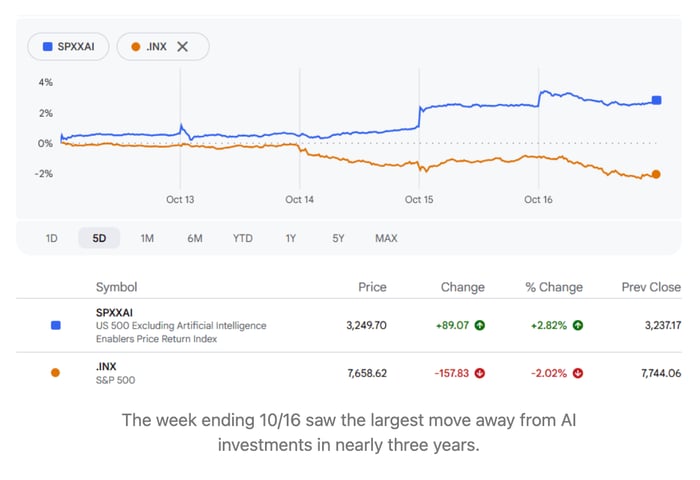
Sources: Big by Matt Stoller
From Stoller: “There’s another metric that investors look at that signals a broader wave of anti-AI sentiment. It’s called the ex-AI index, or SPXXAI, and measures the S&P 500 without the AI companies that have driven much of the broader market’s growth in recent years. This week, the ex-AI index outperformed the S&P 500 by 4.8%, officially the largest spread since 2024. So investors are shifting away from AI and toward the rest of the market, aka the “old economy.”
 Max
Max is a political commentator and essayist who focuses on the intersection of American socioeconomic theory and politics in the modern era. He is the publisher of UNFTR Media and host of the popular Unf*cking the Republic® podcast and YouTube channel. Prior to founding UNFTR, Max spent fifteen years as a publisher and columnist in the alternative newsweekly industry and a decade in terrestrial radio. Max is also a regular contributor to the MeidasTouch Network where he covers the U.S. economy.