

 Image Description: An AI “hype” meter maxing out, the glass is broken and it’s smoking.
Three huge developments in AI show clearly how the air is coming out of the bubble faster than people think. But between the election hype, quarterly earnings season, and Anthropic prepping for the biggest IPO in history—on the heels of the other biggest IPO ever—people just aren’t reading the signs.
The first is China. The second is the off-balance-sheet obligations these companies are being forced to reveal. And the third is the ultimate truth-telling market that just delivered the clearest message thus far. All three support our core thesis: these companies are in the midst of pulling off the biggest capital heist in human history.
China
We’ve been told that AI is a giant footrace with China. Sorry. We’ve been sold this notion. This is the existential threat that requires us to accept another existential—the risk of extermination. Win or die. There’s no in between.
In our haste to beat Chinese firms at the AI game, we forgot to check in with China. A recent Reuters report reveals that the STAR 50—China’s AI index—fell 40% in less than four months, wiping out about $480 billion in market value. Over the same stretch, the Nasdaq only lost about 6%. Are we that much ahead of them in technology gains, or are they ahead of us in the loss of valuation?
The losses aren’t just at the institutional level in China. Remember how Elon Musk recently floated the idea that every child in America should be gifted a share of SpaceX? Just another push to inexorably link our economic fates to the promise of AI. And why companies like Anthropic and OpenAI are racing to go public. They desperately want to entangle retail investors in this mess. Well, the same thing is happening in China. Beijing has reportedly encouraged retail investors to soak up as many AI-related shares as possible, and it has been working. Unitree, the robotics company, was 8,000 times oversubscribed by retail buyers when it listed in August. Its shares have since been cut in half.
There is a domestic angle here in that there is a looming threat of mutual equipment bans between the U.S. and China. So the same people that we’re supposed to be afraid of are having the same conversations about us, and we’re all holding guns to each other’s heads like the standoff at the end of “Reservoir Dogs.”
Remember, this is the rival we keep being told we have to beat at any cost. And its own market is rotating toward wherever the real profits turn out to be. Hold onto that, because American investors are about to face the same question.
BS = Balance Sheet and Bullshit
Here’s the second indicator that blows my mind. The off-balance-sheet commitments of the hyperscalers.
Right now, the markets are glued to the quarterly earnings calls from the big tech firms. Alphabet just reported, and its traditional business was a disappointment. Search revenue grew 12% when Wall Street expected 15%. But its cloud business is cranking. Google Cloud revenue more than doubled. Same for Microsoft. Azure, its cloud compute platform, grew 48%, and the company says AI is increasing capabilities and productivity for its enterprise clients. This is also where Amazon is dominant with AWS cloud services. Clearly, there’s a trend here. Cloud infrastructure is part of the data center buildup. They go hand in hand, and that’s why investors are starting to read the footnotes in these earnings disclosures more closely. They can hide between earnings calls, but these become uncomfortable discussions when they get to risks and footnotes.
Here’s a top-level estimate from The Wall Street Journal (chart sourced from MacroMicro) back in August to give you a sense of the size of this problem.
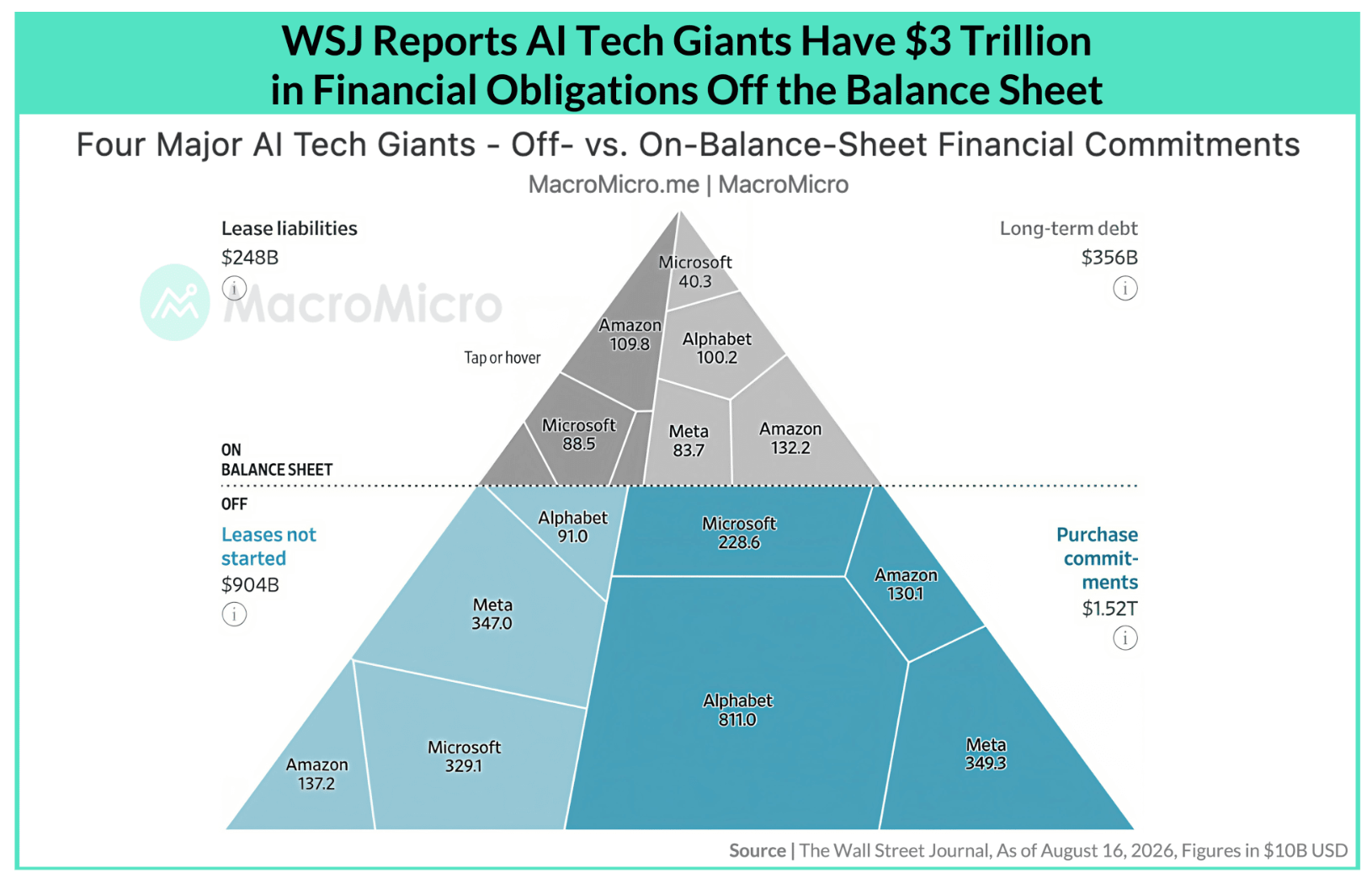
The Journal went through the filings of nine big tech companies, including Alphabet, Amazon, Meta, Microsoft, Oracle, Nvidia, and SpaceX. It found roughly $3 trillion in commitments that don’t appear on their balance sheets. That’s about five times the $600 billion they spent on capital projects over the previous year and about triple what they owe on the leases and loans they actually report.
This staggering sum includes about $1.9 trillion in promises to buy chips, servers, and power. Another $1.2 trillion is data center leases that are signed but haven’t started yet. Under the accounting rules, none of it hits the balance sheet until the equipment shows up or the rent begins.
To be fair, most of this is spending that’s been locked in by contract. But some of it behaves exactly like borrowing as we’ve talked about before. Take Meta’s Hyperion data center in Louisiana. Meta owns 20%. The private credit firm Blue Owl owns the other 80%. And $27 billion in construction debt sits on nobody’s public balance sheet, even though Meta agreed to be the tenant.
Now the bill is showing up in the quarterly numbers. Alphabet spent a record $51 billion on capital projects last quarter, its free cash flow was negative $9 billion, and it confirmed plans to spend $200 billion this year and $300 billion next year. Think about the magnitude of this for a moment. Alphabet went cash-flow negative for the quarter. I’m shaking my head just writing this.
Fuck You, Pay Me
The market erased more than $280 billion of its value after hours. Meanwhile, the bonds tied to these projects are slipping, which brings us to the third indicator that now makes this all impossible to ignore.
I’ve been quoting legendary investor George Noble lately because he’s had the courage to appear on the big financial shows and call bullshit. (He also called for Scott Bessent’s resignation, so he had me at hello.) In his latest blog post, he puts some color to the noise by looking at the real truth-telling market. (Hint: It’s not the stock market.)
“The credit market is doing what credit markets are supposed to do, and it’s sorting the companies that can still borrow from the ones that are about to pay up for it, deal by deal. Stocks haven’t caught up yet.”
Here’s the upshot. Sales of junk bonds, the debt issued by riskier companies, fell from $51 billion in September to about $7 billion in the first three weeks of October. At least seven companies pulled more than $5 billion in bond and loan deals because investors demanded more interest than they were willing to pay. Yields on the lowest-rated corporate debt hit a four-year high of 15.7%. And on the same day, Walmart and Kimberly-Clark raised about $8 billion easily. The bond market is rotating back into staples and solid companies with history and cash flow. It’s separating the wheat from the chaff.
This is why the bond market is always the reality check on valuations. The stock market is the casino. The bond market is the actuarial table. A stock investor can ride a story for years. Let it ride. A lender operates under the “Goodfellas” logic of “fuck you, pay me.”
All of this supports the thesis that these models are ultimately designed to serve the enterprise tier. The consumer models are too expensive, and that’s not where these companies are looking to extract value. We saw it in the SpaceX prospectus, which sized its AI opportunity at $26.5 trillion and assigned $22.7 trillion of it to enterprise applications, against $760 billion for consumer subscriptions.
And now we’re seeing it in Anthropic’s. About 80% of its first-half revenue came from metered usage, mostly businesses paying by the token, and roughly three-quarters came from customers spending $100,000 or more.
This technology is built to accelerate the tendency toward monopolization.
The $3 trillion in off-balance-sheet commitments alone tells you how much of a stake these firms have. The so-called hyperscalers are all in, first with their own cash, then through new stock issuance, and now with massive piles of debt. The difference between them is that credit demands a return. It insists on it.
From the start, these companies have been spinning a utopian socialist narrative of delivering a life of leisure to the masses. But there’s a catch. If you don’t give them enough money to do it right, there’s a good chance it will destroy us all. Give us your money or die.
This was always about tech giants building a moat and tightening their collective grip on the economy. And it has always been a bad bet. The big bad bogeyman on the other side of the planet has already figured it out. Now so has our bond market. It’s only a matter of time until the stock market figures it out too, which is why Anthropic is racing to go public.
 Max
Max is a political commentator and essayist who focuses on the intersection of American socioeconomic theory and politics in the modern era. He is the publisher of UNFTR Media and host of the popular Unf*cking the Republic® podcast and YouTube channel. Prior to founding UNFTR, Max spent fifteen years as a publisher and columnist in the alternative newsweekly industry and a decade in terrestrial radio. Max is also a regular contributor to the MeidasTouch Network where he covers the U.S. economy.