

 Image Description: On The Record 5-5-26. Canada's Pivot to Neoliberalism. 33m American Idiots. GameStop and Amazon. Leeja Miller. UNFTR
Hear Me Out, Canada.
Far be it from me or any other American to pass judgment on the affairs of other nations. Canada might be the place of my birth, but it’s not my home, so I offer this with the utmost love and respect. But we need to talk about Carney.
There’s a version of this essay that reads like a victory lap. Canada grew 1.7% in 2025—second highest in the G7—avoided the recession that most forecasters fully expected, and watched its prime minister become something of a geopolitical celebrity while the American president spent the same period alienating every ally on earth. Mark Carney has a 58% approval rating. He and Mexican President Claudia Sheinbaum are, without hyperbole, the two adults keeping North America in any kind of coherent global conversation. Carney stands at a podium, speaks in complete sentences, references actual data, and treats international partners as, you know, partners. The bar is subterranean and he clears it easily—but in the current landscape, clearing it counts for something.
That’s the version this essay could be. It isn’t.
Let me back up. A little over a year ago, I was sounding the alarm about Pierre Poilievre—a politician I described, and still would, as basically the Ted Cruz of Canada. A performative blowhard whose entire political identity consisted of barbs at Trudeau and aesthetic worship of Trump’s governing style. The genuine danger of a Poilievre government was not that he had some sophisticated right-wing agenda; it was that he didn’t need one. Cruelty as a posture is sufficient, as the United States has now demonstrated at great cost.
Then Trump happened—not as an abstraction but as a direct threat to Canada, right out of the gate. Annexation rhetoric, tariff aggression, the deliberate humiliation of Canadian officials. And it scrambled everything. In terms of putting up a fight, the NDP was in disarray and Jagmeet Singh simply could not meet the moment—and I say that not unkindly, but as a political fact. The momentum swung hard back toward the Liberal Party, and the Liberals had the good sense, or the luck, to select someone who looked and sounded nothing like Justin Trudeau who had worn out his welcome across the Great White North. Instead, Canadians picked a central banker who exudes competence.
I said at the time that this was better than a “lesser of two evils” kind of choice. If Carney could balance the progressive wing of the flailing NDP and beat Poilievre into oblivion then it was a no-brainer. But I also cautioned Canadians to remain vigilant, because it was more than likely that a central banker wasn’t going to govern from the left and so working class Canadians should remain loud.
It has now been long enough to watch what he actually does. And what he is doing is confirming every neoliberal concern, cloaked in the language of national resilience and responsible fiscal management. There’s some good, some bad and some cause for extreme concern.
Let’s start with the foreign trade picture, which genuinely is a win. Canada has negotiated so that 85% of its goods exports are protected under CUSMA from U.S. tariffs, and its effective U.S. tariff rate sits at 5.2%—the lowest among major American trading partners. That is real. The government has secured $97 billion in foreign investment commitments and is actively pursuing new trade relationships with India, Japan, the EU, Australia, among others. The major projects office has $126 billion in projects advancing. Give credit where it’s due.
The domestic economic picture is murkier. Q4 2025 contracted 0.6% as tariffs bit and business investment wobbled. Private sector forecasters are projecting 1.1% GDP growth for 2026, recovering to 1.9% in 2027. Unemployment sits at 6.7%. None of that is catastrophic, but it is also a context in which working people are feeling real pressure, and it is precisely that context that makes the domestic budget choices so revealing.
The actual deficit for 2025–26 came in at $66.9 billion, which was better than projected, so the Carney government can point to this as an example of fiscal discipline. It’s worth noting that this is nearly double Trudeau’s final projection. As Unf*ckers know, I’m not moved by talk of debt and deficits when spending is rational and central banks have access to global bond markets. But it’s a conservative talking point designed to stress people out and make things seem undisciplined.
In response, the Carney government recently released its Economic Update, basically a loose budget proposal with a supporting narrative. It’s non binding but certainly instructive.
The Carney government plans to balance the operating budget by 2028–29, while acknowledging the debt-to-GDP ratio will rise for four straight years and federal debt servicing costs are on track to hit $80 billion annually by 2030–31. Traditionally, Canada has been loath to run deficits, unlike its neighbor to the south. And it’s understandable because we’re very different economies despite our proximity to one another. But it is substantial enough to run modest deficits to fund government programs that have become staples of Canadian life, from dignified retirements to healthcare coverage.
Here’s where it gets dicey.
One example of the neoliberal leaning is Carney exploring talks to privatize airports. Digging deep into a Reagan-esque dictionary (or perhaps Harper) the government is evaluating “alternative models of ownership.” The primary vehicle for such explorations would be a Canadian sovereign wealth fund—open to retail investors, by the way—to “recycle” public assets. Recycling public assets is a euphemism. It means selling things the public owns to fund other things the public needs.
Oil and gas are also a big (and growing) part of the Carney agenda, with a proposed $14.5 billion set aside for the industry with plans to expand transportation capacity significantly. Don’t worry though, much of this sorely needed infrastructure investment into the fossil fuel industry will be offset by 40,000 public service job cuts. The Carney plan also calls for Canada to increase military spending to 5% of GDP. For comparison sake, the U.S. is currently hovering around 3.5% of GDP and we’re the most belligerent assholes on the planet.
Meanwhile, the Canada Social Transfer, the federal bloc program that supports Provinces and Territories with education, social services and early childhood programs is set to increase by 3% per year, which is below expected inflation. That’s how you slowly kill social assistance programs over time.
If you’ve lost track of which party Carney belongs to I get it. And I’m not done.
Income tax for the lowest bracket was cut from 15% to 14%, which is lovely. Of course that means it’s also a hit to the budget, which is why the Trudeau government was pushing for an increase to the capital gains tax to offset any income tax cuts. So no additional pressure for wealthy Canucks, and a slight 1% reduction in taxes on the poorest.
Even more insulting (speaking as an American here) are the de facto healthcare cuts with no increase to dental care plan funding and no new funds for medical care. Oh, and no improvements to Old Age Security. That covers the “dignified retirement” and “universal coverage” bullet points pretty succinctly.
The Canadian Centre for Policy Alternatives warned that Carney’s planned cuts could represent the worst cuts to the federal public service in modern history. Federal union leaders called the budget austerity, plain and simple.
Spring magazine, a socialist publication, put it more bluntly than most: the new Liberal government is effectively a Conservative government under different branding. This IS the correct framing.
Welcome to our world down here in the U.S. When set against Trump, nothing seems out of line or unwelcome. This was always the danger of a Canadian banker-turned-politician ultimately revealing his true colors; against Trump’s chaotic canvas everything seems muted and warm.
Competence in the central banking world means something very specific: it means keeping the ship steady, keeping the investor class confident, making the numbers legible to global capital markets. That is a genuine skill set. It is not a progressive governing philosophy. And so long as the psychic energy of Canadian progressives is directed outward at Trump, there is less directed inward at what the Liberal government is actually doing.
None of this means Carney is Poilievre. He isn’t. Beating Poilievre still mattered. Canada made the right call at the ballot box, in the sense that the alternative was genuinely worse. But winning a bad alternative is not the same thing as winning. The job now is to make sure that political reality does not become a permanent excuse for governing well to the right of where Canada’s working class actually lives.
Progressive Canadians can still be proud of how their prime minister carries himself on the world stage and still demand that he not privatize their airports. They can be glad he isn’t Pierre Poilievre and still insist that pharmacare agreements not be allowed to quietly expire. They can root for him against Trump every single day and still understand that rooting for him is not the same as giving him a blank check domestically.
The left does not win by being a loyal opposition that never actually opposes. It wins by holding the line—loudly, specifically, persistently—on the terrain that matters most to the people who have the least.
Now if we could only eat our own dogfood here in the States.
Pocketbook Politics
I make a note to check on this every couple of months. This is the first time we’ve seen a significant drop in support of Donald Trump by Republicans in the Civiqs survey. As a refresher, this is a continual online survey that reports in real-time with current methodology. It also has a sizable sample and typically lines up with the more venerated polls.
Until the start of the Iran war, Trump’s approval rating was virtually unshakeable. It started to decline around the time of Maduro’s illegal kidnapping but had recovered slightly. While it maintained for a couple of weeks after the start of the war, it has since declined four to five percentage points with disapproval and neither approve/disapprove ticking up slightly.
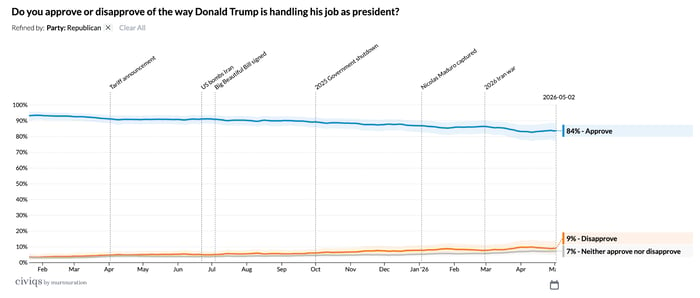
Source: Civiqs
The story here isn’t that Republicans were upset by our illegal bombing campaign in Iran, or the mass murder of elementary school age children. No, no, no. That was just Trump doing hard things for all of our benefit. It was the aftermath, when even the most obstinate Republicans put 2+2 together that Iran cannot be beaten but they can shut down the Strait of Hormuz and disrupt the global supply of oil. Republicans are capable of doing this math to understand that gas prices are going to go through the roof and that we might have just triggered a global recession.
And yet...it has to be said. His approval is still 84%. Nothing short of astounding. And knowing that his overall approval is now below 40%, it tells you just how divided we are as an electorate. Democrats are statistically aligned to the extreme. So the drop in support is most notably among independents, where Trump has seen a 15 point decline.
To the extent that anyone who once thought this guy was doing a great job is now rethinking that posture, the adage holds true: It’s the economy, stupid. But I guess Republican devotion to this man runs deeper than the economy. Well, 84% of Republicans, at least. We already know it ran deeper than decency, morality and the Constitution.
 Max
Max
Max is a political commentator and essayist who focuses on the intersection of American socioeconomic theory and politics in the modern era. He is the publisher of UNFTR Media and host of the popular Unf*cking the Republic® podcast and YouTube channel. Prior to founding UNFTR, Max spent fifteen years as a publisher and columnist in the alternative newsweekly industry and a decade in terrestrial radio. Max is also a regular contributor to the MeidasTouch Network where he covers the U.S. economy.