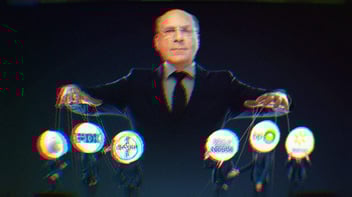

BlackRocked.
On The Record (3-9-26).
 Image Description: A graphic with text reading On The Record 03-09-26: BlackRocked, Graham Blows Iran, AI Warmongers, Crude Oil Shocks, House of El & More.
BlackRock’s recent move to limit withdrawals from its $26 billion private-credit fund exposes the risks of “democratizing” complex financial products by marketing them to ordinary investors. We’re seeing echoes of 1920s Wall Street, when brokers sold margin trading to small investors as “shareholder democracy,” a pitch that ended in ruin when the market crashed. Today’s version packages private credit and alternative investments as opportunities for average savers, but the fine print ensures that when liquidity dries up, it’s retail investors, not institutions, who get stuck holding illiquid assets they can’t exit.
BlackRock’s private‑credit scare is the logical outcome of a decade‑long experiment in “democratizing” risky finance, and it rhymes uncomfortably with the way Wall Street sold stock‑market speculation to small investors a century ago.
In the last few days, BlackRock has had to slam the brakes on withdrawals from its $26 billion HPS Corporate Lending Fund, a non‑traded BDC that makes private loans to companies. Investors asked for redemptions equal to about 9.3% of the fund—roughly $1.2 billion—in a single quarterly window, but the product’s design only allows 5% of shares to be bought back each quarter, so BlackRock paid out about $620 million and told everyone else to wait in line.
To be clear, the brakes on withdrawals are a feature of this type of investment. On the term sheet of this product, the 5% cap is stated in the prospectus so it’s a case of “buyer beware.” These lock-up products are intended for savvy investors with deep pockets and a higher risk appetite. But this gets to the heart of the idea of democratization and the downside of allowing investors to pile into risky investments that are designed to tie up funds for a longer horizon. No one gives a shit about the wealthy investor who takes a haircut in a leveraged debt product where success is designed to extract higher rates from a wide pool of corporate borrowers. But if the average retail investor is encouraged to lock up their hard-earned savings, then it becomes more than a risk.
The reason private credit is having a moment in the sun is because issues with it keep popping up in high profile places, like BlackRock’s vast portfolio. The whole pitch around this and sister products has been that ordinary affluent savers—wealth‑management clients, upper‑middle‑class households—shouldn’t be “locked out” of the juicy returns that pension funds and endowments enjoy in private credit. The language is populist: broader access, leveling the playing field, giving “the average investor” a shot at institutional‑grade strategies. That’s the same register Wall Street used in the 1920s to sell mass stock ownership as “shareholder democracy,”universal ownership of corporate stock as proof that capitalism was for everyone, not just the plutocrats.
The catch is that what gets democratized isn’t just upside; it’s exposure to products whose risks and liquidity constraints were easier to manage when they lived inside big, boring institutions with long time horizons. In a pension fund, private loans are one sleeve of a giant portfolio. In your brokerage app or your adviser’s “alternative income” model, they might be a big chunk of your savings.
If you go back to the 1920s, the rhetoric is eerily familiar. Corporations, brokers, and the New York Stock Exchange promoted “shareholder democracy” and the “democratization of investment” as civic virtues, insisting that ordinary Americans should own a piece of the country’s industrial future. Ads boasted about the rising number of small shareholders, academics like Harold Carver wrote about a new “proprietorship” in which wealth would be more widely shared, and the press pumped out stories of teachers and shopkeepers striking it rich on Wall Street.
The dark side of that democratization was margin. Brokers let small investors buy stocks with 10% down, borrowing the rest against the securities, a practice defenders sold as a way to open the market to people who didn’t have large piles of cash lying around. Figures like Charles Mitchell of National City Bank cast margin credit as a tool to democratize ownership, while critics like Senator Carter Glass (yes, that Glass of Glass-Steagall) warned that using the nation’s credit system to fuel leveraged speculation for the masses was dangerous and illegitimate. When prices fell, those same small investors were the ones wiped out by margin calls and forced liquidations.
The point isn’t that broad participation in capital markets is inherently bad. It’s that democratization became the sales pitch for increasingly complex and fragile structures, with ordinary households absorbing risks they didn’t fully understand and weren’t protected against when the cycle turned. A century later, you can swap “margin account” for “non‑traded BDC,” “target‑date fund with alternatives,” or “semi‑liquid private credit” and the pattern is the same: promise everyone a seat at the table, then design the fine print so the exits are smallest for the people least able to afford a loss.
If you want to spot a bad idea, look at who’s promoting it the most. For example, the Trump White House is leaning hard into this old formula. Take the “Trump Accounts” for newborns: the administration’s signature family‑finance idea seeds an IRA‑like investment account with a $1,000 federal deposit for every baby born between 2025 and 2028, with parents allowed to contribute up to $5,000 a year and employers up to $2,500. On the surface, it’s framed as a patriotic wealth‑building plan, a way to ensure every child has a stake in America’s prosperity from day one. But as we’ve uncovered, this is just a way to reward those who have the ability to match funds in the program and to give Wall Street another pool of low maintenance accounts that produce management fees.
In parallel, Trump signed a 2025 executive order pushing the Labor Department and SEC to encourage more “alternative” investments—private equity, private credit, and other private‑market vehicles—inside 401(k) plans. That order explicitly says the policy of the United States is that every worker saving for retirement should have access to funds that invest in alternatives, echoing the same democratization refrain: if the rich and the pension funds can have it, why can’t you? Asset managers like BlackRock have responded by designing target‑date funds that tuck 5%–20% of assets into private investments.
Supporters say this is about closing the return gap between ordinary savers and institutions. Critics like Elizabeth Warren point out that private markets come with weaker transparency, higher fees, and aggressive performance claims—and that regulators have a spotty record of protecting retirement savers from complex products. Essentially, the same firms promoting “democratized” access to private credit and equity are now being invited, by executive order, into the core of the retirement system, with the blessing of a White House that treats financial complexity as a kind of patriotic opportunity.
Like everything else on Wall Street, everything looks rosy during the good times. Your grandmother is a phenom at picking stocks. Your niece is paying her way through grad school with crypto gains. Everyone’s risk appetite increases while protections and regulations decrease. And eventually, nature runs its course and the downside comes-a-knocking. So here we are. Risk is being pushed down the social ladder, dressed up as opportunity, and delivered through products that will only show their true nature when ordinary households most need liquidity.
You may ask yourself. Where is that large automobile?
Same as it ever was.
Same as it ever was.
 Max
Max
Max is a political commentator and essayist who focuses on the intersection of American socioeconomic theory and politics in the modern era. He is the publisher of UNFTR Media and host of the popular Unf*cking the Republic® podcast and YouTube channel. Prior to founding UNFTR, Max spent fifteen years as a publisher and columnist in the alternative newsweekly industry and a decade in terrestrial radio. Max is also a regular contributor to the MeidasTouch Network where he covers the U.S. economy.