
 Image Description: On The Record 6-16-26. Be Like NYC. 2026 Senate Races. Classy UFC Event. Ivanka Sucks So Hard. High On Stock Supply. UNFTR.
Concrete Jungle, Wet Dream, Tomato
It’s the most cohesive the city has felt since 9/11. Only this time the shared response is joy. Pure, unadulterated joy over the first New York Knicks championship since 1973. I’m not an avid follower of basketball but I am tuned to the rhythm of social phenomena and this was transcendent in every way.
Ask a New Yorker how they feel about the World Cup, the Stanley Cup or the UFC fight on the White House lawn and you’re likely to get a puzzled look. There are no other events. Only this. New York is no stranger to sporting event titles, even if we’re prone to droughts like every other place. And while I’m unfit to opine on the finer points of hoop lore, a colleague gave me a perspective on why this feels different than other teams, other championships and most importantly, all other sports.
Basketball was developed as an activity for white Canadian youths. For the first half century of its existence it remained that way, though segregated leagues would develop over the many decades that followed. It grew in popularity throughout the United States as high schools adopted it and community centers popped up in rural and urban areas. In most instances it was a winter endeavor, a holdover between football and baseball season.
But as urban centers expanded and the practice of redlining took hold to further segregate Black and white communities, recreational real estate came at a premium. There were ballfields, backyards and parks in white communities and thus continuity in America’s outdoor pastimes. Black communities built YMCAs and concrete parks that housed courts. In cities across the country, the basketball court became the center of gravity.
Nowhere is this more pronounced than the most densely populated city in the country.
The basketball court is the connective tissue of every neighborhood in the five boroughs. DJ Kool Herc, credited as one of the progenitors of Hip-Hop was nicknamed Hercules for his abilities on the court. Those same courts would explode with the cultural expressions of Hip-Hop, serving as outdoor community centers inclusive of all backgrounds and ethnicities in the neighborhood. And even though trash talk is a time-honored basketball tradition, there’s something about the New York accent that hits differently.
Other cities are rife with basketball courts, but none as populated as New York City, the undisputed capital of street ball with 1,800 courts. It’s second only to Hong Kong, apparently. More than the sheer volume, however, it’s the density. There’s a whole lotta people in a very small amount of space, relatively speaking, which means there’s always a court within striking distance. And it’s this notion that bridges the physical to the sociological.
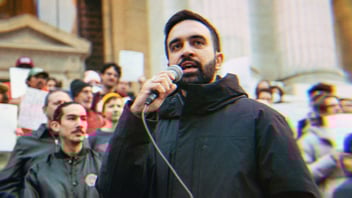
This is the joy of communal existence at its purest. It’s what Zohran Mamdani tapped into. Not because he simply “understood” it at a political level but because he lived it at a deeply sociological level. The billionaire shits through the same sewer pipe as the bodega worker. Right wing conservatives love to invoke imagery of the rugged frontier American spirit, and there’s no question it plays in large swaths of the country. But make no mistake, we’re just as tied to the mythology of the teeming masses who came through Ellis Island. The difference is profound and it’s playing out across our politics.
Ayn Rand’s Atlas Shrugged, libertarian, “my way or the highway” cowboy persona is the other side of Sinatra’s, “If you can make it there, you can make it anywhere” and, “I did it my way” coin. But there’s one key difference.
One celebrates the individual with disdain for the collective. The other celebrates the individual as part of it.
Just as Jalen Brunson’s accomplishments were heroic and singular, they cannot be separated from that of his team. So too is it for the unofficial poem that went viral during this legendary run. “My Mayor is Muslim; my bagel is Jewish; my Christian Dior; Knicks in Four!” (Updated to “The Pope’s on my side, Knicks in five.”)
Even the tension between billionaires and the average American played out differently in this Knicks run. In the middle of the finals, Elon Musk became a paper trillionaire. Billionaire James Dolan tried to blame Mamdani for canceling the outdoor watch parties, but New Yorkers knew better. Billionaire New Yorker Donald Trump attended the only loss of the series and the correlation was lost on no one. Like basketball courts, New York also has the most billionaires in the country and, like I said before, their shit flows through the same sewers as every other New Yorker. They tried to steal the people’s thunder and no one was having it.
The crass irony, of course, is that the gains for the masses are emotional. Every Knicks jersey and hat ultimately feeds the corporations that own the licensing and the billionaire that owns the team. But New Yorkers have always lived beside the most obscene wealth in the world. This is the home of wealth. And the critique of the billionaire class is therefore different. I have a sense that most New Yorkers don’t begrudge the billionaire class in the way it’s often portrayed. Because we always get a taste of that success in some shape or form.
Elon’s IPO was underwritten by the New York firms and they took in historic fees. We’ll get a piece of that in their tax filings. But the people of Texas, who just got their asses handed to them in these finals, they’ll see none of SpaceX’s massive gains. Because Elon moved there specifically to fuck taxpayers. The other big IPOs coming later this year—OpenAI and Anthropic—we’ll get a piece of those as well. The Nasdaq, S&P 500, Dow Jones—all headquartered in New York. In fact, we get a piece of everything because that’s how the collective works. Is it enough? Hell no. But it’s something.
Trump fell asleep in his luxury box then slept alone in his gold tower. Zohran watched from the nose bleeds then partied at a local bar with the people.
Elon Musk gutted federal agencies and bribed the Nasdaq to list his IPO with no restrictions. Zohran built back city agencies and secured universal childcare.
Wemby walked off the court alone, then walked out of the press conference. Brunson went to the Spurs coach first, then to his father, to his teammates and the fans.
You can shine in a collective. And the collective will lift you up and celebrate you. Or you can be a dick who has it all, but winds up with nothing to show for it.
High on More Supply
There’s an interesting trend taking shape on Wall Street. The historic IPO season is grabbing all the headlines but the real action is in secondary offerings. It’s a big enough change that could alter the “number go up” phenomenon we’ve experienced since the 1980s. Add in the bond market and it might be time to grab the popcorn.
Since the Reagan era, the equity markets have been unstoppable. They’ve paused and dipped, but the long-term trend has been up and to the right. Significantly so. There have been four primary drivers. The first and most impactful was the legalization of stock buybacks. The ability to limit the physical supply of shares made rising share prices a matter of simple supply and demand math. The second happened during the Clinton administration when executive compensation was capped. This shifted the compensation strategy from wages to options, which incentivized executives to mess with supply even more.
The third started under Obama and continued for 15 years unabated: low interest rates and excessive money supply. We pumped trillions of dollars into the economy with little incentive on fixed income (low interest rates). Lastly, the only legitimate part of the equation—earnings. The tech boom fueled massive earnings and low corporate taxes meant that corporations held onto increasingly more cash. Cash fed into buybacks, more options were granted, money was cheap and easy. Rinse, repeat.
Now, for the first time in many years, the supply and demand equation is changing.
-Jun-16-2026-03-23-28-3752-PM.png?width=600&height=383&name=unnamed%20(2)-Jun-16-2026-03-23-28-3752-PM.png)
Source: SIFMA Research
Even before Elon’s historic IPO released a flood of new shares on the market, there was an uptick in IPOs. But the bigger story was the release of secondary offerings. These are existing public companies that have released new shares in an effort to raise capital. This is compounding the volume of available shares, which is counteracting the spate of planned buybacks over the year. It remains to be seen whether the new issuances will be enough to neutralize the impact of the trillion dollar buybacks this year but there’s no question that the Anthropic and OpenAI IPOs are going to bump total shares higher than previous years.
This brings the bond market into the equation. Right now treasury bond yields are high, which means that they’re competing with equities for short-term and mid-term gains. If you take the sexy tech sector out of the mix, investors across the spectrum have a real option in fixed income. After years of low yields, there are real returns to be had and a shitload of short-term paper being issued by the government. And if you’re concerned about the viability of the tech sector (i.e. if you think we’re in a bubble) the big tech firms are also issuing debt so you can still invest in tech without the downside risk of tech bubble equity exposure.
This is why you might hear some conservative market observers suggesting that we’re near the peak of irrational exuberance a la 1999 and 2007. So that means all eyes will be on earnings and fundamentals when the euphoria dies down and everyone realizes that we can’t build data centers in space and AI has no business model. Naked emperors all around.
 Max
Max
Max is a political commentator and essayist who focuses on the intersection of American socioeconomic theory and politics in the modern era. He is the publisher of UNFTR Media and host of the popular Unf*cking the Republic® podcast and YouTube channel. Prior to founding UNFTR, Max spent fifteen years as a publisher and columnist in the alternative newsweekly industry and a decade in terrestrial radio. Max is also a regular contributor to the MeidasTouch Network where he covers the U.S. economy.