
Why I’m So Mad at the Democratic Party.
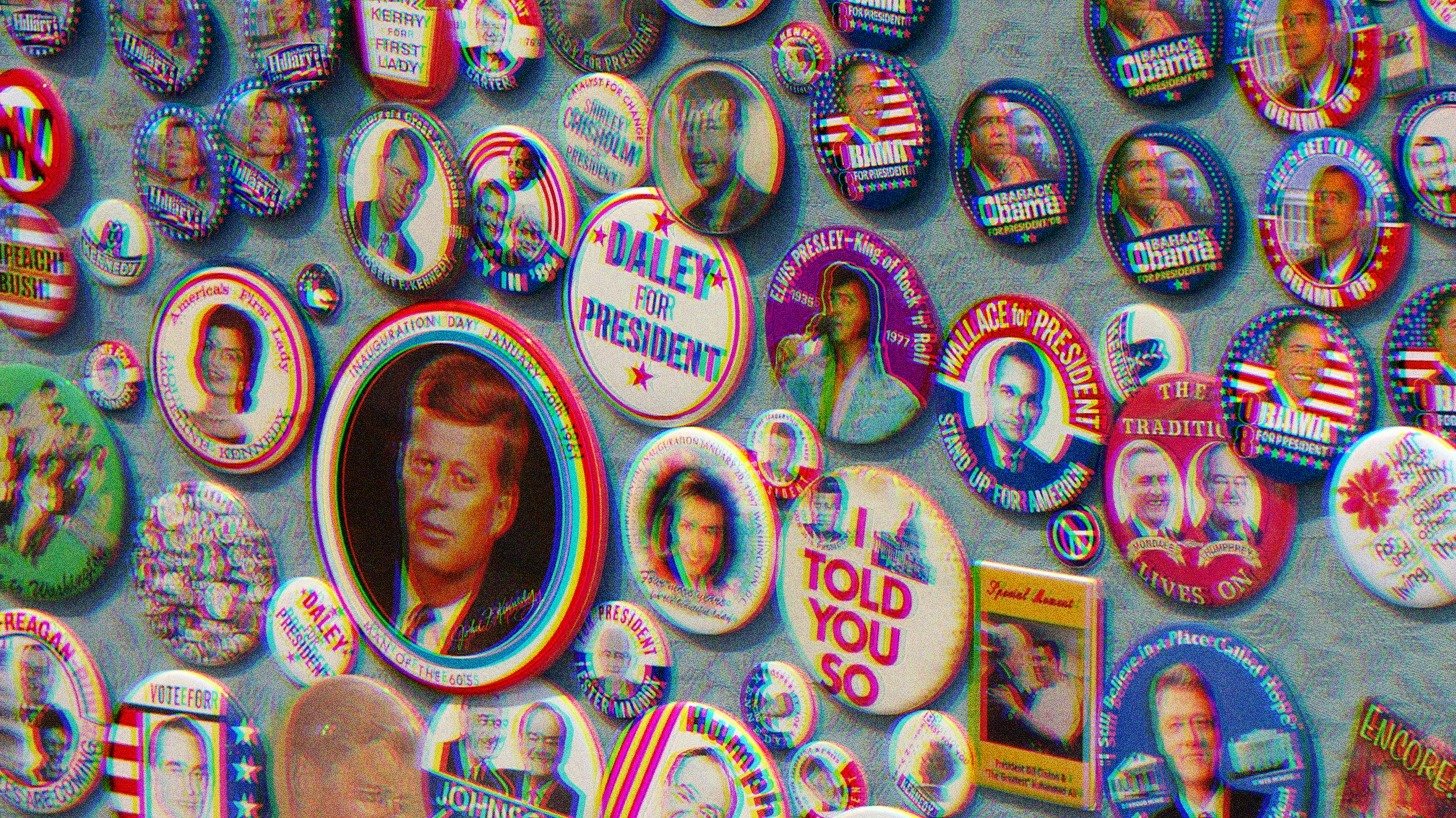 Image Description: Mixed campaign buttons throughout the decades.
Why the Democratic Party’s promise of “restoration” misses the mark; how decades of economic crises reshaped American politics, and why returning to center means chasing a target that keeps moving right. One side built a durable monument to white nationalist capitalism while the other became its world-class pit crew. The fight isn’t about competence or committee chairs—it’s about whether Democrats can offer an actual vision for the future instead of just patching up the damage Republicans leave behind.
A longtime friend of UNFTR echoed a sentiment recently that I’ve heard over the years.
Paraphrasing: Why so hard on the Democrats when the Republicans are so villainous?
I think it deserves more than just “I expect more from Democrats.” So here goes everything…
Shifts in political paradigms are presaged by seismic economic events. One can argue cause and effect in this regard. Perhaps a war created the condition for political upheaval; likewise, epidemics, famines and technological revolutions have all had a hand in shifting the wind and the tide but radical political change is always mired in economics. Populations never tire of security and stability. They don’t yearn for change when there’s food on the table and unlocked doors at bedtime. They don’t flee and migrate when there’s a possibility to build or rebuild, even after a natural disaster. But a genuine and prolonged economic crisis will always bring about a political revolution. It’s a question of depth, duration and character.
And the way forward is always lit by those who are most prepared.
The United States has had political continuity on the surface for 250 years. The framework has certainly held. But there have been several tidal economic shifts in political power throughout this experiment. After all, economic disasters don’t always lead to the collapse of empires, but they can significantly alter the politics of a nation.
Before the Civil War there was the Panic of 1857. The Second Industrial Revolution caused enormous boom and bust cycles but gave rise to the labor movement and progressivism. The Great Depression pushed us toward FDR economic liberalism, which brought us to the Second World War. The stagflation crisis of the 1970s gave rise to neoliberalism and heralded the long painful death of New Deal policies and Johnson’s Great Society.
Cause and effect. Root causes and symptoms. The timing is muddied but the circumstances echo through time.
Because the general framework of the United States has mostly held, even withstanding its greatest test in the Civil War, we have a tendency not to notice the political shifts in the moment. Wars are straightforward. As are pandemics, famines and natural disasters big enough to alter the course of history. But economic upheaval percolates. It takes years, sometimes decades to realize just how much has changed. And we tend to judge the character of the nation by who is in charge. The President is, in many ways, the avatar of American sentiment, as is the case with most nation-states and their leaders.
The repeated bust cycles of the late 1800s gave way to the ebullient and brash optimism of Teddy Roosevelt. This overconfidence manifested in many ways and it held for decades until the disillusionment of the Great Depression. So then we took on the character of Teddy’s cousin; a kind of sanguine resolve that maybe we could recapture a bit of that turn-of-the-century luster. Through multiple wars and revolutionary geopolitical changes, we found ourselves at the top of a mountain in the back half of the 20th Century, only to revisit that haunting feeling that it may have been built from sand when the stagflation crisis interrupted our winning streak. On the other side of it, Ronald Reagan’s inch deep but mile wide appeal invited us to once again climb the mountain, only this time we were in pursuit of a shining light on top of a hill.
It’s tempting to think we can diagnose what ills us today and search for perfect answers by looking to the past. But the best we can do is find the pieces that resonate most within today’s puzzle and ask if they still fit. The world is moving faster and faster, which makes it difficult to pause and try to make sense of it. There is no picture on the side of the puzzle box to guide us; this puzzle is alive and ever changing. In the past quarter century we have collapsed the extended timelines of history into a frenzied and dizzying collage. 9/11. Extensive wars abroad. A global financial crisis. Pandemic. A monetary regime that has no historical corollary. Existential climate threats. Less than half of the U.S. population was online in the year 2000, and now every one of us has a high powered computer in our pockets. Plus, the worldwide population has grown by one-third.
What does it say about us, the speed of these cycles, the pace of change and depth of despair that we would elect Donald Trump twice over the past decade? A man who is somehow both the avatar of disillusionment and the face of change? These are the actions of an electorate that doesn’t know what to feel or how to think about the world as it is. I think I finally understand what we were thinking in the late 1800s when we elected Cleveland to non-consecutive terms. It makes sense why the gilded elite of the 1920s were cast aside for someone who promised to be a traitor to his class. I totally get why Ronald Reagan was able to break through as the star of the Republican Party, when he was regarded as a radical conservative and a zealot for most of his career by his own colleagues.
It comes down to preparedness. Throughout our brief history the United States has been run by people who were the most prepared to seize opportunity within chaos. Even when they lost the reins of power, they were in charge of everything behind the scenes. And when it comes to the past half-century, I still don’t think that we’ve fully come to grips with how complete the neoliberal victory has been over our politics. The fringe cultists from the Mont Pelerin Society and the John Birch Society worked diligently from the end of World War Two through 1980 to construct the ultimate monument to capitalism infused with white nationalism.
And what an edifice it is.
They poured a concrete foundation with reinforced rebar and steel. Built it to code to withstand hurricanes and earthquakes. Erected scaffolding around it so they could easily change the facade to match and mirror the current times. And built underground bunkers in which to hide and adapt because they understood the pendulum better than anyone before. Here they would gather during periods of backsliding. They watched film, studied the opposition and altered the play calls for the next rounds. So long as the end game was protecting the edifice, the monument to white nationalist capitalism, they could allow the other team to put some points on the board.
A young governor from Arkansas beat us? No problem, just as long as you reinforce the racial hierarchy in the criminal justice system and loosen corporate regulations. And do not touch that military budget. A Black president? Here you go. Just protect the ruling class and bankers. And do not touch that military budget. A doddering old fool who projects stability during a global health crisis? Fine, just make it quick, don’t change too much, and for god’s sake, do not touch that military budget.
All the while they chip away at the liberal institutions and make you question your lying eyes through their mainstream mouthpieces. They strip away regulations that constrain the worst instincts of the corporate class. They print unholy sums of money but make it available only for the ruling class. They extract less and less from the elites and apply a little more pressure to the masses each day. A little at a time so as not to break them, just bend them.
It’s not as though we haven’t connected the dots. Read Evil Geniuses by Kurt Andersen. Dark Money by Jane Mayer. Death of the Liberal Class by Chris Hedges. The Shock Doctrine by Naomi Klein. The Quiet Coup by Mehrsa Baradaran. The Family by Jeff Sharlet. Democracy in Chains by Nancy MacLean. The New Jim Crow by Michelle Alexander. Capital in the Twenty-First Century by Thomas Piketty. These aren’t just great modern works of nonfiction, they are textbooks.
Or you can simply read Marx’s Capital, for its teleological understanding of capitalist systems.
That’s what’s under the scaffolding and under the facade. Above the bunker and beneath the doctrine. This moment, Trumpism if you prefer, is as core to the edifice as to function as the central plumbing, electrical and elevator shaft. It is what keeps this all together.
What’s mine is mine and what’s yours is also mine. That which I do not I have I shall take.
You might find this particular facade to be gauche or even clownish, with its gold painted ornaments, silly hats—its ivermectin blood and testosterone paste skin. But make no mistake, underneath it all is the durable core of capitalism.
And that’s what angers me most about what comes next. In this accelerated timeline where we have smashed together a pandemic, climate catastrophes, financial crises and endless war, we both achieved the goals of the original cultists at Mont Pelerin and John Birch and moved past them. Even they don’t know what happens now that they have racked up so many victories. They can’t possibly predict what will happen with a fool in charge who is walking around like Buster Keaton with a ladder in a glass factory. But this much I know: if elections are allowed to stand in this country, they’ll find themselves huddled in the bunker once again. And there they will plan. They’ll move the Xs and Os around the big board, put money in the pockets of enough elected officials that they can slow oppositional momentum, take the temperature of the masses and plan for the next chapter.
It’s the preparedness that gets me. The resolve. The forethought. The lengths that the white nationalist power base in this country will go to protect the capitalist monument at all costs. To sow doubt in liberalism. Cast aspersions on poor Brown people. Foment distrust in your neighbor.
Before there was Project Esther and Project 2025 there was the Project for a New American Century (PNAC) in the 1990s. Before PNAC there was The Horowitz Report in 1980, a 100 page memorandum by Michael Horowitz commissioned by the Scaife Foundation to analyze why liberals dominated public‑interest law and the legal profession, and to propose a plan to reverse that. In the same year the world was introduced to Free to Choose by neoliberal’s poster boy Milton Friedman. Limits of Liberty in 1975 by James Buchanan helped arm neoliberals with an intellectual rationale for treating education—especially universities—as self‑interested public bureaucracies in need of market discipline. The Powell Memorandum in 1971 was the call to arms to the business community to take back the country from liberals, unions and activists who stood to impede capitalism.
These aren’t the same as the textbooks on the left that explain to us what happened. These are the blueprints and instruction manuals for what came to pass. THAT is preparedness.
Okay, so…Why the diatribe? Why now?
We’re in one of those moments. This new war might end in the coming weeks or months, but it has fundamentally altered the global calculus with respect to U.S. foreign policy and relations. Were it isolated, we might get away with it and chalk it up to the whim of a madman. But it came on the heels of us kidnapping a head of state. It’s on top of the most egregious and selfish disruption to the global trade order (that we established) the world has ever seen. And it will plunge the United States and the world by extension into a period of stagflation.
The mosaic of exogenous threats that remain in addition to this chaos make this situation even more of a tinderbox. A catastrophic climate event. Another hot war or retaliation. A failed state in the Global South. Terrorist attacks in the north. Perhaps another pandemic, given we have pulled health funding from every poverty-stricken country on the planet and left them with no backup plan.
Before day one of Trump’s second term, many of us were sounding the alarm. Not because Trump was back like Slim Shady, but because the people behind him were all too familiar and eminently prepared. But even this is more than anyone bargained for. Trump is now Frankenstein’s monster, and if he’s allowed to roam free for several more months, it will take more than midterm elections to stop him.
But that’s all the loyal opposition has planned. Midterms. We’ll get him then. Oh, the hearings! The lawsuits and trials! The legislative intransigence!
The bureaucracy strikes back.
That’s what we have to look forward to. Outside of winning the midterm elections I defy anyone to articulate the oppositional vision to the GOP’s reign of terror. Putting yesterday’s puzzle back together is not a vision for tomorrow. Going back to the way things were when the electorate was so dissatisfied and disillusioned it chose a known liar, adulterer and convicted felon over the status quo.
Here is what the Democratic Party doesn’t understand. The simplest way I can put it.
Every election cycle they promise restoration. My entire adult life this has been the case. A return to normalcy. Back to center. Not a nostalgic return to the good old days—that sentiment belongs to the right. The Democrats offer to divide the pie more equitably.
Now, you might argue the opposite. After all, Clinton’s campaign theme was “Don’t stop thinking about tomorrow.” Barack Obama promised to deliver hope and change. Biden was more on the nose saying this was a battle for the soul of the nation. I’m talking about more than slogans. I’m talking about policy prescriptions. The centerpiece of Democratic centrism has been to rebuild the middle class. Again, a return to center.
The New Democrats led by Bill Clinton believed that free market neoliberalism was the way to accomplish this. All we had to do was reorient the market to serve middle class interests. Barack Obama believed that free market neoliberalism aided by technology would serve the same end. Ironically, the most forward thinking presidency was that of Joe Biden, the second oldest person elected to the presidency after Donald Trump. Perhaps it’s because he lived through pre-neoliberal times. But even his boldest accomplishments wound up as half measures, because he also lived under the illusion of bipartisanship, a long deceased feature of American politics.
Every single policy stance of the Democratic Party platform is simply an adjustment to the current course and sold as “not Trump.”
- Healthcare. Restore subsidies to the Affordable Care Act.
- Foreign Policy. Normalize relations with our allies.
- Taxes. Make billionaires pay their “fair share.”
- Technology. Place guardrails around AI.
- Energy. More renewable energy to support data center growth. But also more oil.
The Democrats always promise a return to center without realizing that center keeps moving to the right. And here’s the bitter irony of it all. We’re in this astounding pattern where Republicans destroy the infrastructure of democracy a bit more every time they take power. And then the Democrats come in to patch things up.
Democrats are just the GOP pit crew.
Don’t you see how insulting it is when we demand a new vision and you offer us Gavin Newsom or Pete Buttegieg? Can you feel our frustration with the idea that everything will be okay if you switch seats in your committees? We’re out here fighting for our lives and you’re just fighting for who gets to hold the gavel next. That’s why I reserve my anger for the Democrats. It’s not that they’re incompetent bureaucrats, it’s that they’re exceptional bureaucrats. The greatest pit crew in the world. So fucking competent. So lacking in vision. We don’t need a new race car, we need a new track.
That’s why I’m so angry with Democrats.
Image Source
 Max
Max
Max is a political commentator and essayist who focuses on the intersection of American socioeconomic theory and politics in the modern era. He is the publisher of UNFTR Media and host of the popular Unf*cking the Republic® podcast and YouTube channel. Prior to founding UNFTR, Max spent fifteen years as a publisher and columnist in the alternative newsweekly industry and a decade in terrestrial radio. Max is also a regular contributor to the MeidasTouch Network where he covers the U.S. economy.