
 Image Description: On The Record 4-27-26. We Are Not Ready for the Next Crisis. WH Dinner Chaos. Bitcoin Surges. The Majority Report. UNFTR logo.
What Will the Next Bailout Look Like?
Donald Trump recently floated the idea of bailing out the UAE and it got me noodling. Methinks he might want to hold onto some of that dry powder for someone else: us.
By now you’ve heard me prattle on about how most Americans never emerged from the Great Recession. The corporate world has kept turning on its axis, but the majority of working people have been running in place or falling behind since this time. The entire UNFTR canon is pretty much dedicated to explaining why and how this all came about. In a nutshell: stagflation in the 1970s from Nixon’s currency shock and dual oil embargoes upended Keynesian norms and provided an opening for the Chicago School economic philosophy (neoliberalism) to take hold.Only the paper neoliberalism model was, and remains, entirely theoretical. We actually wound up with the worst of both words—a nation led by neoliberal enthusiasts who never implemented the true theoretical framework, instead perverting its principles and twisting them into an inverted totalitarian model where corporations have full access to the U.S. treasury and run the economy for their primary benefit. They also spent a tremendous amount of lobbying money to take over government functions to tear down the regulatory regime and implement favorable tax policies.
It was all rather elegant and slow moving.
By 2008, the game was up. The manufacturing core of the United States was hollowed out. The purchasing power of average Americans was in full decline. The rich got to hold onto their money and compound their gains over time through clever loopholes and deregulation schemes. Corporate America reached new heights of recklessness and depravity. And so it all came tumbling down.
At that point, we had a choice. Put an end to the near 40 year failed neoliberal experiment, or double down. We chose the latter.
Before we run through some figures, I think it’s helpful to take stock of where we are today—just a year and change into Donald Trump’s second term. As the manager of the U.S. economy, he tells us everything is great and his minions nod in unison. The millionaire presenters in the mainstream media, increasingly owned by individual billionaires, play their part dutifully by talking about financial conditions as though everything is normal. In fact, nothing is normal.
Donald Trump is very bad at this. He inherited an improving—yet still neoliberal framework economy that doesn’t work for the majority—and promptly started dropping hand grenades everywhere. Tariffs. Tax cuts. Ending trade deals. Starting wars. Terrorizing citizens. You’re living through it so I don’t have to tell you.
Even still, there are those who hold out hope that his economic model will prevail, and that we’ll start doing all that winning he spoke about. It’s not going to happen. And not for nothing, we should have seen it coming.
What If?
An interesting thought experiment is to consider what the U.S. economy would have looked like had COVID not interrupted global supply chains and led to a worldwide shutdown. We’re going to have similar questions about Trump’s second term as we’re living a slow motion repeat of COVID-size disruptions and have only begun to experience the fallout. Experts in oil and gas insist that the supply disruption from closing the Strait of Hormuz is already more significant than the shutdown in 2020. Rough sailing ahead.
Because Trump’s superpower is flooding the zone to make you forget about yesterday, it’s worth recalling what he did to the U.S. economy in his first term.
By late 2018 and into 2019, we were on pretty shaky ground. The yield curve—the spread between the 3-month and 10-year Treasury—inverted in March 2019 and stayed inverted for months, a signal that had preceded every U.S. recession since the 1950s. Manufacturing activity contracted sharply, with the ISM Manufacturing Index falling into contraction territory starting in August 2019. Business investment decelerated. GDP growth slowed from 2.9% in 2018 to 2.3% in 2019. Global trade volumes declined—partly a consequence of Trump’s first escalating tariff war with China. Corporate earnings growth stalled, and the stock market suffered its worst December since the Great Depression in 2018 before the Fed began cutting rates in July 2019—its first cuts since the financial crisis—effectively acknowledging that the expansion was running out of steam.
Had COVID not arrived in 2020, many economists believed a technical recession was already baked in. However, here’s where I’ll let Donnie off the hook for a moment.
In 1973 we had a technical recession, exacerbated by the first oil embargo crisis. In 1980 we had a double dipper under the Gipper so it lasted through 1982. 1990, the Gulf War recession. 2001, the so-called dot-com recession. And of course, 2008. The grand design of the capitalist system is to move between periods of boom and bust, expansion and contraction. And it happens, on average, every seven or eight years. Now because the Global Financial Crisis was closer to a depression than a recession, it lasted a bit longer and the intervention required to prevent total collapse was the biggest on record. That’s key, so hold that under your hat.
So where Donnie gets a pass is that we were technically due for our next one during his first term. And if you look at the majority of U.S. households, I would argue that we were there even if the technicals didn’t show it. Now, take that thing out from under your hat. The reason we haven’t dipped into “technical” recession periods since ‘08 and ‘09 is because the government’s money printing machine hasn’t allowed it. Remember, GDP doesn’t measure health, it measures activity. And the activity in a corporate world that has been awash in a historic amount of government cash has been enough to prevent back-to-back negative GDP quarters, which is how these things are measured.
If we had an honest measurement of economic activity, it would reveal that U.S. households have gone backwards since the Chicago School philosophy took hold of U.S. institutions. Household debt is at an all-time high and purchasing power is on the decline and about to get a whole lot worse.
It’s that 2008 neoliberal inflection point I mentioned earlier that both explains how and why corporate America continues to thrive; it’s also what makes the next chapter so disappointingly predictable. The moment when we decided to run a fully financialized economy that exists on government money and corporate bailouts, rather than sound economic fundamentals.
Financialization
The thing about relying on bailouts and massive financial interventions is that the economic footing of a nation continues to erode if you do nothing to shore it up. I’ll give Biden credit for making an attempt with the Inflation Reduction Act (IRA), but even this wasn’t enough to repair the decades of damage done to the real U.S. economy. And, of course, the Trump administration has done everything in its power to strip apart even the productive parts of the IRA under Russell Vought’s impoundment agenda.
Grasping the scope of what can only be considered the greatest theft of capital in recorded history helps us do a couple of things. First, it helps mitigate those feelings of despair you get watching unserious and unproductive people get ahead while you work your ass off and fall behind. Second, it provides breadcrumbs for us to piece together how the system truly operates. And most importantly, it helps predict where we’re headed.
So here’s the grand scale of it all. In isolation, each one of these events should be considered historic. Taken together, I’m not sure I have the vocabulary to describe the greatest heist ever.
Take a look at this acronym soup.
TARP. TAF. PDCF. CPFF. AMLF. Maiden Lane I, II, and III. AIG. ARRA. CARES. PPP. PSP1. PSP2. PSP3. SMCCF. PMCCF. MLF. MSLP. CAA. ARP. IIJA. CHIPS. IRA.
This is the laundry list of the money that was invented, just manufactured out of thin air and sent coursing through corporate America’s coffers.
The Troubled Asset Relief Program (TARP), was the original sin. Congress authorized $475 billion in October 2008 to buy up the toxic garbage that Wall Street had been manufacturing for a decade. The banks got whole. The homeowners did not.
Meanwhile, the Federal Reserve was running a parallel operation in the shadows. A handful of programs, in addition to rescuing Bear Stearns collectively known as the Maiden Lane facilities, added up to cumulative commitments of roughly $7.77 trillion.
AIG alone got $182 billion between the Fed and Treasury, because the world’s largest insurance company had decided to also become the world’s most reckless derivatives casino. The auto bailout followed with $79 billion.
Then came the ARRA, Obama’s big swing in 2009. $831 billion in stimulus to pull the economy out of the crater that Wall Street had blasted into it. It was real money for real things. It also wasn’t nearly enough, and the austerity that followed made sure the recovery was the slowest and most unequal in modern history. But that’s a different essay.
Skip forward a decade to a virus that shuts down the global economy, and the money printer goes into overdrive.
The CARES Act in March 2020: $2.2 trillion. The single largest economic relief bill in American history, at the time. Inside that number: $350 billion in “forgivable loans” through PPP, $25 billion in grants to the airlines through PSP1, $17 billion earmarked for “national security” industries—that’s Boeing—and a $454 billion Treasury backstop to supercharge Fed lending facilities that could leverage that into $4 trillion or more in corporate credit. The Fed’s balance sheet went from $4.2 trillion to $7.2 trillion almost overnight.
PPP across all rounds totaled $953 billion authorized, with over $800 billion forgiven or disbursed. A lot of it went to actual small businesses. A meaningful chunk of it went to businesses that were never in danger of closing. The Consolidated Appropriations Act in December 2020 added another $900 billion—PPP Round 2 at $284 billion, and another $15 billion to the airlines through PSP2, because apparently $50 billion wasn’t quite enough for an industry that had spent the previous decade buying back its own stock instead of building a cash cushion.
Biden came in and signed the American Rescue Plan worth $1.9 trillion, which included the third airline bailout, bringing the total aviation haul across all three PSP rounds to $59 billion in grants. Not loans. Grants. Then the Infrastructure Investment and Jobs Act: $1.2 trillion. Then CHIPS and Science: $280 billion, with $52.7 billion in direct semiconductor subsidies. Then the Inflation Reduction Act: $891 billion authorized and an actual cost that has ballooned to somewhere $2 trillion over ten years.
All told, since 2008, the U.S. government has maintained a relentless pace of cash infusions into the economy through nearly every possible channel, both fiscal and monetary.
So here’s the tally by administration.
Roughly $8 trillion in the twilight of the Bush years—$475 billion in TARP, plus $7.77 trillion in Federal Reserve emergency commitments that went largely unnoticed because they didn’t require a congressional vote. This started under Bush but continued obviously under Obama who added about $831 billion in direct new fiscal spending.
Then there was somewhere between $4 and $5 trillion in direct fiscal outlays under Trump’s first term—CARES, PPP, the December package—plus a Federal Reserve balance sheet expansion of $3 trillion and backstop commitments that dwarfed anything seen in 2008.
And lastly, roughly $4.3 trillion under Biden, spread across four major legislative packages in four years.
Add it up and you’re north of $10 to $12 trillion in direct fiscal commitments—before you start counting the off-balance-sheet Federal Reserve activities, the implied guarantees, the secondary market interventions. The real number is genuinely unknowable, because a significant portion of it was engineered to be unknowable.
It’s worth noting that in terms of direct fiscal outlays, the biggest offender was Donald Trump in his first term. But Mr. Zone Flood would have you think it never happened. And the Democrats are too infuriatingly incompetent to drive this point home.
Every program, every facility, every acronym on that list was designed to stabilize the system as it existed—the financialized, extractive, shareholder-first system that produced the crises in the first place. The money flowed up. The risk stayed down here with the rest of us. And when the next crisis comes—and it will—we’ll do it all again, because we never once asked whether the machine was worth saving.
But, sure. Go ahead and bail out the UAE. I’m sure we won’t need the money.
Beware Bitcoin
Not a financial advisor, not giving financial advice, blah blah. Just a guy making some observations. Most Americans with savings got there through hard work and discipline. Perhaps a bit of good fortune, or even bad luck in the case of inheritance. No matter how you got there, if you’re not part of the elite society that traffic in compounding strategies that produce double digit returns, then you should be risk averse when it comes to the crypto game.
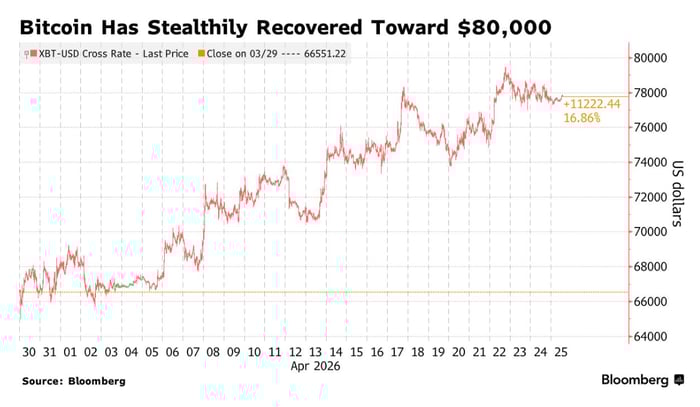
Why do I bring this up now? Because Bitcoin is quietly moving up again. While the world fixes its collective gaze on the oil markets and waits for Trump’s next market-moving social post, crypto looks to be finding its footing again. Enough that it might start to catch your eye. But, buyer beware.
The temptation is to tie this to some sort of fundamental. Take gold, for example. Precarity in the markets and fear among global investors drove central banks, institutions and wealthy individuals into the secure arms of precious metals. Especially gold. When Bitcoin went the other way it exposed crypto for what it is: a speculative bet. The theory that Bitcoin was just “digital gold” went out the window in 2025, leaving the faithful out in the cold. So what does it mean that it’s beginning to recover?
Source: Bloomberg
Bloomberg has some thoughts. “A greater number of analysts have pointed to Strategy’s role within the market. As a Bitcoin treasury firm, its primary purpose has been to accumulate Bitcoin using money raised across the capital markets. In March, Strategy began to deliver on a long-promised pledge to fund the purchases more with proceeds raised from the sale of preferred shares. That has helped to assuage concern about dilution among holders of the common shares.”
Strategy is the Bitcoin treasury vehicle built by Bitcoin enthusiast Michael Saylor. If you’ve dipped your toe into the crypto world, then you’ve heard of him. He still thinks Bitcoin is poised to hit $1 million. I’d be wishing that into existence too if I was sitting on $62 billion worth of Bitcoin.
Yes, you read that correctly. That’s what Strategy does and why they care so much. The company exists to buy Bitcoin, and it does so through a combination of leverage and shareholder money. As of now, Strategy’s basis (the combined per-Bitcoin value of their holdings) is around $75,000, which means they’re basically at breakeven on a mark-to-market basis.
When the person with the most to gain/lose makes a massive market-moving investment into a specific vehicle—any vehicle—it’s not cause to rush right in after them.
 Max
Max
Max is a political commentator and essayist who focuses on the intersection of American socioeconomic theory and politics in the modern era. He is the publisher of UNFTR Media and host of the popular Unf*cking the Republic® podcast and YouTube channel. Prior to founding UNFTR, Max spent fifteen years as a publisher and columnist in the alternative newsweekly industry and a decade in terrestrial radio. Max is also a regular contributor to the MeidasTouch Network where he covers the U.S. economy.