
We Lost More Than This War.
Iran Ascendant.
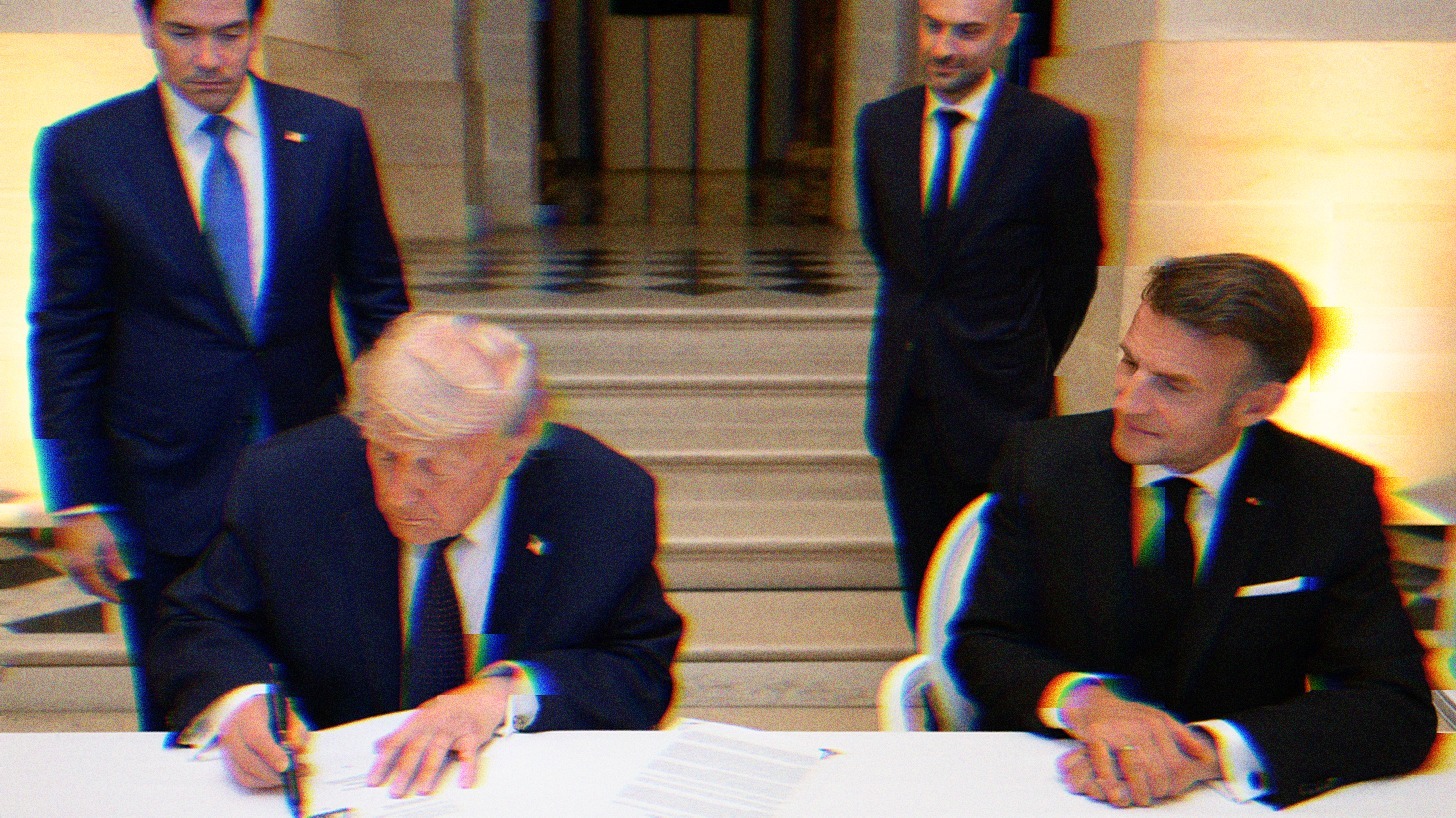 Image Description: Trump signs the Memorandum of Understanding between Iran and the United States at the Palace of Versailles, France. Marco Rubio stands behind Trump, Emmanuel Macron is seated to his left.
No one has ever accused Donald Trump of being a competent strategist. Nor will they ever after starting and losing a costly war to Iran. This bilateral perspective is what we’re fed through U.S. media channels, and is therefore limited and ethnocentric. The wider implications of this unconditional surrender to Iran changes the calculus for a number of nations in the Middle East region and beyond, and may have fundamentally altered the balance of power.
To be clear, the Memorandum of Understanding is, in the words of former U.S. diplomat Aaron David Miller, “a ticket to negotiation.” In other words, there’s still time to screw this up. Or as our dear leader so eloquently said, we can “go right back to dropping bombs.”
Ah, the art of the deal.
Whatever the outcome of this round of negotiations, Israel is one of the biggest losers in this tenuous agreement between the United States and Iran, and it might very well play the spoiler in the weeks and months ahead. It already happened a few days ago with a fresh round of strikes on Lebanon that have reportedly stalled negotiations within the proposed 60-day window we’re under.
This is impossible to speculate on but what we know for certain—should the current framework stand—is that Israel is more isolated than it has been for several decades. Any hope for a détente with the Gulf States to further the blueprint of the Abraham Accords has likely been stalled. More significantly, as Yair Golan, the leader of the centre-left Democrats in Israel noted:
“Netanyahu is ending his tenure with Israel’s enemies stronger, Israel weaker and the deterrence built with the blood of our fighters eroding before our eyes.”
To the extent that Israel has become a proxy for the United States in the Middle East, this framing is still limited in the overall scheme of power dynamics. So let’s zoom out.
Middle East outlet Al-Monitor writes, “Iran remains a formidable and undefeated force capable of threatening Gulf Arab states and global energy flows, they say, while the United States has again revealed the limits of military power against a resilient adversary.” This is the prevailing perception coming from most non-western media. Though as Brookings concludes, “the United States needs to finally come to grips with the reality that its bases and carriers (and potentially even its homeland) will not have sanctuary in future wars against major powers.”
The United States was exposed by an adversary that has only gained in international reputation and stature among its peer nations in the region. For many of the Gulf States, this is more than a disastrous outcome. The Al-Monitor reporting goes on to say: “The deal, Gulf sources say, has already begun to reshape Gulf strategic thinking, eroding confidence in U.S. protection, entrenching Iran as an enduring regional force, and accelerating a shift toward accommodation rather than confrontation.”
If you think of the time, money, energy and alliance-building that has taken place between the Gulf States and the United States over the past century, this is an astonishing turn of events. While Americans view this largely as a wrong-headed and temporarily inconvenient blunder, make no mistake—the rest of the world’s eyes are wide open. We were beaten decidedly and this matters.
It’s impossible to overstate how deeply connected we are to Saudi Arabia in particular. And how this relationship helped mold our alliances with the other Gulf states in the region. A relationship forged in oil with the recognition of Saudi sovereignty in 1931 and a formal partnership between Standard Oil and the Saudi kingdom called Aramco. Today, Saudi Aramco is wholly owned by the kingdom and is one of the largest companies in the world. We have been attached at the hip for nearly 100 years.
Understand that I’m not making a value judgment here. If we put aside our feelings to look at this through the cold capitalist lens, this is a relationship that endured the Great Depression, a world war, the embargoes of the 1970s and rise of OPEC, the Gulf War, all of Bush and Obama’s entanglements, and the dismembering of an American journalist. Oil is our love language, and the Saudis are the poet laureates of crude.
Again, according to Al-Monitor, “Gulf capitals have intensified contacts with Tehran lately, seeking economic and security understandings to reduce the risk of confrontation.”
Only Donald Trump could force one of our tightest co-dependencies to re-evaluate their relationship status. This is his gift.
Beyond the lack of faith in the United States Trump engendered with this failed attempt to flex our muscle—which includes Qatar, the UAE, Oman, Kuwait and Bahrain —there’s the matter of Iraq to the north and adjacent to Iran. Hundreds of thousands of lives lost and trillions of dollars expended in the U.S.-Iraq war, and we effectively control Iraq. But there’s a hidden aspect of this financial control that U.S. media tends to overlook and underappreciate.
According to Shafaq News (a Shia-owned, slightly left leaning but highly reputable organization according to Media Bias Fact Check):
“Since 2003, Iraq has struggled to transform formal sovereignty into fully autonomous state capacity. Its political landscape remains divided between forces that lean toward Washington —often including parts of the Kurdish and Sunni communities— and others that prioritize ties with Tehran, particularly within the Shiite camp.”
It’s important to recognize that Iraq is predominantly Shia Muslim, which more closely aligns much of the population in Iran. Recall the chaos surrounding the assassination of Iranian General Qassem Soleimani in Iraq during the first Trump administration. For many Shiites in Iraq, this was a devastating event as Soleimani was the bridge between the communities and had deep ties in Iraq. His was a complicated legacy to be sure, but it illustrates the complex nature of these nations.
Despite the fact that Iraq’s oil money flows through the Federal Reserve in the United States before repatriating to Iraq, helping us maintain the petrodollar and access to Iraqi oil fields, Shafaq notes;
“Data from the US Energy Information Administration (EIA) shows that Iranian natural gas fuels power plants responsible for roughly 30% to 40% of Iraq’s electricity generation, placing Tehran at the center of Iraq’s energy stability.”
The ties go beyond oil and gas and are deeply rooted in the Iraqi security state as well. The Popular Mobilization Forces (PMF) in Iraq are a state-sponsored paramilitary network with nearly a quarter-of-a-million fighters. According to intelligence analyst firm Alcon Intel, the PMF entrenchment is now nearly irreversible. So the question isn’t whether Iran will fill the power vacuum—it already has. Every historical precedent suggests Iran will use post-deal liquidity to deepen its institutional grip.
So despite the bluster from Washington, Iran’s reach into Iraq never abated. And now it has strengthened as a result of our strategic failure and desire to pull up stakes.
In terms of geopolitical positioning, Iran already has access to the Red Sea through its alliance with Yemen, it maintains pipelines and infrastructure into and through Iraq and now it has two new points of strategic leverage it did not possess before the war: the demonstrated weaponization of the Strait of Hormuz, and the proven ability to directly threaten Gulf state civilian and energy infrastructure. These are permanent additions to Iran’s deterrence posture, regardless of what the 60-day negotiations produce.
Of course, having a stranglehold on strategic territories is only part of the power play. The real win for Iran lies in the potential financial windfall that waits on the other side of Trump’s surrender. Until now, Iran has had to work extremely hard to find ways to monetize its chief export. It has done so through shadow networks of tankers and agreements with Russia, China, and India that have long frustrated Washington.
Even before sanctions relief materializes, Iran’s oil position has been quietly strengthening for years — and the deal dramatically accelerates the trajectory. Prior to any deal, Iran was already exporting around one-and-a-half million barrels per day through a sophisticated parallel market, primarily to China’s “teapot” independent refineries in Shandong province, per Tehran Dispatch. This is among the highest export levels since the Joint Comprehensive Plan of Action (JCPOA) era. A sanctions-relieved Iran can strategically modulate supply to influence prices, reward or punish trading partners, and use oil revenue to fund rapid reconstruction and proxy network reconstitution simultaneously. And now any country or company that seeks to navigate the Strait of Hormuz will do so at the pleasure of the Islamic Republic.
Moreover, according to the EIA, if all oil sanctions were lifted, Iran could return to full production capacity of 3.8 million barrels per day—an increase of roughly 2 million bpd from current output. This is a key geopolitical point Western coverage consistently undersells: Iran does not need to maximize output immediately. And despite the optimistic crude pricing in the markets right now, commodity analyst consensus remains decidedly pessimistic for structural reasons. The present euphoria surrounding the drop in prices is temporary and will give way to the harsh reality of empty Strategic Petroleum Reserves (SPRs) and crisis pricing as the world reboots. Remember, this disruption is much larger than it was during COVID, and it took two years to recover from that shock.
The takeaway here is a sanctions-relieved Iran will soon be flush with cash from its normal operational capabilities and massive demand from allies such as China and India, who are heavily dependent on Iranian oil and gas. But this doesn’t address the more striking and frankly surprising financial aspects of the tentative agreement.
The dollar figures surrounding the MoU are as varied as the sources that offer them. The big ticket item is this nebulous $300 billion “fund” that no one wants to confirm, but everyone seems to be talking about. Vice President Vance has said U.S. taxpayers won’t be on the hook for any funds directed to Iran, but that a “fund” might be set up for others to invest in for the benefit of Iran. For its part, Iran claims that $24b in frozen assets are to be released—another point Vance denies—but that it sustained $29 billion in infrastructure damage. Other reports have Iran’s frozen assets somewhere in the neighborhood of $100 billion. It’s all on the table. Or it isn’t. No one will say for sure.
What seems to be certain is that the combination of the U.S. potentially coercing investments into this slush fund to pay for damages to Iranian infrastructure, the lifting of sanctions on economic activity, and unfettered access to price Iranian crude at market value means Iran will have a windfall of capital.
The reason we’re rushing to get this deal across the finish line has nothing to do with nuclear arms, Israel’s protection, energy infrastructure and control over shipping lanes. It has everything to do with the fact that the world is literally going to run out of oil and gas if this doesn’t end now. Moreover, there’s nothing we can do about it, and Iran knows it. If strategic stockpiles aren’t refilled soon enough and refineries aren’t rebuilt in short order, we could be heading there anyway. And that would mean a potential bloodbath for Trump in the midterms, because raw crude prices and the input prices of everything that depends on fossil fuels will increase exponentially throughout the summer and fall. This will be the undoing of the GOP. That’s not to say he cares about Republicans, he just can’t be bothered with two straight years of inquiries and impeachment articles.
The Western framing, “Iran gave up its nukes and got a payout,” misses the point entirely. The regional reading is almost the inverse: Iran absorbed the full weight of U.S. and Israeli military power, preserved its political establishment, retained its proxy network, secured a financial rehabilitation pipeline, demonstrated the ability to threaten Gulf infrastructure and global energy flows, and emerged with two permanent new instruments of strategic leverage.
The deal didn’t constrain Iran’s regional ambitions. It funded them.
The new Ayatollah said it best. “History will record that the Iranian nation sank the superpower of America in the Persian Gulf.”
Image Source
- The White House, Public domain, via Wikimedia Commons. Changes were made.
 Max
Max
Max is a political commentator and essayist who focuses on the intersection of American socioeconomic theory and politics in the modern era. He is the publisher of UNFTR Media and host of the popular Unf*cking the Republic® podcast and YouTube channel. Prior to founding UNFTR, Max spent fifteen years as a publisher and columnist in the alternative newsweekly industry and a decade in terrestrial radio. Max is also a regular contributor to the MeidasTouch Network where he covers the U.S. economy.