
War in Iran and the Decline of the U.S. Empire.
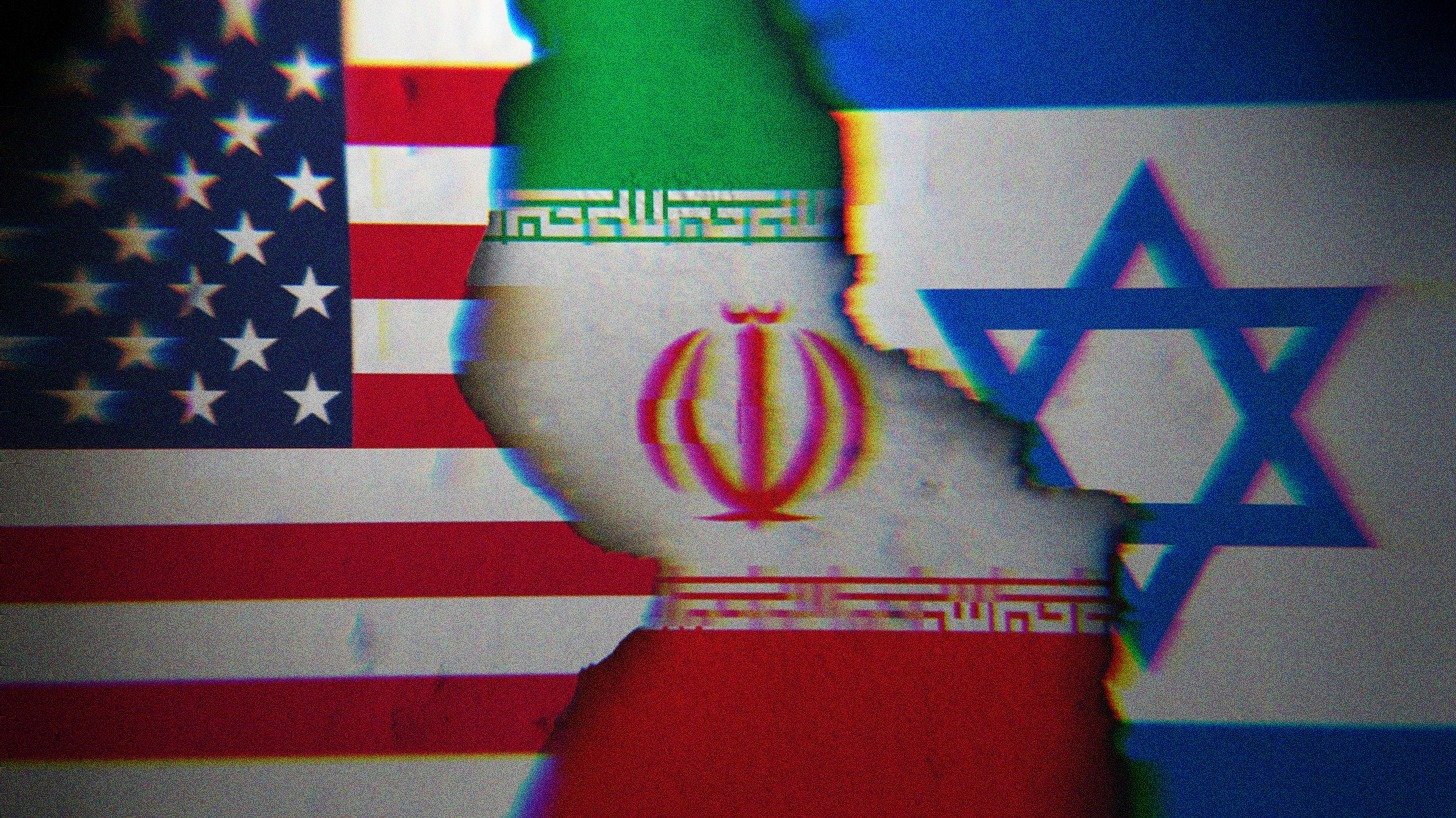 Image Description: The U.S. flag on the left and the Israeli flag on the right. They are fractured in the middle revealing the Iranian flag.
The U.S. and Israel have declared war on the Islamic Republic of Iran, despite indications from Omani negotiators that the parties were close to agreement as late as the night before the bombing of Tehran and other Iranian cities began. Mainstream media have already cranked up the propaganda machine to frame this as everything from a necessary and just maneuver to an unfortunate turn of events. The anglo-centric framing is undeniable and we risk losing the plot. There’s also a stunning lack of historical perspective in any current analyses. Make no mistake, this is an illegal move conducted by a waning empire that put a madman in charge. And it threatens us all.
The United States has begun an illegal war once again, this time on the Islamic Republic of Iran and under the preemptive strike doctrine. To be clear, we are not preventing a strike against the United States but are co-authoring this project with the state of Israel, so presumably this is an effort to prevent an attack on Israeli soil.
This is all speculation, of course, because there has been no firm rationale offered by the United States for this unprovoked attack on Iran, which resulted in the assassination of Ayatollah Ali Khamenei, the Supreme Leader of Iran since 1989 and its president for eight years prior.I want to begin with media literacy. The mainstream coverage of what has transpired since the weekend is notable for the decidedly anglo-American framing.
How long will this last? Will it impact oil prices? They report on details like shipping companies not insuring tankers in the Strait of Hormuz and movement in the stock market. How many American casualties there have been thus far. Will Israel’s Iron Dome defense system withstand the barrage of missiles from Iran? How neighboring Arabic states have been dragged into the conflict. Beirut is under siege again, but of course that’s merely a footnote because it too is a terrorist proxy state of Iran.
Far greater diversity of presentation can be found in independent online sources, but the vast majority of Americans tune to mainstream outlets during times of war, economic catastrophe or natural disasters. Framing is important in the early stages of a war.
Personally, I think every news report should begin with the fact that scores of young girls were killed in the initial attack on Iran. An elementary school in Minab, about a 15 hour drive south of Tehran and another 25 miles from the Strait of Hormuz, was bombed in the very beginning stage of our joint campaign of terror with Israel.
It’s unclear what strategic importance this girls school had in the conflict but I’m sure we’ll hear rumors that it was built over an underground bunker filled with nuclear weapons. Actually, I’m kidding. We won’t ever talk about this again. The death toll from that isolated attack is reportedly over 160, the vast majority of whom are children.
It’s interesting because the media has been marveling over the precision of the U.S. and Israeli strikes thus far. We know all about how the CIA and Israeli intelligence services had been tracking the Supreme Leader’s movements for months until they finally found their moment and struck him alongside several Iranian leaders. They were in their main offices in Tehran. What incredible intelligence. I mean, how could the military have predicted that he would have gone to work? Ostensibly they gathered for a briefing on how the Omani negotiator suggested that talks between the U.S. and Iran were going extremely well, and that Trump would be pleased because the Iranians had given up more than they had under the prior deal with Obama.
What a feint. What a move. Catch them while they’re off guard, right?
What gets me is this idea of precision. This is before we have depleted any forces. Before we stood up to a barrage of counterattacks. When the war theater was clear. Apparently the intelligence and surveillance capability was so exacting that they knew the precise moment the Ayatollah was above ground, (you know, in his office in the center of the city where all official duties are conducted). So exacting that they were able to track his movements and drop a motherfucking bomb directly on his head.
Those first strikes. Unfettered by counterattacks. Loaded with intel. So very precise. That’s the narrative right? No fog of war here. Just ruthless precision.
So I guess our joint intelligence services also knew when the elementary school would be in session. Fifteen hours south of Tehran and 25 miles away from a strategic choke point for oil deliveries. When the girls would be in class. What period it was and what they were studying. I wonder what strategic importance those girls held in this fantastical conflict? Perhaps one of them was going to grow up and give birth to a future Supreme Leader who would be even more despotic than all who came before him. That must be it. The ultimate preemptive strike.
Mistakes are always made during war. Like the supposed friendly fire that just shot down our multi-million dollar fighter jets. But in this case, the war hadn’t started yet. It was just a one-sided attack. We must have known exactly what we were doing. And those school girls must have had it coming.
No Nukes
Not a single international agency believed that Iran was anywhere near the capacity to develop a nuclear arms program. Not one. The Omani negotiators were themselves surprised at how willing Iran was to cave to nearly every U.S. and Israeli demand at the negotiating table. According to their reports, the only thing they were unwilling to bend on was the eradication of their ballistic missile program designed to defend against foreign attacks. In this context that certainly seems reasonable, if not prescient.
Multiple reports surfaced early on that the Iranian people took to the streets to celebrate the assassination of the Supreme Leader. Oh, and millions took to the streets to mourn his death, but more importantly there were people who were happy about this invasion. And there’s no shortage of interviews to be had in pockets of Persian expats in the United States to cheerlead this invasion.
Just like that time we toppled Saddam and ushered in a wave of peace, stability and democracy to the region. Or when we toppled the Taliban in Afghanistan and ushered in a wave of peace, stability and democracy. Or when we toppled Gaddafi in Libya and ushered in a wave of peace, stability and democracy. Or when we backed the insurgents in Syria who eventually toppled the Assad regime and ushered in a wave of peace, stability and democracy. Our record in this region is impeccable.
And it’s not our first go around in Iran, though we were certainly overdue.
Mohammad Mosaddegh came to power in Iran in 1951, and his leadership was affirmed in a democratic election a year later. He was a western educated Muslim who courted American support, much like Fidel Castro would just seven years later after the Cuban Revolution. Much like Ho Chi Minh did seven years prior. This was during a period of great transition in American foreign policy as the newfound hegemonic power in the world.
The period between Ho Chi Minh’s outreach and that of Castro is enormously important in the development of U.S. Cold War policy. Minh was essentially ignored because Vietnam held little value to the U.S. in 1945, but by 1959 we were fully in the grip of Cold War fever in the U.S. Smack dab in the center of this time period was Mosaddegh who had popular support and enjoyed tenuous support from the clerical wing of Iran, as well as the socialist party at the time.
There were several competing forces within Iran. There was an ardent religious nationalist core, a more populist element that aligned with western democratic principles, and vast territories of tribal agricultural populations that sat somewhere in between. If there was an anti-western sentiment among the leading factions, it was against Britain who had taken a far more interventionist and colonial approach to the entire region.
The Americans were seen as a potential political and economic ally that could be reasoned with to keep the imperial powers at bay. How quaint.
As the story goes, of course, the CIA under the guidance of Teddy Roosevelt’s grandson Kermit Roosevelt Jr. began subverting Mosaddegh’s leadership from the start. Together with British intelligence officers it stoked dissent and undermined the newly elected administration that was seemingly perplexed by America’s sudden turn. Within a year Mosaddegh was ousted and Iran fell into the well-orchestrated hands of Mohammed Reza Shah of the Pahlavi dynasty, which itself had questionable claims to the monarchy. But the Shah was undeniably a tool of the U.S. government, which immediately reversed Iran’s nationalized oil claims and gave favorable terms to U.S. oil companies and partial access to the Brits.
Like I said, not our first bite at the apple in Iran. But this period is vital to understand how we got to this point. Among the competing factions during the transition from Mosaddegh to Pahlavi were young Iranian scholars steeped both in Marxist tradition and Shia faith. These scholars were not initially ideologically opposed to the United States, which had yet to fully embrace an anti-communist doctrinal approach that would terrorize Brown populations for the next three quarters of a century. There was a sense that this emerging hegemonic power would be more interested in economic coordination and an isolationist tendency that would allow foreign nations to develop under economic and political self determination. Many of these scholars studied in European Universities and returned to Iran with the intent to design a system of governance that bridged socialist theory, western economic expansionism and Islam into a unique secular blend and populist movement.
But the betrayal of Mosaddegh who many of them supported soured them on American intentions and made them realize that American imperialism might be indistinguishable from British colonialism.
An influential theorist named Jalal Al-e-Ahmad published a work titled Gharbzadegi which loosely translates to “Westoxication” or “Sick from the West.” It was an Islamic informed secular treatise that rebuffed western ideals, not out of anger but out of disingenuousness. His hope was to foster a sense of Iranian identity and nationalism that honored both the secular history of the region, cultural traditions and devotion to Islam. It was a massively influential work that was tolerated by the hardliners due to its popularity and nod to Islamic rules, as well as younger Muslims who had tasted the fruits of western culture but also its poison.
Gharbzadegi would influence other cultural leaders such as Ali Shariati who died in exile under the Shah. Shariati wrote the equally impactful Eslamshenasi which argued that Iran was too young and disjointed for democratic institutions to bring it out of tyranny. Here again, Shariati blended Marxist and Islamic traditions to promote a modern version of radical Iranian governance. Shariati and Al-e Ahmad would even collaborate in the late ‘60s and lecture together at a university where a young Ali Khamenei was in attendance. The man who would become Supreme Leader and die under the rubble of a precision bomb just a few days ago.
Choices
So why the history lesson?
Because history, all of life in fact, is a series of choices, of what if scenarios. Like, what if we had embraced the Mosaddegh regime and negotiated mutually beneficial trade agreements for Iranian oil and helped finance the growth of his era rather than the Shah? Under the Shah and American financial support, the Iranian economy grew at 8% per year over more than a decade. But Islamic traditions weren’t allowed to flourish and Gharbzadegi was inculcated into a generation of traditionalists who grew increasingly frustrated by western interference and theft of natural resources, leading to the Iranian revolutions of the 1970s and the ouster of the Shah. It’s a dramatic oversimplification as Mosaddegh might not have made it on his own. But his failure wouldn’t have the stench of American imperialism.
What if we put bankers in jail in the wake of the Global Financial Crisis and sent a trillion dollars flowing through to the American people instead of the balance sheets of multinational corporations? Would the full recovery of what was lost during this time have prevented the presidency of Donald Trump? What if our Congress and state sponsored mouthpieces at establishment media outlets like The New York Times hadn’t cheerleaded us into decade long wars with Iraq and Afghanistan, but focused instead on disrupting terrorist networks and punishing those actually responsible? What if we continued the path under Eisenhower of respecting spheres of influence instead of taking a Manichean view of the world under Truman and fostering the military industrial complex?
What if, indeed.
That’s why media literacy matters right now. Larry Ellison is already in control of CBS. He’s about to control CNN as well. Most of the corporate media is in the hands of conservative shareholders and multinational corporations. And war is big business to them. A ratings bonanza. If you are genuinely curious about the state of affairs in Iran I would implore you to follow Murtaza Hussain and Jeremy Scahill over at Drop Site. Listen to Danny Bessner and Derek Davison from American Prestige. Follow Al Jazeera English if you need an unvarnished take on what’s happening on the ground in the Middle East, but steer clear of opinion pieces from them if you’re so inclined.
You don’t have to listen to me or other leftists who might be offering credible analyses but are still ethnocentric in our own rights. But likewise, you would do well to avoid establishment figures like the forever villain of The New York Times Thomas Friedman who offered this in response to our unconstitutional and illegal attack on Iran:
“First, I hope this effort to topple the clerical regime in Tehran succeeds. It is a regime that murders its people, destabilizes its neighbors and has destroyed a great civilization. There is no single event that would do more to put the whole Middle East on a more decent, inclusive trajectory than the replacement of Tehran’s Islamic regime with a leadership focused exclusively on enabling the people of Iran to realize their full potential with a real voice in their own future.”
This is the same fuckwit argument he made on the eve of war with Iraq. Iran’s population is twice the size of Iraq’s and its territory is four times the size. We spent months manufacturing consent around the Iraq War and cajoling a coalition of European allies into joining the conflict. We deployed tens of thousands of U.S. troops with post war civilian plans and had long drafted white papers on how best to co-opt their oil interests. And it failed spectacularly. Because, of course it did.
The Trump administration has no such grand designs so this incursion will be even more disastrous if allowed to continue; something the administration appears committed to. And all the Democratic leadership can manage to do is feign outrage that no one told them in advance. That’s the prevailing narrative here. They didn’t ask permission and ignored calls for a war powers resolution; something we do not have and have never enforced in practice. Make no mistake, the Democratic Party is just as complicit in all of this.
Now what you haven’t heard me mention is the governing body in Iran. The “evil and despotic regime itself. A true villain.” Would the Iranian people be better off if the regime collapses? More than likely, but in reality this is unknown. We can’t know that. Is it a murderous regime that represses its own people and violently crushes dissent? Yes, that we can know. Is it our business? And does a regime change portend worse things for the Iranian people like it did in Iraq, Afghanistan, Syria and Libya?
According to Human Rights Watch, the UN and other NGOs, Iran is among the most repressive regimes in the world along with North Korea, Eritrea, Turkmenistan, Syria, Afghanistan, Myanmar, China, Saudi Arabia, Belarus and Russia.
Shall we bomb them all?
Donald Trump has neither the capacity or temperament to engage in this or any war. He and his acolytes are drunk on power and are pumped up on their recent escapade in Venezuela, and the fact that he got away with bombing Iran last year without repercussions. This time will be very different. The loss of life might be catastrophic. The economic fallout might be severe. All of what’s to come will be terrible by any measure.
But even if it all ends today, the fact of the matter is that we have revealed ourselves fully in our first coordinated decision with our ally in Israel. Fifteen hours south of Tehran and 25 miles from the coastline in a city with no strategic importance where the bodies of several young girls have yet to be recovered.
This is who we are now. So listen carefully in the days ahead for how this war is being managed in the media and then refute it flatly. Once you tune your ear to the framing of the establishment you cannot unhear it.
And if you’re wondering what you’re watching, this is what the decline of Empire looks like.
 Max
Max
Max is a political commentator and essayist who focuses on the intersection of American socioeconomic theory and politics in the modern era. He is the publisher of UNFTR Media and host of the popular Unf*cking the Republic® podcast and YouTube channel. Prior to founding UNFTR, Max spent fifteen years as a publisher and columnist in the alternative newsweekly industry and a decade in terrestrial radio. Max is also a regular contributor to the MeidasTouch Network where he covers the U.S. economy.