

Trump OKs More Weapons of Mass Genocide to Israel
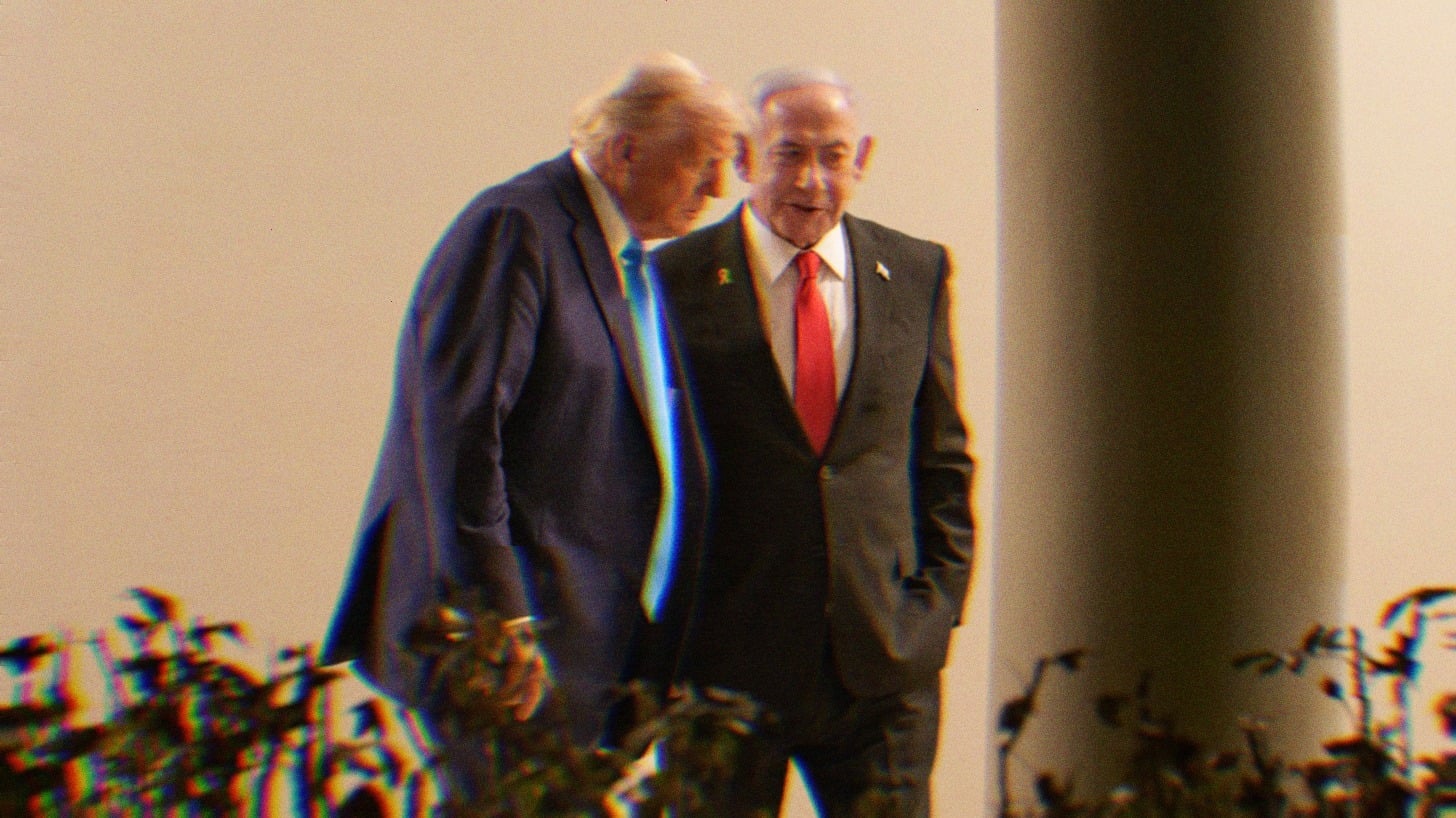 Image Description: Donald Trump and Benjamin Netanyahu standing close together, talking.
This essay appeared in the Sept. 17, 2026 edition of UNFTR’s premium newsletter. Become a UNFTR member to receive our bonus newsletter each week and for other perks.
The Trump administration recently approved a nearly $3 billion sale of weapons of mass genocide to Israel—all of which will be paid for by U.S. taxpayers despite growing opposition to the genocidal state’s war of annihilation against Palestinians in Gaza.
The sale includes 40,000 one-ton bombs (MK-84 and BLU-117), considered some of the most destructive weapons in any military’s arsenal due to their inherent indiscriminate devastation. The move comes the same week that Israel’s defense minister, Israel Katz, reaffirmed that the country plans to ethnically cleanse Gaza (a policy that the corporate media in the United States has curiously elected not to cover, based on our analysis).
“[T]he IDF is prepared, once given the directive to eliminate Hamas, to finish the job so that we can also implement the migration plan,” Katz said. (Yet “genocidal intent” remains elusive, according to Israel’s most enthusiastic defenders.)
To be fair to Katz, it isn’t the first time he openly spoke genocide. “There is no real solution for Gaza in the end without migration,” he said at a conference on Sept. 2. In multiple instances, Katz has cited a survey by the Coordinator of Government Activities in the Territories (COGAT) that claims 80% of people in Gaza want to migrate. Unfamiliar to most outside of Israel, COGAT is a unit within Katz’s own Defense Ministry—one that “over the years [has] become an inseparable part of the army.”
While support for Israel has waned considerably over the last three years—genociding people and instigating another major war would do that—it’s hardly surprising that Trump would move ahead with a sale that would ultimately contribute to even more devastation for the people of Gaza and potentially Lebanon.
Israel’s standing with the American public may be permanently shattered, meaning future arms sales could be that much more difficult to pull off. And despite such a sale technically falling into the jurisdiction of Congress, the administration is likely to bypass the legislative body, just as it has before.
Of course, those we elect to represent us have the power to act as obstacles by passing a veto-proof resolution to stop the sale, but such a maneuver appears unlikely. For one, AIPAC. And beyond that, Congress is going on a (much-deserved?) holiday for the next six weeks despite inflation climbing, an ongoing war (which they didn’t declare so who cares?) and a deepening energy crisis. What’s more, a vacation means there will be no vote on efforts by outgoing Rep. Thomas Massie (R-KY) to vote to impeach Secretary of Defense Pete Hegseth and secure a pair of votes for his Jeffrey Epstein discharge petition.
“We may only be the majority for six more weeks, why would we be cancelling days when the country is burning, the inflation is rampant, there are things we can do here—why would we cancel our own majority?” Massie said on the House floor this week.
Alas, this “sale” will go through regardless of what the American people want to happen, yet another blemish for a country that carries itself as an ostensible democracy.
Speaking of countries that masquerade as democratic, back to Israel. It already has a long, horrific history of deploying the very bombs Trump wants you to pay for on Prime Minister Benjamin Netanyahu’s behalf. It’s important to pause here and understand the awesome power of these planet-cratering bombs:
The MK-84, which is among those listed as part of the sale, first made its debut during the Vietnam War and earned the nickname “The Hammer” during the first Gulf War “for its considerable destructive power and blast radius.” The bomb can blast through metal and form craters of up to 50 feet, and its shrapnel radius can travel as far as 400 yards—the size of four football fields.
In the Palestinian genocide in Gaza alone, there’s countless examples of Israel deploying these very bombs in civilian areas—something 80 countries, including the United States, vowed in 2022 not to do.
Israel was particularly aggressive at the outset of the war of annihilation, according to various analyses. One such by CNN, using satellite imagery, said Israel dropped more than 500 one-ton bombs on Gaza in the genocide’s first month. While Israel—and likely other countries—don’t often broadcast use of such weapons, their horrifying large craters provide the clearest evidence that one-ton bombs have been deployed.
“In two months, we’ve had about the level of strikes in this tiny little area in Gaza as what we saw in Mosul and Raqqa combined,” Larry Lewis, research director at the Center for Naval Analyses (CNA) and formerly the U.S. State Department’s senior adviser on civilian harm, told CNN, referring to the (undeclared) war against ISIS. “It is an incredible amount of strikes, period-wise.”
A New York Times investigation into Israel’s deployment of one-ton bombs in Gaza found that it used those munitions in designated “safe zones” at least 200 times, and that they were dropped “on a routine basis” in the south of Gaza in the genocide’s first six weeks.
“Even for those who followed every Israeli evacuation order and advisory, there was still no safety to be found in a war zone that’s more dangerous for civilians than any in recent history,” said a Times reporter narrating the video investigation.
Harvard researchers conducted their own analysis of such attacks during a similar period covered by the Times. It found that 38 of those bunker-busting munitions exploded within 800 meters (about 874 yards) of hospitals in areas designated as “safe” for civilians.
In addition, a United Nations report documented at least a half-dozen Israeli attacks that caused widespread and indiscriminate damage early in Gaza between October and December 2023. These include the bombing of the Jabalya Refugee Camp on Oct. 9, which destroyed two large buildings and damaged adjacent structures. Among the 42 killed (a number likely higher) in the attack were 14 children, the UN said.
Later that month, at least 105 people were killed, including 47 children, in an Israeli strike on a seven-floor residential building in Gaza City, the UN said.
“An area of 5,700 square [meters] was essentially flattened, with at least seven structures, including Taj3 Tower, completely destroyed and three other structures showing signs of significant damage,” the UN reported.
Sadly, we can do this all day.
“Launching an indiscriminate attack resulting in death or injury to civilians, or an attack in the knowledge that it will cause excessive incidental civilian loss, injury or damage are war crimes; in certain circumstances, it may amount to a direct attack against civilians or civilian objects,” UN researchers wrote.
One of the first to report on the so-called “sale” to Israel was ex-Trump fanboy Tucker Carlson. The former Fox News host reported the details on X on Sept. 15, writing of the taxpayer-funded weapons giveaway: “For perspective, the largest American air raid of World War Two was the Eighth Air Force’s attack on Berlin in March of 1945. Combined, the 2,023 Allied aircraft involved dropped about 3,000 tons of bombs. That’s 7.5 percent of what Trump is sending to Israel.”
“It is not an arms sale,” Carlson added. “It is a gift, funded by American taxpayers through the Foreign Military Financing program, an arrangement designed to disguise welfare as capitalism: Congress appropriates money to the executive branch, which transfers the cash to Israel to ‘buy’ American-made weapons, in this case from General Dynamics. Politicians claim this is a win for America. Most voters have no idea they paid for it.”
Indeed, the United States remains very much complicit in this ongoing genocide—and there will be yet much more blood on our hands.
Image Source
- Dan Scavino, Public domain, via Wikimedia Commons. Changes were made.
 Rashed Mian
Rashed Mian is the managing editor of the award-winning News Beat podcast and co-founder of the newly launched Free The Press (FTP) Substack newsletter. Throughout his career, he has reported on a wide range of issues, with a particular focus on civil liberties, systemic injustice and U.S. hegemony. You can find Rashed on X @rashedmian and on Bluesky @rashedmian.bsky.social.