
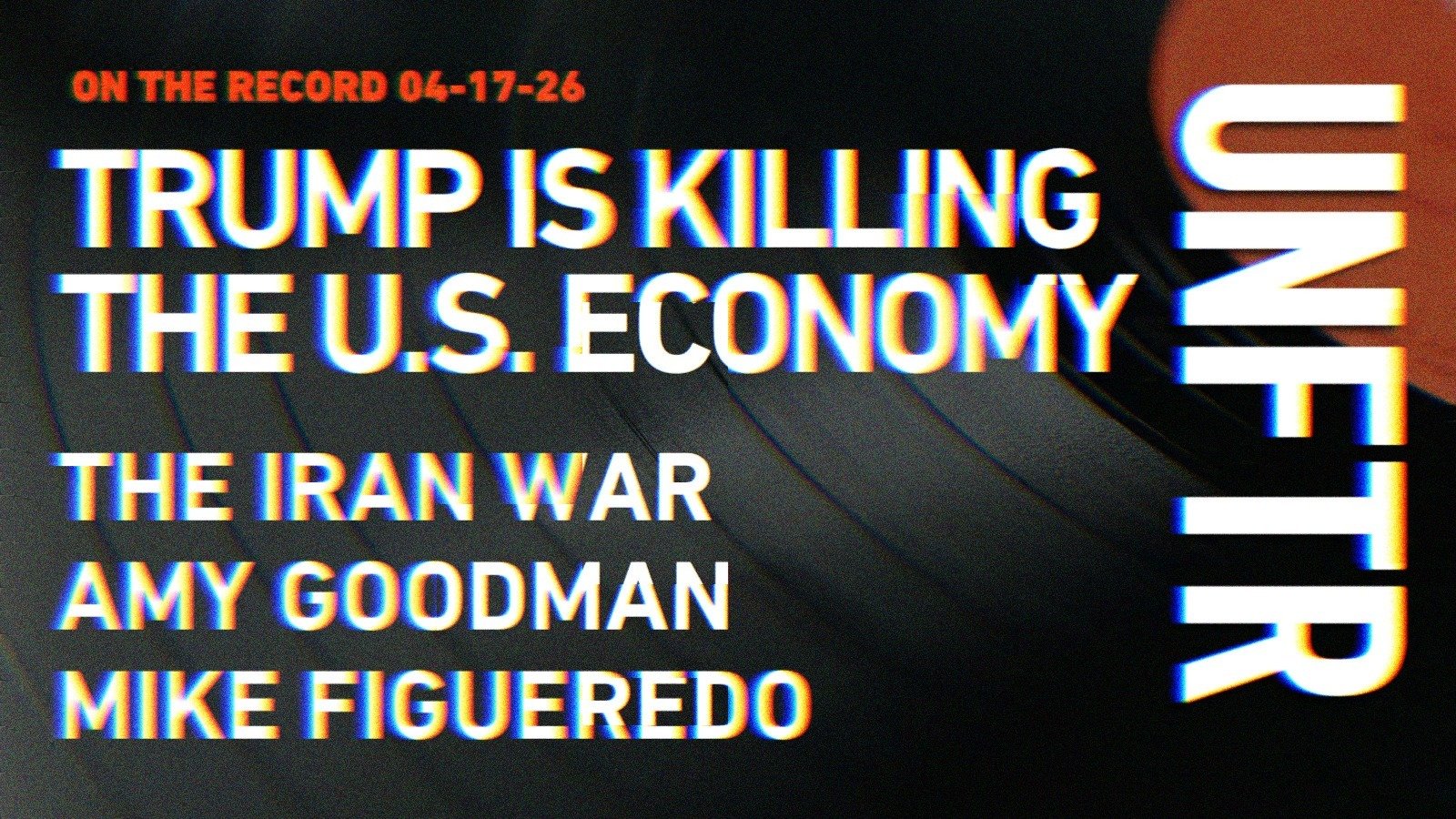
 Image Description: On The Record 4-17-26. Trump Is Killing the U.S. Economy. The Iran War. Amy Goodman. Mike Figueredo. UNFTR logo
Steal This Review
I’m no connoisseur of documentaries, but I am a voracious consumer of media. I offer this disclaimer because I’m not fit to critique the quality of a documentary presentation. But my wife and I recently viewed a documentary about the media and I am simply not over it. Steal This Story, Please! is the newly released documentary about the journey of Democracy Now! and its founder Amy Goodman, and it is nothing short of astounding.
It showed at the Huntington Cinema Arts Centre on Long Island this week and is now in select theaters around the country. We were fortunate to be in the company of Goodman herself, who did a talk back at the end of the film. Turns out she’s from Long Island. Who knew? If you have the opportunity to see it in the theater, please try. If it’s not available in your area, sign up for the mailing list to be notified of when it drops on a streaming service.
Like I said, I’m no film critic, but it’s evident from the opening scene that this isn’t one of those schlock docs. The film is directed by veteran documentarians Carl Deal and Tia Lessin who were given access to both the Democracy Now! archive and Goodman herself, whom they “stalked” in her words for a good amount of time.
A few things struck us about the film and Goodman’s talk afterwards. First off, she’s built differently. Physically, you wouldn’t see her coming. She is demure, unassuming and looks to be around five-foot-nothing. Normally in a field like journalism, physical stature doesn’t really matter. But when you see the situations she throws herself in the middle of, it’s a bit more of an issue. Goodman noted in the documentary that she stopped telling family members where she was headed on (self) assignment, instead opting to call them from the airport on her way to some wartorn and extremely dangerous part of the world.
Amy Goodman is a journalist’s journalist. She is a war correspondent. Front line activist. Relentless interrogator. Prolific researcher. She can write, edit, assign and present. She is the total package. She is also truly indefatigable. Her mind works faster than yours and mine. Her curiosity has yet to find its limit. The film was more than just a boilerplate profile of a dedicated professional; it was a window into our world as seen through the eyes of an optimist and empath who happens to possess the best journalism chops of our time.
Despite the fact that Democracy Now! covers some of the most horrific and brutal events in the world, the arc of the film was decidedly hopeful in the strangest of ways. All of it can be attributed to Goodman herself.
I dislike the phrase “childlike curiosity” but it’s the closest approximation of her style of inquiry. She’s not looking for soundbites to fit into the news package, nor is she interested in “gotcha” questions. She just wants answers to what happen to be the most pressing questions of our time. And one has the sense that she truly believes that if she can get to the heart of a matter and expose it to enough sunlight that it will win the day.
In our increasingly cynical world, Amy Goodman is one of the few people who has good reason to feel this way.
Early in her career she and her colleague Allan Nairn traveled to East Timor, having heard rumors of widespread abuse and a possible genocide at the hands of the Indonesian government. At the time, Indonesia’s leader General Suharto enjoyed widespread support from most of the developed world. In reality, his rule was a brutal dictatorship that was fueling one of the worst humanitarian crises on record. While reporting on demonstrations in East Timor, Goodman and Nairn were injured as firsthand witnesses of a massacre.
The duo’s reporting on the massacre was initially met with incredulity. But they pressed their agenda and worked tirelessly to spread word of what was happening. Gradually, coverage began to snowball across the western world until the pressure campaign to stop funding Suharto’s regime reached a fever pitch in Europe, and eventually, (although far too late), in the United States. It’s impossible to know how much longer the world would have remained in the dark if not for the relentless campaign waged by Goodman and Nairn.
It’s clear that this was a formative event for Goodman in more ways than one. First, it haunts her; she claims to relive the massacre every day of her life. More importantly, it seems to have imbued a sense of optimism in her that if you just keep telling the truth loudly and often enough, you can effect real change. That’s why one of the more heartbreaking segments of the film surrounded the war in Iraq. Goodman and her scrappy team brought that same level of inspired enthusiasm and doggedness to the fight to stop the full-scale assault on Iraq. Only this time, to no avail. The country was overtaken by bloodlust and war fever, and so long as the objects of our rage were from the Middle East, the public cared very little. The resistance never got off the ground.
As the bombs fell and Iraq plunged deeper and deeper into darkness and despair, so too did Goodman. She had told the truth. She reported directly from Iraq and told stories of civilian lives and families that knew nothing of Osama bin Laden and held no hate in their hearts for the United States. Democracy Now! debunked all the WMD claims and shouted at the rain only to find that there was no one listening.
Instead of tucking tail and lapsing into state stenography, Goodman doubled down. She continued to build Democracy Now!, train young reporters and do good journalism. And in her talk at the end of the film, she spoke of how inspired she was by the people of Minneapolis who demonstrated solidarity with their neighbors and won a hard fought (and real) victory against Homeland Security and the Trump administration.
To Goodman, no fight is unwinnable, and she sees victories like this as evidence that the people are still in charge and are capable of taking the reins of our collective future. We just have to want them.
Choke Point
At this point it seems like the Trump administration is trying to fuck the global economy on purpose. The president’s latest “strategy” is to close the Strait of Hormuz from the other side. Now no one can have anything. There. That’ll solve everything.
Let’s recap in case you’re having trouble playing along.
Last year we supposedly destroyed Iran’s nuclear capabilities because it was “weeks away” from being able to produce a nuclear bomb. Several, actually. Just like they were “weeks away” in the early 2000s and all throughout the 2010s. Now we’ve launched a full-scale (not really) war to stop Iran from developing a nuclear bomb because it was months away after we completely destroyed their ability to develop a nuclear bomb just one year ago. In response to this unprovoked war, Iran simply shut the Strait of Hormuz and started bombing strategic U.S. positions in the Middle East and various oil and gas facilities in the Gulf region. This put a COVID level kink in the supply chain and drove oil prices through the roof.
So we negotiated a peace deal with ourselves and told everyone we’d won. On that news, Iran also declared victory and issued a ten point plan with completely different terms than the plan we negotiated with ourselves. Under the cover of the actual and rhetorical bombs being lobbed in both directions, the Knesset in Israel passed a new death penalty law that applies only to Palestinians, stepped up its bombing campaign against Southern Lebanon, sent more IDF members into the West Bank to secure settlements, and killed an additional 730 Palestinians in Gaza since the other ceasefire was announced between Hamas and Israel in October of last year.
Aside from the painfully obvious fact that our Commander in Chief has absolutely no idea how to prosecute a war, and has zero interest in intelligence briefings that show Iran is nearly impenetrable, everything is running pretty smoothly.
If we back away from the foreign policy and military disaster that has turned into the largest unforced error of modern times, the domestic economic picture is incredibly bleak. We can see with our own eyes that the disruption to Asian economies is happening in real time. Price caps, fuel rationing, travel shut downs and strategic reserve releases are rolling across the globe like a tidal wave but no one in the United States seems to notice. It’s like the coronavirus all over again. Don’t get me wrong, we can all see the prices at the pump but even here there seems to be a widespread belief that this is somehow temporary.
This is not temporary.
Any hope that a return to normalcy might occur in the coming months is effectively gone. Had things in the Persian Gulf straightened out after a couple of weeks we might have seen relief in this calendar year. Unfortunately, it’s already gone on too long for oil and gas prices to revert to where they were at the beginning of this year. So expect prices at the pump to remain elevated for the foreseeable future. The important thing is that this is just the beginning, because it’s piling on top of an existing inflation disaster.
Energy costs flow into everything. Every product that’s manufactured uses energy. Every product that’s shipped—by truck, by rail, by container ship—uses diesel. Every piece of food that’s grown requires fertilizer, which is petroleum-based. Every warehouse, every cold chain, every factory floor.
Remember tariffs? The San Francisco Fed published a study in late March showing exactly how tariff-driven inflation works through the economy in stages. Last year importers took it on the chin and manufacturers ate most of what was passed through to them. What leaked through after the bulk of the tariffs were absorbed fell disproportionately on small businesses. The St. Louis Fed dug even deeper (see chart of the week below) to examine how most of the attempted workarounds also resulted in higher import costs, leaving little to no wiggle room throughout the supply chain.
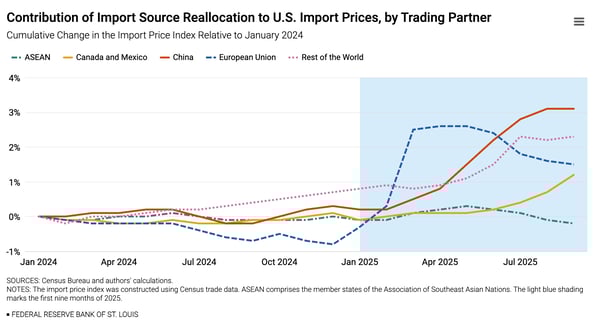
So we already know that the inflation trend reversal in Trump’s first year is almost exclusively related to tariffs. But that’s just year one. The San Francisco Fed piece details how goods inflation peaks in year two. Services inflation—the stickier, harder-to-reverse component—peaks in year three and lingers into year four. We’re entering the window right now where the tariffs that went into effect in early 2025 begin showing up in earnest. Average U.S. tariff rates went from under 2% to nearly 17%. And those price increases are now compounding on top of an energy shock.
This is what has many economists concerned. While all the headlines were about the jump in the Consumer Price Index (CPI) the real story is the Personal Consumption Expenditures (PCE) price index—which is the Fed’s preferred measure because it strips out the more volatile food and energy inputs. The February PCE reading came in at 2.8% headline, 3.0% core. This means that inflation is set to explode once the war is factored in.
Let’s say for argument’s sake that you are the leader of the biggest consumer economy in the world. You’ve already screwed the pooch with your failed tariff plan because the government agencies you control told you as much. Sure, you brought in a few extra dollars, but way more damage to the average American was done in the process. Knowing that affordability (the thing that got you re-elected) is definitely getting worse, would you start a war with the one country that can bring the global economy to a halt? Especially since they’ve done it once before?
No. If your aim was to stay in power, be popular and prove everyone wrong, you would not. Because you would know that the only thing covering up the inflation that YOU CAUSED single handedly through tariffs was declining oil and gas prices that YOU CAUSED by forcing the world to once again reorient the supply chain. In fact, you would also know that the WORST THING you could do to blow the cover off inflation is attack Iran and choke off the world’s supply of oil and gas.
Listen, I know his economic advisers like Howard Lutnick, Kevin Hassett and Peter Navarro aren’t the sharpest tools in the shed. And I’ve been fiercely critical of people like Scott Bessent and Stephen Miran for being useful idiots in their attempts to delegitimize the Federal Reserve and cover for the Liberation Day blunder. However, the negative economic evidence is so overwhelming that there’s no way they haven’t warned Donald Trump of the guaranteed fallout of something as egregious as this war.
Either he is dismissing the advice of his advisers or they are legitimately too scared to tell him. If it’s the former, then he’s deliberately torching the economy in service of some other dystopian goal that probably has something to do with canceling elections. If it’s the latter, then we’re just as screwed, because it means Trump is truly making decisions day-to-day with zero regard for downside risks. It’s the ultimate lose-lose scenario for the American people. They just haven’t realized it yet.
 Max
Max
Max is a political commentator and essayist who focuses on the intersection of American socioeconomic theory and politics in the modern era. He is the publisher of UNFTR Media and host of the popular Unf*cking the Republic® podcast and YouTube channel. Prior to founding UNFTR, Max spent fifteen years as a publisher and columnist in the alternative newsweekly industry and a decade in terrestrial radio. Max is also a regular contributor to the MeidasTouch Network where he covers the U.S. economy.